Sunday, 13th August 1961 in Berlin
Welcome to your daily snapshot of Berlin! It's International Left-Handers Day. Explore 55 historical events, birthdays, deaths, and milestones that shaped this day in Berlin. From remarkable moments in local and world history to the people who left their mark — find out what makes today special. Today's weather in Berlin brings drizzly with temperatures between 9°C and 16°C. Tonight's moon is in its full moon phase, and the zodiac sign of the day is Leo. If you're curious about the history of a day — this page brings together everything worth knowing about this Sunday, 13th August in Berlin, DE.
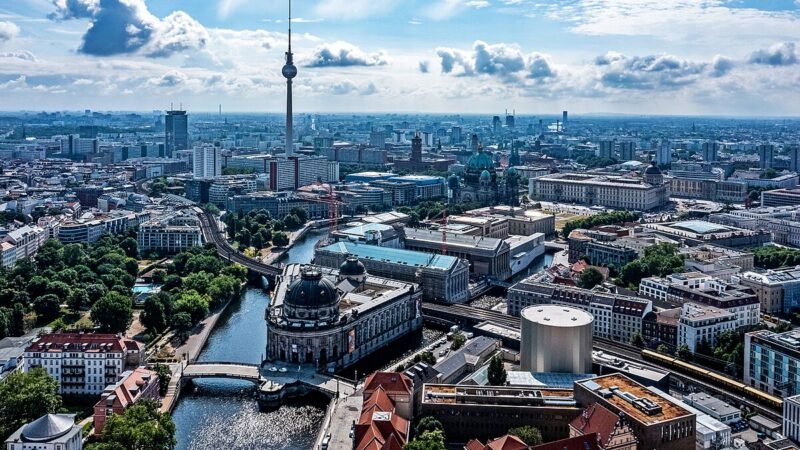
Berlin, the capital of Germany, is a city with a complex history marked by division and reunification. On 13 August 1961, the weather in Berlin was drizzly. The date fell under the zodiac sign of Leo, and a full moon was present in the night sky.
On this day
On 13 August 1940, the German Luftwaffe launched Adlertag, a major air operation designed to destroy the British Royal Air Force and pave the way for invasion across the Channel. The failure of this campaign indefinitely postponed Operation Sea Lion and proved to be a turning point in the Second World War, demonstrating that German military dominance had limits.
More than a century earlier, on 13 August 1704, the Duke of Marlborough achieved one of the most decisive victories of the War of Spanish Succession at the Battle of Blenheim. This triumph over French and Bavarian forces boosted Allied confidence and helped reshape the balance of power in Europe. Additionally, in 1918, Opha May Johnson became the first woman to enlist in the United States Marine Corps, breaking new ground for female military service.
International Left-Handers Day
International Left-Handers Day is observed annually on 13 August to celebrate the approximately ten per cent of the global population who are left-handed. The day recognises the challenges faced by left-handed individuals in a predominantly right-handed world, from using scissors to writing with fountain pens. It was founded in 1976 by Dean R. Campbell and has since become an opportunity for schools and organisations to raise awareness about left-handedness and promote inclusivity.
DayAtlas displays historical weather conditions, significant events, and notable births and deaths for any chosen date and location worldwide.
Find out what's happening today in Berlin.
What the Weather Had in Store for Berlin on 26th November 2026
Purpose reveals itself through practice, not preparation.
Fortune of the Day
13th August in the Stars – Star Sign Leo
Personality Profile
Personality Those born on August 13th combine Leo's natural confidence with Jupiterian wisdom and expansive thinking. They are natural leaders who blend generosity with intellectual depth, inspiring those around them through authenticity and vision.
Strengths & Weaknesses Their strengths lie in creativity, charisma, and strategic thinking. However, they can overestimate their abilities and grow impatient when success doesn't materialize quickly or their vision goes unrecognized.
Love These Leos seek partners who share their passion and support their ambitions. They love generously and dramatically, yet need genuine admiration and space for personal growth and exploration.
Caree & Finance August 13th natives thrive in creative or leadership roles where they can manifest their vision. Jupiter's influence encourages entrepreneurial thinking and magnanimous resource management with long-term perspective.
Health Their fiery nature demands regular movement and creative outlets for stress relief. They should guard against overexertion and maintain balance between ambitious pursuits and proper rest.
That night, the moon was in its full moon phase.
Chinese year of the Ox (Metal).
Fun Facts About 13th August
Name Days in Your Language: Rad, Radella, Radford, Radley, Wilmer
Someone born on this day in 1961 would be 65 years old today — just 23,846 days into life, which is roughly 572,324 hours, 34,339,441 minutes, or 2,060,366,475 seconds spent on Earth so far.
It's the 225. day of the year. In 1961, 13th August falls on a Sunday.
There are 140 days still to come.
We’re currently in Week 32 — the year marches on.
Famous Birthdays on 13th August
On this day, 14 notable people were born on 13th August — spanning from 1958 to 1964. From world leaders to artists and scientists, discover who shares this birthday.
13/08/1964
Jay Buhner, American baseball player and sportscaster
Jay Campbell Buhner, nicknamed "Bone", is an American former professional baseball right fielder. He played for the New York Yankees and Seattle Mariners of Major League Baseball from 1987 to 2001. Noted for his shaved head, thick goatee, and patch of pine tar on the right hip of his uniform, he is regarded as one of the most popular players in Mariners' history.
Tom Prince, American baseball player and manager
Thomas Albert Prince is an American former professional baseball player, and coach. He played in Major League Baseball as a catcher from 1987 to 2003. Although Prince didn't produce impressive offensive statistics, he excelled defensively as a catcher which enabled him to sustain a seventeen-year playing career with several major league teams.
13/08/1963
Steve Higgins, American talk show co-host and announcer, writer, producer, comedian and impressionist
Steve Earl Higgins is an American writer, producer, announcer, actor, and comedian. He has served as the announcer and sidekick of The Tonight Show Starring Jimmy Fallon since 2014, and as a writer and producer of Saturday Night Live since 1995. Prior to The Tonight Show, he was the announcer for Late Night with Jimmy Fallon from 2009 to 2014. Early in his career, he was part of the sketch comedy trio The Higgins Boys and Gruber, who had their own eponymous sketch series on Comedy Central from 1989 to 1991.
Valerie Plame, American CIA agent and author
Valerie Elise Plame is an American writer, novelist, and former Central Intelligence Agency (CIA) officer. As the subject of the 2003 Plame affair, also known as the CIA leak scandal, Plame's identity as a CIA officer was leaked to and subsequently published by Robert Novak of The Washington Post. She described this period and the media firestorm that ensued as "mortifying, and I think I was in shock for a couple years".
Sridevi, Indian actress (died 2018)
Sridevi Kapoor, known mononymously as Sridevi, was an Indian actress who worked in Telugu, Tamil, Hindi, Malayalam, and Kannada language films. Cited as the "first female superstar" of Indian cinema, she was the recipient of various accolades, including a National Film Award, Seven Filmfare Awards, Tamil Nadu State Film Awards, a Kerala State Film Award, and a Nandi Award. Sridevi's career spanned over 50 years in a wide range of genres. She was known for her reticent and introverted off-screen personality, but headstrong and outspoken on-screen persona, often playing strong-willed women. In 2013, Sridevi was honoured with the Padma Shri, the country's fourth highest civilian honour.
13/08/1961
Koji Kondo, Japanese composer and sound director
Koji Kondo is a Japanese composer and senior executive at the video game company Nintendo. He is best known for his contributions for the Super Mario and The Legend of Zelda series, with his Super Mario Bros. theme being the first piece of music from a video game included in the American National Recording Registry. Kondo was hired by Nintendo in 1984 as its first dedicated composer and is currently a Senior Officer at its Entertainment Planning & Development division.
Neil Mallender, English cricketer and umpire
Neil Alan Mallender is a former English cricketer. Born in Kirk Sandall, Yorkshire, Mallender was a right-arm fast-medium bowler and a right-hand lower order batsman who improved as his career progressed. He played first-class cricket in England for Northamptonshire and for Somerset (1987–1994). He also played for Otago, captaining the side in 1990–91 and 1991–92.
Tom Perrotta, American novelist and screenwriter
Thomas R. Perrotta is an American novelist and screenwriter best known for his novels Election (1998) and Little Children (2004), both of which were made into Academy Award-nominated films. Perrotta co-wrote the screenplay for the 2006 film version of Little Children with Todd Field, for which he received an Academy Award nomination for Best Adapted Screenplay. He is also known for his novel The Leftovers (2011), which was adapted into the critically acclaimed TV series on HBO, co-created by Perrotta and Damon Lindelof.
13/08/1960
Ivar Stukolkin, Estonian swimmer
Ivar Stukolkin is a retired Estonian swimmer. He is an Olympic champion in swimming.
13/08/1959
Bruce French, English cricketer and coach
Bruce Nicholas French is a former English cricketer, who played in sixteen Test matches and 13 One Day Internationals for the England cricket team from 1985 to 1988. A wicket-keeper/batsman, French played his first Test against India at Headingley, Leeds in 1986, and his last Test against New Zealand in Wellington in March 1988.
Tom Niedenfuer, American baseball player
Thomas Edward Niedenfuer is an American former professional baseball right-handed pitcher. Exclusively a reliever during his ten-year career, he played his first six-plus seasons for the Los Angeles Dodgers, then finished out with the Baltimore Orioles, Seattle Mariners, and St. Louis Cardinals.
13/08/1958
David Feherty, Northern Irish golfer and sportscaster
David William Feherty is a Northern Irish-born former professional golfer and current golf broadcaster. As a touring professional he won five European Tour events, made the top 10 of the Open Championship twice, and played on Europe's 1991 Ryder Cup team. Late in his career he joined the PGA Tour. Since retiring, he has worked as a television personality; from 1997 through 2015 Feherty served as an on-course reporter for the PGA Tour on CBS. In 2011, he introduced a self-titled interview series on the Golf Channel and subsequently joined NBC Sports full-time in 2016. In July 2022, it was announced that Feherty would depart NBC and become an analyst for LIV Golf.
Feargal Sharkey, Northern Irish singer-songwriter
Seán Feargal Sharkey is a singer and environmentalist from Derry, Northern Ireland. He was the lead vocalist of the punk band The Undertones in the 1970s and 1980s, and became a solo artist in the 1980s and 1990s. His 1985 solo single "A Good Heart" was a number-one hit in the United Kingdom, Australia, Belgium, Ireland, and the Netherlands. After becoming less musically active in the early 1990s, he has performed various roles supporting the UK's commercial music industry, winning several awards and honours for his work in that area.
Randy Shughart, American sergeant, Medal of Honor recipient (died 1993)
Randall David Shughart was a United States Army Delta Force operator who was posthumously awarded the Medal of Honor for his actions during the Battle of Mogadishu, during Operation Gothic Serpent in October 1993.
Lives Remembered on 13th August
On 13th August, 106 remarkable people passed away — from 587 to 2026. Remember the lives and legacies of those we lost on this day.
13/08/2026
Prichard Colón, Puerto Rican boxer (born 1992)
Prichard Colón Meléndez was a Puerto Rican professional boxer, honorary WBC World Champion, and gold medal winner at the 2010 Pan American Youth Championship in the 64 kg category. After a 2015 match with Terrel Williams, in which he was repeatedly struck in the back of the head with a rabbit punch, Colón collapsed in the dressing room and remained in a coma for 221 days due to a brain hemorrhage. He remained in a persistent vegetative state and was unable to speak, receiving physiotherapy until his death in 2026.
13/08/2024
Richard Alatorre, American politician (born 1943)
Richard Alatorre was an American politician who was a member of the California State Assembly from 1973 to 1985 and the Los Angeles City Council from 1985 to 1999, the second Latino to serve on the council in the 20th century. While working as a lobbyist, he had been called "one of the most influential Latino politicians in the state".
Wally Amos, American entrepreneur, founder of Famous Amos (born 1936)
Wallace Amos Jr. was an American writer and businessman. He was the founder of the Famous Amos chocolate chip cookie, the Cookie Kahuna, and Aunt Della's Cookies gourmet cookie brands. He was also the host of the adult reading programs Learn to Read.
Sergio Donati, Italian screenwriter (born 1933)
Sergio Donati was an Italian screenwriter. He wrote for more than 70 films beginning in 1952. He was born in Rome, Italy. He started as a writer and had some of his books optioned for film. He is well known for his collaboration with Italian director Sergio Leone, who encouraged him to take up screenwriting as a full-time career, and with Italian producer Dino de Laurentis.What is film? In the first act, you hang a man up in a tree. In the second act, you throw stones at him. In the third act, he falls down. If he is alive, it is a comedy. If he is dead, it is a drama.
Greg Kihn, American singer-songwriter and guitarist (born 1949)
Gregory Stanley Kihn was an American rock musician, radio personality, and novelist. He founded and led the Greg Kihn Band, and wrote several horror novels. He is best known for the hits "The Breakup Song " in 1981 and "Jeopardy" in 1983.
Frank Selvy, American basketball player and coach (born 1932)
Franklin Delano Selvy was an American National Basketball Association (NBA) player who was best known for holding the record for the most points (100) in a Division I college basketball game. Born in Corbin, Kentucky, Selvy was an All-State basketball player at Corbin High School and was a teammate of College Football Hall of Fame inductee Roy Kidd. Selvy was the No. 1 overall pick in the 1954 NBA draft and was a two-time NBA All-Star, playing nine seasons.
13/08/2021
Nanci Griffith, American singer-songwriter (born 1953)
Nanci Caroline Griffith was an American singer, guitarist, and songwriter. She often appeared on the PBS music program Austin City Limits, starting in 1985 during season 10. Griffith's career spanned a variety of musical genres, predominantly country, folk, and what she termed "folkabilly." She won a Grammy for Best Contemporary Folk Album in 1994 for her 1993 recording, Other Voices, Other Rooms. The album features Griffith covering the songs of artists who were her major influences. One of her better-known songs is "From a Distance," which was written and composed by Julie Gold.
13/08/2018
Jim Neidhart, American wrestler (born 1955)
James Henry Neidhart was an American professional wrestler known for his appearances in the 1980s and 1990s in the World Wrestling Federation as Jim "the Anvil" Neidhart, where he was a two-time WWF Tag Team Champion with his real-life brother-in-law Bret Hart in the Hart Foundation. He also won titles in Stampede Wrestling, Championship Wrestling from Florida, Mid-South Wrestling, Memphis Championship Wrestling and the Mid-Eastern Wrestling Federation. He was part of the Hart wrestling family through marriage to his wife Ellie Hart, teaming with various members throughout his career, and appearing with his daughter Natalya Neidhart on the reality television show Total Divas.
13/08/2016
Kenny Baker, English actor and musician (born 1934)
Kenneth George Baker was a British actor, comedian and musician. He portrayed the character R2-D2 in the Star Wars franchise and also appeared in The Elephant Man, Time Bandits, Willow, Flash Gordon, Amadeus and Labyrinth.
Pramukh Swami Maharaj, Indian Hindu leader (born 1921)
Pramukh Swami Maharaj was the guru and Pramukh, or president, of the Bochasanwasi Akshar Purushottam Swaminarayan Sanstha (BAPS), a major branch of the Swaminarayan Sampradaya, a Hindu denomination. BAPS regards him as the fifth spiritual successor of Swaminarayan, following Gunatitanand Swami, Bhagatji Maharaj, Shastriji Maharaj, and Yogiji Maharaj. He was believed by his followers to be in constant communion with Swaminarayan, and ontologically, the manifestation of Akshar, the eternal abode of Swaminarayan.
13/08/2015
Watban Ibrahim al-Tikriti, Iraqi politician, Iraqi Minister of Interior (born 1952)
Watban Ibrahim al-Nasiri was an Iraqi politician and former interior minister of Iraq. He was the half-brother of Saddam Hussein and the brother of Barzan al-Tikriti. He was taken into coalition custody on April 13, 2003, following his capture as he tried fleeing to Syria. He died in prison of natural causes in 2015.
Bob Fillion, Canadian ice hockey player and manager (born 1920)
Joseph Louis Robert Edgar Fillion was a Canadian professional ice hockey player who played seven seasons for the Montreal Canadiens of the National Hockey League (NHL) between 1943 and 1950. He was a member of two Stanley Cup-winning teams during his career with Montreal; in 1944 and 1946. He also spent time with the Buffalo Bisons of the AHL and the Sherbrooke Saints of the Quebec Senior Hockey League (QSHL). He died on August 13, 2015. At the time of his death, Fillion was the last surviving member of the Canadiens' 1944 Stanley Cup team.
Om Prakash Munjal, Indian businessman and philanthropist, co-founded Hero Cycles (born 1928)
Om Prakash Munjal was an Indian businessman, poet and philanthropist. He was the founder and chairman of Hero Cycles, the world's largest integrated bicycle manufacturing company by volume and Hero Motors, an Indian two-wheeler components manufacturer, and ventured into newer business fields including luxury hotels and four-wheeler components. He is also known for philanthropic activities of running various schools and hospitals. He died on 13 August 2015 at DMC Hero Heart Centre, Ludhiana.
13/08/2014
Frans Brüggen, Dutch flute player and conductor (born 1934)
Franciscus ("Frans") Jozef Brüggen was a Dutch conductor, recorder player and baroque flautist.
Eduardo Campos, Brazilian politician, 14th Brazilian Minister of Science and Technology (born 1965)
Eduardo Henrique Accioly Campos was a Brazilian congressman and governor. Born and raised in Recife, in the Northeast Brazil, he graduated in Economics from the Recife's Federal University of Pernambuco. Campos' maternal grandfather, the governor of the Brazilian state, Pernambuco, made him his Financial Secretary. Campos became a federal congressman in Brazil and got Pernambuco federal money for a shipyard, railways and an oil refinery. Later, as Brazil's Minister for Science and Technology, he supported stem-cell research. He served two terms as governor of his home state, Pernambuco. He helped hospitals, secondary schools, wind power, farms, poor people and anti-crime data-mining. In his 2014 campaign for president of Brazil he criticized the incumbent and her Workers' Party and positioned himself as the business-friendly leader of the Brazilian Socialist Party. For outdoor rallies and local radio interviews, he criss-crossed the country by rented jet. He died on 13 August 2014, three days after his 49th birthday, when his plane crashed in poor weather in the city of Santos.
Martino Finotto, Italian race car driver (born 1933)
Martino Finotto was an Italian racing driver, mainly known for his success in touring car and sports car racing.
Süleyman Seba, Turkish footballer and manager (born 1926)
Süleyman Seba was a Turkish football player of Abkhazian origin and was the longest presiding chairman of the Istanbul-based multisports club Beşiktaş. He was also a chief intelligence officer for the National Intelligence Organization in "the mission of countering communism".
13/08/2013
Lothar Bisky, German politician (born 1941)
Lothar Bisky was a German politician. He was the chairman of the Party of Democratic Socialism (PDS), the successor of East Germany's Socialist Unity Party (SED). In June 2007, he became co-chairman of The Left party, formed by a merger of the PDS and the much smaller Labour and Social Justice – The Electoral Alternative. From 2007 until 2010, he was the President of the Party of the European Left. Also, he was the Publisher of the socialist newspaper Neues Deutschland.
Aaron Selber, Jr., American businessman and philanthropist (born 1927)
Aaron Rosenbaum Selber Jr. was an American businessman, the last president of the former Selber Bros. department store chain, and a philanthropist from Shreveport, the largest city in the northern portion of the U.S. state of Louisiana.
Jean Vincent, French footballer and manager (born 1930)
Jean Vincent was a French international footballer and manager who played as a left winger.
13/08/2012
Hugo Adam Bedau, American philosopher and academic (born 1926)
Hugo Adam Bedau was the Austin B. Fletcher professor of philosophy at Tufts University. He is best known for his work on capital punishment.
Helen Gurley Brown, American journalist and author (born 1922)
Helen Gurley Brown was an American author, publisher, and businesswoman. She was the editor-in-chief of Cosmopolitan magazine for 32 years.
Ray Jordon, Australian cricketer and coach (born 1937)
Raymond Clarence "Slug" Jordon was an Australian first-class cricketer who represented Victoria in the Sheffield Shield and toured with the Australian national cricket team. He was also a successful Australian rules football coach and acted as both reserves and under-19s coach at various clubs in the Victorian Football League (VFL).
Johnny Pesky, American baseball player and manager (born 1919)
John Michael Pesky, nicknamed "the Needle" and "Mr. Red Sox", was an American professional baseball player, manager and coach in Major League Baseball (MLB). He was a shortstop and third baseman during a ten-year major league playing career, appearing in 1,270 games played in 1942 and from 1946 to 1954 for three teams. He missed the 1943–45 seasons while serving in World War II. Pesky was associated with the Boston Red Sox for 61 of his 73 years in baseball—from 1940 through June 3, 1952, 1961 through 1964, and from 1969 until his death. Pesky also managed the Red Sox from 1963 to 1964, and in September 1980.
Joan Roberts, American actress and singer (born 1917)
Joan Roberts was an American actress, most famous for creating the role of Laurey in the original Broadway production of Oklahoma! in 1943.
13/08/2011
Tareque Masud, Bangladeshi director, producer, and screenwriter (born 1957)
Tareque Masud was a Bangladeshi independent film director, film producer, screenwriter and lyricist. He first found success with the films Muktir Gaan (1995) and Matir Moina (2002), for which he won three international awards, including the International Critics' FIPRESCI Prize, in the Directors' Fortnight at 2002 Cannes Film Festival. The film became Bangladesh's first film to compete for the Academy Award for Best Foreign Language Film.
Mishuk Munier, Bangladeshi journalist and cinematographer (born 1959)
Ashfaque Munier was a Bangladeshi media specialist and broadcast journalist. He was known for his photography direction and for being the cofounder of the global news channel The Real News Network. He was one of three sons of Munier Chowdhury. Mishuk served as the chief executive officer and chief editor of satellite TV channel ATN News. He died in a road accident, along with Tareque Masud, on August 13, 2011. He was awarded Ekushey Padak for his contribution to journalism in 2012 by the Bangladeshi government.
13/08/2010
Panagiotis Bachramis, Greek footballer (born 1976)
Panagiotis Bachramis was a Greek professional footballer who played as midfielder. On 13 August 2010, he was killed when a speedboat struck him while he was snorkeling near the beach in Kyparissia.
Lance Cade, American wrestler (born 1981)
Lance Kurtis McNaught was an American professional wrestler. He was best known for his time in World Wrestling Entertainment (WWE), where he performed under the ring name Lance Cade.
Edwin Newman, American journalist and author (born 1919)
Edwin Harold Newman was an American newscaster, journalist, and author. After beginning his career with the wire services and serving in the U.S. Navy during World War II, Newman worked in radio for CBS News. He is known for a 23-year career with NBC News, from 1961 to 1984.
13/08/2009
Lavelle Felton, American basketball player (born 1980)
Lavelle R Felton was an American professional basketball player. In 2009, he was killed in an unsolved shooting.
13/08/2008
Henri Cartan, French mathematician and academic (born 1904)
Henri Paul Cartan was a French mathematician who made substantial contributions to algebraic topology.
Bill Gwatney, American politician (born 1959)
William Alan "Bill" Gwatney was an American politician who served as the State Chair of the Democratic Party of Arkansas. He had previously served as a State Senator for ten years and as the financial chair of Mike Beebe's campaign for Governor of Arkansas in 2006. Gwatney was selected as a superdelegate at the 2008 Democratic National Convention, but was assassinated before the convention.
Jack Weil, American businessman (born 1901)
Jack Arnold Weil was an American businessman who was the founder and CEO of the Denver-based Western clothing manufacturer Rockmount Ranch Wear and was believed to be the oldest working CEO in the United States.
13/08/2007
Brian Adams, American wrestler (born 1964)
Brian Keith Adams was an American professional wrestler. Adams is known for his time with the World Wrestling Federation (WWF), under the name Crush, and for World Championship Wrestling (WCW) under his real name Brian Adams. Trained in Japan by Antonio Inoki, he was a two-time WCW World Tag Team Champion, a one-time WWF Tag Team Champion and a one-time AJPW World Tag Team Champion, among other accomplishments. He was a challenger for various singles titles in the WWF and WCW, including the WWF Championship. In 2002, he briefly tried a career in boxing until retiring due to back and shoulder injuries.
Brooke Astor, American philanthropist and socialite (born 1902)
Roberta Brooke Astor was an American philanthropist, socialite, and writer. She served as the chairwoman of the Vincent Astor Foundation, established by her third husband, Vincent Astor, who was a member of the Astor family. Brooke Astor was the author of two novels and two volumes of personal memoirs.
Phil Rizzuto, American baseball player and sportscaster (born 1917)
Philip Francis Rizzuto, nicknamed "the Scooter", was an American Major League Baseball (MLB) shortstop. He spent his entire 13-year baseball career with the New York Yankees (1941–1956), and was elected to the National Baseball Hall of Fame in 1994.
13/08/2006
Tony Jay, English actor and singer (born 1933)
Tony Jay was a British actor. A former member of the Royal Shakespeare Company, he was known for his voice work in radio, animation, film, and video games. Jay was particularly noted for his distinctive deep baritone voice, which often led to him being cast in villainous or authoritative roles. His voice acting roles included Judge Claude Frollo in Disney's The Hunchback of Notre Dame (1996), Megabyte in ReBoot (1994–2001), Shere Khan in The Jungle Book 2, as well as the TV series TaleSpin, the Elder God in the Legacy of Kain series of video games and Dr. Lipschitz in Rugrats.
Jon Nödtveidt, Swedish musician (born 1975)
Jon Andreas Nödtveidt was a Swedish musician best known as the founder, vocalist and lead guitarist of the extreme metal band Dissection. With the band, he released the seminal and influential extreme metal albums The Somberlain (1993) and Storm of the Light's Bane (1995). In addition to Dissection, Nödtveidt performed with several other projects, including Ophthalamia, The Black, De Infernali and Nifelheim, and also worked as a journalist for Metal Zone, where he covered the growing black metal scene.
Kermit L. Hall, American legal historian and university president (born 1944)
Kermit Lance Hall was a noted legal historian and university president. He served from 1994 to 1998 on the Assassination Records Review Board to review and release to the public documents related to the assassination of U.S. President John F. Kennedy.
13/08/2005
Miguel Arraes, Brazilian lawyer and politician (born 1916)
Miguel Arraes de Alencar was a Brazilian lawyer and politician. He was mayor of Recife, State Deputy, Federal Deputy and three times Governor of Pernambuco.
David Lange, New Zealand lawyer and politician, 32nd Prime Minister of New Zealand (born 1942)
David Russell Lange was a New Zealand politician who served as the 32nd prime minister of New Zealand from 1984 to 1989. A member of the New Zealand Labour Party, Lange was also the minister of education and the minister of foreign affairs alongside his term as prime minister. He was also the attorney-general of New Zealand from 1989 to 1990.
13/08/2004
Julia Child, American chef, author, and television host (born 1912)
Julia Carolyn Child was an American chef, author, and television personality. She is recognized for having brought French cuisine to the American public with her debut cookbook, Mastering the Art of French Cooking, and her subsequent television programs, the most notable of which was The French Chef, which premiered in 1963 and ran for almost ten years.
Akku Yadav, Indian gangster and serial rapist (born 1971 or 1972)
Bharat Kalicharan Yadav, also known as Akku Yadav, was an Indian gangster, burglar, kidnapper, serial rapist, murderer, and extortionist. Akku grew up in the Kasturba Nagar slum, which is located in the Indian central city of Nagpur, Maharashtra. He lived and did business in the slum which housed a number of criminals and two rival gangs.
13/08/2003
Ed Townsend, American singer-songwriter and producer (born 1929)
Edward Benjamin Townsend was an American singer, songwriter, and record producer. He performed and composed "For Your Love", a rhythm and blues doo-wop classic, and co-wrote "Let's Get It On" with Marvin Gaye.
13/08/2001
Otto Stuppacher, Austrian race car driver (born 1947)
Otto Leopold Stuppacher was a racing driver from Vienna, Austria. He competed in hill-climbs and sports car racing before entering 3 Formula One Grands Prix with the ÖASC Racing Team in 1976, with a Tyrrell 007. He was refused entry to the 1976 Austrian Grand Prix, along with teammate Karl Oppitzhauser, despite trying to raise a petition from the other teams.
Jim Hughes, American baseball player and manager (born 1923)
James Robert Hughes was an American professional baseball player. The right-handed pitcher appeared in all or part of six seasons (1952–1957) in Major League Baseball with the Brooklyn Dodgers, Chicago Cubs and Chicago White Sox and worked in 172 games, all but one as a relief pitcher. In 1954, he led the National League in saves with 24 and tied for the league leadership in games pitched with 60. Hughes was a native of Chicago who was listed as 6 feet 1 inch (1.85 m) tall and 200 pounds (91 kg). His baseball career began in 1946, after he had served in the United States Marine Corps in the Pacific theatre of World War II.
Betty Cavanna, American author (born 1909)
Betty Cavanna was the author of popular teen romance novels, mysteries, and children's books for 45 years. She also wrote under the names Elizabeth Headley and Betsy Allen. She was nominated for the Edgar Award for Best Juvenile in 1970 and 1972.
13/08/2000
Nazia Hassan, Pakistani singer-songwriter (born 1965)
Nazia Hassan was a Pakistani singer, songwriter, and philanthropist. Regarded as the "Queen of South Asian Pop,” she is considered one of the most influential musical figures in Pakistani history who completely overturned the music industry in the late 70s and 80s. She is the subcontinent's early pop star after Ahmed Rushdi. Starting in the 1980s, as part of the duo Nazia and Zoheb, she and her brother Zoheb Hassan, have sold over 65 million records worldwide.
13/08/1999
Ignatz Bubis, German Jewish religious leader (born 1927)
Ignatz Bubis, German Jewish leader, was the influential chairman of the Central Council of Jews in Germany from 1992 to 1999. In this capacity he led a public campaign against German antisemitism. Bubis's high-profile both in Frankfurt and nationwide involved him in a number of public controversies.
Jaime Garzón, Colombian journalist and lawyer (born 1960)
Jaime Hernando Garzón Forero was a Colombian comedian, journalist, politician, and peace activist. He was popular on Colombian television during the 1990s for his unique political satire. In addition to his work on television, he also had roles as a peace negotiator during the Colombian conflict, working for the release of FARC guerrillas' hostages.
13/08/1998
Nino Ferrer, Italian-French singer-songwriter and guitarist (born 1934)
Nino Agostino Arturo Maria Ferrari, known as Nino Ferrer, was an Italian-born French singer-songwriter and author.
Edward Ginzton, Ukrainian-American physicist and academic (born 1915)
Edward Leonard Ginzton was a Ukrainian-American engineer.
Julien Green, American author (born 1900)
Julien Green, often Julian Green, was an American writer who lived most of his life in France and wrote primarily in French, although he also wrote some works in English. Over a long and prolific career, he authored novels and essays, several plays, and a biography of Francis of Assisi, produced a four-volume autobiography, and for decades maintained a daily journal that he edited and published in nineteen volumes. The posthumous publication of the unexpurgated journals revealed aspects of his personality and sexuality that had been omitted from the published editions, revealed details about many of his prominent contemporaries, and documented the gay subculture of 20th-century France.
Rafael Robles, Dominican-American baseball player (born 1947)
Rafael Orlando Robles Natera was a Dominican shortstop in Major League Baseball. He was born in San Pedro de Macorís, Dominican Republic. He was signed by the San Francisco Giants as an amateur free agent before the 1967 season, and later drafted by the San Diego Padres from the San Francisco Giants as the 51st pick in the 1968 Major League Baseball expansion draft. He played for the San Diego Padres from 1969 to 1970, and again in 1972.
13/08/1996
António de Spínola, Portuguese general and politician, 14th President of Portugal (born 1910)
António Sebastião Ribeiro de Spínola was a Portuguese military officer, author and conservative politician. During the Estado Novo regime he became one of Portugal's most senior military commanders, leading military operations against independence movements. After the Carnation Revolution, partially organised by under-ranked military captains, he was invited to be the president of Portugal. His role in Portugal's transition to democracy remains highly controversial, particularly regarding his role in leading the 11 March 1975 attempted coup as well as the anticommunist terrorist organisation Movimento Democrático de Libertação de Portugal. He was noted for wearing a monocle on his right eye.
13/08/1995
Alison Hargreaves, English mountaineer (born 1963)
Alison Jane Hargreaves was a British mountaineer and alpinist. Her accomplishments included scaling Mount Everest in 1995 solo and without supplementary oxygen or support from a Sherpa team. She solo climbed all of the great north faces of the Alps in a single season—a first for any climber. This feat included climbing the north face of the Eiger in the Alps. Hargreaves also climbed 6,812-metre (22,349 ft) Ama Dablam in Nepal.
Jan Křesadlo, Czech-English psychologist and author (born 1926)
Václav Jaroslav Karel Pinkava, better known by his pen name Jan Křesadlo, was a Czech psychologist who was also a prizewinning novelist and poet.
Mickey Mantle, American baseball player and sportscaster (born 1931)
Mickey Charles Mantle, nicknamed "the Mick" and "the Commerce Comet", was an American professional baseball player who played his entire Major League Baseball (MLB) career (1951–1968) with the New York Yankees, primarily as a center fielder. Mantle is regarded by many as one of the best players and sluggers of all time. He was an American League (AL) Most Valuable Player three times and was inducted into the Baseball Hall of Fame in 1974.
13/08/1991
James Roosevelt, American general and politician (born 1907)
James Roosevelt II was an American businessman, Marine officer, activist, and Democratic Party politician. The eldest son of President Franklin D. Roosevelt and Eleanor Roosevelt, he served as an official Secretary to the President for his father and was later elected to the United States House of Representatives representing California, serving five terms from 1955 to 1965. Roosevelt received the Navy Cross while serving as a Marine Corps officer during World War II.
13/08/1989
Tim Richmond, American race car driver (born 1955)
Timothy Lee Richmond was an American race car driver from Ashland, Ohio. He competed in IndyCar racing before transferring to NASCAR's Winston Cup Series. Richmond was one of the first drivers to change from open wheel racing to NASCAR stock cars full-time, which later became an industry trend. He won the 1980 Indianapolis 500 Rookie of the Year award and had 13 victories during eight NASCAR seasons.
Larkin I. Smith, American police officer and politician (born 1944)
Larkin Irvin Smith was an American congressman from Mississippi serving for seven months until he was killed in a plane crash in Perry County, Mississippi in 1989.
13/08/1986
Helen Mack, American actress (born 1913)
Helen Mack was an American actress. She started her career as a child actress in silent films, moving to Broadway plays and touring one of the vaudeville circuits. Her greater success as an actress was as a leading lady in the 1930s. She made the transition to performing on radio and then into writing, directing, and producing shows during the Golden Age of Radio. She later wrote for Broadway, stage and television. Her career spanned the infancy of the motion picture industry, the beginnings of Broadway, the final days of vaudeville, the transition to sound movies, the Golden Age of Radio, and the rise of television.
13/08/1984
Tigran Petrosian, Georgian-Armenian chess player (born 1929)
Tigran Vardani Petrosian was a Soviet-Armenian chess grandmaster. The ninth World Chess Champion from 1963 to 1969, he was nicknamed "Iron Tigran" due to his almost-impenetrable defensive playing style, which emphasized safety above all else. Petrosian is often credited with popularizing chess in Armenia.
13/08/1979
Andrew Dasburg, American painter and sculptor (born 1887)
Andrew Michael Dasburg was an American modernist painter and "one of America's leading early exponents of cubism". Born in Paris and raised in New York City, he trained at the Art Students League of New York before traveling to Paris, where he encountered the work of Paul Cézanne and became deeply influenced by Cubism. He became an ardent promoter of the Cubist style and exhibited at the landmark 1913 Armory Show, where his three Cubist-oriented oil paintings were considered "daringly experimental".
13/08/1978
Lonnie Mayne, American wrestler (born 1944)
Ronald Doyle "Lonnie" Mayne was an American professional wrestler in the 1960s and 1970s who frequently went by the name Moondog Mayne. He wrestled in various National Wrestling Alliance territories, as well as the World Wide Wrestling Federation in 1973.
13/08/1975
Murilo Mendes, Brazilian poet and telegrapher (born 1901)
Murilo Monteiro Mendes was a Brazilian Modernist poet, considered to be one of the forerunners of the Surrealist movement in Brazil.
13/08/1974
Ida McNeil, American broadcaster and designer of the flag of South Dakota (born 1888)
Ida McNeil was an American broadcaster and the designer of the first state flag of South Dakota. She and her husband, Dana McNeil, founded KGFX, in Pierre, South Dakota, one of the first radio stations in South Dakota, in 1927. She continued to run the station after his death in 1936 until her retirement in 1962. She has been nicknamed "Mrs. Pierre" for her work in broadcasting and "the Betsy Ross of South Dakota" for her state flag design.
13/08/1971
W. O. Bentley, English race car driver and engineer, founded Bentley Motors Limited (born 1888)
Walter Owen Bentley, was an English engineer who founded Bentley in London. He was a motorcycle and car racer as a young man. After making a name for himself as a designer of aircraft and automobile engines, Bentley established his own firm in 1919. He built the firm into one of the world's premier luxury and performance auto manufacturers, and led the marque to multiple victories at the 24 Hours of Le Mans. After selling his namesake company to Rolls-Royce in 1931, he was employed as a designer for Lagonda, Aston Martin and Armstrong Siddeley.
13/08/1965
Hayato Ikeda, Japanese lawyer and politician, 58th Prime Minister of Japan (born 1899)
Hayato Ikeda was a Japanese politician who served as prime minister of Japan from 1960 to 1964. He is best known for his Income Doubling Plan, which promised to double the size of Japan's economy in 10 years, and for presiding over the 1964 Tokyo Olympics.
13/08/1963
Louis Bastien, French cyclist and fencer (born 1881)
Eugène Louis Bastien was a French racing cyclist and fencer who competed in the late 19th century and early 20th century. He participated in Cycling at the 1900 Summer Olympics in Paris and won the gold medal in the men's 25 kilometre race. He also competed in the individual épée event at the same games.
13/08/1958
Francis J. McCormick, American football, basketball player, and coach (born 1903)
Francis J. "Mickey" McCormick was an American football and basketball player and coach. He served as the head football coach at St. Norbert College from 1934 to 1942 and at Carroll College—now known as Carroll University—in Waukesha, Wisconsin from 1949 to 1957, compiling a career college football record of 69–57–9. McCormick was also the head basketball coach at St. Norbert from 1934 to 1943 and again during the 1944–45 season, tallying a mark of 62–74. He was one of the more outspoken coaches against the NCAA rule change on "free substitution" in 1953.
13/08/1954
Demetrius Constantine Dounis, Greek violinist and mandolin player (born 1886)
Demetrius Constantine Dounis, also known as D. C. Dounis, was an influential teacher of violin and string instrument technique, as well as violinist, violist, and mandolin player.
13/08/1946
H. G. Wells, English novelist, historian, and critic (born 1866)
Herbert George Wells was an English writer, prolific in many genres. He wrote more than forty novels and dozens of short stories. His non-fiction output included works of social commentary, politics, history, popular science, satire, biography, and autobiography. Wells is most known today for his groundbreaking science fiction novels; he has sometimes been called the "father of science fiction", a title that has also been given to Jules Verne and Hugo Gernsback.
13/08/1937
Sigizmund Levanevsky, Soviet aircraft pilot of Polish origin (born 1902)
Sigizmund Aleksandrovich Levanevsky was a Soviet pioneer of long-range flight who was awarded the title Hero of the Soviet Union in 1934 for his role in the SS Chelyuskin rescue.
13/08/1934
Mary Hunter Austin, American author and playwright (born 1868)
Mary Hunter Austin was an American writer. One of the early nature writers of the American Southwest, her classic The Land of Little Rain (1903) describes the fauna, flora, and people of the region between the High Sierra and the Mojave Desert of southern California.
13/08/1917
Eduard Buchner, German chemist, Nobel Prize laureate (born 1860)
Eduard Buchner was a German chemist and expert on fermentation, awarded the 1907 Nobel Prize in Chemistry for his work on fermentation.
13/08/1912
Jules Massenet, French composer (born 1842)
Jules Émile Frédéric Massenet was a French composer of the Romantic era best known for his operas, of which he wrote more than thirty. The two most frequently staged are Manon (1884) and Werther (1892). He also composed oratorios, ballets, orchestral works, incidental music, piano pieces, songs and other music.
13/08/1910
Florence Nightingale, Italian-English nurse and theologian (born 1820)
Florence Nightingale was an English social reformer, statistician and the founder of modern nursing. Nightingale came to prominence while serving as a manager and trainer of nurses during the Crimean War, in which she organised care for wounded soldiers at Constantinople. She significantly reduced death rates by improving hygiene and living standards. Nightingale gave nursing a favourable reputation and became an icon of Victorian culture, especially in the persona of "The Lady with the Lamp" making ward rounds for wounded soldiers at night.
13/08/1900
Collis Potter Huntington, American railway magnate (born 1821)
Collis Potter Huntington was an American industrialist and railway magnate. He was one of the Big Four tycoons of western railroading who invested in Theodore Judah's idea to build the Central Pacific Railroad as part of the first U.S. transcontinental railroad. Huntington helped lead and develop other major interstate lines, such as the Southern Pacific Railroad and the Chesapeake & Ohio Railway (C&O), which he was recruited to help complete. The C&O, completed in 1873, fulfilled a long-held dream of Virginians of a rail link from the James River at Richmond to the Ohio River valley. The railroad facilities adjacent to the river there resulted in expansion of the former small town of Guyandotte, West Virginia, into part of a new city which was named Huntington in his honor.
13/08/1865
Ignaz Semmelweis, Hungarian physician and obstetrician (born 1818)
Ignaz Philipp Semmelweis was a Hungarian medical doctor and scientist of German descent who was an early pioneer of antiseptic procedures, known as the "saviour of mothers". Postpartum infection, also known as puerperal fever or childbed fever, was common in the 19th century, and often fatal. Semmelweis demonstrated that the incidence of infection could be drastically reduced by requiring healthcare workers in obstetrical clinics to disinfect their hands. In 1847, he proposed hand washing with chlorinated lime solutions at Vienna General Hospital's First Obstetrical Clinic, where doctors' wards had thrice the mortality of midwives' wards. The maternal mortality rate dropped from 18% to less than 2%, and he published a book of his findings, Etiology, Concept and Prophylaxis of Childbed Fever, in 1861.
13/08/1863
Eugène Delacroix, French painter and lithographer (born 1798)
Ferdinand Victor Eugène Delacroix was a French Romantic artist who was regarded as the leader of the French Romantic school.
13/08/1826
René Laennec, French physician, invented the stethoscope (born 1781)
René-Théophile-Hyacinthe Laennec was a French medical doctor and musician. His skill at carving his own wooden flutes led him to invent the stethoscope in 1816, while working at the Hôpital Necker. He pioneered its use in diagnosing various chest conditions. He became a lecturer at the Collège de France in 1822 and professor of medicine in 1823. His final appointments were that of head of the medical clinic at the Hôpital de la Charité and professor at the Collège de France. He went into a coma and subsequently died of tuberculosis on 13 August 1826, at age 45.
13/08/1795
Ahilyabai Holkar, Queen of Indore (born 1725)
Ahilyabai Holkar, also spelled Ahalya Bai, Rajmata Ahilyabai Holkar was the Holkar Queen of the Malwa kingdom. She was later ruling queen of Indore within the Maratha Empire. She established Maheshwar as the seat of the Holkar Dynasty.
13/08/1766
Margaret Fownes-Luttrell, English painter (born 1726)
Margaret Fownes-Luttrell was a British heiress, the wife of Henry Fownes Luttrell. She was the heiress of Dunster Castle, under the stipulation in her father's will that her husband should take the additional surname of Luttrell. Four portraits of her exist in Dunster castle and a fifth at Bathealton Court.
13/08/1749
Johann Elias Schlegel, German poet and critic (born 1719)
Johann Elias Schlegel was a German critic and dramatic poet.
13/08/1744
John Cruger, Danish-American businessman and politician, 39th Mayor of New York City (born 1678)
John Cruger was an immigrant to colonial New York with an uncertain place of birth, but his family was originally Danish. In New York from at least 1696, he became a prosperous merchant and established a successful family. He served as an alderman for twenty-two years and as 39th Mayor of New York City from 1739 until his death in 1744.
13/08/1721
Jacques Lelong, French priest and author (born 1665)
Jacques Lelong was a French bibliographer born in Paris. He joined the Knights of Malta at the age of ten, but later joined the Oratorians.
13/08/1686
Louis Maimbourg, French priest and historian (born 1610)
Louis Maimbourg was a French Jesuit and historian.
13/08/1667
Jeremy Taylor, Irish bishop and saint (born 1613)
Jeremy Taylor (1613–1667) was an English cleric in the Church of England who achieved fame as an author during the Protectorate of Oliver Cromwell. He is sometimes known as the "Shakespeare of Divines" for his poetic style of expression, and he is frequently cited as one of the greatest prose writers in the English language.
13/08/1617
Johann Jakob Grynaeus, Swiss clergyman and theologian (born 1540)
Johann Jakob Grynaeus or Gryner was a Swiss Protestant divine.
13/08/1608
Giambologna, Italian sculptor (born 1529)
Giambologna, also known as Jean de Boulogne (French), Jehan Boulongne (Flemish) and Giovanni da Bologna (Italian), was the last significant Italian Renaissance sculptor, with a large workshop producing large and small works in bronze and marble in a late Mannerist style.
13/08/1523
Gerard David, Flemish painter (born 1460)
Gerard David was an Early Netherlandish painter and manuscript illuminator known for his brilliant use of color. Only a bare outline of his life survives, although some facts are known. He may have been the Meester gheraet van brugghe who became a master of the Antwerp guild in 1515. He was very successful in his lifetime and probably ran two workshops, in Antwerp and Bruges. Like many painters of his period, his reputation diminished in the 17th century until he was rediscovered in the 19th century.
13/08/1447
Filippo Maria Visconti, duke of Milan (born 1392)
Filippo Maria Visconti was the Duke of Milan from 1412 until his death in 1447.
13/08/1382
Eleanor of Aragon, queen of Castile (born 1358)
Eleanor of Aragon was the daughter of King Peter IV of Aragon and Eleanor of Sicily. She was a member of the House of Barcelona and Queen of Castile by her marriage.
13/08/1311
Pietro Gradenigo, doge of Venice
Pietro Gradenigo was the 49th Doge of Venice, reigning from 1289 until his death.
13/08/1297
Nawrūz, Mongol emir
Nawrūz was a son of governor Arghun Aqa and a powerful 13th-century Oirat emir who played an important role in the politics of the Mongol Ilkhanate.
13/08/1134
Irene of Hungary, Byzantine empress (born 1088)
Irene of Hungary was the Byzantine empress by marriage to John II Komnenos. The Byzantine Empire was at its height during this period, and her husband, John II, has been regarded as the greatest of the Komnenian emperors. She is venerated as a saint in the Eastern Orthodox Church and is sometimes listed as the Blessed Irene of Hungary (post-congregation) by some Catholic sources, but not by others. Although Hungary belongs to the Western Catholic Church, Piroska is venerated there as a Hungarian saint.
13/08/0981
Gyeongjong, king of Goryeo (Korea) (born 955)
Gyeongjong, personal name Wang Chu, was the fifth ruler of the Goryeo dynasty of Korea. He was the eldest son of King Gwangjong, and was confirmed as Crown Prince in the year of his birth. He was also the maternal and paternal grandson of King Taejo.
13/08/0908
Al-Muktafi, Abbasid caliph
Abū Muḥammad ʿAlī ibn Aḥmad ibn Ṭalḥa ibn Jaʿfar ibn Muḥammad ibn Hārūn al-Muktafī bi'Llāh, better known by his regnal name al-Muktafī bi-Llāh, was the caliph of the Abbasid Caliphate from 902 to 908. More liberal and sedentary than his militaristic father al-Mu'tadid, al-Muktafi essentially continued his policies, although most of the actual conduct of government was left to his viziers and officials. His reign saw the defeat of the Qarmatians of the Syrian Desert, and the reincorporation of Egypt and the parts of Syria ruled by the Tulunid dynasty. The war with the Byzantine Empire continued with alternating success, although the Arabs scored a major victory in the Sack of Thessalonica in 904. His death in 908 opened the way for the installation of a weak ruler, al-Muqtadir, by the palace bureaucracy, and began the terminal decline of the Abbasid Caliphate that ended in 946 with the caliphs becoming puppet rulers under the Buyid dynasty.
13/08/0900
Zwentibold, king of Lotharingia (born 870)
Zwentibold, a member of the Carolingian dynasty, was the illegitimate son of Emperor Arnulf. In 895, his father granted him the Kingdom of Lotharingia, which he ruled until his death.
13/08/0696
Takechi, Japanese prince
Prince Takechi was a member of the royal family in Japan during the Asuka period.
13/08/0662
Maximus the Confessor, Byzantine theologian
Maximus the Confessor, also spelled Maximos, otherwise known as Maximus the Theologian and Maximus of Constantinople, was a Christian monk, theologian, and Neoplatonic scholar.
13/08/0612
Fabia Eudokia, Byzantine empress (born 580)
Eudokia or Eudocia, originally named Fabia, was a North African woman who became Eastern Roman empress as the first wife of Heraclius from 610 to her death. She was a daughter of Rogas, a wealthy African man, according to Theophanes the Confessor.
13/08/0604
Wen, emperor of the Sui Dynasty (born 541)
Emperor Wen of Sui, personal name Yang Jian (楊堅), childhood name Naluoyan (那羅延), Xianbei name Puliuru Jian (普六茹堅), was the founding emperor of the Sui dynasty of China. As a Buddhist, he encouraged the spread of Buddhism through the state.
13/08/0587
Radegund, Frankish princess and saint (born 520)
Radegund was a Thuringian princess and Frankish queen, who founded the Abbey of the Holy Cross at Poitiers. She is the patroness saint of several churches in France and England and of Jesus College, Cambridge.
Celebrations & Special Days Worldwide on 13th August
Christian feast day: Benedetto Sinigardi
Benedetto Sinigardi, also known as Fra Benedetto di Arezzo or Sinigardi di Arezzo was a Franciscan friar, and is considered to be the author of the Angelus prayer.
Christian feast day: Benildus Romançon
Benildus Romançon, F.S.C. was a French schoolteacher and member of the Brothers of the Christian Schools who was declared a saint by the Catholic Church in 1967. His feast day is 13 August.
Christian feast day: Cassian of Imola
Cassian, or Saint Cassian of Imola, or Cassius was a Christian saint of the 4th century. His feast day is August 13.
Christian feast day: Clara Maass (Lutheran Church)
Clara Louise Maass was an American nurse who died as a result of volunteering for medical experiments to study yellow fever.
Christian feast day: Florence Nightingale, Octavia Hill (Lutheran Church)
Florence Nightingale was an English social reformer, statistician and the founder of modern nursing. Nightingale came to prominence while serving as a manager and trainer of nurses during the Crimean War, in which she organised care for wounded soldiers at Constantinople. She significantly reduced death rates by improving hygiene and living standards. Nightingale gave nursing a favourable reputation and became an icon of Victorian culture, especially in the persona of "The Lady with the Lamp" making ward rounds for wounded soldiers at night.
Christian feast day: Blessed Gertrude of Aldenberg
Beatification is an act by which the Catholic Church formally recognizes that a deceased member of the faithful is believed to have entered Heaven and is capable of interceding on behalf of individuals who pray in their name, permitting a restricted, local form of public veneration.
Christian feast day: Hippolytus of Rome
Hippolytus of Rome was one of the most important Christian thinkers of the second and third centuries, though his provenance, identity, and corpus remain elusive to scholars and historians. Suggested communities include Rome, Palestine, Egypt, Anatolia, and other regions of the Middle East. The best historians of literature in the ancient church, including Eusebius and Jerome, openly admit they cannot name where Hippolytus the biblical commentator and theologian served in leadership. They had read his works but did not possess evidence of his community. Photios I of Constantinople describes him in his Bibliotheca as a disciple of Irenaeus, who was said to be a disciple of Polycarp; from the context, it seems Photios was suggesting Hippolytus publicly identified himself in this way. But this assertion is doubtful. One older theory claims he came into conflict with the popes of his time and seems to have headed a schismatic group as a rival to the bishop of Rome, thus becoming an antipope. In this view, he opposed the Roman popes because they softened the penitential system to accommodate the large number of new pagan converts. However, he was reconciled to the Church before he died as a martyr.
Christian feast day: Blessed Jakob Gapp
Beatification is an act by which the Catholic Church formally recognizes that a deceased member of the faithful is believed to have entered Heaven and is capable of interceding on behalf of individuals who pray in their name, permitting a restricted, local form of public veneration.
Christian feast day: Jeremy Taylor (Anglican Communion)
Jeremy Taylor (1613–1667) was an English cleric in the Church of England who achieved fame as an author during the Protectorate of Oliver Cromwell. He is sometimes known as the "Shakespeare of Divines" for his poetic style of expression, and he is frequently cited as one of the greatest prose writers in the English language.
Christian feast day: John Berchmans
John Berchmans, SJ was a Belgian Jesuit scholastic and is revered as a saint in the Catholic Church.
Christian feast day: Junian of Mairé
Saint Junian was a 6th-century Christian hermit and abbot. He was the founder of Mairé, or Mariacum, Abbey at Mairé-Levescault in Poitou, France and is the patron saint of Poitou ploughmen.
Christian feast day: Blessed Marco d'Aviano
Mark of Aviano, born Carlo Domenico Cristofori was an Italian Capuchin friar. In 2003, he was beatified by Pope John Paul II.
Christian feast day: Maximus the Confessor
Maximus the Confessor, also spelled Maximos, otherwise known as Maximus the Theologian and Maximus of Constantinople, was a Christian monk, theologian, and Neoplatonic scholar.
Christian feast day: Nerses Glaietsi (Catholic Church)
Nerses IV the Gracious was Catholicos of Armenia from 1166 to 1173.
Christian feast day: Pope Pontian
Pope Pontian was the bishop of Rome from 21 July 230 to 28 September 235. In 235, during the persecution of Christians in the reign of the Emperor Maximinus Thrax, Pontian was arrested and sent to the island of Sardinia.
Christian feast day: Radegunde
Radegund was a Thuringian princess and Frankish queen, who founded the Abbey of the Holy Cross at Poitiers. She is the patroness saint of several churches in France and England and of Jesus College, Cambridge.
Christian feast day: Wigbert
Wihtberht or Wigbert born in Wessex around 675, was an Anglo-Saxon Benedictine monk and a missionary and disciple of Boniface who travelled with the latter in Frisia and northern and central Germany to convert the local tribes to Christianity. His feast day is August 13th in the Roman Catholic Church and on April 12th in the Eastern Orthodox Church.
Christian feast day: August 13 (Eastern Orthodox liturgics)
August 13 in Eastern Orthodox liturgical calendars is a feast day and a day of commemoration of saints and martyrs. Although some Orthodox churches use the Revised Julian Calendar and others use the traditional Julian calendar, the fixed commemorations for their respective August 13 are broadly the same, no matter which calendar is used.
Independence Day, celebrates the independence of Central African Republic from France in 1960.
This is a list of public holidays in the Central African Republic
International Lefthanders Day (International)
International Left Handers Day is an international day observed annually on August 13 to celebrate the uniqueness and differences of left-handed individuals. The day was first observed in 1976 by Dean R. Campbell, founder of the Left-handers Club. This day was established to raise awareness about the challenges and experiences faced by left-handed individuals in a predominantly right-handed world.
Women's Day, commemorates the enaction of Tunisian Code of Personal Status in 1956. (Tunisia)
Since the December 2010 revolution in Tunisia and protests across the Middle East and North Africa (MENA) began, Tunisian women have played an unprecedented part in the protests. Habib Bourguiba began instituting secular freedoms for women in 1956, such as access to higher education, the right to file for divorce, and certain job opportunities. Women in Tunisia enjoy certain freedoms and rights that are denied to women in neighboring countries, although the social norms have shifted since 2011.
World Organ Donation Day
Organ donation is defined as the process when a person authorizes an organ of their own to be removed and transplanted to another person, legally, either by consent while the donor is alive, through a legal authorization for deceased donation made prior to death, or for deceased donations through the authorization by the legal next of kin.
What Happened on 13th August?
55 significant events took place on Sunday, 13th August — stretching from -29 to 2020. Explore the moments that shaped history on this day.
13/08/2020
Israel–United Arab Emirates relations are formally established.
Diplomatic relations between Israel and the United Arab Emirates trace their origins to the early days of the Oslo Accords, where Israeli and Emirati diplomats had contact with each other in the 1990s in Washington, D.C. The first diplomatic facility between the two countries opened in 2015, when Israel opened an official diplomatic mission in Abu Dhabi to the International Renewable Energy Agency.
13/08/2015
At least 76 people are killed and 212 others are wounded in a truck bombing in Baghdad, Iraq.
On 13 August 2015, a truck bombing attack was launched targeting a Baghdad food market in Sadr City, a predominantly Shi'ite neighborhood.
13/08/2014
A Cessna Citation Excel crashes in Santos, São Paulo, Brazil killing all seven people aboard, including Brazilian Socialist Party presidential candidate Eduardo Campos.
The Cessna Citation Excel is an American midsize business jet in the Cessna Citation family. Announced in October 1994, the Model 560XL first flew on February 29, 1996, certification was granted in April 1998, and over 1,000 have been delivered. The 2,100 nmi-range, 20,200 lb MTOW jet is powered by two 3,650–4,080 lbf (16.2–18.1 kN) PW545 turbofans, has the cruciform tail and unswept supercritical wing of the Citation V (560), and a slightly shortened Citation X stand-up cabin. The XLS 2004 update had upgraded engines and a glass cockpit and the 2008 XLS+ had upgraded engines and a revised nose. The Citation Ascend, which entered service in 2025, has interior, communications and avionics updates, a flat cabin floor, and enlarged windows.
13/08/2008
Russo-Georgian War: Russian units occupy the Georgian city of Gori.
The Russo-Georgian War, also known as the Russian invasion of Georgia, was a war waged against Georgia by the Russian Federation and the Russian-backed separatist regions of South Ossetia and Abkhazia in August 2008. The fighting took place in the strategically important South Caucasus region. It is regarded as the first European war of the 21st century.
13/08/2004
One hundred fifty-six Congolese Tutsi refugees are massacred at the Gatumba refugee camp in Burundi.
The Democratic Republic of the Congo (DRC), also known as the DR Congo, Congo-Kinshasa, or simply the Congo, and formerly named Zaire, is a country in Central Africa. By land area, it is the second-largest country in Africa and the eleventh-largest in the world. With a population of about 116 million people, the Democratic Republic of the Congo is the fourth-most populous country in Africa and the most populous Francophone country in the world. French is the official and most widely spoken language. There are over 200 indigenous languages, of which Lingala is the most widely spoken. The capital, largest city, and economic center is Kinshasa. The DRC is bordered by the Republic of the Congo, the Cabinda exclave of Angola, and the South Atlantic Ocean to the west; the Central African Republic and South Sudan to the north; Uganda, Rwanda, Burundi, and Tanzania to the east; and Zambia and Angola to the south. Centered on the Congo Basin, most of the DRC's terrain is covered by dense rainforests and is crossed by many rivers. The east and southeast are mountainous.
13/08/1997
The animated TV comedy South Park airs its very first episode.
South Park is an American animated sitcom created by Trey Parker and Matt Stone for Comedy Central. The series revolves around four boys—Stan Marsh, Kyle Broflovski, Eric Cartman, and Kenny McCormick—and their adventures in and around the titular Colorado town. South Park also features many recurring characters. The series became infamous for its profanity and dark, surreal humor that satirizes a large range of subject matter.
13/08/1990
A mainland Chinese fishing boat Min Ping Yu No. 5202 is hit by a Taiwanese naval vessel and sinks in a repatriation operation of mainland Chinese immigrants, resulting in 21 deaths. This is the second tragedy less than a month after Min Ping Yu No. 5540 incident.
Min Ping Yu No. 5202 was a 50-foot (15 m) mainland Chinese fishing boat from Baiqing Township, Pingtan County, Fujian Province that sank on August 13, 1990, drowning 21 people, after being hit by Taiwan's naval vessel ROCS Wen Shan PF-834 while carrying out a repatriation operation of mainland Chinese illegal immigrants. Of the 50 mainland Chinese on board, 29 were rescued by Taiwan's Navy. It was the second tragedy in repatriation of mainland Chinese illegal immigrants in less than a month after Min Ping Yu No. 5540 incident, in which 25 Fujian residents being repatriated from Taiwan died from asphyxia.
13/08/1978
One hundred fifty Palestinians in Beirut are killed in a terrorist attack during the second phase of the Lebanese Civil War.
Palestinians are an Arab national group native to the region of Palestine, descended from those who have inhabited the area over the millennia. They represent a highly homogenized community who share a cultural and ethnic identity, and close linguistic and cultural ties with other Levantine Arabs.
13/08/1977
Members of the British National Front (NF) clash with anti-NF demonstrators in Lewisham, London, resulting in 214 arrests and at least 111 injuries.
The National Front (NF) is a far-right, fascist political party in the United Kingdom. It is currently led by Tony Martin. A minor party, it has never had its representatives elected to the British or European Parliaments, although it gained a small number of local councillors through defections and it has had a few of its representatives elected to community councils. Founded in 1967, it reached the height of its electoral support during the mid-1970s, when it was briefly England's fourth-largest party in terms of vote share.
13/08/1973
Aviaco Flight 118 crashes on approach to A Coruña Airport in A Coruña, Spain, killing all 85 people on the plane and one other one the ground.
Aviaco Flight 118 was a Sud Aviation SE 210 Caravelle operated by Aviaco that crashed in the village of Montrove, Spain, on 13 August 1973, while attempting to land at Alvedro Airport in heavy fog. The aircraft crashed into several houses approximately 2 kilometres from the airport. All 85 persons on board perished in the crash and subsequent fire. One person in the village also died.
13/08/1969
The Apollo 11 astronauts enjoy a ticker-tape parade in New York City. That evening, at a state dinner in Los Angeles, they are awarded the Presidential Medal of Freedom by U.S. President Richard Nixon.
Apollo 11 was the American spaceflight that first landed humans on the Moon, and the fifth crewed mission of NASA's Apollo program. The mission was crewed by Commander Neil Armstrong, Command Module Pilot Michael Collins, and Lunar Module Pilot Edwin "Buzz" Aldrin, all of whom were on their second and final spaceflight.
13/08/1968
Alexandros Panagoulis attempts to assassinate the Greek dictator Colonel Georgios Papadopoulos in Varkiza, Athens.
Alexandros Panagoulis was a Greek politician and poet. He took an active role in the fight against the Regime of the Colonels (1967–1974) in Greece. He became famous for his attempt to assassinate dictator Georgios Papadopoulos on 13 August 1968, but also for the torture to which he was subjected during his detention. After the restoration of democracy, he was elected to the Greek parliament as a member of the Centre Union (E.K.).
13/08/1967
Two young women became the first fatal victims of grizzly bear attacks in the 57-year history of Montana's Glacier National Park in separate incidents.
Night of the Grizzlies (1969) is a book by Jack Olsen which details events surrounding the night of August 13, 1967, when two young women were separately attacked and killed in Glacier National Park, Montana, by grizzly bears. Both women, Julie Helgeson, 19, of Albert Lea, Minnesota, and Michele Koons, 19, of San Diego, California, died of their injuries.
13/08/1964
Peter Allen and Gwynne Evans are hanged for the murder of John Alan West becoming the last people executed in the United Kingdom.
The murder of John Alan West on 7 April 1964 was the crime which led to the last death sentences being carried out in the United Kingdom. West, a 53-year-old van driver for a laundry company, was beaten and stabbed to death by Gwynne Evans and Peter Allen, who had gone to rob him at his home in Seaton, Cumberland. Both murderers were unemployed, had a history of petty crime and were arrested and charged within two days of the crime. At trial, each blamed the other, but the jury found both men guilty, and both were sentenced to death.
13/08/1961
Cold War: East Germany closes the border between the eastern and western sectors of Berlin to thwart its inhabitants' attempts to escape to the West, and construction of the Berlin Wall is started. The day is known as Barbed Wire Sunday.
The Cold War was a period of international geopolitical rivalry between the United States (US) and the Soviet Union (USSR) and their respective allies, the capitalist Western Bloc and communist Eastern Bloc. It began in the aftermath of the Second World War and ended with the dissolution of the Soviet Union in 1991. The term cold war is used because there was no direct fighting between the two superpowers, though each supported opposing sides in regional conflicts known as proxy wars. In addition to the struggle for ideological and economic influence and an arms race in both conventional and nuclear weapons, the Cold War was expressed through technological rivalries such as the Space Race, espionage, propaganda campaigns, embargoes, and sports diplomacy.
13/08/1960
The Central African Republic declares independence from France.
The Central African Republic (CAR) is a landlocked country in Central Africa. It is bordered by Chad to the north, Sudan to the northeast, South Sudan to the east, the Democratic Republic of the Congo to the south, the Republic of the Congo to the southwest, and Cameroon to the west. The CAR covers a land area of about 620,000 square kilometres (240,000 sq mi). As of 2024, it has a population of 5,357,744, consisting of about 80 ethnic groups. Having been a French colony under the name Ubangi-Shari, Sango is its national language and was also its co-official language alongside French. Its capital and largest city is Bangui, which sits on the country's southern border with the Democratic Republic of the Congo.
13/08/1954
Radio Pakistan broadcasts the "Qaumī Tarāna", the national anthem of Pakistan for the first time.
The Pakistan Broadcasting Corporation ; also known as Radio Pakistan, serves as the national public broadcaster for radio in Pakistan. Although some local stations predate its founding, it is the oldest existing broadcasting network in Pakistan. The network was established on 14 August 1947, following Pakistan's independence from Britain. On 20 December 1972 its character was changed to a statutory body governed by a board of directors and led by a Director General. Radio is broadcast through FM, AM and shortwave radio frequencies. Select programming is also available through WRN.
13/08/1944
World War II: German troops begin the pillage and razing of Anogeia in Crete that would continue until September 5.
The Razing of Anogeia or the Holocaust of Anogeia refers to the complete destruction of the village of Anogeia in central Crete (Greece) and the murder of about 25 of its inhabitants on 13 August 1944 by German occupying forces during World War II. This was the third time Anogeia was destroyed, as the Ottomans had destroyed it twice; first in July 1822 and again in November 1867, during the Great Cretan Revolt.
13/08/1942
Major General Eugene Reybold of the U.S. Army Corps of Engineers authorizes the construction of facilities that would house the "Development of Substitute Materials" project, better known as the Manhattan Project.
Eugene Reybold was distinguished as the World War II Chief of Engineers who directed the largest United States Army Corps of Engineers in the nation's history.
13/08/1940
World War II: The German Luftwaffe launches an air operation, codenamed Adlertag, during the Battle of Britain in an attempt to destroy the British Royal Air Force.
World War II, or the Second World War, was a global conflict between two coalitions: the Allies and the Axis powers. Nearly all of the world's countries were involved, with many engaging in total war on an unprecedented scale. World War II was the deadliest conflict in history, causing the deaths of 60 to 75 million people, a majority of whom were civilians. Millions died as a result of massacres, starvation, disease and genocides. After the Allied victory, Germany, Austria, Japan and Korea were occupied, and German and Japanese leaders were tried for war crimes.
13/08/1937
Second Sino-Japanese War: The Battle of Shanghai begins.
The Second Sino-Japanese War was fought between the Republic of China and the Empire of Japan and its puppet states between 1937 and 1945, following a period of conflict that started in 1931. It is often regarded as the beginning of World War II in Asia, as the wars became heavily intertwined after Japan attacked the United States. It was the largest Asian war in the 20th century.
13/08/1920
Polish–Soviet War: The Battle of Warsaw begins and will last till August 25. The Red Army is defeated.
The Polish–Soviet War was fought primarily between the Second Polish Republic and the Russian Soviet Federative Socialist Republic, following World War I and the Russian Revolution.
13/08/1918
Women enlist in the United States Marine Corps for the first time. Opha May Johnson is the first woman to enlist.
The United States Marine Corps (USMC), also referred to as the United States Marines or simply the Marines, is the naval infantry service branch of the United States Armed Forces. The service is responsible for conducting expeditionary and amphibious warfare through combined arms, implementing its own infantry, artillery, aerial, and special operations forces. The U.S. Marine Corps is a part of the United States Department of Defense and is one of the six armed forces of the United States and one of the eight uniformed services of the United States.
Bayerische Motoren Werke AG (BMW) is established as a public company in Germany.
Bayerische Motoren Werke AG, trading as BMW Group, is a German multinational conglomerate manufacturer of luxury vehicles and motorcycles headquartered in Munich, Germany. The moniker "BMW" first came into use when the German firm Rapp Motorenwerke changed its name to Bayerische Motoren Werke GmbH in 1917. Thereafter, in 1922, the name and assets of BMW GmbH were transferred to the aircraft manufacturer Bayerische Flugzeugwerke AG, thereby giving rise to the company known today as BMW AG.
13/08/1913
First production in the UK of stainless steel by Harry Brearley.
Stainless steel is an iron-based alloy that contains chromium, making it resistant to rust and corrosion. Alternatively, it is known as inox, corrosion-resistant steel (CRES), Nirosta or rustless steel. Stainless steel's resistance to corrosion comes from its chromium content of 10.5% or more, which forms a passive film that protects the material and can self-heal when exposed to oxygen. It can be further alloyed with elements like molybdenum, carbon, nickel and nitrogen to enhance specific properties for various applications.
13/08/1906
The all black infantrymen of the U.S. Army's 25th Infantry Regiment are accused of killing a white bartender and wounding a white police officer in Brownsville, Texas, despite exculpatory evidence; all are later dishonorably discharged. (Their records were later restored to reflect honorable discharges but there were no financial settlements.)
The 25th Infantry Regiment was an infantry regiment of the United States Army activated in 1866 and deactivated in 1957. One of the "Buffalo Soldier" units, the racially segregated regiment saw action during the American Indian Wars, Spanish–American War, Philippine–American War and World War II.
13/08/1905
Norwegians vote to end the union with Sweden.
A referendum on dissolving the union with Sweden was held in Norway on 13 August 1905. Voters were asked whether they endorsed the Storting's declaration of 7 June that the personal union, in place since 1814, had ceased to exist. Dissolution was approved by 368,208 votes to 184, or 99.95% of valid votes, on a voter turnout of 85.4%, one of the most lopsided results in the history of national referendums.
13/08/1900
The steamer Deutschland of Hamburg America Lines sets a new record for the eastward passage when it docks in Plymouth, England, five days, 11 hours and 45 minutes after sailing from New York, breaking by three hours, six minutes its previous mark in its maiden voyage in July.
SS Deutschland was a passenger liner built in Stettin and launched on 10 January 1900 for the Hamburg America Line (HAPAG) of Germany. She was officially the second ocean liner to have four funnels on the transatlantic route, the first being Kaiser Wilhelm der Grosse of 1897.
13/08/1898
Spanish–American War: Spanish and American forces engage in a mock battle for Manila, after which the Spanish commander surrendered in order to keep the city out of Filipino rebel hands.
The Spanish–American War was an armed conflict fought between the United States and Spain in 1898. It began with the sinking of the USS Maine in Havana Harbor in Cuba, and eventually resulted in the U.S. acquiring Puerto Rico, Guam, the Philippines, and establishing a protectorate over Cuba. It represented U.S. intervention in the Cuban War of Independence and Philippine Revolution, with the latter later leading to the Philippine–American War. The Spanish–American War brought an end to almost four centuries of Spanish presence in the Americas, Asia, and the Pacific; the United States meanwhile not only became a major world power, but also gained several island possessions spanning the globe, which provoked rancorous debate over the wisdom of expansionism.
Carl Gustav Witt discovers 433 Eros, the first near-Earth asteroid to be found.
Carl Gustav Witt was a German astronomer and discoverer of two asteroids who worked at the Berlin Urania Observatory, a popular observatory of the Urania astronomical association of Berlin.
13/08/1889
William Gray of Hartford, Connecticut is granted United States Patent Number 408,709 for "Coin-controlled apparatus for telephones."
Hartford is the capital city of the U.S. state of Connecticut. The city, located in Hartford County, had a population of 121,054 at the 2020 census and was estimated at 124,006 in 2025. Hartford is the most populous city in the Capitol Planning Region and the core city of the Greater Hartford metropolitan area with 1.17 million residents in total.
13/08/1876
A performance of Wagner's Das Rheingold opens the first Ring cycle at the first Bayreuth Festival.
Das Rheingold, WWV 86A, is the first of the four epic music dramas that constitute Richard Wagner's cycle Der Ring des Nibelungen. It premiered as a single opera at the National Theatre of Munich on 22 September 1869, and received its first performance as part of the Ring cycle at the Bayreuth Festspielhaus on 13 August 1876.
13/08/1868
The 8.5–9.0 Mw Arica earthquake strikes southern Peru with a maximum Mercalli intensity of XI (Extreme), causing 25,000+ deaths and a destructive basin-wide tsunami that affected Hawaii and New Zealand.
The 1868 Arica earthquake occurred on 13 August 1868, near Arica, then part of Peru, now part of Chile, at 21:30 UTC. It had an estimated magnitude between 8.8 and 9.1, although earlier studies suggested a broader range of 8.5–9.3. A tsunami in the Pacific Ocean was produced by the earthquake, which was recorded in Hawaii, Japan, Australia, and New Zealand.
13/08/1814
The Convention of London, a treaty between the United Kingdom and the United Netherlands, is signed in London, England.
The Anglo-Dutch Treaty of 1814 was signed by the United Kingdom and the Netherlands in London on 13 August 1814. It was signed by Lord Castlereagh on behalf of the British government and Hendrik Fagel on behalf of the Dutch government. The treaty restored several of the Dutch colonies occupied by British forces during the Napoleonic Wars, although several others were permanently ceded to Britain. It also included Dutch acknowledgement of British opposition to the Atlantic slave trade and agreements to improve the Low Countries' defences. Disputes arising from the treaty resulted in the signing of the Anglo-Dutch Treaty of 1824.
13/08/1806
Battle of Mišar during the Serbian Revolution begins. The battle ends two days later with a Serbian victory over the Ottomans.
The Battle of Mišar was fought between Serbian revolutionaries and an Ottoman army, it took place from 13 to 15 August 1806 during the First Serbian Uprising.
13/08/1792
King Louis XVI of France is formally arrested by the National Tribunal, and declared an enemy of the people.
Louis XVI was the last king of France before the fall of the monarchy during the French Revolution. The son of Louis, Dauphin of France, and Maria Josepha of Saxony, Louis became the new Dauphin when his father died in 1765. In 1770, he married Austrian Archduchess Marie Antoinette. He became King of France and Navarre on his paternal grandfather's death on 10 May 1774, and reigned until the abolition of the monarchy on 21 September 1792. From 1791 onwards, he used the style of king of the French.
13/08/1779
American Revolutionary War: The Royal Navy defeats the Penobscot Expedition with the most significant loss of United States naval forces prior to the attack on Pearl Harbor.
The American Revolutionary War, also known as the Revolutionary War or American War of Independence or simply the American Revolution, was the armed conflict that comprised the final eight years of the broader American Revolution, in which American Patriot forces organized as the Continental Army and, commanded by George Washington, defeated the British Army. The conflict was fought in North America, the Caribbean, and the Atlantic Ocean. The war's outcome seemed uncertain for most of the war, but Washington and the Continental Army's decisive victory in the Siege of Yorktown in 1781 led King George III and the Kingdom of Great Britain to negotiate an end to the war. In 1783, in the Treaty of Paris, the British Crown acknowledged the independence of the Thirteen Colonies, leading to the establishment of the United States as an independent and sovereign nation.
13/08/1724
Johann Sebastian Bach leads the first performance of Nimm von uns, Herr, du treuer Gott, BWV 101, a chorale cantata on a famous tune.
Johann Sebastian Bach was a German composer and musician of the late Baroque period. He is known for his prolific output across a variety of instruments and forms, including the orchestral Brandenburg Concertos; solo instrumental works such as the Cello Suites and Sonatas and Partitas for Solo Violin; keyboard works such as the Goldberg Variations and The Well-Tempered Clavier; organ works such as the Schübler Chorales and the Toccata and Fugue in D minor; and choral works such as the St. Matthew Passion and the Mass in B minor. He is known for his mastery of counterpoint, as heard in The Musical Offering and The Art of Fugue. Felix Mendelssohn precipitated the Bach Revival with a performance of the St. Matthew Passion in 1829. Ever since, Bach has been acclaimed as one of the greatest composers in the history of Western music.
13/08/1704
War of the Spanish Succession: Battle of Blenheim: English and Imperial forces are victorious over French and Bavarian troops.
The War of the Spanish Succession was a European great power conflict. The death of King Charles II of Spain in November 1700 without children led to a succession crisis between Philip of Anjou and Charles of Austria. Philip was the candidate named universal heir by Charles II in his will, and his claim was supported by his grandfather King Louis XIV of France; Charles of Austria was backed by the Second Grand Alliance. Related conflicts include the Great Northern War and Queen Anne's War in North America.
13/08/1650
Colonel George Monck of the English Army forms Monck's Regiment of Foot, which will later become the Coldstream Guards.
George Monck, 1st Duke of Albemarle was a professional soldier from Devon who fought on both sides during the Wars of the Three Kingdoms. A prominent military figure under the Commonwealth, his support was crucial to the 1660 Stuart Restoration of Charles II.
13/08/1645
Sweden and Denmark sign the Peace of Brömsebro.
The Treaty of Brömsebro was signed on 13 August 1645, and ended the Torstenson War, a local conflict that began in 1643 between Sweden and Denmark–Norway. Negotiations for the treaty began in February the same year.
13/08/1624
The French king Louis XIII appoints Cardinal Richelieu as prime minister.
Louis XIII was King of France from 1610 until his death in 1643 and King of Navarre from 1610 to 1620, when the crown of Navarre was merged with the French crown.
13/08/1553
Michael Servetus is arrested by John Calvin in Geneva, Switzerland as a heretic.
Michael Servetus was a Spanish theologian, physician, cartographer, and Renaissance humanist. He was the first European to correctly describe the function of pulmonary circulation, as discussed in Christianismi Restitutio (1553). He was a polymath versed in many sciences: mathematics, astronomy and meteorology, geography, human anatomy, medicine and pharmacology, as well as jurisprudence, translation, poetry, and the scholarly study of the Bible in its original languages.
13/08/1536
Buddhist monks from Kyoto, Japan's Enryaku-ji temple set fire to 21 Nichiren temples throughout Kyoto in what will be known as the Tenbun Hokke Disturbance.
Kyoto, officially Kyoto City , is the capital city of Kyoto Prefecture in the Kansai region of Japan's largest and most populous island of Honshu. As of 2020, the city had a population of 1.46 million, making it the ninth-most populous city in Japan. More than half (56.8%) of Kyoto Prefecture's population resides in the city. The city is the cultural anchor of the substantially larger Greater Kyoto, a metropolitan statistical area home to approximately 3.8 million people. It is also part of the even larger Keihanshin metropolitan area, along with Osaka and Kobe.
13/08/1532
Union of Brittany and France: The Duchy of Brittany is absorbed into the Kingdom of France.
The union of the Duchy of Brittany with the Crown of France was the culmination of a political process begun at the end of the 15th century in the wake of the Mad War. It resulted in the Edict of Union of 13 August 1532 and the incorporation of the duchy into the Crown lands of France, a critical step in the formation of modern-day France.
13/08/1521
After an extended siege, forces led by Spanish conquistador Hernán Cortés capture Tlatoani Cuauhtémoc and conquer the Aztec capital of Tenochtitlan.
The fall of Tenochtitlan, the capital of the Mexica, was an important event in the Spanish conquest of the Mexica. It occurred in 1521 following extensive negotiations between local factions and Spanish conquistador Hernán Cortés. He was aided by La Malinche, his interpreter and companion, and by thousands of indigenous allies, especially Tlaxcaltec warriors.
13/08/1516
The Treaty of Noyon between France and Spain is signed. Francis I of France recognizes Charles's claim to Naples, and Charles V, Holy Roman Emperor, recognizes Francis's claim to Milan.
The War of the League of Cambrai, also known by its second stage as the War of the Holy League, was fought from December 1508 to December 1516, as part of the wider Italian Wars of 1494–1559. The main participants of the war, who fought for its entire duration, were France, the Holy Roman Empire, the Papal States, and the Republic of Venice; they were joined at various times by nearly every significant power in Western Europe, including Spain, England, the Duchy of Milan, the Republic of Florence, the Duchy of Ferrara, and the Swiss.
13/08/1415
The English invasion of France begins when English king Henry V lands in France.
The Lancastrian War was the third and final phase of the Hundred Years' War between England and France. It lasted from 1415, when Henry V of England invaded Normandy, to 1453, when the English were definitively defeated in Aquitaine. It followed a long period of peace from the end of the Caroline War in 1389. The phase is named after the House of Lancaster, the ruling house of the Kingdom of England, to which Henry V belonged. The early years of the Lancastrian War were dominated by the forces of the House of Plantagenet, who held the English throne and also claimed that of France. Initial English successes, notably at the Battle of Agincourt, coupled with divisions among the French ruling class, allowed Henry V to win the allegiance of large parts of France. Under the terms of the Treaty of Troyes of 1420, Henry V married the French princess Catherine of Valois and was made regent of the kingdom and heir to the throne of France. A victory on paper was thus achieved by the English, with their claims now having legal standing. Some of the French nobility refused to recognise the agreement, however, and so military conflict continued. Henry V and, after his death, his brother John, Duke of Bedford, brought the English to the height of their power in France, with a Plantagenet crowned in Paris.
13/08/1099
Election of Pope Paschal II following the death of pope Urban II in the previous month.
Pope Paschal II, born Raniero Raineri di Bleda, was head of the Catholic Church and ruler of the Papal States from 13 August 1099 to his death in 1118. A monk of the Abbey of Cluny, he was created the cardinal-priest of San Clemente by Pope Gregory VII (1073–85) in 1073. He was consecrated as pope in succession to Pope Urban II (1088–99) on 19 August 1099. His reign of almost twenty years was exceptionally long for a medieval pope.
13/08/0900
Count Reginar I of Hainault rises against Zwentibold of Lotharingia and slays him near present-day Susteren.
Reginar Longneck or Reginar I, Latin: Rainerus or Ragenerus Longicollus, was a leading nobleman in the kingdom of Lotharingia, variously described in contemporary sources with the titles of count, margrave, missus dominicus and duke. He stands at the head of a Lotharingian dynasty known to modern scholarship as the Reginarids, because of their frequent use of the name "Reginar".
13/08/0871
Emperor Louis II of Italy and Empress Engelberga are captured by Prince Adelchis of Benevento.
Louis II, sometimes called the Younger, was the king of Italy and emperor of the Carolingian Empire from 844, co-ruling with his father Lothair I until 855, after which he ruled alone.
13/08/0582
Maurice is crowned Emperor of the Byzantine Empire by the dying emperor Tiberius.
Maurice was Eastern Roman emperor from 582 to 602 and the last member of the Justinian dynasty. A successful general, Maurice was chosen as heir and son-in-law by his predecessor Tiberius II.
13/08/0554
Emperor Justinian I issues a Pragmatic Sanction in which he organises the renewed Roman rule over the recently re-conquered Italy. All privileges granted to Romans under the Gothic rule until 538 are confirmed, confiscated estates restored and the participation of the Roman Church in civil government increased.
Justinian I, also known as Justinian the Great, was Roman emperor from 527 to 565. His reign was marked by the ambitious but only partly realized renovatio imperii. This ambition was expressed by the partial recovery of the territories of the defunct Western Roman Empire.
13/08/0523
John I becomes the new Pope after the death of Pope Hormisdas.
Pope John I was the bishop of Rome from 13 August 523 to his death on 18 May 526. He was a native of Siena, in Italy. Pope John I played a pivotal role in standardizing how the Western Church calculated the date of Easter, with the help of the monk Dionysius Exiguus, in 525. He was sent on a diplomatic mission to Constantinople by the Ostrogoth King Theoderic to negotiate better treatment for Arians. Although John was relatively successful, upon his return to Ravenna, Theoderic had him imprisoned for allegedly conspiring with Constantinople. The frail pope died of neglect and ill-treatment.
01/01/1970
Octavian holds the first of three consecutive triumphs in Rome to celebrate the victory over the Dalmatian tribes.
Augustus, also known as Octavian, was the founder of the Roman Empire and the first Roman emperor from 27 BC until his death in AD 14. The reign of Augustus initiated an imperial cult and an era of imperial peace when the Roman world was largely free of armed conflict. The principate, a style of government in which the emperor showed nominal deference to the Senate, was established during his reign and lasted until the Crisis of the Third Century.