Saturday, 6th August 1966 in Lisbon
Welcome to your daily snapshot of Lissabon! It's Hiroshima Day. Explore 47 historical events, birthdays, deaths, and milestones that shaped this day in Lissabon. From remarkable moments in local and world history to the people who left their mark — find out what makes today special. Today's weather in Lissabon brings sunny with temperatures between 16°C and 27°C. Tonight's moon is in its waxing crescent phase, and the zodiac sign of the day is Leo. If you're curious about the history of a day — this page brings together everything worth knowing about this Saturday, 6th August in Lissabon, PT.
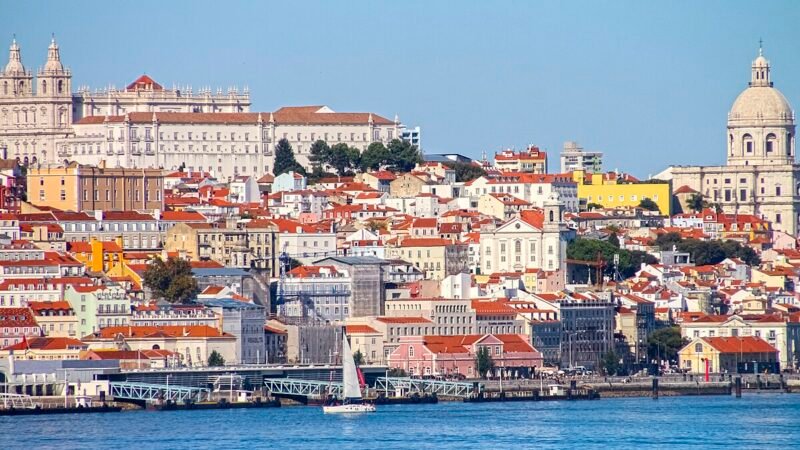
Lisbon, Portugal's capital city situated on the Tagus estuary, was experiencing sunny weather on this Saturday in August. The date fell under the zodiac sign of Leo, and the moon was in its waxing crescent phase.
On this day
On 6 August 1945, the United States Army Air Force bomber Enola Gay dropped the Little Boy atomic bomb on Hiroshima, Japan, in an attack that killed approximately 70,000 people instantly. The bombing remains the first and only nuclear weapon use in warfare and precipitated Japan's surrender within days, ending World War II in the Pacific.
Twenty years earlier, on 6 August 1965, U.S. president Lyndon B. Johnson signed the Voting Rights Act into law, landmark legislation that outlawed literacy tests and other discriminatory voting practices responsible for the widespread disfranchisement of African Americans across the South. The act represented a significant victory for the Civil Rights Movement and fundamentally altered American electoral politics by enforcing voting rights protections at the federal level.
Hiroshima Day
Hiroshima Day commemorates the atomic bombing of Hiroshima on 6 August 1945, when the United States dropped the Little Boy bomb on the Japanese city, killing approximately 70,000 people instantly and many more from radiation exposure in the following weeks. The observance falls on this date annually to remember the victims and survivors of the attack. The day has been observed since the end of World War II and serves as a global reminder of the humanitarian consequences of nuclear weapons. It is recognised by the United Nations and observed by peace advocates worldwide as a call for nuclear disarmament.
DayAtlas provides historical events, weather conditions, notable births and deaths, and astrological information for any date and location, allowing users to explore what happened on specific days throughout history.
Find out what's happening today in Lissabon.
What the Weather Had in Store for Lissabon on 27th November 2026
Silence between heartbeats proves the heart still works.
Fortune of the Day
6th August in the Stars – Star Sign Leo
Personality Profile
Personality Those born on August 6th radiate natural authority and charisma. They combine Leo's pride with the curious restlessness of the number 5, making them dynamic and versatile individuals. Their drive for self-expression is powerful, their presence magnetic.
Strengths & Weaknesses Their strengths lie in creativity, generosity, and innate leadership. However, they can appear stubborn and constantly seek new challenges. Impatience and the need for constant change can lead to superficiality.
Love August 6th natives love intensely and expect admiring partners. They need freedom and independence within relationships. Loyalty matters, but monotony repels them—they seek adventure and mutual inspiration.
Caree & Finance Professionally, they shine in creative and leadership roles. Entrepreneurship suits them naturally. Financial risks and impulsive investments can be problematic; structure helps preserve opportunities.
Health Energy is abundant, but restlessness strains the nervous system. Regular exercise and creative outlets are essential. Learning to unwind matters—meditation and mindful breaks support long-term wellbeing.
That night, the moon was in its waxing crescent phase.
Chinese year of the Horse (Fire).
Fun Facts About 6th August
Name Days in Your Language: Adriel, Araceli, Falco, Falcon, Itzel, Lucia, Lucille, Lucine, Lucy, Luz
Someone born on this day in 1966 would be 60 years old today — just 22,028 days into life, which is roughly 528,693 hours, 31,721,596 minutes, or 1,903,295,782 seconds spent on Earth so far.
It's the 218. day of the year. In 1966, 6th August falls on a Saturday.
There are 147 days still to come.
We’re currently in Week 31 — the year marches on.
Famous Birthdays on 6th August
On this day, 10 notable people were born on 6th August — spanning from 1963 to 1969. From world leaders to artists and scientists, discover who shares this birthday.
06/08/1969
Simon Doull, New Zealand cricketer and sportscaster
Simon Blair Doull is a New Zealand radio personality, commentator, and former international cricketer. He was a right-arm medium pacer who was capable of swing bowling. He was plagued by injuries as a result of which his international career was cut short. Playing for the New Zealand national cricket team, he figured in just 32 Tests and 42 ODIs, taking 98 and 36 wickets respectively. Doull's finest hour arrived when he took 7–65 against India in the Boxing Day Wellington Test in 1998. He played his last Test, against Australia, in March 2000, before turning to commentary and broadcasting.
Elliott Smith, American singer-songwriter and guitarist (died 2003)
Steven Paul Smith, known as Elliott Smith, was an American musician and singer-songwriter. Raised primarily in Texas, he lived much of his life in Portland, Oregon, where he gained popularity in the 1990s. Smith's primary instrument was the guitar, though he also played piano, clarinet, bass guitar, drums, and harmonica. His work was distinguished by his "whispery, spiderweb-thin" vocal style, his "artful chord changes", and his themes of "addiction, depression, and alienation". The New Musical Express (NME) described him as a "widely adored singer-songwriter" who "touched countless lives with his compelling musicianship and lyricism".
06/08/1968
Jack de Gier, Dutch footballer
Jack de Gier is a Dutch professional football manager and former player who played as a forward.
06/08/1966
Regina Carter, American jazz and classical violinist, and composer
Regina Carter is an American jazz violinist. She is the cousin of jazz saxophonist James Carter.
06/08/1965
Stéphane Peterhansel, French racing driver
Stéphane Peterhansel is a rally driver from France. He holds the record for wins at the Dakar Rally, with 14 victories. He currently drives for Land Rover Defender Rally Team.
Yuki Kajiura, Japanese pianist and composer
Yuki Kajiura is a Japanese composer, arranger and music producer. She has provided the music for several popular anime series, such as Sword Art Online, Puella Magi Madoka Magica, Fate/Zero, The Garden of Sinners, Pandora Hearts, and Demon Slayer: Kimetsu no Yaiba.
David Robinson, American basketball player and lieutenant
David Maurice Robinson is an American former professional basketball player. Nicknamed "the Admiral" for his service in the U.S. Navy, he spent his entire 14-year career with National Basketball Association (NBA) franchise San Antonio Spurs and is now a minority owner of the team. He is widely considered one of the greatest centers in both college basketball and NBA history.
06/08/1964
Kemi Omololu-Olunloyo, Nigerian journalist, activist, social media expert, and pharmacist
Olukemi "Kemi" Omololu-Olunloyo is a Nigerian blogger, an activist against gun violence and drug abuse, and also a social media personality.
06/08/1963
Charles Ingram, English soldier, author, and game show contestant
Charles William Ingram is a British convicted fraudster and a former major in the British Army who gained fame for his appearance on the ITV television game show Who Wants to Be a Millionaire? Across two episodes recorded in September 2001, Ingram correctly answered 15 questions to win the show's maximum prize of £1 million, becoming the third recorded contestant ever to do so; however, he was denied the winnings due to suspicion of cheating and was subsequently arrested.
Kevin Mitnick, American computer security consultant, author, and convicted hacker (died 2023)
Kevin David Mitnick was an American computer security consultant, author, and convicted hacker. In 1995, he was arrested for various computer and communications-related crimes, and spent five years in prison after being convicted of fraud and illegally intercepting communications. Mitnick's pursuit, arrest, trial and sentence were all controversial, as were the associated media coverage, books, and films, with his supporters arguing that his punishment was excessive and that many of the charges against him were fraudulent, and not based on actual losses. After his release from prison, he ran his own security firm, Mitnick Security Consulting, LLC, and was also involved with other computer security businesses.
Lives Remembered on 6th August
On 6th August, 108 remarkable people passed away — from 258 to 2024. Remember the lives and legacies of those we lost on this day.
06/08/2024
Billy Bean, American baseball player (born 1964)
William Daro Bean was an American professional baseball player. He played in Major League Baseball (MLB) as an outfielder for the Detroit Tigers (1987–1989), the Los Angeles Dodgers (1989), and the San Diego Padres (1993–1995). He also played for the Kintetsu Buffaloes of Nippon Professional Baseball (NPB) in 1992.
Connie Chiume, South African actress and filmmaker (born 1952)
Connie Temweka Gabisile Chiume was a South African actress and filmmaker. She was known for her film roles in Black Panther, Black Is King and Blessers. On television, she appeared in S'gudi S'nyasi, Yizo Yizo 2, Zone 14, Rhythm City and Gomora.
James Bjorken, American theoretical physicist (born 1934)
James Daniel "BJ" Bjorken was an American theoretical physicist. He was a Putnam Fellow in 1954, received a BS in physics from MIT in 1956, and obtained his PhD from Stanford University in 1959. Bjorken was a visiting scholar at the Institute for Advanced Study in the fall of 1962. He was also emeritus professor in the SLAC Theory Group at the Stanford Linear Accelerator Center, and was a member of the Theory Department of the Fermi National Accelerator Laboratory (1979–1989).
06/08/2020
Vern Rumsey, American bass guitarist (born 1973)
Vernon Emmry Aldo Rumsey was an American musician. He is best known for his work as the bassist of the post-hardcore band Unwound, in which he was a co-founding member. He was also in the bands Long Hind Legs, Oslo, Fitz of Depression, and Witchypoo, and was playing in the band Flora v. Fauna.
06/08/2018
Joël Robuchon, French Chef (born 1945)
Joël Robuchon was a French chef and restaurateur. He was named "Chef of the Century" by the guide Gault Millau in 1989, and awarded the Meilleur Ouvrier de France in cuisine in 1976. He published several cookbooks, two of which have been translated into English, chaired the committee for the Larousse Gastronomique, and hosted culinary television shows in France. He operated more than a dozen restaurants across Bangkok, Bordeaux, Hong Kong, Las Vegas, London, Macau, Madrid, Monaco, Montreal, Paris, Shanghai, Singapore, Taipei, Tokyo, and New York City. His restaurants have been acclaimed, and he held 31 Michelin Guide stars among them by the time of his death in 2018, the most any restaurateur has ever held. He is considered to be one of the greatest chefs of all time.
Margaret Heckler, American politician (born 1931)
Margaret Mary Heckler was an American politician and diplomat who represented Massachusetts's 10th congressional district in the United States House of Representatives from 1967 until 1983. A member of the Republican Party, she also served as the 15th United States secretary of health and human services from 1983 to 1985, as well as United States ambassador to Ireland from 1986 to 1989.
Anya Krugovoy Silver, American poet (born 1968)
Anya Krugovoy Silver was an American poet. She won a Guggenheim fellowship, and a Georgia Author of the Year Award.
06/08/2017
Betty Cuthbert, Australian sprinter (born 1938)
Elizabeth Alyse Cuthbert, was an Australian athlete and a four-time Olympic champion. She was nicknamed Australia's "Golden Girl". During her career, she set world records for 60 metres, 100 yards, 200 metres, 220 yards and 440 yards. Cuthbert also contributed to Australian relay teams completing a win in the 4 × 100 metres, 4 × 110 yards, 4 × 200 metres and 4 × 220 yards. Cuthbert had a distinctive running style, with a high knee lift and mouth wide open. She was named in 1998 an Australian National Treasure and was inducted as a Legend in the Sport Australia Hall of Fame in 1994 and the Athletics Australia Hall of Fame in 2000.
Darren Daulton, American baseball player (born 1962)
Darren Arthur Daulton, nicknamed "Dutch", was an American professional baseball catcher who played in Major League Baseball (MLB) for the Philadelphia Phillies and Florida Marlins (1997). While with the Phillies, Daulton was a three-time MLB All-Star and won the 1992 Silver Slugger Award. He won the 1997 World Series with the Marlins.
06/08/2015
Ray Hill, American football player (born 1975)
Raymond Millous Hill was a college and professional American football player. He was a defensive back at Michigan State, and played four seasons in the National Football League (NFL), splitting three seasons between the Miami Dolphins and the Buffalo Bills. He was signed by the New England Patriots as a free agent in 2001, and was part of their Super Bowl XXXVI championship season. He suffered a leg injury during the 2001 preseason, and was placed on injured reserve for the entire season. His younger brother Renaldo Hill, also played in the NFL.
Orna Porat, German-Israeli actress (born 1924)
Orna Porat was a German-born Israeli theater actress.
06/08/2014
Ralph Bryans, Northern Irish motorcycle racer (born 1941)
Ralph Bryans was a Grand Prix motorcycle road racer from Northern Ireland. Bryans was Ireland's only Grand Prix world champion, winning the 50 cc title in 1965.
Ananda W.P. Guruge, Sri Lankan scholar and diplomat (born 1928)
Ananda Wahihana Palliya Guruge, known as Ananda W. P. Guruge, was a Sri Lankan diplomat, Buddhist scholar and writer. Guruge was the former Ambassador Extraordinary and Plenipotentiary of Sri Lanka to UNESCO, France, and United States from 1985 to 1994. Guruge was adjunct professor of Religious Studies at Cal State Fullerton and was the dean of academic affairs at University of the West.
John Woodland Hastings, American biochemist and academic (born 1927)
John Woodland "Woody" Hastings, was a leader in the field of photobiology, especially bioluminescence, and was one of the founders of the field of circadian biology. He was the Paul C. Mangelsdorf Professor of Natural Sciences and Professor of Molecular and Cellular Biology at Harvard University. He published over 400 papers and co-edited three books.
06/08/2013
Stan Lynde, American author and illustrator (born 1931)
Myron Stanford Lynde was an American comic strip artist, painter and novelist.
Mava Lee Thomas, American baseball player (born 1929)
Mava Lee Thomas [′′Tommie′′] was an infielder and catcher who played in the All-American Girls Professional Baseball League (AAGPBL). She was a switch-hitter and threw right-handed.
Jerry Wolman, American businessman (born 1927)
Jerry Wolman was an American developer in Washington, D.C. and owned the Philadelphia Eagles of the National Football League in the 1960s.
06/08/2012
Richard Cragun, American-Brazilian ballet dancer and choreographer (born 1944)
Richard Cragun was an American ballet dancer, teacher and ballet director who performed with the Stuttgart Ballet in Germany from 1965 to 1996.
Marvin Hamlisch, American pianist, composer, and conductor (born 1944)
Marvin Frederick Hamlisch was an American composer and conductor. He is one of a handful of people to win Emmy, Grammy, Oscar, and Tony awards, a feat dubbed the "EGOT". He and composer Richard Rodgers are the only people to have won those prizes and a Pulitzer Prize ("PEGOT").
Robert Hughes, Australian-American author and critic (born 1938)
Robert Studley Forrest Hughes was an Australian art critic, writer and producer of television documentaries. He was described in 1997 by Robert Boynton of The New York Times as "the most famous art critic in the world".
Bernard Lovell, English physicist and astronomer (born 1913)
Sir Alfred Charles Bernard Lovell was a British physicist and radio astronomer. He was the first director of Jodrell Bank Observatory, from 1945 to 1980.
Mark O'Donnell, American playwright (born 1954)
Mark O'Donnell was an American writer and humorist.
Ruggiero Ricci, American violinist and educator (born 1918)
Ruggiero Ricci was an American violinist known for performances and recordings of the works of Paganini.
Dan Roundfield, American basketball player (born 1953)
Danny Thomas Roundfield was an American professional basketball player. The 6 ft 8 in (2.03 m) power forward/center graduated from Detroit's Chadsey Senior High School in 1971. On the collegiate scene, Roundfield was twice selected to the All-Mid-American Conference Team for Central Michigan University; he was also the 1975 MAC Player of the Year.
06/08/2011
Fe del Mundo, Filipino pediatrician and educator (born 1911)
Fe Villanueva del Mundo was a Filipino pediatrician. She founded the first pediatric hospital in the Philippines and helped shape the country's modern child healthcare system. Her pioneering work in pediatrics in the Philippines spanned eight decades.
06/08/2009
Riccardo Cassin, Italian mountaineer and author (born 1909)
Riccardo Cassin was an Italian mountaineer, developer of mountaineering equipment and author, and an important figure in the history of rock climbing, alpine climbing and big wall climbing.
Willy DeVille, American singer-songwriter and guitarist (born 1950)
Willy DeVille was an American singer and songwriter. During his thirty-five-year career, first with his band Mink DeVille (1974–1986) and later on his own, DeVille created songs rooted in traditional American musical styles. He worked with collaborators from across the spectrum of contemporary music, including Jack Nitzsche, Doc Pomus, Dr. John, Mark Knopfler, Allen Toussaint, and Eddie Bo. Latin rhythms, blues riffs, doo-wop, Cajun music, strains of French cabaret, and echoes of early-1960s uptown soul can be heard in DeVille's work.
John Hughes, American director, producer, and screenwriter (born 1950)
Jonathan Wilden Hughes Jr. was an American filmmaker, writer, and producer. He is best known for writing, directing, and producing the films Sixteen Candles (1984), The Breakfast Club (1985), Weird Science (1985), Ferris Bueller's Day Off (1986), Planes, Trains and Automobiles (1987), and Uncle Buck (1989), in addition to writing the films Pretty in Pink (1986), National Lampoon's Christmas Vacation (1989), Home Alone (1990), 101 Dalmatians (1996), and Flubber (1997).
06/08/2008
Angelos Kitsos, Greek lawyer and author (born 1934)
Angelos Kitsos was the president of Rizarios Foundation .He was a Greek from Monodendri, Zagori. He was member of the Councils of the Foundation for the Restoration of Greeks from Albania and the Foundation of Research of the Ionian and Adriatic space. He was a towering figure for Zagori and the rest of Epirus and Western Greece. Kitsos was a lawyer, but he also worked on script-writing for a number of documentaries, and wrote a number of books.
06/08/2007
Zsolt Daczi, Hungarian guitarist (born 1969)
Zsolt Daczi was a Hungarian guitarist. He was born in Kiskunhalas, Hungary.
06/08/2005
Robin Cook, Scottish educator and politician, Secretary of State for Foreign and Commonwealth Affairs (born 1946)
Robert Finlayson "Robin" Cook was a British Labour Party politician who served as a Member of Parliament (MP) from 1974 until his death in 2005 and served in the Cabinet as Foreign Secretary from 1997 until 2001, when he was replaced by Jack Straw. He then served as Leader of the House of Commons from 2001 until 2003.
Creme Puff, tabby domestic cat, oldest recorded cat (born 1967)
Creme Puff was a mixed tabby domestic cat, owned by Jake Perry of Austin, Texas. She was the oldest cat ever recorded, according to the 2010 edition of Guinness World Records, when she died at the age of 38 years and 3 days.
06/08/2004
Rick James, American singer-songwriter and producer (born 1948)
James Ambrose Johnson Jr., better known by his stage name Rick James, was an American singer, songwriter, and record producer.
Donald Justice, American poet and academic (born 1925)
Donald Rodney Justice was an American poet and teacher of creative writing who won the Pulitzer Prize for Poetry in 1980.
06/08/2003
Julius Baker, American flute player and educator (born 1915)
Julius Baker was one of the foremost American orchestral flute players and educators. During the course of five decades he concertized with several of America's premier orchestral ensembles including the Chicago Symphony and the New York Philharmonic Orchestra. In addition, he was a faculty member at several premier conservatories of music including; The Juilliard School of Music, the Curtis Institute of Music and Carnegie Mellon University.
06/08/2002
Edsger W. Dijkstra, Dutch physicist, computer scientist, and academic (born 1930)
Edsger Wybe Dijkstra was a Dutch computer scientist, programmer, mathematician, and science essayist.
06/08/2001
Jorge Amado, Brazilian novelist and poet (born 1912)
Jorge Leal Amado de Faria, known as Jorge Amado, was a Brazilian writer of the modernist school. He remains the best-known of modern Brazilian writers, with his work having been translated into some 49 languages and popularized in film, including Dona Flor and Her Two Husbands in 1976, and having been nominated for the Nobel Prize in Literature at least seven times. His work reflects the image of a Mestiço Brazil and is marked by religious syncretism. He depicted a cheerful and optimistic country that was beset, at the same time, with deep social and economic differences.
Adhar Kumar Chatterji, Indian Naval officer (born 1914)
Admiral Adhar Kumar Chatterji was an admiral in the Indian Navy. He served as the 5th chief of the naval staff, from 4 March 1966, until 28 February 1970. He was the first Indian officer of the navy to hold the rank of full admiral. He is credited with the transformation of the Indian Navy. He made sweeping changes and restructured the navy, creating the Western and Eastern Naval Commands and the Western Fleet. Under him, the Indian Navy also entered the submarine age, with the commissioning of INS Kalvari (S23) in 1967.
Wilhelm Mohnke, German general (born 1911)
Wilhelm Mohnke was a German brigadier general who was one of the original members of the Schutzstaffel SS-Stabswache Berlin formed in March 1933. Mohnke, who had joined the Nazi Party in September 1931, rose through the ranks to become one of Adolf Hitler's last remaining general officers at the end of World War II in Europe.
Shan Ratnam, Sri Lankan physician and academic (born 1928)
Emeritus Professor Sittampalam Shanmugaratnam, also known as Shan Ratnam, was a Singaporean obstetrician and gynaecologist.
Dorothy Tutin, English actress (born 1930)
Dame Dorothy Tutin was an English actress. Renowned for her performances on stage and screen, she received numerous accolades, including two Laurence Olivier Awards and two Standard Theatre Awards, in addition to nominations for two British Academy Film Awards, two British Academy Television Awards, and a Tony Award. She was made a CBE in 1967 and a Dame (DBE) in 2000.
06/08/1998
André Weil, French-American mathematician and academic (born 1906)
André Weil was a French mathematician, known for his foundational work in number theory and algebraic geometry. He was one of the most influential mathematicians of the twentieth century. His influence is due both to his original contributions to a remarkably broad spectrum of mathematical theories, and to the mark he left on mathematical practice and style, through some of his own works as well as through the Bourbaki group, of which he was one of the principal founders.
06/08/1997
Shin Ki-ha, South Korean lawyer and politician (born 1941)
Shin Ki-ha, was a South Korean politician. A four-term lawmaker, he was a former parliamentary leader of the South Korean political party National Congress for New Politics.
06/08/1994
Domenico Modugno, Italian singer-songwriter and politician (born 1928)
Domenico Modugno was an Italian singer, songwriter, actor and, later in life, a member of the Italian Parliament. He is known for his 1958 international hit song "Nel blu dipinto di blu", for which he received the first Grammy Awards for Record of the Year and Song of the Year. He is considered the first Italian cantautore.
06/08/1993
Tex Hughson, American baseball player (born 1916)
Cecil Carlton Hughson was an American Major League Baseball starting pitcher who played his entire career in the American League with the Boston Red Sox. He batted and threw right-handed.
06/08/1992
Leszek Błażyński, Polish boxer (born 1949)
Leszek Błażyński was a Polish boxer who twice won the bronze medal in the men's flyweight division at the Summer Olympics. He first did so in 1972, when Munich hosted the Games. Four years later in Montreal, he once again captured the bronze after a loss in the semifinals against eventual winner Leo Randolph of the United States.
06/08/1991
Shapour Bakhtiar, Iranian soldier and politician, 74th Prime Minister of Iran (born 1915)
Shapour Bakhtiar was an Iranian politician who served as the last Prime Minister of Iran under the rule of Mohammad Reza Pahlavi. Bakhtiar stated that he favored neither a republican nor a monarchical system, advocating instead for what he called a "progressive democracy".
Roland Michener, Canadian lawyer and politician, 20th Governor General of Canada (born 1900)
Daniel Roland Michener was a Canadian lawyer, politician, and diplomat who served as the 20th governor general of Canada from 1967 to 1974.
Harry Reasoner, American journalist, co-created 60 Minutes (born 1923)
Harry Reasoner was an American journalist for CBS and ABC News. He is known for his adroit use of language as a television commentator and as one of the original hosts of the news magazine 60 Minutes.
06/08/1990
Jacques Soustelle, French anthropologist and politician (born 1912)
Jacques Soustelle was an important and early figure of the Free French Forces, a politician who served in the French National Assembly and at one time served as Governor General of Algeria, an anthropologist specializing in Pre-Columbian civilizations, and vice-director of the Musée de l'Homme in Paris in 1939. Soustelle and his followers opposed any compromise with anticolonial activists in Algeria in the Algerian War.
06/08/1987
Ira C. Eaker, American general (born 1896)
Lieutenant General Ira Clarence Eaker was a general of the United States Army Air Forces during World War II. Eaker, as second-in-command of the prospective Eighth Air Force, was sent to England to form and organize its bomber command. While he struggled to build up airpower in England, the organization of the Army Air Forces evolved and he was named commander of the Eighth Air Force on December 1, 1942.
06/08/1986
Emilio Fernández, Mexican actor, director, and screenwriter (born 1904)
Emilio Fernández Romo, nicknamed "El Indio", was a Mexican film director, screenwriter, and actor. He was one of the most prolific and acclaimed film directors of the Golden Age of Mexican cinema in the 1940s and '50s. His film María Candelaria (1944) won the Palme d'Or at the 1946 Cannes Film Festival, the first Mexican film to receive the honor. As an actor, he worked in numerous film productions in both Mexico and in Hollywood.
06/08/1985
Forbes Burnham, Guyanese politician, 2nd President of Guyana (born 1923)
Linden Forbes Sampson Burnham was a Guyanese politician and the leader of the Co-operative Republic of Guyana from 1964 until his death in 1985. He served as Premier of British Guiana from 1964 to 1966, Prime Minister of Guyana from 1964 to 1980 and then as the first executive president of Guyana from 1980 to 1985. He is often regarded as a strongman dictator who embraced his own version of socialism and ethnocentrism.
06/08/1983
Klaus Nomi, German singer-songwriter and actor (born 1944)
Klaus Sperber, known professionally as Klaus Nomi, was a German countertenor and baritone noted for his wide vocal range and an unusual, otherworldly stage persona.
06/08/1979
Feodor Felix Konrad Lynen, German biochemist and academic, Nobel Prize laureate (born 1911)
Feodor Felix Konrad Lynen was a German biochemist. In 1964, he won the Nobel Prize in Physiology or Medicine together with Konrad Bloch for their discoveries concerning the mechanism and regulation of cholesterol and fatty acid metabolism while he was director of the Max-Planck Institute for Cellular Chemistry in Munich.
06/08/1978
Pope Paul VI (born 1897)
Pope Paul VI was head of the Catholic Church and sovereign of Vatican City from 21 June 1963 until his death on 6 August 1978. Succeeding John XXIII, he continued the Second Vatican Council, which he closed in 1965, implementing its numerous reforms. He fostered improved ecumenical relations with Eastern Orthodox and Protestant churches, which resulted in many historic meetings and agreements.
Edward Durell Stone, American architect, designed Radio City Music Hall and the Kennedy Center for the Performing Arts (born 1902)
Edward Durell Stone was an American architect known for the formal, highly decorative buildings he designed in the 1950s and 1960s. His works include the Museum of Modern Art, in New York City; the Parliament House of Pakistan in Islamabad; the Museo de Arte de Ponce in Ponce, Puerto Rico; the United States Embassy in New Delhi, India; The Keller Center at the University of Chicago; the John F. Kennedy Center for the Performing Arts in Washington, D.C., the EcoTarium, formerly known as the New England Science Center in Worcester, Massachusetts; and the campus of Windham College in Putney, Vermont.
06/08/1976
Gregor Piatigorsky, Russian-American cellist and educator (born 1903)
Gregor Piatigorsky was a Ukrainian-born Russian and American cellist.
06/08/1973
Fulgencio Batista, Cuban colonel and politician, 9th President of Cuba (born 1901)
Fulgencio Batista y Zaldívar was a Cuban military officer and politician who served as president of Cuba from 1940 to 1944, from 1952 to 1954 and again from 1955 to his resignation in 1959, when he was overthrown in the Cuban Revolution. From 1934 to 1940 he was the de facto leader of Cuba.
06/08/1970
Nikos Tsiforos, Greek director and screenwriter (born 1912)
Nikos Tsiforos was a Greek humorist, screenwriter, and film director. He had more than 60 film scripts to his credit between 1948 and 1970. He further directed 17 films between 1948 and 1961.
06/08/1969
Theodor W. Adorno, German sociologist and philosopher (born 1903)
Theodor W. Adorno was a German philosopher, cultural theorist, and music critic. He was a leading member of the Frankfurt School of critical theory, whose work has come to be associated with thinkers such as Ernst Bloch, Walter Benjamin, Max Horkheimer, Erich Fromm, and Herbert Marcuse, for whom the works of Sigmund Freud, Karl Marx, and G. W. F. Hegel were essential to a critique of modern society. As a critic of both fascism and what he called the culture industry, he authored numerous works—such as Dialectic of Enlightenment (1947), Minima Moralia (1951), and Negative Dialectics (1966)—that strongly influenced the European New Left.
06/08/1968
Ye Gongchuo, Chinese politician, poet, and calligrapher (born 1881)
Ye Gongchuo was a Chinese politician, calligrapher, poet, and art patron. Born in Panyu County, Guangdong, to the family of a Qing dynasty official, Ye passed the imperial examination and joined the Ministry of Posts and Communications. He rose through the ministry rapidly, then allied himself with Sun Yat-sen's anti-Qing movement in the 1911 Revolution. During the first decades of the Republic of China, Ye occupied several ministerial positions as a member of the Communications Clique, at times working with the Beiyang government and other times siding with the Kuomintang.
06/08/1964
Cedric Hardwicke, English actor and director (born 1893)
Sir Cedric Webster Hardwicke was an English stage and film actor whose career spanned over 50 years. His theatre work included notable performances in productions of the plays of Shakespeare and Shaw, and his film work included leading roles in several adapted literary classics.
06/08/1959
Preston Sturges, American director, screenwriter, and playwright (born 1898)
Preston Sturges was an American playwright, inventor, screenwriter, and film director.
06/08/1952
Betty Allan, Australian statistician and biometrician (born 1905)
Frances Elizabeth Allan was an Australian statistician. She was known as the first statistician at the Commonwealth Scientific and Industrial Research Organisation (CSIRO), as "the effective founder of the CSIRO Division of Mathematics and Statistics", and for her advocacy of biometrics.
06/08/1946
Tony Lazzeri, American baseball player and coach (born 1903)
Anthony Michael Lazzeri was an American professional baseball second baseman during the 1920s and 1930s, predominantly with the New York Yankees of Major League Baseball (MLB). He was part of the famed "Murderers' Row" Yankee batting lineup of the late 1920s, along with Babe Ruth, Lou Gehrig, and Bob Meusel.
06/08/1945
Richard Bong, American soldier and pilot, Medal of Honor recipient (born 1920)
Richard Ira "Dick" Bong was a United States Army Air Forces officer and Medal of Honor recipient in World War II. He was one of the most decorated American fighter pilots and the country's top flying ace in the war, credited with shooting down 40 Japanese aircraft, all with the Lockheed P-38 Lightning. He died in California while testing a Lockheed P-80 jet fighter shortly before the war ended. Bong was posthumously inducted into the National Aviation Hall of Fame in 1986 and has several commemorative monuments named in his honor around the world, including an airport, two bridges, a theater, a veterans historical center, a recreation area, a neighborhood terrace, and several avenues and streets, including the street leading to the National Museum of the United States Air Force in Dayton, Ohio.
Hiram Johnson, American lawyer and politician, 23rd Governor of California (born 1866)
Hiram Warren Johnson was an American attorney and politician who served as the 23rd governor of California from 1911 to 1917 and represented California in the U.S. Senate for five terms from 1917 to 1945. Johnson achieved national prominence in the early 20th century as a leading progressive and ran for vice president on Theodore Roosevelt's Progressive ticket in the 1912 presidential election. As a U.S. senator, Johnson voted for American entry into World War I and was later a critic of the foreign policy of both Woodrow Wilson and Franklin D. Roosevelt. Johnson was the only governor of his state from 1856 until 1943 to serve more than one term.
06/08/1931
Bix Beiderbecke, American cornet player, pianist, and composer (born 1903)
Leon Bismark "Bix" Beiderbecke was an American jazz cornetist, pianist and composer. Beiderbecke was one of the most influential jazz soloists of the 1920s, a cornet player noted for an inventive lyrical approach and purity of tone, with such clarity of sound that one contemporary described it like "shooting bullets at a bell”.
06/08/1925
Surendranath Banerjee, Indian academic and politician (born 1848)
Sir Surendranath Banerjee, often known as Rashtraguru, was an Indian nationalist leader during the British Raj. He founded the Indian National Association to bring Hindus and Muslims together for political action. He was also one of the founding members of the Indian National Congress. Unlike Congress, however, Surendranath supported Montagu–Chelmsford Reforms, and with many liberal leaders he left Congress and founded a new organisation, Indian National Liberation Federation, in 1919.
Gregorio Ricci-Curbastro, Italian mathematician (born 1853)
Gregorio Ricci-Curbastro was an Italian mathematician. He is most famous as the discoverer of tensor calculus.
06/08/1920
Stefan Bastyr, Polish pilot and author (born 1890)
Stefan Bastyr was a Polish aviator and military pilot, one of the pioneers of the Polish aviation. He is credited with the first military flight in the history of the Polish Air Force on 5 November 1918, almost a week before Poland officially regained her independence, at the opening stages of the Polish-Ukrainian War.
06/08/1915
Jennie de la Montagnie Lozier, American physician (born 1841)
Jeanne de la Montagnie Lozier was an American physician and educator from New York City. She worked as an instructor of languages and literature in Hillsdale College from the age of nineteen, and after earning her medical degree from New York Medical College, became a professor of physiology. She was a delegate to the International Homoeopathic Congress in Paris in 1889 and was president of Sorosis Club from 1891 to 1894.
06/08/1906
George Waterhouse, English-New Zealand politician, 7th Prime Minister of New Zealand (born 1824)
George Marsden Waterhouse was a Premier of South Australia from 8 October 1861 until 3 July 1863 and the seventh premier of New Zealand from 11 October 1872 to 3 March 1873.
06/08/1904
Eduard Hanslick, Austrian author and critic (born 1825)
Eduard Hanslick was an Austrian music critic, aesthetician and historian. Among the leading critics of his time, he was the chief music critic of the Neue Freie Presse from 1864 until the end of his life. His best known work, the 1854 treatise Vom Musikalisch-Schönen, was a landmark in the aesthetics of music and outlines much of his artistic and philosophical beliefs on music.
06/08/1893
Jean-Jacques Challet-Venel, Swiss lawyer and politician (born 1811)
Jean-Jacques Challet-Venel was a Swiss politician and member of the Swiss Federal Council (1864–1872).
06/08/1881
James Springer White, American religious leader, co-founded the Seventh-day Adventist Church (born 1821)
James Springer White, also known as Elder White, was a co-founder of the Seventh-day Adventist Church and the husband of Ellen G. White. In 1849, he started the first Sabbatarian Adventist periodical entitled The Present Truth, in 1855 he relocated the fledgling center of the movement to Battle Creek, Michigan, and in 1863 played a pivotal role in the formal organization of the denomination. He later played a major role in the development of the Adventist educational structure beginning in 1874 with the formation of Battle Creek College.
06/08/1866
John Mason Neale, English priest, scholar, and hymnwriter (born 1818)
John Mason Neale was an English Anglican priest, scholar, and hymnwriter. He worked on and wrote a wide range of holy Christian texts, including obscure medieval hymns, both Western and Eastern. Among his most famous hymns is the 1853 Good King Wenceslas, set on St. Stephen's day, known as Boxing Day in the UK. An Anglo-Catholic, Neale's works have found positive reception in high-church Anglicanism and Western Rite Orthodoxy.
06/08/1850
Edward Walsh, Irish poet (born 1805)
Edward Walsh was an Irish poet, the son of a sergeant in the Cork Militia, and was born in Derry City, where his father's regiment had been sent for training. His parents were natives in the village of Millstreet, County Cork, near which his father at one time possessed a small holding.
06/08/1828
Konstantin von Benckendorff, Russian general and diplomat (born 1785)
Konstantin von Benckendorff was a Russian general and diplomat of Baltic German descent.
06/08/1815
James A. Bayard, American lawyer and politician (born 1767)
James Asheton Bayard Sr. was an American lawyer and politician from Wilmington, Delaware. He was a member of the Federalist Party, who served as U.S. Representative from Delaware and U.S. Senator from Delaware.
06/08/1794
Henry Bathurst, 2nd Earl Bathurst, English lawyer and politician, Lord High Chancellor of Great Britain (born 1714)
Henry Bathurst, 2nd Earl Bathurst, known as The Lord Apsley from 1771 to 1775, was a British lawyer and politician. He was Lord High Chancellor of Great Britain from 1771 to 1778.
06/08/1757
Ádám Mányoki, Hungarian painter (born 1673)
Ádám Mányoki was a Hungarian Baroque portrait painter.
06/08/1753
Georg Wilhelm Richmann, Estonian-Russian physicist and academic (born 1711)
Georg Wilhelm Richmann was a Russian physicist of Baltic German origin who did pioneering work on electricity, atmospheric electricity, and calorimetry. He died by electrocution in St. Petersburg when struck by apparent ball lightning produced by an experiment attempting to ground the electrical discharge from a storm.
06/08/1695
François de Harlay de Champvallon, French archbishop (born 1625)
François de Harlay de Champvallon was the fifth Archbishop of Paris.
06/08/1694
Antoine Arnauld, French mathematician and philosopher (born 1612)
Antoine Arnauld was a French Catholic theologian, priest, philosopher and mathematician. He was one of the leading intellectuals of the Jansenist group of Port-Royal and had a very thorough knowledge of patristics. Contemporaries called him le Grand to distinguish him from his father.
06/08/1679
John Snell, Scottish-English soldier and philanthropist, founded the Snell Exhibition (born 1629)
Sir John Snell, founder of the Snell Exhibitions at the University of Oxford, was born in Ayrshire, Scotland, the son of a blacksmith. He attended the University of Glasgow from 1642 to 1644.
06/08/1666
Tjerk Hiddes de Vries, Frisian naval hero and commander (born 1622)
Tjerk Hiddes de Vries was a Dutch States Navy officer. The French, who could not pronounce his name, called him Kiërkides. His name was also given as Tsjerk, Tierck or Tjerck.
06/08/1660
Diego Velázquez, Spanish painter and educator (born 1599)
Diego Rodríguez de Silva y Velázquez was a Spanish Baroque painter, the leading artist in the court of King Philip IV of Spain and Portugal, and of the Spanish Golden Age. He is generally considered one of the greatest artists in the history of Western art.
06/08/1657
Bohdan Khmelnytsky, Ukrainian soldier and politician, 1st Hetman of Zaporizhian Host (born 1595)
Zynoviy Bohdan Mykhailovych Khmelnytsky of the Abdank coat of arms was a Ruthenian nobleman and military commander of Zaporozhian Cossacks as Hetman of the Zaporozhian Host, which was then under the suzerainty of the Polish–Lithuanian Commonwealth. He led the Cossacks to victory in a successful uprising against the Commonwealth and its magnates (1648–1654) that resulted in the creation of an independent Cossack state in Dnieper Ukraine.
06/08/1645
Lionel Cranfield, 1st Earl of Middlesex, English merchant and politician (born 1575)
Lionel Cranfield, 1st Earl of Middlesex was an English merchant and politician. He sat in the House of Commons between 1614 and 1622 when he was raised to the peerage as Baron Cranfield.
06/08/1637
Ben Jonson, English poet and playwright (born 1572)
Benjamin Jonson was an English playwright, poet and actor. Jonson's artistry exerted a lasting influence on English poetry and stage comedy. He popularised the comedy of humours; he is best known for the satirical plays Every Man in His Humour (1598), Volpone, or The Fox, The Alchemist (1610), and Bartholomew Fair (1614), and for his lyric and epigrammatic poetry, including famous short poems like "Drink to Me Only with Thine Eyes" and "On My First Sonne". He is regarded as "the second most important English dramatist, after William Shakespeare, during the reign of James I."
06/08/1628
Johannes Junius, German lawyer and politician (born 1573)
Johannes Junius was the mayor of Bamberg, and a victim of the Bamberg witch trials, who wrote a letter to his daughter from jail while he awaited execution for witchcraft.
06/08/1588
Josias I, Count of Waldeck-Eisenberg, Count of Waldeck-Eisenberg (1578–1588) (born 1554)
Count Josias I of Waldeck-Eisenberg was a German nobleman who was Count of Waldeck-Eisenberg from 1578 until his death.
06/08/1553
Girolamo Fracastoro, Italian physician (born 1478)
Girolamo Fracastoro was an Italian physician, poet, and scholar in mathematics, geography and astronomy. Fracastoro subscribed to the philosophy of atomism, and rejected appeals to hidden causes in scientific investigation. His studies of the mode of syphilis transmission are an early example of epidemiology.
06/08/1530
Jacopo Sannazaro, Italian poet (born 1458)
Jacopo Sannazaro was an Italian poet, humanist, member and head of the Accademia Pontaniana from Naples.
06/08/1458
Pope Callixtus III (born 1378)
Pope Callixtus III, born Alonso de Borja, but referred to in English-language accounts as Alfonso de Borgia as a member of the House of Borgia, was head of the Catholic Church and ruler of the Papal States from 8 April 1455 to his death, in August 1458.
06/08/1414
Ladislaus of Naples (born 1377)
Ladislaus of Naples was King of Naples from 1386 until his death and an unsuccessful claimant to the kingdoms of Hungary and Croatia. Ladislaus was a skilled political and military leader, protector and controller of Pope Innocent VII; however, he earned a bad reputation concerning his personal life. He profited from disorder throughout Italy to greatly expand his kingdom and his power, appropriating much of the Papal States to his own use. He was the last male of the Capetian House of Anjou.
06/08/1412
Margherita of Durazzo, Queen consort of Charles III of Naples (born 1347)
Margaret of Durazzo was Queen of Naples and Hungary and Princess of Achaea as the spouse of Charles III of Naples. She was regent of Naples from 1386 until 1393 during the minority of her son Ladislaus of Naples.
06/08/1384
Francesco I of Lesbos
Francesco I Gattilusio was an Italian noble, the first member of the Gattilusio family to rule the Aegean island of Lesbos as a vassal of the Byzantine emperor.
06/08/1272
Stephen V of Hungary (born 1239)
Stephen V of Hungary was King of Hungary and Croatia between 1270 and 1272, and Duke of Styria from 1258 to 1260. He was the oldest son of King Béla IV of Hungary and Maria Laskarina. King Béla had his son crowned king at the age of six and appointed him Duke of Slavonia. Still a child, Stephen married Elizabeth, a daughter of a chieftain of the Cumans whom his father settled in the Great Hungarian Plain.
06/08/1221
Saint Dominic, Spanish priest, founded the Dominican Order (born 1170)
Dominic de Guzmán, almost exclusively known as Saint Dominic, was a Castilian religious priest and the founder of the Order of Preachers (Dominicans). He is the patron saint of astronomers and natural scientists, and he and the Dominicans are traditionally credited with spreading and popularizing the rosary.
06/08/1195
Henry the Lion, Duke of Saxony and Bavaria (born 1129)
Henry the Lion, also known as Henry III, Duke of Saxony and Henry XII, Duke of Bavaria, was a member of the Welf dynasty.
06/08/1162
Ramon Berenguer IV, Count of Barcelona (born 1113)
Ramon Berenguer IV, sometimes called the Saint, was the count of Barcelona and the prince of Aragon who brought about the union of the County of Barcelona with the Kingdom of Aragon to form the Crown of Aragon.
06/08/1027
Richard III, Duke of Normandy
Richard III was the duke of Normandy who reigned from August 1026 to his death. His brief reign opened with a revolt by his brother.
06/08/0750
Marwan II, Umayyad general and caliph (born 688)
Marwan ibn Muhammad ibn Marwan, commonly known as Marwan II, was the fourteenth and last caliph of the Umayyad Caliphate, ruling from 744 until his death. His reign was dominated by a civil war, and he was the last Umayyad ruler to rule the united Caliphate before the Abbasid Revolution toppled the Umayyad dynasty.
06/08/0523
Pope Hormisdas (born 450)
Pope Hormisdas was the bishop of Rome from 20 July 514 to his death on 6 August 523. His papacy was dominated by the Acacian schism, started in 484 by Acacius of Constantinople's efforts to placate the non-Chalcedonians. His efforts to resolve this schism were successful, and on 28 March 519, the reunion between Constantinople and Rome was ratified in the cathedral of Constantinople before a large crowd.
06/08/0258
Pope Sixtus II
Pope Sixtus II, also written as Pope Xystus II, was Pope from 31 August 257 until his death on 6 August 258. He was killed along with seven deacons, including Lawrence of Rome, during the persecution of Christians by the Emperor Valerian.
Celebrations & Special Days Worldwide on 6th August
Christian holidays and observances Transfiguration of Jesus
The Transfiguration of Jesus is an event described in the New Testament where Jesus is transfigured and becomes radiant in glory upon a mountain. The Synoptic Gospels recount the occasion, and the Second Epistle of Peter also refers to it. Ancient Christian texts considered non-canonical by Catholic and Eastern Orthodox doctrine, such as the Treatise on the Resurrection from the Nag Hammadi corpus, refer to the scene as well.
Christian holidays and observances Anna Maria Rubatto
Anna Maria Rubatto was an Italian Roman Catholic nun who assumed the name Maria Francesca of Jesus.
Christian holidays and observances Felicissimus and Agapitus
Felicissimus and Agapitus were two of the six deacons of Pope Sixtus II who were martyred with him on or about 6 August 258, Felicissimus and Agapitus on the same day as the Pope. The seventh deacon, Lawrence of Rome, was martyred on 10 August of the same year.
Christian holidays and observances Pope Hormisdas
Pope Hormisdas was the bishop of Rome from 20 July 514 to his death on 6 August 523. His papacy was dominated by the Acacian schism, started in 484 by Acacius of Constantinople's efforts to placate the non-Chalcedonians. His efforts to resolve this schism were successful, and on 28 March 519, the reunion between Constantinople and Rome was ratified in the cathedral of Constantinople before a large crowd.
Christian holidays and observances Justus and Pastor
Justus and Pastor, venerated as Christian martyrs, were two schoolboy brothers who were killed for their faith during the Diocletian Persecution. The boys are today considered the patron saints of Alcalá de Henares. They are mentioned by the Christian poet Prudentius.
Christian holidays and observances Pope Sixtus II
Pope Sixtus II, also written as Pope Xystus II, was Pope from 31 August 257 until his death on 6 August 258. He was killed along with seven deacons, including Lawrence of Rome, during the persecution of Christians by the Emperor Valerian.
Christian holidays and observances August 6 (Eastern Orthodox liturgics)
August 6 in Eastern Orthodox liturgical calendars is a feast day and a day of commemoration of saints and martyrs. Although some Orthodox churches use the Revised Julian Calendar and others use the traditional Julian calendar, the fixed commemorations for their respective August 6 are broadly the same, no matter which calendar is used.
Sheikh Zayed bin Sultan Al Nahyan's Accession Day. (United Arab Emirates)
Sheikh Zayed bin Sultan Al Nahyan was an Emirati politician, philanthropist, and the founding father of the United Arab Emirates. Zayed served as the governor of Eastern Region from 1946 until he became the ruler of Abu Dhabi in 1966, and served as the first president of the United Arab Emirates from its independence on 2 December 1971 until his death in 2004. He is referred in the United Arab Emirates as the Father of the Nation for being the principal driving force behind the unification of the United Arab Emirates.
Independence Day (Bolivia), celebrates the independence of Bolivia from Spain in 1825.
There are current eleven public holidays in Bolivia. Both secular and some Christian holidays are recognized.
Independence Day (Jamaica), celebrates the independence of Jamaica from the United Kingdom in 1962.
Independence Day is the national day of Jamaica, celebrated in annually on 6 August, the anniversary of the coming into force of the Jamaica Independence Act 1962. It is one of the most senior public holidays in Jamaica.
Hiroshima Peace Memorial Ceremony (Hiroshima, Japan)
Hiroshima Peace Memorial Ceremony is an annual Japanese vigil.
Russian Railway Troops Day (Russia)
The following is the list of official public holidays recognized by the Government of Russia. On these days, government offices, embassies, schools, companies and some shops, are closed. If the date of observance falls on a weekend, the following Monday will be a day off in lieu of the holiday.
What Happened on 6th August?
47 significant events took place on Saturday, 6th August — stretching from 258 to 2015. Explore the moments that shaped history on this day.
06/08/2015
A suicide bomb attack kills at least 15 people at a mosque in the Saudi city of Abha.
The 2015 Abha mosque bombing occurred on 6 August 2015, when a suicide bomb attack killed 17 people at a mosque in the south-western Saudi Arabian city of Abha.
06/08/2012
NASA's Curiosity rover lands on the surface of Mars.
The National Aeronautics and Space Administration is an independent agency of the U.S. federal government responsible for the United States' civil space program, as well as research in aeronautics and space. Headquartered in Washington, D.C., NASA operates ten field centers across the US and is organized into three mission directorates: Human Spaceflight, Research and Technology, and Science. Established in 1958 amid the Space Race, NASA succeeded the National Advisory Committee for Aeronautics (NACA) to give the US space program a distinct civilian orientation focused on peaceful applications. Since then, it has led most American spaceflight programs, including Project Mercury, Project Gemini, the Apollo program, Skylab, the Space Shuttle, the International Space Station (ISS), and the ongoing multinational Artemis program.
06/08/2011
War in Afghanistan: A United States military helicopter is shot down, killing 30 American special forces members and a working dog, seven Afghan soldiers, and one Afghan civilian. It was the deadliest single event for the United States in the War in Afghanistan.
The war in Afghanistan was a prolonged armed conflict from 2001 to 2021. It began with an invasion by a United States–led coalition under the name Operation Enduring Freedom in response to the September 11 attacks (9/11) carried out by the Taliban-allied and Afghanistan-based al-Qaeda. The Taliban were expelled from major population centers by American-led forces supporting the anti-Taliban Northern Alliance, thus toppling the Taliban-ruled Islamic Emirate. In 2004, the U.S.-backed Islamic Republic was established, but by then, the Taliban, led by founder Mullah Omar, had reorganized and begun an insurgency against the Afghan government and coalition forces. The conflict ended as the 2021 Taliban offensive reestablished the Islamic Emirate. It was the longest war in United States military history, surpassing the Vietnam War by seven months.
06/08/2010
Flash floods across a large part of Jammu and Kashmir, India, damages 71 towns and kills at least 255 people.
Floods occurred on 6 August 2010 across a large part of Ladakh, then part of the state of Jammu and Kashmir. 71 towns and villages were damaged, including the main town in the area, Leh. At least 255 people are reported to have died, six of whom were foreign tourists, after a cloudburst and heavy overnight rains triggered flash floods, mudflows, and debris flows. 200 people were reported missing in the initial aftermath of the storm, and thousands more were rendered homeless after the flooding caused extensive damage to property and infrastructure. Overall, 9,000 people were directly affected by the event.
06/08/2009
Metalworkers at a Ssangyong Motor factory in Pyeongtaek, South Korea agree to end a 77-day strike that culminated in a police raid via helicopters leading to several deaths and arrests.
The KG Mobility Corporation, abbreviated as KGM, is a South Korean automobile manufacturer. It traces its origins back to Dong-A Motor, a manufacturer established in 1954. The company was named SsangYong Motor Company in 1988, following its acquisition in 1986 by the SsangYong Group, a chaebol. Since then, SsangYong Motor has been acquired successively by Daewoo Motors, Chinese manufacturer SAIC Motor, and Indian manufacturer Mahindra & Mahindra. In 2022, the company was acquired by South Korean chaebol KG Group and adopted its present name in March 2023. In certain markets, including Australia and Turkey, the company continues to use "Ssangyong" or "KGM Ssangyong" branding.
06/08/2008
A military junta led by Mohamed Ould Abdel Aziz stages a coup d'état in Mauritania, overthrowing president Sidi Ould Cheikh Abdallahi.
Mohamed Ould Abdel Aziz is a retired Mauritanian military officer and politician who served as the 8th President of Mauritania from 2009 to 2019.
06/08/2001
Erwadi fire incident: Twenty-eight mentally ill persons tied to a chain are burnt to death at a faith based institution at Erwadi, Tamil Nadu.
The Erwadi fire incident was an incident that occurred on 6 August 2001, when 28 inmates of a faith-based mental asylum died in the fire. All these inmates were bound by chains at the Moideen Badusha Mental Home in Erwadi village in Tamil Nadu, India.
06/08/1997
Korean Air Flight 801 crashed at Nimitz Hill, Guam, killing 229 of the 254 people on board.
Korean Air Flight 801 was a scheduled international passenger flight operated by Korean Air, from Gimpo International Airport, Seoul to Antonio B. Won Pat International Airport, Guam. On August 6, 1997, the Boeing 747-300 operating the flight crashed on Bijia Peak, south of Nimitz Hill, in Asan-Maina, Guam, while on approach to the destination airport, killing 229 of the 254 people aboard, making it the deadliest aviation accident to occur in American dependent territory, and the fourth-deadliest aviation accident on American soil overall.
06/08/1996
NASA announces that the ALH 84001 meteorite, thought to originate from Mars, contains evidence of primitive life-forms.
The National Aeronautics and Space Administration is an independent agency of the U.S. federal government responsible for the United States' civil space program, as well as research in aeronautics and space. Headquartered in Washington, D.C., NASA operates ten field centers across the US and is organized into three mission directorates: Human Spaceflight, Research and Technology, and Science. Established in 1958 amid the Space Race, NASA succeeded the National Advisory Committee for Aeronautics (NACA) to give the US space program a distinct civilian orientation focused on peaceful applications. Since then, it has led most American spaceflight programs, including Project Mercury, Project Gemini, the Apollo program, Skylab, the Space Shuttle, the International Space Station (ISS), and the ongoing multinational Artemis program.
06/08/1991
Tim Berners-Lee releases files describing his idea for the World Wide Web. WWW makes its first appearance as a publicly available service on the Internet.
Sir Timothy John Berners-Lee, also known as TimBL, is an English computer scientist best known as the inventor of the World Wide Web, HTML, the URL system, and HTTP. He is a professorial research fellow at the University of Oxford and a professor emeritus at the Massachusetts Institute of Technology (MIT).
Takako Doi, chair of the Social Democratic Party, becomes Japan's first female speaker of the House of Representatives.
Takako Doi was a Japanese politician who served as leader of the Japan Socialist Party (JSP) from 1986 to 1991 and later its successor the Social Democratic Party (SDP) from 1996 to 2003. As leader of the JSP, she became the first female leader of a major Japanese political party, and the country's first female opposition leader. Doi's leadership and the result of the 1989 Upper House elections are considered watershed moments for female political participation in Japan.
06/08/1990
Gulf War: The United Nations Security Council orders a global trade embargo against Iraq in response to Iraq's invasion of Kuwait.
The Gulf War was an armed conflict between Iraq and a 42-country coalition led by the United States in response to the Iraqi invasion of Kuwait on 2 August 1990. The coalition's efforts were carried out in two phases: Operation Desert Shield, which marked the military buildup in the Persian Gulf region from August 1990 to January 1991; and Operation Desert Storm, which began with the bombing campaign against Iraq on 17 January and continued until the liberation of Kuwait on 28 February.
06/08/1986
A low-pressure system that redeveloped off the New South Wales coast dumps a record 328 millimeters (13 inches) of rain in a day on Sydney, New South Wales, Australia.
New South Wales is a state on the east coast of Australia. It borders Queensland to the north, Victoria to the south, and South Australia to the west. Its coast borders the Coral and Tasman Seas to the east. The Australian Capital Territory and Jervis Bay Territory are enclaves within the state. New South Wales' state capital is Sydney, which is also Australia's most populous city. As of September 2025, the population of New South Wales was over 8.6 million, making it Australia's most populous state. Almost two-thirds of the state's population live in the Greater Sydney area.
06/08/1965
US President Lyndon B. Johnson signs the Voting Rights Act of 1965 into law.
Lyndon Baines Johnson, also known as LBJ, was the 36th president of the United States, serving from 1963 to 1969. The 37th vice president, he assumed the presidency following the assassination of John F. Kennedy. Johnson was a Southern Democrat who represented Texas in both houses of the U.S. Congress and earned a reputation as a talented and persuasive legislator. His presidency was marked by the passage of landmark civil rights legislation, the creation of Great Society programs such as Medicare and Medicaid, and a significant escalation in U.S. involvement in the Vietnam War.
06/08/1962
Jamaica becomes independent from the United Kingdom.
Jamaica is an island country in the Caribbean, covering 10,991 square kilometres (4,244 sq mi). It is the third-largest island in the Greater Antilles and the Caribbean, after Cuba and Hispaniola. Jamaica lies about 145 km (78 nmi) south of Cuba, 191 km (103 nmi) west of Hispaniola, and 215 km (116 nmi) southeast of the Cayman Islands. With 2.8 million people, Jamaica is the third-most populous Anglophone country in the Americas and the fourth-most populous country in the Caribbean. Kingston is the capital and largest city.
06/08/1960
Cuban Revolution: Cuba nationalizes American and foreign-owned property in the nation.
The Cuban Revolution was the military and political movement that overthrew the dictatorship of Fulgencio Batista, who had ruled Cuba from 1952 to 1959. The revolution began after the 1952 Cuban coup d'état, in which Batista overthrew the emerging Cuban democracy and consolidated power. Among those who opposed the coup was Fidel Castro, then a young lawyer, who initially tried to challenge the takeover through legal means in the Cuban courts. When these efforts failed, Fidel Castro and his brother Raúl led an armed assault on the Moncada Barracks, a Cuban military post, on 26 July 1953.
06/08/1958
Law of Permanent Defense of Democracy, outlawing the Communist Party of Chile and banning 26,650 persons from the electoral lists, is repealed in Chile.
In 1948, on the initiative of Chilean President Gabriel González Videla, the Chilean National Congress enacted the Permanent Defense of Democracy Law, referred to by many as the Damned Law, which outlawed the Communist Party of Chile and banned 26,650 persons from the electoral lists.
06/08/1956
After going bankrupt in 1955, the American broadcaster DuMont Television Network makes its final broadcast, a boxing match from St. Nicholas Arena in New York in the Boxing from St. Nicholas Arena series.
1955 (MCMLV) was a common year starting on Saturday of the Gregorian calendar, the 1955th year of the Common Era (CE) and Anno Domini (AD) designations, the 955th year of the 2nd millennium, the 55th year of the 20th century, and the 6th year of the 1950s decade.
06/08/1945
World War II: Hiroshima, Japan is devastated when the atomic bomb "Little Boy" is dropped by the United States B-29 Enola Gay. Around 70,000 people are killed instantly, and some tens of thousands die in subsequent years from burns and radiation poisoning.
World War II, or the Second World War, was a global conflict between two coalitions: the Allies and the Axis powers. Nearly all of the world's countries were involved, with many engaging in total war on an unprecedented scale. World War II was the deadliest conflict in history, causing the deaths of 60 to 75 million people, a majority of whom were civilians. Millions died as a result of massacres, starvation, disease and genocides. After the Allied victory, Germany, Austria, Japan and Korea were occupied, and German and Japanese leaders were tried for war crimes.
06/08/1942
Queen Wilhelmina of the Netherlands becomes the first reigning queen to address a joint session of the United States Congress.
Wilhelmina was Queen of the Netherlands from 1890 until her abdication in 1948. She reigned for nearly 58 years, making her the longest-reigning monarch in Dutch history. Her reign encompassed World War I, the Dutch economic crisis of 1933, and World War II.
06/08/1940
Estonia is annexed by the Soviet Union.
Estonia, officially the Republic of Estonia, is a country in the Baltic region of Northern Europe. It is bordered to the north by the Gulf of Finland across from Finland, to the west by the Baltic Sea across from Sweden, to the south by Latvia, and to the east by Russia. The territory of Estonia consists of the mainland, the larger islands of Saaremaa and Hiiumaa, and over 2,300 other islands and islets on the east coast of the Baltic Sea. Its capital city of Tallinn, along with the city of Tartu, are the country's two largest urban areas. The Estonian language, of the Finnic family, is the official language and the first language of the majority of nearly 1.4 million people. Estonia is one of the least populous member states of the European Union.
06/08/1926
Gertrude Ederle becomes the first woman to swim across the English Channel.
Gertrude Caroline Ederle was an American competition swimmer, Olympic champion, and world record-holder in five events. On August 6, 1926, she became the first woman to swim across the English Channel with her finish time of 14 hours and 45 minutes, beating the record set by Enrique Tirabocchi in 1923 by one hour, 48 minutes. Among other nicknames, the press called her "Queen of the Waves".
First public screening using the Vitaphone process
Vitaphone was a sound film system used for feature films and nearly 1,000 short films made by Warner Bros. Pictures and its sister studio First National from 1926 to 1931. Vitaphone is the last major analog sound-on-disc system and the only one that was widely used and commercially successful. The soundtrack is not printed on the film, but issued separately on phonograph records. The discs, recorded at 33+1⁄3 rpm and typically 16 inches (41 cm) in diameter, are played on a turntable physically coupled to the projector motor while the film is projected. Its frequency response is 4300 Hz. Many early talkies, such as The Jazz Singer (1927), used the Vitaphone system. The name "Vitaphone" derived from the Latin and Greek words, respectively, for "living" and "sound".
06/08/1917
World War I: Battle of Mărășești between the Romanian and German armies begins.
The Battle of Mărășești was the last major battle fought by the Central Powers against the Kingdom of Romania and Russia on the Romanian front during World War I. Romania was mostly occupied by the Central Powers, but the Battle of Mărășești kept the northern region of the country free from occupation.
06/08/1916
The Paraguayan Regional Workers' Federation reorganizes itself into the Regional Workers' Center of Paraguay.
The Paraguayan Regional Workers' Federation was a Paraguayan trade union center. Established by anarcho-syndicalists in 1906, for a time, the FORP was the only trade union center in the country, organizing a series of strike actions in various different trades. During the Paraguayan Civil War of 1911–1912, the FORP was subjected to political repression and went into a decline, with some unions in the labor movement moving away from anarcho-syndicalism towards reformism. In 1916, the FORP was reorganized into the Regional Workers' Center of Paraguay (CORP), which continued to uphold its anarcho-syndicalist platform.
06/08/1915
World War I: Battle of Sari Bair: The Allies mount a diversionary attack timed to coincide with a major Allied landing of reinforcements at Suvla Bay.
The Battle of Sari Bair, also known as the August Offensive, represented the final attempt made by the British in August 1915 to seize control of the Gallipoli peninsula from the Ottoman Empire during the First World War.
06/08/1914
World War I: U-boat campaign: Two days after the United Kingdom had declared war on Germany over the German invasion of Belgium, ten German U-boats leave their base in Heligoland to attack Royal Navy warships in the North Sea.
World War I, or the First World War, also known as the Great War, was a global conflict between two coalitions: the Allies and the Central Powers. One of the deadliest conflicts in history, World War I caused 15 to 22 million deaths, including those resulting from war crimes and genocides. The war also contributed to the spread of the Spanish flu pandemic. The conflict saw important developments in weaponry, including machine guns, artillery, aircraft, chemical weapons and tanks.
World War I: Serbia declares war on Germany; Austria declares war on Russia.
Serbia, officially the Republic of Serbia, is a landlocked country in Southeastern and Central Europe. It is bordered by Hungary to the north, Romania to the northeast, Bulgaria to the southeast, North Macedonia to the south, Croatia to the northwest, Bosnia and Herzegovina to the west, Montenegro to the southwest, and it also claims a border with Albania through the disputed territory of Kosovo. Serbia has about 6.5 million inhabitants; its capital, Belgrade, is also its largest city.
06/08/1901
Kiowa land in Oklahoma is opened for white settlement, effectively dissolving the contiguous reservation.
Kiowa or G̶áuigú people are a Native American tribe and an Indigenous people of the Great Plains of the United States. They migrated southward from western Montana into the Rocky Mountains in Colorado in the 17th and 18th centuries and eventually into the Southern Plains by the early 19th century. In 1867, the Kiowa were forced to a reservation in Southwestern Oklahoma.
06/08/1890
At Auburn Prison in New York, murderer William Kemmler becomes the first person to be executed by electric chair.
Auburn Correctional Facility is a state prison on State Street in Auburn, New York, United States. It was built on land that was once a Cayuga village. It is classified as a maximum security facility.
06/08/1870
Franco-Prussian War: The Battle of Spicheren is fought, resulting in a German victory.
The Franco-Prussian War, occasionally known as the Franco-German War, and sometimes referred to in France as the War of 1870, was a conflict between France and the North German Confederation led by Prussia. Lasting from 19 July 1870 to 28 January 1871, the conflict was caused primarily by France's determination to reassert its dominant position in continental Europe, which appeared in question following the decisive Prussian victory over Austria in 1866.
Franco-Prussian War: The Battle of Wörth results in a decisive German victory.
The Battle of Wörth, also known as the Battle of Reichshoffen or as the Battle of Frœschwiller, refers to the second battle of Wörth, which took place on 6 August 1870 in the opening stages of the Franco-Prussian War. In the second battle, troops from Germany commanded by Crown Prince Frederick William and directed by his chief of staff, General Leonhard Graf von Blumenthal, defeated the French under Marshal MacMahon near the village of Wœrth in Alsace, on the Sauer River, 10 kilometres (6.2 mi) north of Haguenau.
06/08/1862
American Civil War: The Confederate ironclad CSS Arkansas is scuttled on the Mississippi River after suffering catastrophic engine failure near Baton Rouge, Louisiana.
The American Civil War was fought in the United States between the Union and the Confederacy, which was formed in 1861 by Southern states that had seceded from the Union to preserve the institution of slavery. The South saw slavery as threatened because of the election of Abraham Lincoln as president in 1860, the abolitionist movement, and the growing electoral power of the North. The war ended with a Union victory, dissolution of the Confederacy and the national abolition of slavery, freeing four million African Americans.
06/08/1861
Britain imposes the Lagos Treaty of Cession to suppress slavery in what is now Nigeria.
The Treaty of Cession, 6 August 1861 or the Lagos Treaty of Cession was a treaty between the British Empire and Oba Dosunmu of Lagos wherein Dosunmu, under the threat of military bombardment, ceded Lagos Island to Britain, whilst retaining the title and powers of Oba, subject to English laws.
06/08/1825
The Bolivian Declaration of Independence is proclaimed.
Bolivia's independence was definitively proclaimed on 6 August 1825 at a congress held in Chuquisaca.
06/08/1824
Peruvian War of Independence: Patriot forces led by Simón Bolívar defeat the Spanish Royalist army in the Battle of Junín.
The Peruvian War of Independence was a series of military conflicts in Peru from 1809 to 1826. Part of the broader Spanish American wars of independence, it led to the dissolution of the Spanish Viceroyalty of Peru and the emergence of Peru as an independent state on 28 July 1821. The Battle of Ayacucho in 1824 secured the independence of Peru and definitively ended Spanish rule in South America. However, Peru achieved full sovereignty only after the end of Simon Bolívar's influence and the Gran Colombian military occupation. His Federation of the Andes project was discarded and the last Gran Colombian garrison returned the Real Felipe Fortress to the Peruvians on 16 February 1827.
06/08/1819
Norwich University is founded in Vermont as the first private military school in the United States.
Norwich University is a private university in Northfield, Vermont, United States. The university was founded in 1819 as the "American Literary, Scientific and Military Academy". It is the oldest of six senior military colleges and is recognized by the United States Department of Defense as the "Birthplace of ROTC".
06/08/1806
Francis II, Holy Roman Emperor, declares the moribund empire to be dissolved, although he retains power in the Austrian Empire.
Francis II and I was the last Holy Roman Emperor from 1792 to 1806, and the first Emperor of Austria from 1804 to 1835. He was also King of Germany, Hungary, Croatia and Bohemia, and served as the first president of the German Confederation following its establishment in 1815.
06/08/1787
Sixty proof sheets of the Constitution of the United States are delivered to the Constitutional Convention in Philadelphia, Pennsylvania.
The Constitution of the United States is the supreme law of the United States of America. It superseded the Articles of Confederation, the nation's first constitution, on March 4, 1789. Originally including seven articles, the Constitution defined the foundational structure of the federal government.
06/08/1777
American Revolutionary War: The bloody Battle of Oriskany prevents American relief of the Siege of Fort Stanwix.
The American Revolutionary War, also known as the Revolutionary War or American War of Independence or simply the American Revolution, was the armed conflict that comprised the final eight years of the broader American Revolution, in which American Patriot forces organized as the Continental Army and, commanded by George Washington, defeated the British Army. The conflict was fought in North America, the Caribbean, and the Atlantic Ocean. The war's outcome seemed uncertain for most of the war, but Washington and the Continental Army's decisive victory in the Siege of Yorktown in 1781 led King George III and the Kingdom of Great Britain to negotiate an end to the war. In 1783, in the Treaty of Paris, the British Crown acknowledged the independence of the Thirteen Colonies, leading to the establishment of the United States as an independent and sovereign nation.
06/08/1661
The Treaty of The Hague is signed by Portugal and the Dutch Republic.
The Treaty of The Hague was signed on 6 August 1661 between representatives of the Dutch Republic and Portugal. Based on the terms of the treaty, the Dutch Republic recognized Portuguese sovereignty over New Holland in exchange for an indemnity of 4 million reis, conversion from 2 million caroli guilders, over the span of 16 years.
06/08/1585
Toyotomi Hideyoshi is officially appointed kampaku (Imperial Regent).
Toyotomi Hideyoshi , otherwise known as Kinoshita Tōkichirō and Hashiba Hideyoshi , was a Japanese samurai and daimyō of the late Sengoku and Azuchi–Momoyama periods, regarded as the second "Great Unifier" of Japan. He rose to the rank and title of kampaku and daijō-daijin , the highest offices at the imperial court. He was the first commoner to become kampaku. He then passed the position and title of kampaku to his nephew, Toyotomi Hidetsugu. He remained in power as Taikō (太閤), the title of a retired kampaku, until his death.
06/08/1538
Bogotá, Colombia, is founded by Gonzalo Jiménez de Quesada.
Bogotá is the capital and largest city of Colombia. The city is administered as the Capital District, as well as the capital of, though not politically part of, the surrounding department of Cundinamarca. Bogotá is a territorial entity of the first order, with the same administrative status as the departments of Colombia. It is the main political, economic, administrative, industrial, cultural, aeronautical, technological, scientific, medical, educational and airport center of the country and northern South America.
06/08/1284
The Republic of Pisa is defeated in the Battle of Meloria by the Republic of Genoa, thus losing its naval dominance in the Mediterranean.
The Republic of Pisa was an independent state existing from the 11th to the 15th century, centered on the Tuscan city of Pisa. It rose to become an economic powerhouse, a commercial center whose merchants dominated Mediterranean and Italian trade for a century, before being surpassed and superseded by the Republic of Genoa.
06/08/0768
Antipope Constantine II is deposed and blinded by the Lombard troops of primicerius Christopher.
Antipope Constantine II was a Roman prelate who claimed the papacy from 28 June 767 to 6 August 768. He was overthrown through the intervention of the Lombards and tortured before he was condemned and expelled from the Church during the Lateran Council of 769.
06/08/0686
The Umayyad forces suffer a decisive defeat against the pro-Alid forces under Ibrahim ibn al-Ashtar in the battle of Khazir.
The Umayyad Caliphate, or the Umayyad Empire, was the second Islamic caliphate, ruled by the Umayyad dynasty from 661 to 750. It succeeded the Rashidun Caliphate, whose third caliph, Uthman ibn Affan, was also a member of the Umayyad clan. The Umayyad family established hereditary rule under Mu'awiya ibn Abi Sufyan, the long-time governor of Syria, who became caliph in 661 after emerging victorious in the First Fitna. Syria served as the caliphate's metropolitan province thereafter, with Damascus as its capital.
06/08/0258
Pope Sixtus II is arrested while celebrating mass and then beheaded with several of his deacons.
Pope Sixtus II, also written as Pope Xystus II, was Pope from 31 August 257 until his death on 6 August 258. He was killed along with seven deacons, including Lawrence of Rome, during the persecution of Christians by the Emperor Valerian.