Wednesday, 6th June 1951 in Berlin
Welcome to your daily snapshot of Berlin! It's World Pest Day. Explore 40 historical events, birthdays, deaths, and milestones that shaped this day in Berlin. From remarkable moments in local and world history to the people who left their mark — find out what makes today special. Today's weather in Berlin brings rainy with temperatures between 12°C and 21°C. Tonight's moon is in its full moon phase, and the zodiac sign of the day is Gemini. If you're curious about the history of a day — this page brings together everything worth knowing about this Wednesday, 6th June in Berlin, DE.
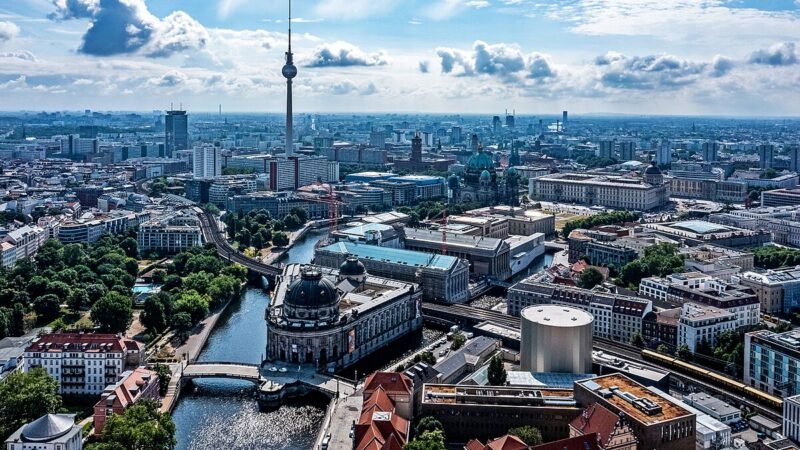
Berlin, the capital of Germany, is a major European city with a complex 20th-century history. On 6 June 1951, the weather in Berlin was rainy. The date falls under the zodiac sign Gemini, and the moon was in its full phase.
On this day
On 6 June 1944, Operation Overlord commenced as the largest amphibious military operation in history, with Allied troops landing on the beaches of Normandy in France. This pivotal moment in World War II marked the beginning of the liberation of Nazi-occupied Western Europe and remains one of the most significant military undertakings ever executed.
Decades later, on 6 June 1985, the remains of Josef Mengele, a Nazi physician infamous for conducting inhumane human experiments on inmates at Auschwitz, were exhumed in Embu das Artes, Brazil. This discovery provided closure regarding one of the Third Reich's most notorious war criminals, whose atrocities had long haunted the historical record.
World Pest Day
World Pest Day, observed on 6 June each year, raises awareness about the risks posed by pests to food security, public health, and the environment. The date commemorates the first use of pesticides to combat the desert locust, a significant agricultural threat, in 1912. The observance has been recognised internationally since 2010 by the Food and Agriculture Organisation of the United Nations. The day emphasises the importance of integrated pest management and sustainable practices in agriculture and urban environments.
DayAtlas provides historical context for any date and location, displaying weather conditions, significant events, and notable births and deaths. Users can explore what happened on specific days throughout history whilst viewing meteorological data and astrological information.
Find out what's happening today in Berlin.
What the Weather Had in Store for Berlin on 27th November 2026
Three threads make stronger cloth than three hundred tangled fibers.
Fortune of the Day
6th June in the Stars – Star Sign Gemini
Personality Profile
Personality People born on June 6th embody the classic Gemini spirit: lively, curious, and perpetually in motion. They think quickly, enjoy talking, and require constant mental stimulation. Their adaptability allows them to shine in diverse situations.
Strengths & Weaknesses Their greatest strengths are flexibility, communication skills, and quick thinking. However, impatience, superficiality, and scattered focus can become problematic. They jump easily from one idea to the next.
Love Those born on June 6th value intellectual connection and communication above all in relationships. They need partners who share their curiosity and love philosophical discussions. Monotony is their relationship killer.
Caree & Finance These individuals thrive in careers requiring communication, versatility, and creative problem-solving. Journalism, teaching, marketing, or sales align with their strengths. Financial stability demands discipline, as they're easily distracted.
Health Their restless nature can lead to nervousness and sleep issues. Regular exercise and mental balance through activities like meditation help considerably. They benefit from structured routines to channel their energy effectively.
That night, the moon was in its full moon phase.
Chinese year of the Rabbit (Metal).
Fun Facts About 6th June
Name Days in Your Language: Dante, Delaney, Donte, Norbert, Norberta, Norberto
Someone born on this day in 1951 would be 75 years old today — just 27,568 days into life, which is roughly 661,648 hours, 39,698,895 minutes, or 2,381,933,748 seconds spent on Earth so far.
It's the 157. day of the year. In 1951, 6th June falls on a Wednesday.
There are 208 days still to come.
We’re currently in Week 23 — the year marches on.
Famous Birthdays on 6th June
On this day, 6 notable people were born on 6th June — spanning from 1948 to 1954. From world leaders to artists and scientists, discover who shares this birthday.
06/06/1954
Władysław Żmuda, Polish footballer and manager; 91 caps for Poland and voted Best Young Player at the 1974 FIFA World Cup
Władysław Antoni Żmuda is a Polish former professional footballer who played as a defender for Śląsk Wrocław, Widzew Łódź, Hellas Verona, New York Cosmos and US Cremonese. He earned 91 caps for the Poland national team and is a four-time FIFA World Cup participant. At the 1974 FIFA World Cup, where Poland claimed third place, he received the FIFA Young Player Award.
06/06/1952
Harvey Fierstein, American actor and playwright; winner of four Tony Awards
Harvey Forbes Fierstein is an American actor, playwright, and screenwriter, known for his distinctive gravelly voice. He gained notice for his theater work in Torch Song Trilogy, winning both the Tony Award for Best Play and Best Actor in a Play. He went on to win the Tony Award for Best Book of a Musical for La Cage aux Folles, then Best Actor in a Musical for playing Edna Turnblad in Hairspray, a role he reprised for the Hairspray Live! television special.
06/06/1951
Khuraman Gasimova, Azerbaijani opera singer
Khuraman Ahkram gizi Gasimova is an Azerbaijani soprano opera singer and actress who is known for winning the Maria Callas Grand Prix in 1982, and receiving a silver medal at the 7th International Tchaikovsky Competition in 1982. She was made a People's Artist of Azerbaijan in 1986 and was named to the Sheref Order in 2011.
Dwight Twilley, American pop/rock singer and songwriter (died 2023)
Dwight Twilley was an American pop/rock singer and songwriter, most notable for the top 20 hit singles "I'm on Fire" (1975) and "Girls" (1984). His music is associated with the power pop style. Twilley and Phil Seymour performed as the Dwight Twilley Band through 1978, and Twilley performed as a solo act afterwards.
06/06/1949
Holly Near, American folk singer and songwriter
Holly Near is an American singer-songwriter, actress, teacher, and activist.
06/06/1948
Arlene Harris, American entrepreneur, inventor, investor and policy advocate
Arlene Joy Harris is an entrepreneur, inventor, investor, and policy advocate in the telecommunications industry. She is the president and co-founder of Dyna LLC, an incubator for start-up and early-stage organizations historically in the wireless technology field. Harris is widely recognized as a pioneer in mobile and wireless enterprise and an innovator of consumer products and services. In May 2007, she became the first female inductee of the Wireless Hall of Fame, and was named to the Consumer Technology Hall of Fame in 2017.
Lives Remembered on 6th June
On 6th June, 53 remarkable people passed away — from 184 to 2016. Remember the lives and legacies of those we lost on this day.
06/06/2016
Viktor Korchnoi, Russian chess grandmaster; arguably the best player never to become World Chess Champion (born 1931)
Viktor Lvovich Korchnoi was a Soviet and later Swiss chess grandmaster and chess writer. He is considered one of the strongest players never to have become World Chess Champion.
Peter Shaffer, English playwright and screenwriter; works included Equus and Amadeus (born 1926)
Sir Peter Levin Shaffer was an English playwright, screenwriter, and novelist. His best-known works are the plays Equus (1973) and Amadeus (1979), both of which earned him the Tony Award for Best Play. They were later adapted for the screen by Shaffer himself in 1977 and 1984, respectively. He was nominated for an Academy Award for both screenplays, winning for Amadeus, which also earned him a Golden Globe Award. Shaffer also earned nominations for two BAFTA Awards and a Laurence Olivier Award.
06/06/2015
Vincent Bugliosi, American lawyer and author; prosecuting attorney in the Tate–LaBianca murders case (born 1934)
Vincent T. Bugliosi Jr. was an American prosecutor and author who served as Deputy District Attorney for the Los Angeles County District Attorney's Office between 1964 and 1972. He became best known for successfully prosecuting Charles Manson and other defendants accused of the August 1969 Tate–LaBianca murders.
Ludvík Vaculík, Czech journalist and author; noted for The Two Thousand Words which inspired the Prague Spring (born 1926)
Ludvík Vaculík was a Czech writer and journalist. He was born in Brumov, Moravian Wallachia. A prominent samizdat writer, he was best known as the author of the "Two Thousand Words" manifesto of June 1968.
06/06/2014
Lorna Wing, English psychiatrist and physician; pioneered studies of autism (born 1928)
Lorna Gladys Wing was a British psychiatrist who conducted research into autism. She coined the term Asperger's syndrome and helped found the National Autistic Society.
06/06/2013
Jerome Karle, American crystallographer and academic; awarded the 1985 Nobel Prize in Chemistry for research into the molecular structure of chemical compounds (born 1918)
Jerome Karle was an American physical chemist. Jointly with Herbert A. Hauptman, he was awarded the Nobel Prize in Chemistry in 1985, for the direct analysis of crystal structures using X-ray scattering techniques.
Esther Williams, American swimmer and actress (born 1921)
Esther Jane Williams was an American competitive swimmer and actress. She set regional and national records in her late teens on the Los Angeles Athletic Club swim team. Unable to compete in the 1940 Summer Olympics because of the outbreak of World War II, she joined Billy Rose's Aquacade, where she took on the role vacated by Eleanor Holm after the show's move from New York City to San Francisco. While in the city, she spent five months swimming alongside Olympic gold medal-winner and Tarzan star Johnny Weissmuller. Williams caught the attention of Metro-Goldwyn-Mayer scouts at the Aquacade. After appearing in several small roles, then with Mickey Rooney in an Andy Hardy film, and with future five-time co-star Van Johnson in A Guy Named Joe, Williams made a series of films in the 1940s and early 1950s known as "aquamusicals", which featured elaborate performances with synchronised swimming and diving.
06/06/2012
Vladimir Krutov, Russian ice hockey player; together with Igor Larionov and Sergei Makarov, formed the famed KLM Line. (born 1960)
Vladimir Yevgenyevich Krutov, nicknamed "the Tank", was a Russian professional ice hockey forward. Together with Igor Larionov and Sergei Makarov, he was part of the famed "KLM Line". He is considered one of the best ice hockey wingers of the 1980s.
06/06/2009
Jean Dausset, French-Spanish immunologist and academic; awarded the 1980 Nobel Prize in Physiology or Medicine for his studies of the genetic basis of immunological reaction (born 1916)
Jean-Baptiste-Gabriel-Joachim Dausset was a French immunologist born in Toulouse, France. Dausset received the Nobel Prize in Physiology or Medicine in 1980 along with Baruj Benacerraf and George Davis Snell for their discovery and characterisation of the genes making the major histocompatibility complex. Using the money from his Nobel Prize and a grant from the French Television, Dausset founded the Human Polymorphism Study Center (CEPH) in 1984, which was later renamed the Foundation Jean Dausset-CEPH in his honour. He married Rose Mayoral in 1963, with whom he had two children, Henri and Irène. Jean Dausset died on June 6, 2009, in Mallorca, Spain, at the age of 92.
06/06/2006
Billy Preston, American singer-songwriter, pianist, and actor (born 1946)
William Everett Preston was an American keyboardist, singer, and songwriter whose work encompassed R&B, rock, soul, funk, and gospel. Preston was a top session keyboardist in the 1960s, backing Little Richard, Sam Cooke, Ray Charles, the Everly Brothers, Reverend James Cleveland, the Beatles, and the Rolling Stones. He gained attention as a solo artist with hit singles "That's the Way God Planned It", the Grammy-winning "Outa-Space", "Will It Go Round in Circles", "Space Race", "Nothing from Nothing", and "With You I'm Born Again". Additionally, Preston co-wrote "You Are So Beautiful", which became a hit for Joe Cocker.
06/06/2005
Anne Bancroft, American film actress; winner of the 1963 Academy Award for Best Actress for The Miracle Worker (born 1931)
Anne Bancroft was an American actress. Respected for her acting prowess and versatility, Bancroft received an Academy Award, three BAFTA Awards, two Golden Globe Awards, two Tony Awards, two Primetime Emmy Awards, and a Cannes Film Festival Award. She is one of 24 thespians to achieve the Triple Crown of Acting.
06/06/1996
George Davis Snell, American geneticist and immunologist; awarded the Nobel Prize in Physiology or Medicine in 1980 for his studies of histocompatibility (born 1903)
George Davis Snell NAS was an American mouse geneticist and basic transplant immunologist.
06/06/1994
Mark McManus, Scottish actor (born 1935)
Mark McManus was a Scottish actor known for his roles in the British television series Sam, Bulman, The Brothers, Strangers, and Dramarama, and the feature film 2000 Weeks. He was best known for playing the tough Glaswegian Detective Chief Inspector Jim Taggart in the long-running STV television series Taggart from 1983 until his death in 1994.
Barry Sullivan, American film actor (born 1912)
Patrick Barry Sullivan was an American actor of film, television, theatre, and radio. In a career that spanned over 40 years, Sullivan appeared in over 100 movies from the 1930s to the 1980s, primarily as a leading actor after establishing himself in the industry, and later as a character actor.
06/06/1991
Stan Getz, American saxophonist and jazz innovator (born 1927)
Stan Getz was an American jazz saxophonist. Playing primarily the tenor saxophone, Getz was known as "The Sound" because of his warm, lyrical tone, with his prime influence being the wispy, mellow timbre of his idol, Lester Young. Coming to prominence in the late 1940s with Woody Herman's big band, Getz is described by critic Scott Yanow as "one of the all-time great tenor saxophonists". Getz performed in bebop and cool jazz groups. Influenced by João Gilberto and Antônio Carlos Jobim, he also helped popularize bossa nova in the United States with the hit 1964 single "The Girl from Ipanema".
06/06/1983
Hans Leip, German author, poet, and playwright who wrote the lyrics of Lili Marleen (born 1893)
Hans Leip was a German soldier, novelist, poet and playwright, best remembered as the lyricist of Lili Marleen.
06/06/1982
Kenneth Rexroth, American poet and academic (born 1905)
Kenneth Charles Marion Rexroth was an American poet, translator, and critical essayist. He is regarded as a central figure in the San Francisco Renaissance, and paved the groundwork for the movement. Although he did not consider himself to be a Beat poet, and disliked the association, he was dubbed the "Father of the Beats" by Time magazine. Largely self-educated, Rexroth learned several languages and translated poems from Chinese, French, Spanish, and Japanese.
06/06/1979
Jack Haley, American actor (born 1897)
John Joseph Haley Jr. was an American actor, comedian, dancer, radio host, singer, drummer and vaudevillian. He is most notable for his portrayal of the Tin Man and his farmhand counterpart Hickory in the 1939 Metro-Goldwyn-Mayer film The Wizard of Oz.
06/06/1976
J. Paul Getty, American businessman, founded the Getty Oil Company (born 1892)
Jean Paul Getty Sr. was an American petroleum industrialist who founded the Getty Oil Company in 1942 and was the longtime patriarch of the Getty family. A native of Minneapolis, Minnesota, he was the son of pioneer oilman George Getty. In 1957, Fortune magazine named J. Paul Getty the wealthiest living American, while the 1966 Guinness Book of Records declared him to be the world's wealthiest private citizen, worth an estimated $1.2 billion. At the time of his death, he was worth more than $6 billion. A book published in 1996 ranked him as the 67th wealthiest American who ever lived.
06/06/1968
Robert F. Kennedy, American soldier, lawyer, and politician, 64th United States Attorney General (assassinated) (born 1925)
Robert Francis Kennedy, also known by his initials RFK, was an American politician and lawyer. A member of the Democratic Party, Kennedy served as the 64th United States attorney general from 1961 to 1964, and as a U.S. senator from New York from 1965 until his assassination in 1968. Like his brothers John F. Kennedy and Ted Kennedy, he is considered an icon of American liberalism in the 20th century.
06/06/1963
William Baziotes, American painter and academic (born 1912)
William Baziotes was an American painter influenced by Surrealism and was a contributor to Abstract Expressionism.
06/06/1962
Yves Klein, French painter (born 1928)
Yves Klein was a French artist and an important figure in postwar European art. He was a leading member of the French artistic movement of Nouveau réalisme, founded in 1960 by art critic Pierre Restany. Klein was a pioneer in the development of performance art, and is seen as an inspiration to and as a forerunner of minimal art, as well as pop art. He developed and used International Klein Blue.
Tom Phillis, Australian motorcycle racer (born 1934)
Thomas Edward Phillis was an Australian professional Grand Prix motorcycle road racer. He won the 1961 125cc motorcycle road racing World Championship and was the first person to lap the Isle of Man TT mountain circuit at over 100 mph on a pushrod-engined motorcycle. He was also the first person to win a World Championship motorcycle race on a Japanese machine.
06/06/1961
Carl Gustav Jung, Swiss psychiatrist and psychotherapist (born 1875)
Carl Gustav Jung was a Swiss psychiatrist, psychotherapist, and psychologist who founded the school of analytical psychology. He was a prolific author of over twenty books, illustrator, correspondent, and academic, best known for his concept of archetypes. Widely considered one of the most influential psychologists of all time, Jung's work has fostered not only scholarship, but also popular interest. His work has been influential in the fields of psychiatry, anthropology, archaeology, literature, philosophy, psychology, and religious studies.
06/06/1955
Max Meldrum, Scottish-Australian painter and educator (born 1875)
Duncan Max Meldrum was a Scottish-born Australian artist and art teacher, best known as the founder of Australian tonalism, a representational painting style that became popular in Melbourne during the interwar period. He also won fame for his portrait work, winning the prestigious Archibald Prize for portraiture in 1939 and 1940.
06/06/1948
Louis Lumière, French film director, producer, and screenwriter (born 1864)
The Lumière brothers, Auguste Marie Louis Nicolas Lumière and Louis Jean Lumière, were French manufacturers of photography equipment, best known for their Cinématographe motion picture system and the short films they produced between 1895 and 1905, which places them among the earliest filmmakers.
06/06/1947
James Agate, English author and critic (born 1877)
James Evershed Agate was an English diarist and theatre critic between the two world wars. He took up journalism in his late twenties and was on the staff of The Manchester Guardian in 1907–1914. He later became a drama critic for The Saturday Review (1921–1923), The Sunday Times (1923–1947) and the BBC (1925–1932). The nine volumes of Agate's diaries and letters cover the British theatre of his time and non-theatrical interests such as sports, social gossip and private preoccupations with health and finances. He published three novels, translated a play briefly staged in London, and regularly published collections of theatre essays and reviews.
06/06/1946
Gerhart Hauptmann, German novelist, poet, and playwright, Nobel Prize laureate (born 1862)
Gerhart Johann Robert Hauptmann was a German dramatist and novelist. He is counted among the most important promoters of literary naturalism, though he integrated other styles into his work as well. He received the Nobel Prize in Literature in 1912.
06/06/1941
Louis Chevrolet, American race car driver and businessman, founded Chevrolet and Frontenac Motor Corporation (born 1878)
Louis-Joseph Chevrolet was a Swiss-born American racing driver, mechanic, and entrepreneur who co-founded the Chevrolet Motor Car Company in 1911.
06/06/1939
Constantin Noe, Megleno-Romanian editor and professor (born 1883)
Constantin Noe was a Megleno-Romanian editor and professor. He was born in 1883 in the Megleno-Romanian village of Lagkadia, then in the Ottoman Empire and now in Greece. He was one of the best students of the Romanian High School of Bitola, from which he graduated in 1903. On the same year, Noe became professor in several of the Romanian schools in the Balkans and one of the main figures of the Megleno-Romanian national movement. In 1907, he and several others of his colleagues were arrested and sentenced to four months in prison under the pretext of not using books approved by the General Directorate of Education of the Salonica vilayet of the Ottoman Empire in the schools they were teaching at.
06/06/1935
Julian Byng, 1st Viscount Byng of Vimy, English field marshal and politician, 12th Governor General of Canada (born 1862)
Field Marshal Julian Hedworth George Byng, 1st Viscount Byng of Vimy, was a British Army officer who served as Governor General of Canada, the 12th since the Canadian Confederation.
06/06/1922
Lillian Russell, American actress and singer (born 1860)
Lillian Russell was an American actress and singer. She became one of the most famous actresses and singers of the late 19th and early 20th centuries, praised for her beauty and style, as well as for her voice and stage presence.
06/06/1916
Yuan Shikai, Chinese general and politician, 2nd President of the Republic of China (born 1859)
Yuan Shikai was a Chinese general and statesman. As leader of the Beiyang Army, he played a decisive role in securing the abdication of the Qing court. He served as the second provisional president and the first formal president of the Republic of China, with his administration known as the Beiyang government. He declared himself Emperor of the Chinese Empire in December 1915 but was forced to abdicate in March 1916.
06/06/1891
John A. Macdonald, Scottish-Canadian lawyer and politician, 1st Prime Minister of Canada (born 1815)
Sir John Alexander Macdonald was the first prime minister of Canada, serving from 1867 to 1873 and from 1878 until his death in 1891. He was the dominant figure of Canadian Confederation, and had a political career that spanned almost half a century.
06/06/1881
Henri Vieuxtemps, Belgian violinist and composer (born 1820)
Henri François Joseph Vieuxtemps was a Belgian composer and violinist. He occupies an important place in the history of the violin as a prominent exponent of the Franco-Belgian violin school during the mid-19th century. He is also known for playing what is now known as the Vieuxtemps Guarneri del Gesù, a violin of superior workmanship.
06/06/1878
Robert Stirling, Scottish minister and engineer, invented the stirling engine (born 1790)
Robert Stirling was a Scottish clergyman and engineer. He invented the Stirling engine and was inducted into the Scottish Engineering Hall of Fame in 2014.
06/06/1865
William Quantrill, American Confederate guerrilla band leader (born 1837)
William Clarke Quantrill was a Confederate guerrilla leader during the American Civil War.
06/06/1861
Camillo Benso, Count of Cavour, Italian politician, 1st Prime Minister of Italy (born 1810)
Camillo Paolo Filippo Giulio Benso, Count of Cavour, Isolabella and Leri, generally known as the Count of Cavour or simply Cavour, was an Italian politician, statesman, businessman, economist, and noble, and a leading figure in the movement towards Italian unification. He was one of the leaders of the Historical Right and Prime Minister of the Kingdom of Sardinia from 1852, a position he maintained until his death, throughout the Second Italian War of Independence and Giuseppe Garibaldi's campaigns to unite Italy. After the declaration of a united Kingdom of Italy, Cavour took office as the first Prime Minister of Italy; he died after only three months in office and did not live to see the Roman Question solved through the complete unification of the country after the Capture of Rome in 1870.
06/06/1832
Jeremy Bentham, English jurist and philosopher (born 1748)
Jeremy Bentham was an English philosopher, jurist, and social reformer regarded as the founder of modern utilitarianism.
06/06/1813
Antonio Cachia, Maltese architect, engineer and archaeologist (born 1739)
Antonio Cachia (1739–1813) was a Maltese architect, civil and military engineer and archaeologist who was active in the late 18th and early 19th century.
06/06/1799
Patrick Henry, American lawyer and politician, 1st Governor of Virginia (born 1736)
Patrick Henry was an American politician, planter and orator who declared to the Second Virginia Convention (1775): "Give me liberty or give me death!" A Founding Father, he served as the first and sixth post-colonial governor of Virginia, from 1776 to 1779 and from 1784 to 1786.
06/06/1661
Martino Martini, Italian Jesuit missionary (born 1614)
Martino Martini was a Jesuit missionary in China. Born and raised in Trento, he worked as a cartographer and historian of ancient imperial China.
06/06/1583
Nakagawa Kiyohide, Japanese daimyo (born 1556)
Nakagawa Kiyohide was a daimyō in Azuchi–Momoyama period. His childhood name was Nakagawa Toranosuke. His common name was Nakagawa Sebe.
06/06/1548
João de Castro, Portuguese soldier and politician, Governor of Portuguese India (born 1500)
Dom João de Castro was a Portuguese nobleman, scientist, writer and colonial administrator, who served as the fourth Portuguese Viceroy of India from 1545 to 1548. He was called Strong Castro by the poet Luís de Camões. De Castro was the second son of Álvaro de Castro, the civil governor of Lisbon. His wife was Leonor Coutinho.
06/06/1480
Vecchietta, Italian painter, sculptor, and architect (born 1412)
Lorenzo di Pietro, known as Vecchietta, was an Italian Sienese School painter, sculptor, goldsmith, and architect of the Renaissance. He is among the artists profiled in Vasari's Le Vite delle più eccellenti pittori, scultori, ed architettori.
06/06/1252
Robert Passelewe, Bishop of Chichester
Robert Passelewe was a medieval Bishop of Chichester-elect, royal clerk and Archdeacon of Lewes.
06/06/1251
William III of Dampierre, Count of Flanders
William III was the lord of Dampierre from 1231 and count of Flanders from 1247 until his death. He was the son of William II of Dampierre and Margaret II of Flanders.
06/06/1217
Henry I, King of Castile and Toledo (born 1204)
Henry I was the king of Castile from 1214 until 1217. Throughout his short reign, the boy king was a puppet monarch torn between his sister and heir, Queen Berengaria, and guardian, Count Álvaro Núñez de Lara.
06/06/1134
Norbert of Xanten, German bishop and saint (born 1060)
Norbert of Xanten, also known as Norbert Gennep, was a German Catholic bishop who was the Archbishop of Magdeburg, founder of the Premonstratensian order of canons regular, and is venerated as a saint in the Catholic Church. Norbert was canonized by Pope Gregory XIII in the year 1582, and his statue appears above the Piazza colonnade of St. Peter's Square in Rome.
06/06/1097
Agnes of Aquitaine, Queen of Aragon and Navarre
Agnes of Aquitaine was a queen consort of Navarre. She was a daughter of William VIII, Duke of Aquitaine, and his third wife, Hildegarde of Burgundy.
06/06/0913
Alexander III, Byzantine emperor (born 870)
Alexander was briefly Byzantine emperor from 912 to 913, and the third emperor of the Macedonian dynasty.
06/06/0863
Abu Musa Utamish, vizier to the Abbasid Caliphate
Abu Musa Utamish was a Turkic military officer of the Abbasid Caliphate. He played an important role in the first years of the period known as the Anarchy at Samarra, during which he rapidly became one of the most powerful officials in the government. He was appointed as vizier upon the caliph al-Musta'in's ascension in 862, but was assassinated after approximately a year in office.
06/06/0184
Qiao Xuan, Chinese official (born c. 110)
Year 184 (CLXXXIV) was a leap year starting on Wednesday of the Julian calendar. At the time, it was known as the Year of the Consulship of Eggius and Aelianus. The denomination 184 for this year has been used since the early medieval period, when the Anno Domini calendar era became the prevalent method in Europe for naming years.
Celebrations & Special Days Worldwide on 6th June
Christian feast day: Bessarion of Egypt
Bessarion of Egypt, also known as Bessarion of Scetis or Bessarion the Great was an Egyptian Christian monk who lived around the 4th to 5th century in Egypt, wandering in the Nitrian Desert.
Christian feast day: Claudius of Besançon
Saint Claudius of Besançon, sometimes called Claude the Thaumaturge, was a priest, monk, abbot, and bishop. A native of Franche-Comté, Claudius became a priest at Besançon and later a monk. Georges Goyau in the Catholic Encyclopedia wrote that “The Life of St. Claudius, Abbot of Condat, has been the subject of much controversy.” Anglican Henry Wace claimed that "on this saint the inventors of legends have compiled a vast farrago of improbabilities."
Christian feast day: Iarlaithe mac Loga
Iarlaithe mac Loga, also known as Jarlath, was an Irish priest and scholar from Connacht, remembered as the founder of the monastic School of Tuam and of the Archdiocese of Tuam, of which he is the patron saint. No medieval biography of Jarlath is extant, but sources for his life and cult include genealogies, martyrologies, the Irish Lives of St Brendan of Clonfert, and a biography compiled by John Colgan in the 17th century.
Christian feast day: Ini Kopuria (Anglican Church of Melanesia, Church of England, Episcopal Church)
Ini Kopuria was a Solomon Islands police officer from Maravovo, Guadalcanal, who founded the Melanesian Brotherhood in 1925. He and the Bishop of Melanesia, John Manwaring Steward, formed a brotherhood to spread Christianity to non-Christian areas of Melanesia.
Christian feast day: Blessed Innocent Guz
Beatification is an act by which the Catholic Church formally recognizes that a deceased member of the faithful is believed to have entered Heaven and is capable of interceding on behalf of individuals who pray in their name, permitting a restricted, local form of public veneration.
Christian feast day: Marcellin Champagnat
Marcellin Joseph Benedict Champagnat, FMS was a French Catholic priest who founded the Marist Brothers, a religious congregation of brothers devoted to Mary and dedicated to education. He was canonized in 1999 and his feast day is 6 June, his death anniversary.
Christian feast day: Blessed Maria Laura Mainetti
Maria Laura Mainetti was an Italian religious sister of the Sisters of the Cross. Mother superior of a convent in Chiavenna that specialised in helping juvenile delinquents, she was stabbed to death in a satanic sacrifice by three teenage girls on the night of 6 June 2000. Mainetti's death was declared a martyrdom by the Congregation for the Causes of Saints in 2020, and she was beatified on 6 June 2021, the twenty-first anniversary of her murder.
Christian feast day: Rafael Guízar y Valencia
Rafael Guízar y Valencia was a Mexican bishop of the Roman Catholic Church who was persecuted during the Mexican Revolution. Named Bishop of Xalapa in 1919, he was driven out of his diocese and forced to live the remainder of his life in hiding in Mexico City. Pope Benedict XVI canonized Guízar on 15 October 2006.
Christian feast day: Norbert
Norbert of Xanten, also known as Norbert Gennep, was a German Catholic bishop who was the Archbishop of Magdeburg, founder of the Premonstratensian order of canons regular, and is venerated as a saint in the Catholic Church. Norbert was canonized by Pope Gregory XIII in the year 1582, and his statue appears above the Piazza colonnade of St. Peter's Square in Rome.
Christian feast day: June 6 (Eastern Orthodox liturgics)
June 6 in Eastern Orthodox liturgical calendars is a feast day and a day of commemoration of saints and martyrs. Although some Orthodox churches use the Revised Julian Calendar and others use the traditional Julian calendar, the fixed commemorations for their respective June 6 are broadly the same, no matter which calendar is used.
D-Day Invasion Anniversary
The Normandy landings were the landing operations and associated airborne operations on 6 June 1944 of the Allied invasion of Normandy in Operation Overlord during the Second World War. Codenamed Operation Neptune and often referred to as D-Day, it is the largest seaborne invasion in history. The operation began the liberation of France and the rest of Western Europe, and laid the foundations for the Allied victory on the Western Front.
Engineer's Day in Taiwan
Engineer's Day is observed in several countries on various dates of the year.
Korean Children's Union Foundation Day in North Korea
This is a list of public holidays in North Korea, known as myŏngjŏl. See also the Korean calendar for a list of traditional holidays. As of 2017, the North Korean calendar has 71 official public holidays, including Sundays. In the past, North Koreans relied on rations provided by the state on public holidays for feasts. Recently, with marketization people are able to save up money and buy the goods they need.
Memorial Day in South Korea
Memorial Day or Hyeonchungil (Korean: 현충일) is a South Korean public holiday on the sixth day of June by article 2, subparagraph 8. of 'Regulations On Holidays Of Government Offices' that commemorates all the Koreans who have contributed or died while serving the Republic of Korea.
National Day of Sweden, marking the end of the Kalmar Union and the coronation of King Gustav Vasa
The National Day of Sweden is observed annually as a public holiday on 6 June. Prior to 1983, the day was celebrated only as the Swedish Flag Day. It was officially named the Swedish National Day by the Swedish parliament in 1983, and became a public holiday in 2005. The day is celebrated in honor of the election of Gustav Vasa as King of Sweden in 1523 and of the adoption of the constitutions of 1809 and 1974.
National Huntington's Disease Awareness Day in the United States
Huntington's or Huntington disease (HD), also known as Huntington's chorea, is a fatal neurodegenerative disease that is usually inherited. It typically presents as a triad of progressive psychiatric, cognitive, and motor symptoms. The earliest symptoms are often subtle problems with mood or mental/psychiatric abilities, which precede the motor symptoms for many people. The definitive physical symptoms, including a general lack of coordination and an unsteady gait, eventually follow. Over time, the basal ganglia region of the brain gradually becomes damaged.
Queensland Day
Queensland Day is officially celebrated on 6 June as the birthday of the Australian state of Queensland.
UN Russian Language Day
UN Russian Language Day is observed annually on 6 June. The event was established by the United Nations Educational, Scientific and Cultural Organization (UNESCO) in 2010. UN Russian Language Day coincides with the birthday of Alexander Pushkin, a Russian poet who is considered the father of the modern Russian language.
What Happened on 6th June?
40 significant events took place on Wednesday, 6th June — stretching from 913 to 2024. Explore the moments that shaped history on this day.
06/06/2024
The launch of SpaceX Starship integrated flight test 4 (IFT-4)
Starship flight test 4 was the fourth flight test of the SpaceX Starship launch vehicle. SpaceX performed the flight test on June 6, 2024. The prototype vehicles flown were the Starship Ship 29 upper-stage and Super Heavy Booster 11.
06/06/2023
Russo-Ukrainian war: The Kakhovka Dam is destroyed.
The Russo-Ukrainian war began in February 2014 and is ongoing. Following Ukraine's Revolution of Dignity, Russia occupied Crimea and annexed it from Ukraine. It then supported Russian separatist armed groups who started a war in the eastern Donbas region against Ukraine's military. In 2018, Ukraine declared the region to be occupied by Russia. The first eight years of conflict also involved naval incidents and cyberwarfare. In February 2022, Russia launched a full-scale invasion of Ukraine and began occupying more of the country, starting the current phase of the war, the largest conflict in Europe since World War II. The war has resulted in a refugee crisis and hundreds of thousands of deaths.
06/06/2017
Syrian civil war: The Battle of Raqqa begins with an offensive by the Syrian Democratic Forces (SDF) to capture the city from the Islamic State of Iraq and the Levant (ISIL).
The Syrian civil war was an armed conflict that began with the Syrian revolution in March 2011, when popular discontent with the Ba'athist regime ruled by Bashar al-Assad triggered large-scale protests and pro-democracy rallies across Syria, as part of the wider Arab Spring. The Assad regime responded to the protests with lethal force, which led to a series of defections, the emergence of armed opposition groups, and the civilian uprising descending into a civil war. The war lasted almost 14 years and culminated in the fall of the Assad regime in December 2024. Many sources regard this as the end of the civil war even though clashes have continued into 2026.
06/06/2002
Eastern Mediterranean event. A near-Earth asteroid estimated at ten meters in diameter explodes over the Mediterranean Sea between Greece and Libya. The explosion is estimated to have a force of 26 kilotons, slightly more powerful than the Nagasaki atomic bomb.
The 2002 Eastern Mediterranean Event was a high-energy upper atmosphere explosion over the Mediterranean Sea, around 34°N 21°E on June 6, 2002. This explosion, similar in power to a small atomic bomb, has been related to a small asteroid undetected while approaching Earth. The object disintegrated as a meteor air burst over the sea, and no meteorite fragments were recovered.
06/06/1994
China Northwest Airlines Flight 2303 crashes near Xi'an Xianyang International Airport, killing all 160 people on board.
China Northwest Airlines Flight 2303 was a domestic flight from Xi'an to Guangzhou, People's Republic of China. On June 6, 1994, the aircraft operating the flight, a Tupolev Tu-154M, broke up in-flight and crashed as a result of an autopilot malfunction which caused violent shaking and overstressed the airframe. All 160 people on board were killed. As of 2026, it remains the deadliest airplane crash ever in mainland China.
06/06/1993
Punsalmaagiin Ochirbat wins the first presidential election in Mongolia.
Punsalmaagiin Ochirbat was a Mongolian politician and geologist who served as the first president of Mongolia from 1990 to 1997. A member of the Mongolian People's Revolutionary Party since 1965, he served multiple ministerial positions between 1972 and 1990. In the aftermath of the 1990 Democratic Revolution, he briefly served as Chairman of the Presidium of the People's Great Khural from March to September 1990.
06/06/1992
Copa Airlines Flight 201 breaks apart in mid-air and crashes into the Darién Gap in Panama, killing all 47 aboard.
Copa Airlines Flight 201 was a regularly scheduled passenger flight from Tocumen International Airport in Panama City, Panama, to Alfonso Bonilla Aragón International Airport in Cali, Colombia. On 6 June 1992, the Boeing 737-200 operating the route rolled, entered a steep dive, disintegrated in mid-air, and crashed into the jungle of the Darién Gap 29 minutes after takeoff, killing all 47 people on board. The in-flight breakup was caused by faulty instrument readings and several other contributing factors, including incomplete training.
06/06/1985
The grave of "Wolfgang Gerhard" is opened in Embu, Brazil; the exhumed remains are later proven to be those of Josef Mengele, Auschwitz's "Angel of Death"; Mengele is thought to have drowned while swimming in February 1979.
Embu das Artes, previously and commonly known simply as Embu, is a Brazilian municipality in the State of São Paulo. It is part of the Metropolitan Region of São Paulo. The population is 259,788 in an area of 70.40 km2.
06/06/1982
1982 Lebanon War: The war begins as forces under Israeli Defense Minister Ariel Sharon invade southern Lebanon during Operation Peace for the Galilee, eventually reaching as far north as the capital Beirut.
The 1982 Lebanon War, also called the Second Israeli invasion of Lebanon, began on 6 June 1982, when Israel invaded southern Lebanon. The invasion followed a series of attacks and counter-attacks between the Palestine Liberation Organization (PLO) operating in southern Lebanon and the Israel Defense Forces (IDF), which had caused civilian casualties on both sides of the border. The Israeli military operation, codenamed Operation Peace for Galilee, was launched after gunmen from the Abu Nidal Organization attempted to assassinate Shlomo Argov, Israel's ambassador to the United Kingdom. Israeli prime minister Menachem Begin blamed the PLO, using the incident as a casus belli. It was the second invasion of Lebanon by Israel, following the 1978 South Lebanon conflict.
06/06/1976
Chief Minister of Sabah Faud Stephens, Peter Joinud Mojuntin, and several other politicians are killed in a plane crash near Kota Kinabalu International Airport in Malaysia.
The chief minister of Sabah is the head of government of Sabah, Malaysia. Since September 2020, the position has been held by Hajiji Noor from the Parti Gagasan Rakyat Sabah from the coalition of Gabungan Rakyat Sabah (GRS) which had won the 2020 Sabah state election. As in other parts of the Malaysian federation, the Westminster Parliamentary system is adopted, whereby, the leader of the party with the most seats in the state legislature would usually become the chief minister of Sabah. In other words, it is the person commanding the support of the state legislature. The chief minister is appointed by the head of state known as the Yang di-Pertua Negeri. In comparison to other states in Malaysia, the office of the chief minister of Sabah has been held by a more diverse group of people in terms of ethnicity and religion. The post has been held by Kadazan-Dusuns, Bajaus, Malays, Chinese, Muruts, Rungus, Sungai, Idaans, and other persons of mixed heritage as well as being Muslims, Buddhists and Christians.
06/06/1975
British referendum results in continued membership of the European Economic Community, with 67% of votes in favour.
A referendum, plebiscite, or ballot measure is a direct vote by the electorate on a proposal, law, or political issue. A referendum may be either binding, resulting in the adoption of a new policy, or consultive, functioning like a large opinion poll.
06/06/1971
Soyuz 11 is launched. The mission ends in disaster when all three cosmonauts, Georgy Dobrovolsky, Vladislav Volkov, and Viktor Patsayev are suffocated by uncontrolled decompression of the capsule during re-entry on 29 June.
Soyuz 11 was the only crewed mission to board the world's first space station, Salyut 1. The crew – Georgy Dobrovolsky, Vladislav Volkov, and Viktor Patsayev – arrived at the space station on 7 June 1971, and departed on 29 June 1971. The mission ended in disaster when the crew capsule depressurised during preparations for re-entry, killing the three-person crew. The crew members of Soyuz 11 are the only humans to have died in space.
Hughes Airwest Flight 706 collides with a McDonnell Douglas F-4 Phantom II of the United States Marine Corps over the San Gabriel Mountains, killing 50.
Hughes Airwest Flight 706 was a regularly scheduled flight operated by American domestic airline Hughes Airwest from Los Angeles, California, to Seattle, Washington, with several intermediate stops. On Sunday, June 6, 1971, the McDonnell Douglas DC-9 serving as Flight 706 departed Los Angeles just after 6 p.m. en route to Seattle as a McDonnell Douglas F-4 Phantom II of the United States Marine Corps was approaching Marine Corps Air Station El Toro near Irvine at the end of a flight from Naval Air Station Fallon in Nevada. The two aircraft collided in midair over the San Gabriel Mountains near Duarte, killing all 49 aboard the DC-9 and the F-4 pilot; the F-4 radar intercept officer ejected and survived.
06/06/1966
March Against Fear: African-American civil rights activist James Meredith is wounded in an ambush by white sniper James Aubrey Norvell. Meredith and Norvell are photographed by Jack R. Thornell, whose photo will receive the 1967 Pulitzer Prize in Photography, the last one to be awarded in the category.
The March Against Fear was a major 1966 demonstration in the Civil Rights Movement in the South. Activist James Meredith launched the event on June 5, 1966, intending to make a solitary walk from Memphis, Tennessee, to Jackson, Mississippi via the Mississippi Delta, starting at Memphis's Peabody Hotel and proceeding to the Mississippi state line, then continuing through, respectively, the Mississippi cities of Hernando, Grenada, Greenwood, Indianola, Belzoni, Yazoo City, and Canton before arriving at Jackson's City Hall. The total distance marched was approximately 270 miles over a period of 21 days. The goal was to counter the continuing racism in the Mississippi Delta after passage of federal civil rights legislation in the previous two years and to encourage African Americans in the state to register to vote. He invited only individual black men to join him and did not want it to be a large media event dominated by major civil rights organizations.
06/06/1944
World War II: Commencement of Operation Overlord: The Allied invasion of Normandy begins with the execution of Operation Neptune—commonly referred to as D-Day—the largest seaborne invasion in history. Nearly 160,000 Allied troops cross the English Channel with about 5,000 landing and assault craft, 289 escort vessels, and 277 minesweepers participating. By the end of the day, the Allies have landed on five invasion beaches and are pushing inland.
Operation Overlord was the codename for the Battle of Normandy, the Allied operation that launched the successful invasion of German-occupied Western Europe during World War II. The operation was launched on 6 June 1944 (D-Day) with the Normandy landings. A 1,200-plane airborne assault preceded an amphibious assault involving more than 5,000 vessels. Nearly 160,000 troops crossed the English Channel on 6 June, and more than two million Allied troops were in France by the end of August.
World War II: Capture of the Caen canal and Orne river bridges by British paratroopers, also known as Operation Coup de Main (incorrectly referred to as Operation Deadstick.)
The capture of the Caen Canal and Orne River bridges was an operation by airborne forces of the British Army that took place in the early hours of 6 June 1944 as part of the Normandy landings of the Second World War. The objective was to capture intact two road bridges in Normandy across the River Orne and the Caen Canal, providing the only exit eastwards for British forces from their landing on Sword Beach. Intelligence reports said both bridges were heavily defended by the Germans and wired for demolition. Once captured, the bridges had to be held against any counter-attack, until the assault force was relieved by commandos and other infantry advancing from the landing beach.
06/06/1942
World War II: The United States Navy's victory over the Imperial Japanese Navy at the Battle of Midway is a major turning point in the Pacific Theater. All four Japanese fleet carriers taking part—Akagi, Kaga, Sōryū and Hiryū—are sunk, as is the heavy cruiser Mikuma. The American carrier Yorktown and the destroyer Hammann are also sunk.
World War II, or the Second World War, was a global conflict between two coalitions: the Allies and the Axis powers. Nearly all of the world's countries were involved, with many engaging in total war on an unprecedented scale. World War II was the deadliest conflict in history, causing the deaths of 60 to 75 million people, a majority of whom were civilians. Millions died as a result of massacres, starvation, disease and genocides. After the Allied victory, Germany, Austria, Japan and Korea were occupied, and German and Japanese leaders were tried for war crimes.
06/06/1934
New Deal: U.S. President Franklin D. Roosevelt signs the Securities Exchange Act of 1934 into law, establishing the U.S. Securities and Exchange Commission.
The New Deal was a series of economic, social, and political reforms in response to the Great Depression in the United States under the first and second administrations of President Franklin D. Roosevelt. Following a demand-side economic theory, Roosevelt sought to utilize the authority of the federal government to increase spending and introduce programs to spur growth and combat issues specific to the depression, such as unemployment, labor relations, financial reform, and social welfare.
06/06/1933
The first drive-in theater opens in Camden, New Jersey.
A drive-in theater/theatre or drive-in cinema is a form of cinema structure consisting of a large outdoor movie screen, a projection booth, a concession stand, and a large parking area for automobiles. Within this enclosed area, customers can view movies from the privacy and comfort of their cars. Some drive-ins have small playgrounds for children and a few picnic tables or benches.
06/06/1925
The original Chrysler Corporation is founded by Walter Chrysler from the remains of the Maxwell Motor Company.
FCA US, LLC, doing business as Stellantis North America and known historically as the Chrysler Corporation, is one of the "Big Three" automobile manufacturers in the United States, headquartered in Auburn Hills, Michigan. It is the American subsidiary of the multinational automotive company Stellantis. Stellantis North America sells vehicles worldwide under the Chrysler, Dodge, Jeep, and Ram Trucks nameplates. It also includes Mopar, its automotive parts and accessories division, and SRT, its performance automobile division. The division also distributes Alfa Romeo, Fiat, and Maserati vehicles in North America.
06/06/1918
World War I: U.S. Marine Corps suffers its worst single day's casualties during the Battle of Belleau Wood while attempting to recapture the wood at Château-Thierry (the losses are exceeded at the Battle of Tarawa in November 1943).
World War I, or the First World War, also known as the Great War, was a global conflict between two coalitions: the Allies and the Central Powers. One of the deadliest conflicts in history, World War I caused 15 to 22 million deaths, including those resulting from war crimes and genocides. The war also contributed to the spread of the Spanish flu pandemic. The conflict saw important developments in weaponry, including machine guns, artillery, aircraft, chemical weapons, and tanks.
06/06/1917
Paraguayan President Benigno Ferreira introduces the country's first labor law, establishing the workweek and weekend.
Benigno Asunción Ferreira was President of Paraguay from 1906 to his overthrow in a 1908 military coup. He was a member of the Liberal Party.
06/06/1912
The eruption of Novarupta in Alaska begins. It is the largest volcanic eruption of the 20th century.
Novarupta is a volcano located on the Alaska Peninsula on a slope of Trident Volcano in Katmai National Park and Preserve, about 290 miles (470 km) southwest of Anchorage. Novarupta was formed in 1912, during the largest volcanic eruption of the 20th century, in which it released 30 times the volume of magma of the 1980 eruption of Mount St. Helens.
06/06/1894
Governor Davis H. Waite orders the Colorado state militia to protect and support the miners engaged in the Cripple Creek miners' strike.
The governor of Colorado is the head of government of the U.S. state of Colorado. The governor is the head of the executive branch of Colorado's state government and is charged with enforcing state laws. The governor has the power to either approve or veto bills passed by the Colorado General Assembly, to convene the legislature, and to grant pardons, except in cases of treason or impeachment. The governor is also the commander-in-chief of the state's military forces.
06/06/1892
The Chicago "L" elevated rail system begins operation.
The Chicago "L" is a rapid transit system serving the city of Chicago and some of its surrounding suburbs in the U.S. state of Illinois. The system is operated by the Chicago Transit Authority (CTA), one of the three service boards of the Northern Illinois Transit Authority (NITA). It is the fourth-largest rapid transit system in the United States in terms of total route length, at 102.8 miles (165.4 km), as of 2014, and the third-busiest rapid transit system in the United States after the New York City Subway and the Washington Metro. As of January 2024, the "L" had 1,480 rail cars operating across eight different routes on 224.1 miles of track. CTA trains make about 1,888 trips each day servicing 146 train stations. In 2025, the system had 135,202,800 rides, or about 447,000 per weekday in the second quarter of 2026.
06/06/1889
The Great Seattle Fire destroys all of downtown Seattle.
The Great Seattle Fire was a fire that destroyed the entire central business district of Seattle, Washington, on June 6, 1889. The conflagration lasted for less than a day, burning through the afternoon and into the night, during the same summer as the Great Spokane Fire and the Great Ellensburg Fire. Seattle quickly rebuilt using brick buildings that sat 20 feet (6.1 m) above the original street level. Its population swelled during reconstruction, becoming the largest city in the newly admitted state of Washington.
06/06/1882
The Shewan forces of Menelik II of Ethiopia defeat the Gojjame army in the Battle of Embabo. The Shewans capture Negus Tekle Haymanot of Gojjam, and their victory leads to a Shewan hegemony over the territories south of the Abay River.
Shewa, formerly romanized as Shua, Shoa, Showa, Shuwa, is a historical region of Ethiopia which was formerly an autonomous kingdom within the Ethiopian Empire. The modern Ethiopian capital Addis Ababa is located at its center.
06/06/1862
American Civil War: The First Battle of Memphis, a naval engagement fought on the Mississippi River, results in the capture of Memphis, Tennessee by Union forces from the Confederates.
The American Civil War was fought in the United States between the Union and the Confederacy, which was formed in 1861 by Southern states that had seceded from the Union to preserve the institution of slavery. The South saw slavery as threatened because of the election of Abraham Lincoln as president in 1860, the abolitionist movement, and the growing electoral power of the North. The war ended with a Union victory, dissolution of the Confederacy and the national abolition of slavery, freeing four million African Americans.
06/06/1859
Queensland is established as a separate colony from New South Wales. The date is still celebrated as Queensland Day.
Queensland is a state in northeastern Australia, the second-largest and third-most-populous state in Australia. It is bordered by the Northern Territory, South Australia and New South Wales to the west, south-west and south, respectively. To the east, Queensland is bounded by the Coral Sea and the Pacific Ocean; to the state's north is the Torres Strait, separating the Australian mainland from Papua New Guinea, and the Gulf of Carpentaria to the north-west. With an area of 1,723,030 square kilometres (665,270 sq mi), Queensland is the world's sixth-largest subdivision of any country on earth; it is larger than all but 16 countries. Due to its size, Queensland's geographical features and climates are diverse, and include tropical rainforests, rivers, coral reefs, mountain ranges and white sandy beaches in its tropical and sub-tropical coastal regions, as well as deserts and savanna in the semi-arid and desert climatic regions of its interior.
06/06/1844
The Young Men's Christian Association (YMCA) is founded in London.
YMCA is a worldwide youth organization based in Vernier, Canton of Geneva, Switzerland, with more than 64 million beneficiaries in 120 countries. It has nearly 90,000 staff, some 920,000 volunteers and 12,000 branches worldwide. It was founded in London on 6 June 1844 by George Williams as the Young Men's Christian Association. The organization's stated aim is to put Christian values into practice by developing a healthy body, mind, and spirit.
06/06/1832
The June Rebellion in Paris is put down by the National Guard.
The June Rebellion, also called the Paris Uprising of 1832, was an anti-monarchist insurrection of Parisian republicans on 5 and 6 June 1832.
06/06/1822
Alexis St Martin is accidentally shot in the stomach, leading to William Beaumont's studies on digestion.
Alexis Bidagan dit St-Martin was a Canadian voyageur who is known for his part in experiments on digestion in humans, conducted on him by the American Army physician William Beaumont between 1822 and 1833. St-Martin was shot in a near-fatal accident in 1822. His wound did not heal fully, leaving an opening into his stomach. Studies of St-Martin's stomach led to greater understanding of digestive physiology, particularly in the role of gastric juices.
06/06/1813
War of 1812: In the Battle of Stoney Creek, considered a critical turning point in the war, a British force of 700 under John Vincent defeats an American force twice its size under William Winder and John Chandler.
The War of 1812 was a conflict initiated by the United States against the United Kingdom and its allies fought mainly in North America and at sea during the wider Napoleonic Wars. The United States declared war on Britain on 18 June 1812. Although peace terms were agreed upon in the December 1814 Treaty of Ghent, the war did not officially end until the peace treaty was ratified by the United States Senate on 17 February 1815.
06/06/1762
Seven Years' War: British forces begin the Siege of Havana and temporarily capture the city.
The Seven Years' War, 1756 to 1763, was a global conflict fought by numerous great powers, primarily in Europe, with significant subsidiary campaigns in North America and the Indian subcontinent. The primary warring states were Great Britain and Prussia fighting against France and Austria, with other countries joining these coalitions: Portugal, Spain, Sweden, and Russia, plus Saxony and many other minor states of the Holy Roman Empire. Related conflicts include the Third Silesian War, French and Indian War, Third Carnatic War, Anglo-Spanish War (1762–1763), and Spanish–Portuguese War.
06/06/1674
Shivaji is crowned as the first Chhatrapati of the Maratha Empire at Raigad Fort.
Shivaji I was an Indian ruler and a member of the Bhonsle dynasty. Shivaji inherited a fiefdom from his father who served as a retainer for the Sultanate of Bijapur, which later formed the genesis of the Maratha Kingdom. In 1674, he was formally crowned the Chhatrapati of his realm at Raigad Fort.
06/06/1654
Swedish Queen Christina abdicates her throne in favour of her cousin Charles Gustav and converts to Catholicism.
Christina, a member of the House of Vasa, was Queen of Sweden from 1632 until her abdication in 1654. Her conversion to Catholicism and refusal to marry led her to relinquish her throne and move to Rome.
06/06/1523
Swedish regent Gustav Vasa is elected King of Sweden and, marking a symbolic end to the Kalmar Union, 6 June is designated the country's national day.
Gustav Eriksson Vasa, also known as Gustav I, was King of Sweden from 1523 until his death in 1560. He was previously self-recognised Protector of the Realm (Riksföreståndare) from 1521, during the Swedish War of Liberation against King Christian II of Denmark, Norway and Sweden. Gustav rose to lead this war following the Stockholm Bloodbath, where his father was executed. Gustav's election as king on 6 June 1523 and his triumphant entry into Stockholm eleven days later marked Sweden's final secession from the Kalmar Union.
06/06/1513
War of the League of Cambrai: In the Battle of Novara, Swiss troops defeat the French under Louis II de la Trémoille, forcing them to abandon Milan; Duke Massimiliano Sforza is restored.
The War of the League of Cambrai, also known by its second stage as the War of the Holy League, was fought from December 1508 to December 1516, as part of the wider Italian Wars of 1494–1559. The main participants of the war, who fought for its entire duration, were France, the Holy Roman Empire, the Papal States, and the Republic of Venice; they were joined at various times by nearly every significant power in Western Europe, including Spain, England, the Duchy of Milan, the Republic of Florence, the Duchy of Ferrara, and the Swiss.
06/06/1505
The M8.2–8.8 Lo Mustang earthquake affects Tibet and Nepal, causing severe damage in Kathmandu and parts of the Indo-Gangetic plain.
The 1505 Lo Mustang earthquake occurred on 6 June 1505 and had an estimated magnitude between 8.2 and 8.8, making it one of the largest earthquakes in Nepalese history. The earthquake killed an estimated 30 percent of the Nepalese population at the time. The epicenter was in northern Nepal, and the earthquake also affected southern Tibet and northern India.
06/06/0913
Constantine VII, the eight-year-old illegitimate son of Leo VI the Wise, becomes nominal ruler of the Byzantine Empire under the regency of a seven-man council headed by Patriarch Nicholas Mystikos, appointed by Constantine's uncle Alexander on his deathbed.
Constantine VII Porphyrogenitus was the fourth Byzantine emperor of the Macedonian dynasty, reigning from 6 June 913 to 9 November 959. He was the son of Emperor Leo VI and his fourth wife, Zoe Karbonopsina, and the nephew of his predecessor Alexander.