Thursday, 18th October 1956 in Prague
Welcome to your daily snapshot of Prag! It's World Menopause Day. Explore 54 historical events, birthdays, deaths, and milestones that shaped this day in Prag. From remarkable moments in local and world history to the people who left their mark — find out what makes today special. Today's weather in Prag brings drizzly with temperatures between 9°C and 14°C. Tonight's moon is in its waning crescent phase, and the zodiac sign of the day is Libra. If you're curious about the history of a day — this page brings together everything worth knowing about this Thursday, 18th October in Prag, CZ.
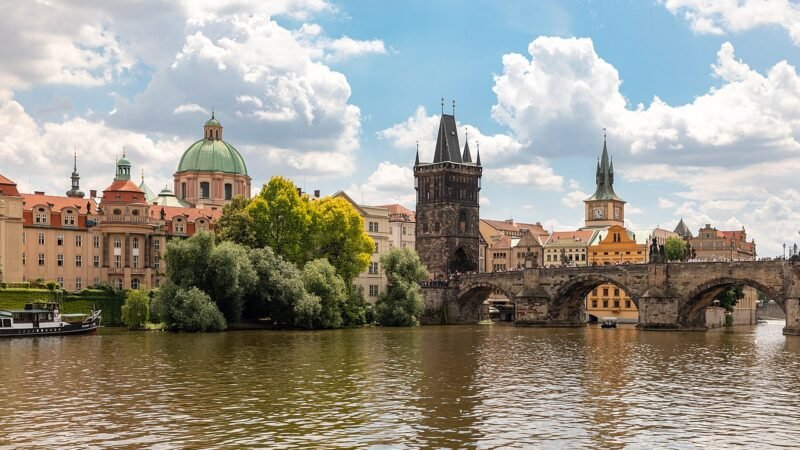
Prague, located in the Czech Republic, is the capital city and largest urban centre in the country, serving as a major cultural and historical hub in Central Europe. On this October day in 1956, the city experienced drizzly conditions typical of the season. The sun was in Libra, with the moon appearing as a waning crescent in the night sky.
On this day
On this date in 1887, the renowned composer Johannes Brahms conducted the premiere of his Double Concerto in A minor, a work he had composed specifically for the violinist Joseph Joachim and cellist Robert Hausmann. This concerto stands as one of Brahms' most significant chamber works and remains a cornerstone of the classical repertoire.
Three centuries earlier, in 1565, the first recorded naval engagement between Europeans and Japanese took place when a flotilla of samurai attacked two Portuguese trade vessels at the Battle of Fukuda Bay in Nagasaki. This encounter marked a pivotal moment in the initial contact between European traders and the Japanese military, establishing a pattern of interaction that would shape East-West relations for centuries to come.
World Menopause Day
World Menopause Day falls on 18 October each year and aims to raise awareness of the menopause and hormone replacement therapy options. The day was established by the International Menopause Society in 1999 to promote dialogue between healthcare professionals and women experiencing menopause. It addresses the clinical, social and psychological impact of menopause across all cultures and healthcare systems.
DayAtlas provides comprehensive historical information for any date and location worldwide, displaying weather conditions for the day, significant events, and notable births and deaths that occurred on that date.
Find out what's happening today in Prag.
What the Weather Had in Store for Prag on 28th November 2026
Patterns repeat until someone decides to step outside them.
Fortune of the Day
18th October in the Stars – Star Sign Libra
Personality Profile
Personality Those born on October 18th blend classic Libran diplomacy with Uranus's innovative edge. They appear charming and balanced, yet possess an unconventional streak that sets them apart from typical Libras. Their personality radiates both elegance and creative originality.
Strengths & Weaknesses Strengths include charm, fairness, and courage to pursue unusual solutions. They navigate conflicts skillfully and inject fresh ideas into situations. Weakness remains occasional indecision; the drive for innovation can breed restlessness.
Love In partnerships, these natives seek balance infused with intellectual stimulation. They need partners who understand their progressive nature and grant space for independence. Romance works only when mental connection and freedom are guaranteed.
Caree & Finance Career opportunities lie in fields merging diplomacy and innovation: design, technology, mediation, culture. Financial stability grows from trusting their unconventional abilities. They thrive in environments valuing creativity.
Health Stress relief comes through mental stimulation and social activity more than quiet rest alone. These natives benefit from regular movement that also balances their nervous system. Mental equilibrium matters as much as physical fitness.
That night, the moon was in its waning crescent phase.
Chinese year of the Monkey (Fire).
Fun Facts About 18th October
Name Days in Your Language: Blaine, Blair, Blane, Luca, Lucas, Lukas, Luke, Wynn, Wynton
Someone born on this day in 1956 would be 70 years old today — just 25,608 days into life, which is roughly 614,597 hours, 36,875,828 minutes, or 2,212,549,739 seconds spent on Earth so far.
It's the 292. day of the year. In 1956, 18th October falls on a Thursday.
As this is a leap year, there are 74 days still to come.
We’re currently in Week 42 — the year marches on.
Famous Birthdays on 18th October
On this day, 24 notable people were born on 18th October — spanning from 1954 to 1959. From world leaders to artists and scientists, discover who shares this birthday.
18/10/1959
Kirby Chambliss, American pilot
Kirby Chambliss is an American world champion aerobatic and air race pilot who raced in the Red Bull Air Race World Series under the Red Bull brand.
Mauricio Funes, Salvadoran politician, former president of El Salvador (died 2025)
Carlos Mauricio Funes Cartagena was a Salvadoran politician and journalist who served as the 41st president of El Salvador from 2009 to 2014. Funes won the 2009 presidential election as the candidate of the left-wing Farabundo Martí National Liberation Front (FMLN).
Milcho Manchevski, Macedonian-American director and screenwriter
Milcho Manchevski is a Macedonian-American film director, photographer and artist.
John Nord, American wrestler
John Eric Nord is an American retired professional wrestler. He is best known for his appearances with the American Wrestling Association and World Class Championship Wrestling in the 1980s as Nord the Barbarian and Yukon John and with the World Wrestling Federation, All Japan Pro Wrestling and World Championship Wrestling in the 1990s as The Berzerker and under his birth name.
18/10/1958
Thomas Hearns, American boxer
Thomas Hearns is an American former professional boxer who competed from 1977 to 2006. Nicknamed the "Motor City Cobra," and more famously "the Hitman," Hearns' tall, slender build and long arms and broad shoulders allowed him to move up over fifty pounds (23 kg) in his career and become the first boxer in history to win world titles in five weight divisions: welterweight, light middleweight, middleweight, super middleweight, and light heavyweight.
Megumi Ishii, Japanese actress and politician
Yoko Ishii , better known as Megumi Ishii is a Japanese actress and politician who is represented by the talent agency, Wonder Production. In 2015, she was elected to the Kunitachi Municipal Assembly.
Letitia James, American lawyer, activist and politician
Letitia Ann "Tish" James is an American lawyer and politician from the state of New York. She has served since 2019 as the 67th attorney general of New York (NYAG), having been first elected to the post in 2018. A member of the Democratic Party, James is the first Black person to serve as New York attorney general and is the first Black woman to hold statewide office in New York.
Kjell Samuelsson, Swedish ice hockey player and coach
Kjell William Alf Samuelsson is a Swedish former professional ice hockey defenseman who played 14 seasons in the National Hockey League (NHL) with the New York Rangers, Philadelphia Flyers, Pittsburgh Penguins, and Tampa Bay Lightning between 1985 and 1999. On December 17, 2018 he was named interim assistant coach of the Lehigh Valley Phantoms of the AHL. He was then the Flyers' director of player development for ten years, before being fired on June 1, 2023.
18/10/1957
Jon Lindstrom, American actor, director, producer, and screenwriter
Jon Robert Lindstrom is an American actor, writer, director, producer, and musician. He is well known for his roles of Kevin Collins and Ryan Chamberlain on the ABC Daytime soap opera General Hospital and its spin-off Port Charles. Since 2025, he has portrayed the role of Joey Armstrong on the CBS Daytime soap opera Beyond the Gates. In 2024 his debut novel Hollywood Hustle, published February 6 by Crooked Lane Books, is an official USA Today Bestseller.
Catherine Ringer, French singer-songwriter, dancer, and actress
Catherine Ringer was a French singer, songwriter, composer, multi-instrumentalist, dancer, choreographer, actress, pornographic performer, and co-founder of the pop rock group Les Rita Mitsouko. She was the daughter of French artist Sam Ringer. She was also the lead vocalist for Plaza Francia Orchestra where she performed with Eduardo Makaroff and Christoph H. Müller, formerly of Gotan Project.
18/10/1956
Craig Bartlett, American animator, producer, screenwriter, and voice actor
Craig Michael Bartlett is an American animator. He wrote, directed, created, and produced the Nickelodeon television series Hey Arnold! and the PBS Kids television series Dinosaur Train and Ready Jet Go!.
Martina Navratilova, Czech-American tennis player and coach
Martina Navratilova is a Czech-American former professional tennis player. She was ranked world No. 1 in women's singles for 332 weeks, including as the year-end No. 1 seven times, and was world No. 1 in women's doubles for a record 237 weeks. Navratilova won 167 top-level singles titles and 177 doubles titles, including an Open Era record 59 major titles: 18 in singles, an all-time record 31 in women's doubles, and an Open Era record 10 in mixed doubles. Her nine Wimbledon singles titles are an all-time record. Alongside Chris Evert, her greatest rival, Navratilova dominated women's tennis for much of the 1980s.
Jim Talent, American lawyer and politician
James Matthes Talent is an American politician who was a U.S. senator from Missouri from 2002 to 2007. He is a member of the Republican Party.
18/10/1955
Jean-Pierre Hautier, Belgian journalist and television host (died 2012)
Jean-Pierre Hautier was a Belgian television presenter and broadcaster for RTBF.
Vanessa Briscoe Hay, American singer-songwriter and keyboard player
Vanessa Briscoe Hay is an American singer for the Athens, Georgia bands Pylon, Supercluster and Pylon Reenactment Society.
Timmy Mallett, English radio and television host
Timmy Mallett is an English television presenter, broadcaster, author and artist. He is known for his striking visual style, colourful glasses and shirts, and a giant pink foam mallet, as well as his "utterly brilliant!" and "blaaah!" catchphrases.
Stu Mead, American painter and illustrator
Stuart "Stu" Mead is an American artist who lives and works in Berlin, Germany.
David Twohy, American director, producer, and screenwriter
David Neil Twohy is an American film director and screenwriter. He is known for working on science fiction-action films, most notably The Chronicles of Riddick series.
Rita Verdonk, Dutch journalist and politician, Dutch Minister of Justice
Maria Cornelia Frederika "Rita" Verdonk is a Dutch politician and businesswoman formerly affiliated with the People's Party for Freedom and Democracy (VVD) and later Proud of the Netherlands (TON), which she founded in 2007. Since 2022, she has been a municipal councillor of The Hague, elected on the list led by Richard de Mos.
Denis Watson, Zimbabwean golfer
Denis Leslie Watson is a professional golfer from Zimbabwe.
Mark Welland, English physicist and academic
Sir Mark Edward Welland, is a British physicist who is a professor of nanotechnology at the University of Cambridge and head of the Nanoscience Centre. He has been a fellow of St John's College, Cambridge, since 1986 and started his career in nanotechnology at IBM Research, where he was part of the team that developed one of the first scanning tunnelling microscopes. He served as the Master of St Catharine's College, Cambridge from 2016 to 2023.
18/10/1954
Nick Houghton, English general
Field Marshal John Nicholas Reynolds Houghton, Baron Houghton of Richmond, is a retired senior British Army officer and former Chief of the Defence Staff (CDS) of the British Armed Forces. He was appointed CDS in July 2013, following the retirement of General Sir David Richards. He served as commanding officer of the 1st Battalion, the Green Howards in Northern Ireland during The Troubles and later became Commander of the 39th Infantry Brigade in Northern Ireland. He deployed as Senior British Military Representative and Deputy Commanding General, Multi-National Force – Iraq during the Iraq War. Later, he became Chief of Joint Operations at Permanent Joint Headquarters and served as Vice-Chief of the Defence Staff until assuming the position of CDS. Houghton retired from the British Army in July 2016, and was succeeded as CDS by Air Chief Marshal Sir Stuart Peach.
Arliss Howard, American actor, director, producer, and screenwriter
Leslie Richard "Arliss" Howard is an American actor, screenwriter, and film director. He is known for his roles in the films Full Metal Jacket (1987), Tequila Sunrise (1988), The Lost World: Jurassic Park (1997), The Time Traveler's Wife (2009), Moneyball (2011), and Mank (2020).
Bob Weinstein, American film executive
Robert Weinstein is an American filmmaker and businessman. He was the founder and head of Dimension Films and former co-chairman of Miramax Films and the Weinstein Company (TWC), all of which he co-founded with his older brother, Harvey. Bob Weinstein is also the founder of Watch This Entertainment. He had focused on making action and horror films, as well as on "family films, comedies and upscale adult thrillers".
Lives Remembered on 18th October
On 18th October, 127 remarkable people passed away — from 31 to 2025. Remember the lives and legacies of those we lost on this day.
18/10/2025
Sam Rivers, American bassist (born 1977)
Samuel Robert Rivers was an American musician. He was the bassist, backing vocalist and one of the founding members of the nu metal band Limp Bizkit.
Yang Chen-Ning, Chinese theoretical physicist (born 1922)
Yang Chen-Ning also known as C.N. Yang and Franklin Yang, was a Chinese-American theoretical physicist who made significant contributions to statistical mechanics, integrable systems, gauge theory, particle physics and condensed matter physics.
Lia Smith, American diver and transgender rights advocate.
Lia Purcell Smith was an American student at Middlebury College in Middlebury, Vermont, who died by suicide on October 18, 2025, at the age of 21. She was reported missing by her father on October 19, 2025, and her body was found by the Vermont State Police near Middlebury College's organic farm in Cornwall, Vermont, on October 24, 2025. Smith, who was a transgender woman, was a member of the Middlebury Panthers women's swimming and diving team and experienced backlash, doxing, and deadnaming from critics of transgender women athletes.
18/10/2024
Yehuda Bauer, Israeli historian of the Holocaust (born 1926)
Yehuda Bauer was a Czech-born Israeli historian and scholar of the Holocaust. He was a professor of Holocaust studies at the Avraham Harman Institute of Contemporary Jewry at the Hebrew University of Jerusalem.
Ginés González García, Argentine politician and physician (born 1945)
Ginés Mario González García was an Argentine politician and physician who served twice as the country's Minister of Health under the successive presidencies of Eduardo Duhalde and Néstor Kirchner, from 2002 to 2007, and under President Alberto Fernández, from 2019 to 2021. A specialist in public healthcare, González García also served as Argentine Ambassador to Chile from 2007 to 2015.
18/10/2022
Harvey Wollman, American politician, 26th Governor of South Dakota (born 1935)
Harvey Lowell Wollman was an American politician who served as the 26th governor of South Dakota from 1978 to 1979. He was the first lieutenant governor in the history of South Dakota to succeed to the governorship. To date, he is the most recent Democrat to serve as South Dakota's governor.
18/10/2021
Colin Powell, American military leader and statesman, 65th Secretary of State (born 1937)
Colin Luther Powell was an American U.S. Army general, diplomat, and statesman who served as the 65th United States secretary of state from 2001 to 2005, being the first Black American to hold the office, and was the highest-ranking Black American in the federal executive branch in American history until the election of Barack Obama as president in 2008. Initially politically independent, Powell joined the Republican Party in 1995, but left it in 2021 following the January 6 United States Capitol attack. He was the 15th national security advisor from 1987 to 1989, and the 12th chairman of the Joint Chiefs of Staff from 1989 to 1993.
18/10/2020
René Felber, 81st President of the Swiss Confederation (born 1933)
René Felber was a Swiss politician. He was a member of the Swiss Federal Council from 1987 to 1993. In 1992, he served as the president of Switzerland.
18/10/2019
Rui Jordão, Angolan-born Portuguese footballer (born 1952)
Rui Manuel Trindade Jordão was a Portuguese footballer.
18/10/2018
Lisbeth Palme, Swedish child psychologist, former chairwoman of UNICEF (born 1931)
Anna Lisbeth Christina Palme was a Swedish children's psychologist, UNICEF chairwoman and the wife of Swedish prime minister Olof Palme, until his assassination in 1986.
Abdel Rahman Swar al-Dahab, 5th President of the Sudan (born 1934)
Abdel Rahman Suwar al-Dahab was a Sudanese military officer who served as the Head of State of Sudan from 6 April 1985, to 6 May 1986.
18/10/2017
Marino Perani, Italian football player and manager (born 1939)
Marino Perani was an Italian football manager and player, who played as a forward, usually as a winger.
18/10/2015
Robert Dickerson, Australian painter (born 1924)
Robert Henry Dickerson was an Australian figurative painter and former member of the Antipodeans group of artists. Dickerson is one of Australia's most recognised figurative artists and one of a generation of influential artists who include Ray Crooke, Charles Blackman, Laurence Hope, Margaret Olley and Inge King.
Gamal El-Ghitani, Egyptian journalist and author (born 1945)
Gamal al-Ghitani was an Egyptian author of historical and political novels and cultural and political commentaries and was the editor-in-chief of the literary periodical Akhbar Al-Adab till 2011.
Robert W. Farquhar, American engineer (born 1932)
Robert Willard Farquhar was an American mission design specialist who worked for NASA. He designed halo orbits and was involved in a number of spaceflight missions.
Frank Watkins, American bass player (born 1968)
Frank Watkins was an American heavy metal musician best known as a former, long-time bass player for the death metal band Obituary; he played with them from 1989 to 1997 and then from 2003 until 2010. He had been the bass player of the Norwegian black metal band Gorgoroth at the time of his death, where he had been known as Bøddel.
Paul West, English-American author, poet, and academic (born 1930)
Paul Noden West was a British-born American novelist, poet, and essayist. He was born in Eckington, Derbyshire in England to Alfred and Mildred (Noden) West. Before his death, he resided in Ithaca, New York, with his wife Diane Ackerman, a writer, poet, and naturalist. West is the author of more than 50 books.
18/10/2014
Mariano Lebrón Saviñón, Dominican author and academic (born 1922)
Mariano Lebrón Saviñón was a Dominican author of the 20th century. One of the founders of the second private university in the Dominican Republic, he named it the Universidad Nacional Pedro Henríquez Ureña, also writing its anthem. He was born on August 3, 1922, in Santo Domingo, the son of a Spanish immigrant, José Lebrón Morales, and a Dominican mother, Rosa Cándida Saviñón Pérez, of Canarian descent. He attended primary and secondary education in Santo Domingo. He received his medical degree at the University of Santo Domingo in 1946, and in 1949 in Buenos Aires, Argentina.
Edward Regan, American academic and politician (born 1930)
Edward Van Buren Regan was an American politician and public figure from New York State. He was a member of the Republican Party.
Sidney Shapiro, American-Chinese author and translator (born 1915)
Sidney Shapiro was an American-born Chinese actor, translator, and writer who lived in China from 1947 to 2014. He lived in Beijing for more than 50 years and became a member of the National Committee of the Chinese People's Political Consultative Conference. He was one of very few naturalized citizens of the People's Republic of China.
18/10/2013
Tom Foley, American lawyer and politician, 57th Speaker of the United States House of Representatives (born 1929)
Thomas Stephen Foley was an American lawyer, diplomat, and politician who served as the 49th speaker of the United States House of Representatives from 1989 to 1995. A member of the Democratic Party, Foley represented Washington's 5th congressional district for 30 years (1965–1995). He was the first speaker of the House in over a century since Galusha Grow in 1862 to be defeated in a re-election campaign.
Bum Phillips, American football player and coach (born 1923)
Oail Andrew "Bum" Phillips Jr. was an American football coach at the high school, college and professional levels. He served as head coach in the National Football League (NFL) for the Houston Oilers from 1975 to 1980 and the New Orleans Saints from 1981 to 1985.
Allan Stanley, Canadian ice hockey player and coach (born 1926)
Allan Herbert Stanley was a Canadian professional ice hockey defenceman who played for the New York Rangers, Chicago Blackhawks, Boston Bruins, Philadelphia Flyers and Toronto Maple Leafs of the National Hockey League (NHL) between 1948 and 1969. A four-time Stanley Cup winner and three-time member of the second NHL All-Star team, Stanley was inducted to the Hockey Hall of Fame in 1981.
Bill Young, American sergeant and politician (born 1930)
Charles William Young was an American politician who served in the United States House of Representatives from 1971 until his death in 2013. A Republican from Florida, Young served as chairman of the House Committee on Appropriations from 1999 to 2005. He was the longest-serving Republican member of Congress at the time of his death.
18/10/2012
Brain Damage, American wrestler (born 1977)
Marvin Lambert, best known by his ring name Brain Damage, was an American professional wrestler.
Sylvia Kristel, Dutch model and actress (born 1952)
Sylvia Maria Kristel was a Dutch actress and model who appeared in over 50 films. She was the eponymous character in five of the seven Emmanuelle films, including originating the role with Emmanuelle (1974).
Slater Martin, American basketball player and coach (born 1925)
Slater Nelson "Dugie" Martin Jr. was an American professional basketball player and coach who was a playmaking guard for 11 seasons in the National Basketball Association (NBA). A seven-time NBA All-Star, he won five championships. He is a member of the Naismith Memorial Basketball Hall of Fame.
George Mattos, American pole vaulter (born 1929)
George Mattos was an American pole vaulter. He competed for his native country in two Olympics, 1952 when he finished 9th and 1956 when he finished 4th, both times behind American teammate Bob Richards.
Albert Lee Ueltschi, American pilot and businessman, founded FlightSafety International (born 1917)
Albert Lee Ueltschi is considered the father of modern flight training and was the founder of FlightSafety International. Ueltschi was once personal pilot to Juan Trippe and an associate to Charles Lindbergh. On July 21, 2001, he was enshrined at Dayton, Ohio in the National Aviation Hall of Fame, along with test pilot Joe Engle, United States Marine Corps flying ace Marion Carl, and USAF ace Robin Olds. In 2013, Flying magazine ranked Ueltschi number 13 on its list of the "51 Heroes of Aviation".
David S. Ware, American saxophonist and composer (born 1949)
David Spencer Ware was an American jazz saxophonist, composer, and bandleader.
18/10/2010
Marion Brown, American saxophonist and musicologist (born 1931)
Marion Brown was an American jazz alto saxophonist, composer, writer, visual artist, and ethnomusicologist. He was a member of the avant-garde jazz scene in New York City during the 1960s, playing alongside musicians such as John Coltrane, Archie Shepp, and John Tchicai. He performed on Coltrane's landmark 1965 album Ascension. AllMusic reviewer Scott Yanow described him as "one of the brightest and most lyrical voices of the 1960s avant-garde."
Billy Raimondi, American baseball player (born 1912)
William Louis Raimondi was an American professional baseball catcher. He played in Minor League Baseball for 22 years, including 21 years in the Pacific Coast League (PCL). He played for the Oakland Oaks from 1932 to 1949, the Sacramento Solons from 1949 to 1950, and the Los Angeles Angels from 1951 to 1953. Raimondi is a member of the PCL Hall of Fame, elected in 1951.
18/10/2009
Adriaan Kortlandt, Dutch ethologist and biologist (born 1918)
Adriaan Kortlandt was a Dutch ethologist. He has been described together with Vernon Reynolds and Jane Goodall as "...one of a trio of pioneers ... who founded field studies of chimpanzees in the 1960s."
Nancy Spero, American painter and academic (born 1926)
Nancy Spero was an American visual artist known for her political and feminist paintings and hand pulled art prints.
18/10/2008
Dee Dee Warwick, American singer (born 1945)
Delia Juanita Warrick, known professionally as Dee Dee Warwick, was an American soul singer. Born in East Orange, New Jersey, she was the sister of singer Dionne Warwick, the niece of Cissy Houston, and a first cousin of singers Whitney Houston and Leontyne Price.
18/10/2007
Alan Coren, English journalist and author (born 1938)
Alan Coren was an English writer, humorist, broadcaster and satirist. He was a regular panellist on the BBC Radio quiz The News Quiz and a team captain on BBC television's Call My Bluff. Coren was the editor of Punch for almost a decade; later, he edited The Listener magazine.
William J. Crowe, American admiral and diplomat, United States Ambassador to the United Kingdom (born 1925)
William James Crowe Jr. was a United States Navy admiral and diplomat who served as the 11th chairman of the Joint Chiefs of Staff under presidents Ronald Reagan and George H. W. Bush, and as the ambassador to the United Kingdom and Chair of the Intelligence Oversight Board under President Bill Clinton.
Vincent DeDomenico, American businessman, founded the Napa Valley Wine Train (born 1915)
Vincent Michael "Vince" DeDomenico, Sr. was an American entrepreneur, one of the inventors of Rice-A-Roni, and a founder of the Napa Valley Wine Train.
Lucky Dube, South African singer-songwriter and keyboard player (born 1964)
Lucky Philip Dube was a South African reggae musician and Rastafarian. His record sales across the world earned him the Best Selling African Musician prize at the 1996 World Music Awards. In his lyrics, Dube discussed issues affecting South Africans and Africans in general to a global audience. He recorded 22 albums in a 25-year period and was Africa's best-selling reggae artist of all time. Dube was murdered in the Johannesburg suburb of Rosettenville on the evening of 18 October 2007.
18/10/2006
Mario Francesco Pompedda, Italian cardinal (born 1929)
Carlo Mario Francesco Pompedda was an Italian cardinal of the Roman Catholic Church and the Prefect of the Apostolic Signatura for the Roman Curia. He spent nearly fifty years in a variety of posts within the Catholic Church's ecclesiastical court system, from 1955 to 2004.
Anna Russell, English-Canadian singer and actress (born 1911)
Anna Russell was an English–Canadian singer and comedian. She gave many concerts in which she sang and played comic musical sketches, also playing the piano. Among her best-known works are her concert performances and recordings of The Ring of the Nibelungs – a humorous 22-minute synopsis of Wagner's Der Ring des Nibelungen – and her parody How to Write Your Own Gilbert and Sullivan Opera.
Laurie Taitt, Guyanese-English hurdler (born 1934)
John Lawrence Taitt was a British sprint hurdler. He was born in Georgetown, Demerara-Mahaica, British Guiana and competed at the 1964 Summer Olympics.
18/10/2005
Johnny Haynes, English-Scottish footballer (born 1934)
John Norman Haynes was an English association footballer who played as an inside forward. He made 56 appearances for his country including 22 as captain. He was selected for three World Cup finals squads playing in the latter two of those. Nicknamed "the Maestro", his attacking play was noted for two-footed passing ability, vision and deftness of touch. Haynes is widely regarded as Fulham's greatest ever player, remaining loyal there for twenty years despite coming no nearer to a major trophy win than two FA Cup semi-final appearances. Immediately following the abolition of the £20 maximum wage in 1961, he became the first player to be paid £100 a week. He also had a spell on loan with Toronto City in 1961 and ended his playing days at Durban City, winning there the only trophy he won in his football career.
Bill King, American sportscaster (born 1927)
Wilbur King was an American sports announcer. In 2016, the National Baseball Hall of Fame named King recipient of the 2017 Ford C. Frick Award, the highest honor for American baseball broadcasters.
18/10/2003
Preston Smith, American businessman and politician, 40th Governor of Texas (born 1912)
Preston Earnest Smith was an American entrepreneur and politician who served as the 40th governor of Texas from 1969 to 1973. A conservative member of the Democratic Party, he previously served as the 35th lieutenant governor from 1963 to 1969. He was elected to the Texas House of Representatives in 1945 and served until 1951 and to the Texas Senate in 1957.
Manuel Vázquez Montalbán, Spanish journalist, author, and critic (born 1939)
Manuel Vázquez Montalbán was a prolific Spanish writer from Barcelona: journalist, novelist, poet, essayist, anthologue, prologist, humorist, critic and political prisoner as well as a gastronome and an FC Barcelona supporter.
18/10/2000
Julie London, American singer and actress (born 1926)
Julie London was an American singer and actress whose career spanned more than 40 years. A torch singer noted for her contralto voice, London recorded over thirty albums of pop and jazz standards between 1955 and 1969. Her recording of "Cry Me a River", a song she introduced on her debut album Julie Is Her Name, was inducted into the Grammy Hall of Fame in 2001. In addition to her musical renown, London was nominated for a Golden Globe Award in 1974 for her portrayal of Nurse Dixie McCall in the television series Emergency!
Gwen Verdon, American actress and dancer (born 1925)
Gwyneth Evelyn "Gwen" Verdon was an American actress and dancer. She won four Tony Awards for her musical comedy performances, and she served as an uncredited choreographer's assistant and specialty dance coach for theater and film. Verdon was a critically acclaimed performer on Broadway in the 1950s, 1960s, and 1970s, having originated many roles in musicals, including Lola in Damn Yankees, the title character in Sweet Charity, and Roxie Hart in Chicago.
18/10/1987
Adriaan Ditvoorst, Dutch director and screenwriter (born 1940)
Adriaan Ditvoorst was a Dutch film director and screenwriter. He directed nine films between 1965 and 1984. His 1967 film Paranoia was entered into the 17th Berlin International Film Festival.
18/10/1984
Henri Michaux, French painter and poet (born 1899)
Henri Michaux was a Belgian-born French experimental poet, writer and painter. Michaux is renowned for his strange, highly original poetry and prose, and also for his art: the Paris Museum of Modern Art and the Guggenheim Museum in New York had shows of his work in 1978. His autobiographical texts that chronicle his psychedelic experiments with LSD and mescaline include Miserable Miracle and The Major Ordeals of the Mind and the Countless Minor Ones. He is recognised for his idiosyncratic travelogues and books of art criticism. Michaux is also known for his stories about Plume – "a peaceable man" – one of the most unenterprising heroes in literature, a character subject to many misfortunes.
18/10/1983
Diego Abad de Santillán, Spanish economist and author (born 1897)
Sinesio Baudillo García Fernández, commonly known by his pseudonym Diego Abad de Santillán, was a Spanish Argentine anarcho-syndicalist economist. Born in León, his family moved to Argentina while he was young. He returned to Spain for his higher education and became involved in the Spanish anarchist movement. After his studies, he went back to Argentina and became involved with the Argentine Regional Workers' Federation (FORA), co-founding the International Workers' Association (IWA). Following the 1930 Argentine coup d'état and the establishment of the Second Spanish Republic, he again went to Spain, becoming involved in the Iberian Anarchist Federation (FAI). During the Spanish Civil War, he served in the Catalan government as Minister of Economy. After the war, he returned to Argentina and largely ceased political activities, going back to Spain only after the Spanish transition to democracy.
Willie Jones, American baseball player (born 1925)
Willie Edward Jones, nicknamed "Puddin' Head", was an American professional baseball third baseman who played in Major League Baseball (MLB) for the Philadelphia Phillies (1947–1959), Cleveland Indians (1959), and Cincinnati Reds (1959–1961). He batted and threw right-handed.
18/10/1982
Dwain Esper, American director and producer (born 1892)
Dwain Atkins Esper was an American director and producer of exploitation films.
Pierre Mendès France, French lawyer and politician, 143rd Prime Minister of France (born 1907)
Pierre Isaac Isidore Mendès France was a French politician who served as prime minister of France for eight months from 1954 to 1955. As a member of the Radical Party, he headed a government supported by a coalition of Gaullists (RPF), moderate socialists (UDSR), Christian democrats (MRP) and liberal-conservatives (CNIP). Pierre-Mendès France is primarily remembered as the French Prime Minister who was in office at the outbreak of the Algerian independence war in 1954. During his tenure, France initiated close military cooperation with Israel, selling arms and aircraft to the young state. Mendès-France laid the groundwork for France’s military nuclear program and the early transfer of nuclear technology to Israel.
John Robarts, Canadian lawyer and politician, 17th Premier of Ontario (born 1917)
John Parmenter Robarts was a Canadian lawyer and politician who served as the 17th premier of Ontario from 1961 to 1971. He was a member of the Progressive Conservative Party of Ontario.
Bess Truman, American wife of Harry S. Truman, 40th First Lady of the United States (born 1885)
Elizabeth Virginia Truman was First Lady of the United States from 1945 to 1953 as the wife of President Harry S. Truman. She had previously served as Second Lady of the United States from January to April 1945. At 97 years, 247 days, she was the longest-lived first and second spouse.
18/10/1980
Edwin Way Teale, American photographer and author (born 1899)
Edwin Way Teale was an American naturalist, photographer and writer. Teale's works serve as primary source material documenting environmental conditions across North America from 1930–1980. He is perhaps best known for his series The American Seasons, four books documenting over 75,000 miles (121,000 km) of automobile travel across North America following the changing seasons.
18/10/1978
Ramón Mercader, Spanish journalist, assassin of Leon Trotsky (born 1914)
Jaime Ramón Mercader del Río was a Spanish communist and NKVD secret agent who assassinated the revolutionary Leon Trotsky in Mexico City in August 1940 with an ice axe, for which Mercader was imprisoned for 19 years and 8 months.
18/10/1977
Andreas Baader, German militant (born 1943)
Berndt Andreas Baader was a West German communist and leader of the far-left terrorist organization Red Army Faction (RAF), also commonly known as the Baader-Meinhof Group.
Gudrun Ensslin, German militant leader, founded the Red Army Faction (born 1940)
Gudrun Ensslin was a German far-left terrorist and founder of the West German far-left militant group Red Army Faction.
18/10/1976
Viswanatha Satyanarayana, Indian poet and author (born 1895)
Viswanatha Satyanarayana was a 20th-century Telugu writer. His works included poetry, novels, dramatic play, short stories and speeches, covering a wide range of subjects such as analysis of history, philosophy, religion, sociology, political science, linguistics, psychology and consciousness studies, epistemology, aesthetics and spiritualism. He was a student of the illustrious Telugu writer Chellapilla Venkata Sastry, of the Tirupati Venkata Kavulu duo. Viswanatha's wrote in both a modern and classical style, in complex modes. His popular works include Ramayana Kalpavrukshamu, Kinnersani Patalu and the novel Veyipadagalu. Among many awards, he was awarded the Jnanpith Award in 1970, the first for a Telugu writer, and Padma Bhushan in 1971.
18/10/1975
K. C. Douglas, American rural blues singer (born 1913)
K. C. Douglas was an American rural blues singer and guitarist.
Al Lettieri, American actor (born 1928)
Alfredo Anthony Lettieri was an American actor and screenwriter. Active during the 1960s and 1970s, he commonly portrayed villainous characters. Lettieri achieved recognition for his performance as mobster Virgil Sollozzo in the crime film The Godfather (1972), and appeared in several other productions alongside Hollywood's biggest screen stars.
Graham Haberfield, English actor (born 1941)
Coronation Street is a British soap opera, initially produced by Granada Television. Created by writer Tony Warren, Coronation Street first broadcast on ITV on 9 December 1960. The following is a list of characters introduced in the show's third year, by order of first appearance.
18/10/1973
Margaret Caroline Anderson, American publisher, founded The Little Review (born 1886)
Margaret Caroline Anderson was the American founder, editor and publisher of the art and literary magazine The Little Review, which published a collection of modern American, English and Irish writers between 1914 and 1929. The periodical is most noted for introducing many prominent American and British writers of the 20th century, such as Ezra Pound and T. S. Eliot, in the United States and publishing the first thirteen chapters of James Joyce's then-unpublished novel Ulysses.
Walt Kelly, American illustrator and animator (born 1913)
Walter Crawford Kelly Jr. was an American animator and cartoonist, best known for the comic strip Pogo. He began his animation career in 1936 at Walt Disney Productions, contributing to Pinocchio, Fantasia, and Dumbo. In 1941, at the age of 28, Kelly transferred to work at Dell Comics, where he created Pogo, which eventually became his platform for political and philosophical commentary.
Leo Strauss, German-American political scientist, philosopher, and academic (born 1899)
Leo Strauss was a German-American political philosopher and historian of philosophy whose work greatly influenced twentieth-century political theory in the United States and the study of classical political thought. He is known best for his interpretation of ancient and medieval philosophy, his account of classical natural right, and his claim that philosophers often wrote esoterically, presenting different teachings to general and specialist readers. Strauss argued that the modern turn in philosophy, beginning with Niccolò Machiavelli and culminating in historicism and relativism, marked a decisive break with the classical understanding of politics and the good life. His work sought to recover the questions and methods of ancient political philosophy as a corrective to the perceived crisis of modern thought.
18/10/1969
Gyula Mándi, Hungarian footballer and manager (born 1899)
Gyula Mándi, also referred to as Mándi Gyula or Julius Mandel was a Hungarian Olympic national team and club footballer, who played as a defender and fullback/ He was also a manager of club and national teams. He was Jewish.
18/10/1966
Elizabeth Arden, Canadian-American businesswoman, founded Elizabeth Arden, Inc. (born 1878)
Elizabeth Arden, also known as Elizabeth N. Graham, was a Canadian-American businesswoman who founded what is now Elizabeth Arden, Inc., and built a cosmetics empire in the United States.
S. S. Kresge, American businessman, founded Kmart (born 1867)
Sebastian Spering Kresge was an American merchant and businessman. He created and owned two chains of department stores: the S. S. Kresge Company, one of the 20th century's largest discount retail organizations, and the Kresge-Newark traditional department store chain. The discounter was renamed the Kmart Corporation in 1977.
18/10/1965
Henry Travers, Irish-American actor (born 1874)
Travers John Heagerty, known professionally as Henry Travers, was an English film and stage character actor who specialised in portraying slightly bumbling but amiable and likeable older men. His best known role to today's audiences was the guardian angel Clarence Odbody in the 1946 film It's a Wonderful Life. He also received an Academy Award nomination for his supporting role in Mrs. Miniver (1942). Other notable films include The Invisible Man (1933), Dark Victory (1939), High Sierra (1941), and The Bells of St. Mary's (1945).
18/10/1962
Iván Petrovich, Serbian-German actor and singer (born 1894)
Iván Petrovich was a Serbian film actor and singer.
18/10/1961
Tsuru Aoki, Japanese-American actress (born 1892)
Tsuru Aoki was a Japanese stage and screen actress whose career was most prolific in the United States during the silent film era of the 1910s through the 1920s. Aoki may have been the first Asian actress to garner top billing in American motion pictures.
18/10/1959
Boughera El Ouafi, Algerian-French runner (born 1903)
Ahmed Boughera El Ouafi was a French Algerian marathon runner who represented France at the 1924 and 1928 Summer Olympics, winning gold in the latter. He was largely unacknowledged in his lifetime, facing discrimination in France due to his Algerian origin, but received posthumous recognition.
18/10/1956
Yoshio Markino, Japanese painter and author (born 1869)
Yoshio Markino was a Japanese artist and author who from 1897 – 1942 was based in London. During the Edwardian years of 1903 – 1915 he was the most well known Japanese person living in London, and was widely praised for bridging the Japanese and Western artistic aesthetic in his artwork, particularly in his depiction of London's fog, gaslights and wet streets, which became his hallmark. Like his contemporaries Whistler and Monet, he viewed the London fog from an outsider's point of view and marvelled at the effect it had on light, both natural and artificial. Markino became known affectionately as Heiji of London Fog, and wrote: 'I think London without mists would be like a bride without a trousseau'. His autobiography A Japanese Artist in London, published in 1910 and written in an eccentric style, described his years of extreme poverty in London while trying to establish himself as an illustrator and artist. From his early years he was fascinated by Western culture and remained a committed Anglophile all his life.
18/10/1948
Walther von Brauchitsch, German field marshal (born 1881)
Walther Heinrich Alfred Hermann von Brauchitsch was a German Generalfeldmarschall and Commander-in-Chief (Oberbefehlshaber) of the German Army during the first two years of World War II. Born into an aristocratic military family, he entered army service in 1901. During World War I, he served with distinction on the corps-level and division-level staff on the Western Front.
18/10/1947
Michiaki Kamada, Japanese admiral (born 1890)
Michiaki Kamada was a vice-admiral of the Imperial Japanese Navy who saw service in the Pacific Theatre of World War II.
18/10/1943
Pere Areny, Andorran convicted murderer, last person executed by Andorra (born 1913)
Pere Areny Aleix was an Andorran man who was the last person to be executed by Andorra.
18/10/1942
Mikhail Nesterov, Russian painter (born 1862)
Mikhail Vasilyevich Nesterov was a Russian and Soviet painter; associated with the Peredvizhniki and Mir iskusstva. He was one of the first exponents of Symbolist art in Russia.
18/10/1941
Manuel Teixeira Gomes, Portuguese lawyer and politician, 7th President of Portugal (born 1860)
Manuel Teixeira Gomes was a Portuguese politician who served as the President of Portugal from 1923 to 1925.
18/10/1935
Gaston Lachaise, French-American sculptor (born 1882)
Gaston Lachaise was a French-born sculptor, active in America in the early 20th century. A native of Paris, he is most noted for his robust female nudes such as his heroic Standing Woman. Gaston Lachaise was taught the fundamentals of European sculpture while living in France. While still a student, he met and fell in love with an older American woman, Isabel Dutaud Nagle, then followed her after she returned to America. There, he became profoundly impressed by the great vitality and promise of his adopted country. Those life-altering experiences clarified his artistic vision and inspired him to define the female nude in a new and powerful manner. His drawings, typically made as ends in themselves, also exemplify his remarkably new treatment of the female body.
18/10/1934
Santiago Ramón y Cajal, Spanish pathologist, histologist, and neuroscientist, Nobel Prize laureate (born 1852)
Santiago Ramón y Cajal was a Spanish neuroscientist, pathologist, and histologist specialising in neuroanatomy, and the central nervous system. He and Camillo Golgi received the Nobel Prize in Physiology or Medicine in 1906. Ramón y Cajal was the first Spaniard to win a scientific Nobel Prize. His original investigations of the microscopic structure of the brain made him a pioneer of modern neuroscience.
18/10/1931
Thomas Edison, American engineer and businessman, invented the phonograph (born 1847)
Thomas Alva Edison was an American inventor and businessman known for his work on the incandescent light bulb, the phonograph, electric power distribution and early motion pictures. The merger of the Edison General Electric Company and the competitor Thomson-Houston Electric Company resulted in the formation of General Electric. Edison registered 1,093 patents in the United States.
Lesser Ury, German painter (born 1861)
Leo Lesser Ury was a German impressionist painter and printmaker, associated with the Düsseldorf school of painting.
18/10/1921
Ludwig III of Bavaria (born 1845)
Ludwig III was the last King of Bavaria, reigning from 1913 to 1918. Initially, he served in the Bavarian military as a lieutenant and went on to hold the rank of Oberleutnant during the Austro-Prussian War. He entered politics at the age of 18, as a member of the Bavarian parliament, and was a keen participant, supporting electoral reforms. Later in life, he served as regent and de facto head of state from 1912 to 1913, ruling for his incapacitated cousin, Otto. After the Bavarian parliament passed a law allowing him to do so, Ludwig deposed Otto and assumed the throne for himself. He led Bavaria during World War I. His short reign was seen as championing conservative causes and he was influenced by the Catholic encyclical Rerum novarum.
18/10/1911
Alfred Binet, French psychologist and author (born 1857)
Alfred Binet, born Alfredo Binetti, was a French psychologist who together with Théodore Simon invented the first practical intelligence test, the Binet–Simon Intelligence Test. In 1904, Binet took part in a commission set up by the French Ministry of Education to decide whether school children with learning difficulties should be sent to a special boarding school attached to a lunatic asylum, as advocated by the French psychiatrist and politician Désiré-Magloire Bourneville, or whether they should be educated in classes attached to regular schools as advocated by the Société libre pour l'étude psychologique de l'enfant (SLEPE) of which Binet was a member. There was also debate over who should decide whether a child was capable enough for regular education. Bourneville argued that a psychiatrist should do this based on a medical examination. Binet and Simon wanted this to be based on objective evidence. This was the beginning of the IQ test. A preliminary version was published in 1905. The full version was published in 1908, and slightly revised in 1911, just before Binet's death.
18/10/1908
Nozu Michitsura, Japanese field marshal (born 1840)
Field Marshal Marquess Nozu Michitsura was a Japanese field marshal and leading figure in the early Imperial Japanese Army.
18/10/1893
Charles Gounod, French composer and educator (born 1818)
Charles-François Gounod was a French composer, conductor, and organist of the Romantic era. He wrote twelve operas, of which the most popular has always been Faust (1859); his Roméo et Juliette (1867) also remains in the international repertoire. He composed a large amount of church music, many songs, and popular short pieces including his "Ave Maria" and "Funeral March of a Marionette".
18/10/1892
William W. Chapman, American lawyer and politician (born 1808)
William Williams Chapman was an American politician and lawyer in Oregon and Iowa. He was born and raised in Virginia. He served as a United States Attorney in Iowa when it was part of the Michigan and Wisconsin territories, and then represented the Iowa Territory in the United States House of Representatives. He later immigrated to the Oregon Country, where he served in the Oregon Territorial Legislature.
18/10/1889
Antonio Meucci, Italian-American engineer (born 1808)
Antonio Santi Giuseppe Meucci was an Italian inventor and an associate of Giuseppe Garibaldi, a major political figure in the history of Italy. Meucci is best known for developing a voice-communication apparatus that several sources credit as the first telephone.
18/10/1886
Philipp Franz von Siebold, German physician and botanist (born 1796)
Jhr. Philipp Franz Balthasar von Siebold was a German physician, botanist and traveller. He achieved prominence by his studies of Japanese flora and fauna. He was the father of the first female Japanese doctor educated in Western medicine, Kusumoto Ine.
18/10/1876
Francis Preston Blair, American journalist (born 1791)
Francis Preston Blair Sr. was an American journalist, newspaper editor, and influential figure in national politics advising various U.S. presidents across party lines. He was an early member of the Democratic Party, and a strong supporter of President Andrew Jackson, having helped him win Kentucky in the 1828 presidential election. From 1831 to 1845, Blair worked as Editor-in-Chief of the Washington Globe, which served as the primary propaganda instrument for the Democratic Party, and was largely successful. He was an influential advisor to President Jackson, and served prominently in a group of unofficial advisors and assistants known as the "Kitchen Cabinet".
18/10/1871
Charles Babbage, English mathematician and engineer, invented the mechanical computer (born 1791)
Charles Babbage was an English polymath. A mathematician, philosopher, inventor and mechanical engineer, Babbage originated the concept of a digital programmable computer.
18/10/1865
Henry John Temple, 3rd Viscount Palmerston, English soldier and politician, Prime Minister of the United Kingdom (born 1784)
Henry John Temple, 3rd Viscount Palmerston, known as Lord Palmerston, was an Anglo-Irish nobleman and statesman who was Prime Minister of the United Kingdom from 1855 to 1858 and from 1859 to his death in 1865. A member of the Tory, Whig and Liberal parties, Palmerston was also the first Liberal prime minister. An ideologue of free trade and a major sponsor of the Opium Wars against the Chinese Empire and the war against Egypt, he dominated British foreign policy from 1830 to 1865 when Britain stood at the height of its imperial power.
18/10/1817
Etienne Nicolas Méhul, French pianist and composer (born 1763)
Étienne Nicolas Méhul was a French composer of the late classical and early romantic periods. He was known as "the most important opera composer in France during the Revolution". He was also the first composer to be called a "Romantic". He is known particularly for his operas, written in keeping with the reforms introduced by Gluck and Mozart.
18/10/1775
Christian August Crusius, German philosopher and theologian (born 1715)
Christian August Crusius was a German philosopher and Protestant theologian.
18/10/1770
John Manners, Marquess of Granby, English general and politician, Lord Lieutenant of Derbyshire (born 1721)
Lieutenant-General John Manners, Marquess of Granby was a British Army officer and politician. The eldest son of John Manners, 3rd Duke of Rutland, as he did not outlive his father and inherit the dukedom, Manners was known by his father's subsidiary title, Marquess of Granby. He served in the military during the Jacobite rising of 1745 and the Seven Years' War, being subsequently rewarded with the post of Commander-in-Chief of the Forces. Manners was popular with the troops who served under him and many British pubs are still named after him today.
18/10/1744
Sarah Churchill, Duchess of Marlborough (born 1660)
Sarah Churchill, Duchess of Marlborough was an English courtier and noblewoman who became one of the most influential women of her time through her close relationship with Anne, Queen of Great Britain. Churchill's influence on Anne was widely known, and leading public figures often turned their attentions to her, hoping to attain favour from the queen.
18/10/1739
António José da Silva, Brazilian-Portuguese playwright (born 1705)
António José da Silva Coutinho was a Brazilian-Portuguese dramatist born in colonial Brazil, known as "the Jew". The Brazilian spelling of his first name is Antônio; António José da Silva Coutinho in Hebrew is אנטוניו ז'וזה דה סילווה.
18/10/1678
Jacob Jordaens, Belgian painter illustrator (born 1593)
Jacques "Jacob" Jordaens was a Flemish painter, draughtsman and a designer of tapestries and prints. He was a prolific artist who created biblical, mythological, and allegorical compositions, genre scenes, landscapes, illustrations of Flemish sayings and portraits. After the death of Rubens and Anthony van Dyck, he became the leading Flemish Baroque painter of his time. Unlike those illustrious contemporaries he never travelled abroad to study the Antique and Italian painting and, except for a few short trips to locations elsewhere in the Low Countries, he resided in Antwerp his entire life. He also remained largely indifferent to Rubens and van Dyck's intellectual and courtly aspirations. He expressed this attitude in his art by avoiding idealistic treatment of his subject in contrast to these contemporaries.
18/10/1667
Fasilides, Ethiopian emperor (born 1603)
Fasilides, also known as Fasil, Basilide, or Basilides, was Emperor of Ethiopia from 1632 to his death on 18 October 1667, and a member of the Solomonic dynasty. His throne name was Alam Sagad.
18/10/1646
Isaac Jogues, French priest, missionary, and martyr (born 1607)
Isaac Jogues was a French missionary and martyr who traveled and worked among the Haudenosaunee, Wendat (Huron), and other Native populations in North America. He was the first European to name Lake George, calling it Lac du Saint Sacrement. In 1646, Jogues was martyred by the Mohawk at their village of Ossernenon, near the Mohawk River.
18/10/1604
Igram van Achelen, Dutch lawyer and politician (born 1528)
Igram van Achelen was a Dutch statesman.
18/10/1570
Manuel da Nóbrega, Portuguese-Brazilian priest and missionary (born 1517)
Manuel da Nóbrega, SJ was a Portuguese Jesuit priest and the first provincial of the Society of Jesus in colonial Brazil. Together with José de Anchieta, he was very influential in the early history of Brazil. He participated in the founding of several cities, such as Recife, Salvador, Rio de Janeiro, and São Paulo, as well as many Jesuit colleges and seminaries.
18/10/1564
Johannes Acronius Frisius, Dutch physician and mathematician (born 1520)
Johannes Acronius Frisius was a Dutch medical doctor and mathematician of the 16th century.
18/10/1561
Yamamoto Kansuke, Japanese samurai (born 1501)
Yamamoto Kansuke was a Japanese samurai of the Sengoku period. He was known as one of the "Twenty-Four Generals of Takeda Shingen". Also known by his formal name, Haruyuki (晴幸). He was a brilliant strategist, and is particularly known for his plan which led to success in the fourth battle of Kawanakajima against Uesugi Kenshin. However, Kansuke never lived to see his plan succeed; thinking it to have failed, he charged headlong into the enemy ranks, dying in battle.
18/10/1558
Mary of Hungary (born 1505)
Mary of Austria, also known as Mary of Hungary, was Queen of Hungary and Bohemia as the wife of King Louis II, and was later governor of the Habsburg Netherlands.
18/10/1545
John Taverner, English organist and composer (born 1490)
John Taverner was an English composer and organist, regarded as one of the most important English composers of his era. He is best-known for Missa Gloria tibi Trinitas and The Western Wynde Mass, and Missa Corona Spinea is also often viewed as a masterwork.
18/10/1541
Margaret Tudor, queen of James IV of Scotland (born 1489)
Margaret Tudor was Queen of Scotland from 1503 until 1513 as the wife of James IV. She then served as regent of Scotland during her son's minority, and fought to extend her regency. Margaret was the eldest daughter of Henry VII of England and Elizabeth of York, and the elder sister of Henry VIII. Through her descendants, the House of Stuart eventually acceded to the thrones of England and Ireland, culminating in the "Union of the Crowns" under her great-grandson James VI and I in 1603 following the death of her niece Elizabeth I.
18/10/1526
Lucas Vázquez de Ayllón, Spanish explorer (born 1475)
Lucas Vázquez de Ayllón was a Spanish magistrate and explorer who in 1526 established the short-lived San Miguel de Gualdape colony, one of the first European attempts at a settlement in what is now the United States. Ayllón's account of the region inspired a number of later attempts by the Spanish and French governments to colonize the southeastern United States.
18/10/1511
Philippe de Commines, French-speaking Fleming in the courts of Burgundy and France (born 1447)
Philippe de Commines was a writer and diplomat in the courts of Burgundy and France. He has been called "the first truly modern writer" and "the first critical and philosophical historian since classical times". Neither a chronicler nor a historian in the usual sense of the word, his analyses of the contemporary political scene are what made him virtually unique in his own time.
18/10/1508
Patrick Hepburn, 1st Earl of Bothwell, Lord High Admiral of Scotland
Patrick Hepburn, 1st Earl of Bothwell was Lord High Admiral of Scotland. He rose to political prominence after supporting James IV against his father, and was proxy at the King's marriage.
18/10/1503
Pope Pius III (born 1439)
Pope Pius III, born Francesco Todeschini, then Francesco Todeschini-Piccolomini, was head of the Catholic Church and leader of the Papal States from 22 September 1503 to his death. At just twenty-six days, he had one of the shortest pontificates in papal history.
18/10/1480
Uhwudong, Korean dancer and poet (born 1440)
Ŏudong or Eoudong, personal name Pak Guma, was a Korean dancer, writer, artist, and poet from a noble family during the Joseon period of dynastic Korea. Most of her work has not been preserved. Historical records remember her as one of the most infamous women of her time.
18/10/1442
Infante João of Portugal (born 1400)
Infante John, Constable of Portugal was a Portuguese infante (prince) of the House of Aviz, Constable of Portugal and master of the Portuguese Order of St. James (Santiago). In Portugal, he is commonly referred to as the O Infante Condestável.
18/10/1417
Pope Gregory XII (born 1326)
Pope Gregory XII, born Angelo Corraro, Corario, or Correr, was head of the Catholic Church from 30 November 1406 to 4 July 1415. Reigning during the Western Schism, he was opposed by the Avignon claimant Benedict XIII and the Pisan claimants Alexander V and John XXIII. Gregory XII wanted to unify the Church and voluntarily resigned in 1415 to end the schism.
18/10/1382
James Butler, 2nd Earl of Ormond, Irish politician, Lord Justice of Ireland (born 1331)
James Butler, 2nd Earl of Ormond was a noble in the Peerage of Ireland. He was Lord Justice of Ireland in 1359, 1364, and 1376, and a dominant political leader in Ireland in the 1360s and 1370s.
18/10/1366
Petrus Torkilsson, Archbishop of Uppsala
Petrus Torkilsson was Bishop of Linköping, 1342–1351 and Archbishop of Uppsala, Sweden, 1351–1366.
18/10/1214
John de Gray, bishop of Norwich
John de Gray or de Grey was an English prelate who served as Bishop of Norwich, and was elected but unconfirmed Archbishop of Canterbury. He was employed in the service of Prince John even before John became king, for which he was rewarded with a number of ecclesiastical offices, culminating in his pro forma election to Norwich in 1200. De Gray continued in royal service after his elevation to the episcopate, lending the King money and undertaking diplomatic missions on his behalf. In 1205, King John attempted to further reward de Gray with a translation to the archbishopric of Canterbury, but a disputed election process led to de Gray's selection being quashed by Pope Innocent III in 1206.
18/10/1141
Leopold, Duke of Bavaria (born 1108)
Leopold, known as Leopold the Generous, was Margrave of Austria from 1136, and Duke of Bavaria from 1139 until his death in 1141.
18/10/1101
Hugh I, Count of Vermandois (born 1053)
Hugh, called the Great was the first count of Vermandois from the House of Capet. His wife, Adelaide de Vermandois was the heiress and holder of the title of Countess of Vermandois, holding the lineage rights, but Hugh ruled as Count of Vermandois jure uxoris from 1085 to 1101. He is known primarily for being one of the leaders of the First Crusade. His nickname Magnus is probably a bad translation into medieval Latin of an Old French nickname, le Maisné, meaning "the younger", referring to Hugh as younger brother of King Philip I of France.
18/10/1081
Nikephoros Palaiologos, Byzantine general
Nikephoros Palaiologos was a Byzantine general of the 11th century.
18/10/1035
Sancho III of Pamplona (born 992)
Sancho Garcés III, also known as Sancho the Great, was the King of Pamplona from 1004 until his death in 1035. He also ruled the County of Aragon and by marriage the counties of Castile, Álava and Monzón. He later added the counties of Sobrarbe (1015), Ribagorza (1018) and Cea (1030), and would intervene in the Kingdom of León, taking its eponymous capital city in 1034.
18/10/0815
Abu'l-Saraya, Zaydi rebel leader
Abu'l-Sarāyā al-Sarī ibn Manṣūr al-Shaybānī was leader of a Zaydi revolt against the Abbasid Caliphate in Kufa and Iraq in 815. The revolt spread quickly across southern Iraq, and his agents even took over Mecca and Medina. At one point, the rebels threatened even Baghdad, but the Abbasid general Harthama ibn A'yan drove them back to Kufa in a series of victories. Forced to abandon Kufa in late August, Abu'l-Saraya and his followers tried to flee, but were pursued, defeated, and captured. Abu'l-Saraya himself was executed at Baghdad on 18 October. The uprising continued in the Hejaz for a few months under Muhammad ibn Ja'far al-Sadiq as anti-caliph at Mecca, until this too was suppressed by the Abbasid troops.
18/10/0707
Pope John VII (born 650)
Year 707 (DCCVII) was a common year starting on Saturday of the Julian calendar. The denomination 707 for this year has been used since the early medieval period, when the Anno Domini calendar era became the prevalent method in Europe for naming years.
18/10/0325
Emperor Ming of Jin (born 299)
Emperor Ming of Jin (simplified Chinese: 晋明帝; traditional Chinese: 晉明帝; pinyin: Jìn Míng Dì; Wade–Giles: Chin Ming-ti; 299 – 18 October 325, personal name Sima Shao, courtesy name Daoji, was an emperor of the Eastern Jin dynasty of China. During his brief reign, he led the weakened Jin out of domination by the warlord Wang Dun, but at his early death, the empire was left to his young son Emperor Cheng, and the fragile balance of power that he created was soon broken, leading to the Su Jun Disturbance and weakening the Jin state even further. Subsequent Eastern Jin emperors until Emperor Fei were his descendants, being either his sons or grandsons.
18/10/0031
Lucius Aelius Sejanus, Roman politician (born 20 BC)
The 30s decade ran from January 1, AD 30, to December 31, AD 39.
Celebrations & Special Days Worldwide on 18th October
Alaska Day (Alaska, United States)
Alaska Day is a legal holiday in the U.S. state of Alaska, observed on October 18. It is the anniversary of the formal transfer of territories in present-day Alaska from the Russian Empire to the United States, which occurred on Friday, 18 October [O.S. 6 October] 1867.
Christian feast day: Asclepiades of Antioch
Asclepiades of Antioch called the Confessor, was Patriarch of Antioch from 211 until his death. He succeeded Serapion as Patriarch of Antioch in 211. He was given the title of martyr, due to the trials he endured during Roman persecution.
Christian feast day: Isaac Jogues
Isaac Jogues was a French missionary and martyr who traveled and worked among the Haudenosaunee, Wendat (Huron), and other Native populations in North America. He was the first European to name Lake George, calling it Lac du Saint Sacrement. In 1646, Jogues was martyred by the Mohawk at their village of Ossernenon, near the Mohawk River.
Christian feast day: Luke the Evangelist
Luke the Evangelist was one of the Four Evangelists—the four traditionally ascribed authors of the canonical gospels. The Early Church Fathers ascribed to him authorship of both the Gospel of Luke and the Acts of the Apostles. Prominent figures in early Christianity such as Jerome and Eusebius later reaffirmed his authorship. Scholarly opinion on the tradition is roughly evenly divided near the end of the 20th century.
Christian feast day: Monon
Saint Monon was a Scottish hermit and martyr. His feast day is 18 October.
Christian feast day: Peter of Alcantara, can also be celebrated on October 19.
Peter of Alcántara, OFM was a Spanish Franciscan friar who was canonized in 1669.
Christian feast day: October 18 (Eastern Orthodox liturgics)
October 18 in Eastern Orthodox liturgical calendars is a feast day and a day of commemoration of saints and martyrs. Although some Orthodox churches use the Revised Julian Calendar and others use the traditional Julian calendar, the fixed commemorations for their respective October 18 are broadly the same, no matter which calendar is used.
Day of Restoration of Independence (Azerbaijan), celebrates the independence of Azerbaijan from the Soviet Union in 1991.
The Day of Restoration of Independence is a state holiday in Azerbaijan. It is celebrated annually on October 18. On this day in 1991, the Supreme Soviet of Azerbaijan adopted a Constitutional Act on the Declaration of Independence of Azerbaijan. The declaration was confirmed by a referendum in December 1991.
Necktie Day (Croatia)
A necktie – also called a long tie or, more usually, simply a tie – is a cloth article of formal neckwear or office attire worn for decorative or symbolic purposes, knotted at the throat, resting under a folded shirt collar, and usually draped down the chest. On rare occasions, neckties are worn above a winged shirt collar. Neckties are usually paired with collared dress shirts under suit jackets or blazers, but have often been seen with other articles, such as sport coats and v-neck sweaters. Neckties can also be part of a uniform; however, in occupations where manual labor is involved, the end of the necktie is often tucked into the button line front placket of a dress shirt, such as the dress uniform of the United States Marine Corps.
Persons Day (Canada)
Persons Day is an annual celebration in Canada, held on October 18. The day commemorates the case of Edwards v. Canada , more commonly known as The Persons Case – a famous Canadian constitutional case decided on October 18, 1929, by the British Judicial Committee of the Privy Council, which at that time was the court of last resort for Canada. The Persons Case held that women were eligible to sit in the Senate of Canada.
What Happened on 18th October?
54 significant events took place on Thursday, 18th October — stretching from 33 to 2019. Explore the moments that shaped history on this day.
18/10/2019
NASA Astronauts Jessica Meir and Christina Koch take part in the first all-female spacewalk when they venture out of the International Space Station to replace a power controller.
The NASA Astronaut Corps is a unit of the United States National Aeronautics and Space Administration (NASA) that selects, trains, and provides astronauts as crew members for U.S. and international space missions. It is based at Johnson Space Center in Houston, Texas.
Riots in Chile's capital Santiago escalate into open battles, with attacks reported at nearly all of the city's 164 Metro stations. President Sebastián Piñera later announces a 15-day state of emergency in the capital.
The estallido social was a series of massive demonstrations and severe riots occurring mainly between October 2019 and March 2020, in response to a rise in fares on the Santiago Metro, a probity crisis, cost of living, university graduate unemployment, privatisation, and inequality prevalent in the country. It originated in Santiago and took place in all regions of Chile, with greater effect in the regional capitals.
18/10/2007
Karachi bombing: A suicide attack on a motorcade carrying former Pakistani Prime Minister Benazir Bhutto kills 139 and wounds 450 more. Bhutto herself is uninjured.
A bombing attack on a motorcade carrying former Prime Minister Benazir Bhutto occurred on 18 October 2007 in Karachi, Pakistan. The bombing occurred two months before she was assassinated.
18/10/2003
Bolivian gas conflict: Bolivian President Gonzalo Sánchez de Lozada is forced to resign and leave Bolivia.
The Bolivian Gas War or Bolivian gas conflict was a social confrontation in Bolivia reaching its peak in 2003, centering on the exploitation of the country's vast natural gas reserves. The expression can be extended to refer to the general conflict in Bolivia over the exploitation of gas resources, thus including the 2005 protests and the election of Evo Morales as president. Before these protests, Bolivia had seen a series of similar earlier protests during the Cochabamba protests of 2000, which were against the privatization of the municipal water supply.
18/10/1993
Space Shuttle Columbia is launched on STS-58 to perform life sciences research.
Space Shuttle Columbia (OV-102) was a Space Shuttle orbiter manufactured by Rockwell International and operated by NASA. Named after the first American ship to circumnavigate the globe, and the female personification of the United States, Columbia was the first of five Space Shuttle orbiters to fly in space, debuting the Space Shuttle launch vehicle on its maiden flight on April 12, 1981 and becoming the first spacecraft to be re-used after its first flight when it launched on STS-2 on November 12, 1981. As only the second full-scale orbiter to be manufactured after the Approach and Landing Test vehicle Enterprise, Columbia retained unique external and internal features compared with later orbiters, such as test instrumentation and distinctive black chines. In addition to a heavier aft fuselage and the retention of an internal airlock throughout its lifetime, these made Columbia the heaviest of the five spacefaring orbiters: around 1,000 kilograms heavier than Challenger and 3,600 kilograms heavier than Endeavour when originally constructed. Columbia also carried ejection seats based on those from the SR-71 during its first six flights until 1983, and from 1986 onwards carried an imaging pod on its vertical stabilizer.
18/10/1992
Merpati Nustantara Airlines Flight 5601 crashes into Mount Papandayan near the town of Garut in West Java, Indonesia, killing 31.
Merpati Nusantara Airlines Flight 5601 (MNA5601/MZ5601) was a domestic scheduled passenger flight from Semarang to Bandung, Indonesia. On 18 October 1992, the two-year-old CASA/IPTN CN-235-10 was on approach to Bandung when it crashed into Mount Puntang, near Mount Papandayan, West Java, Indonesia at 1:30 pm in bad weather. The aircraft exploded on impact, killing all twenty-seven passengers and four crew on board.
18/10/1991
The Supreme Council of Azerbaijan adopts a declaration of independence from the Soviet Union.
Azerbaijan, officially the Republic of Azerbaijan, is a landlocked country at the boundary of Western Asia and Eastern Europe. It is a part of the South Caucasus region and is bounded by the Caspian Sea to the east, Russia's republic of Dagestan to the north, Georgia to the northwest, Turkey and Armenia to the west, and Iran to the south. Baku is the capital and largest city.
18/10/1989
The Space Shuttle Atlantis launches on STS-34 to deploy the Jupiter-bound Galileo space probe.
Space Shuttle Atlantis is a retired Space Shuttle orbiter vehicle which belongs to NASA, the spaceflight and space exploration agency of the United States. Atlantis was manufactured by the Rockwell International company in Southern California and was delivered to the Kennedy Space Center in Eastern Florida in April 1985. Atlantis is the fourth operational and the second-to-last Space Shuttle built. Its maiden flight was STS-51-J made from October 3 to 7, 1985. It was, along with Challenger, one of only two orbiters equipped to carry the Shuttle-Centaur booster.
A Ilyushin Il-76 of the Soviet Air Forces crashes into the Caspian Sea near Sumgait, killing 57.
The Ilyushin Il-76 is a multi-purpose, fixed-wing, four-engine turbofan strategic airlifter designed by the Soviet Union's Ilyushin design bureau as a commercial freighter in 1967, to replace the Antonov An-12. It was developed to deliver heavy machinery to remote and poorly served areas. Military versions of the Il-76 have been widely used in Europe, Asia and Africa, including use as an aerial refueling tanker and command center.
18/10/1979
The Federal Communications Commission (FCC) begins allowing people to have home satellite earth stations without a federal government license.
The Federal Communications Commission (FCC) is an independent agency of the United States federal government that regulates communications by radio, television, wire, internet, Wi-Fi, satellite, and cable across the United States. The FCC maintains jurisdiction over the areas of broadband access, fair competition, radio frequency use, media responsibility, public safety, and homeland security.
18/10/1978
Based on the world's first children's art museum, the Henrik Igityan National Centre for Aesthetics opens in Yerevan.
Henrik Igityan National Centre for Aesthetics (NCA) is a gallery and museum in Yerevan, Armenia. It was based on, and as of 2024 includes, the Children's Art Museum, which was founded in 1970 by Henrik Igityan and Zhanna Aghamiryan.
18/10/1977
German Autumn: A set of events revolving around the kidnapping of Hanns Martin Schleyer and the hijacking of a Lufthansa flight by the Red Army Faction (RAF) comes to an end when Schleyer is murdered and various RAF members allegedly commit suicide.
The German Autumn refers to the period and political atmosphere in the Federal Republic of Germany during September and October 1977. This period was marked by a series of attacks by the Red Army Faction (RAF), a far-left militant group designated as a terrorist organization by the West German government. The German Autumn included the kidnapping and murder of German industrialist and former SS officer Hanns Martin Schleyer, the hijacking of Lufthansa Flight 181, and the suicides of the imprisoned leading members of the first generation of the RAF. These events represented the final act of the RAF's so-called "Offensive 77". The German Autumn is considered one of the most serious crises in the history of the Federal Republic of Germany.
18/10/1967
The Soviet probe Venera 4 reaches Venus and becomes the first spacecraft to measure the atmosphere of another planet.
The Soviet Union, officially the Union of Soviet Socialist Republics (USSR), was a transcontinental country that spanned much of Eurasia from its formation in 1922 until its dissolution in 1991. It was the world's third-most populous country, the largest by area, and bordered twelve other countries. A diverse multinational state, it was organized as a federal union of national republics, with the largest and most populous being the Russian Soviet Federative Socialist Republic (SFSR). The world's flagship communist state, it was governed by the Communist Party under Marxism–Leninism, through soviet councils. The Soviet economy was also centrally planned. Its capital and largest city was Moscow.
18/10/1963
Félicette, a black and white female Parisian stray cat, becomes the first cat launched into space.
Félicette was a Parisian cat that became the first feline launched into space on 18 October 1963 as part of the French space program. She was one of 14 female cats trained for spaceflight. The cats had electrodes implanted into their skulls to monitor their neurological activity throughout the flight. During the flight, electrical impulses were applied to the brain and a leg to stimulate responses. The capsule was recovered 13 minutes after the rocket was ignited. Most of the data from the mission was of good quality, and Félicette survived the flight but was euthanised two months later for the examination of her brain.
18/10/1954
Texas Instruments announces the Regency TR-1, the first mass-produced transistor radio.
The Regency TR-1 was the first commercially manufactured transistor radio, introduced in 1954. About 150,000 units were sold, due to the novelty of its small size and portability. Previously, transistors had only been used in military or industrial applications, and the TR-1 was the first to demonstrate their utility in consumer electronics. As a pioneering product of its time, surviving specimens are highly sought after by collectors.
18/10/1945
The USSR's nuclear program receives plans for the United States plutonium bomb from Klaus Fuchs at the Los Alamos National Laboratory.
The Soviet Union, officially the Union of Soviet Socialist Republics (USSR), was a transcontinental country that spanned much of Eurasia from its formation in 1922 until its dissolution in 1991. It was the world's third-most populous country, the largest by area, and bordered twelve other countries. A diverse multinational state, it was organized as a federal union of national republics, with the largest and most populous being the Russian Soviet Federative Socialist Republic (SFSR). The world's flagship communist state, it was governed by the Communist Party under Marxism–Leninism, through soviet councils. The Soviet economy was also centrally planned. Its capital and largest city was Moscow.
A group of the Venezuelan Armed Forces, led by Mario Vargas, Marcos Pérez Jiménez and Carlos Delgado Chalbaud, stages a coup d'état against president Isaías Medina Angarita, who is overthrown by the end of the day.
Venezuela, officially the Bolivarian Republic of Venezuela, is a country on the northern coast of South America, consisting of a continental landmass and various islands and islets in the Caribbean Sea. It comprises an area of 912,050 km2 (352,140 sq mi), with a population estimated at 31.8 million in 2025. The capital and largest urban agglomeration is Caracas. The continental territory is bordered on the north by the Caribbean Sea and the Atlantic Ocean, on the west by Colombia, on the south by Brazil, on the east by Guyana, and on the northeast by Trinidad and Tobago. Venezuela consists of 23 states, the Capital District, and the Federal Dependencies covering Venezuela's offshore islands. Venezuela is among the most urbanized countries in Latin America, with an estimated urbanization rate of 88.4% in 2022. The vast majority of Venezuelans live in urban areas in the north, including in the capital.
Argentine military officer and politician Juan Perón marries actress Eva Duarte.
Argentina, officially the Argentine Republic, is a country in the far south of South America. It covers an area of 2,780,085 km2 (1,073,397 mi2), making it the second-largest country in South America, after Brazil, the fourth-largest country in the Americas, and the eighth-largest country in the world. Argentina shares the bulk of the Southern Cone with Chile to the west and is bordered by Bolivia and Paraguay to the north, Brazil to the northeast, Uruguay the South Atlantic Ocean to the east, and the Drake Passage to the south. Argentina is a federal state divided into twenty-three provinces, and one autonomous city, which is the federal capital and largest city of the nation, Buenos Aires. The provinces and the capital have their own constitutions but exist under a federal system. Argentina claims sovereignty over the Falkland Islands, South Georgia and the South Sandwich Islands, the Southern Patagonian Ice Field, and a part of Antarctica.
18/10/1944
World War II: Soviet Union begins the liberation of Czechoslovakia from Nazi Germany.
World War II, or the Second World War, was a global conflict between two coalitions: the Allies and the Axis powers. Nearly all of the world's countries were involved, with many engaging in total war on an unprecedented scale. World War II was the deadliest conflict in history, causing the deaths of 60 to 75 million people, a majority of whom were civilians. Millions died as a result of massacres, starvation, disease and genocides. After the Allied victory, Germany, Austria, Japan and Korea were occupied, and German and Japanese leaders were tried for war crimes.
World War II: The state funeral of Field Marshal Erwin Rommel takes place in Ulm, Germany.
Johannes Erwin Eugen Rommel, known as The Desert Fox, was a German Generalfeldmarschall during World War II. He served in the Wehrmacht of Nazi Germany, as well as in the Reichswehr of the Weimar Republic, and Imperial German Army of the German Empire.
18/10/1929
The Judicial Committee of the Privy Council overrules the Supreme Court of Canada in Edwards v. Canada when it declares that women are considered "Persons" under Canadian law.
The Judicial Committee of the Privy Council (JCPC) is the highest court of appeal for the Crown Dependencies, the British Overseas Territories, some Commonwealth countries and a few institutions in the United Kingdom. Established on 14 August 1833 to hear appeals formerly heard by the King-in-Council, the Privy Council formerly acted as the court of last resort for the entire British Empire except for the United Kingdom itself.
18/10/1922
The British Broadcasting Company (later Corporation) is founded by a consortium, to establish a nationwide network of radio transmitters to provide a national broadcasting service.
The British Broadcasting Company Limited (BBC) was the commercial forerunner to the public British Broadcasting Corporation and formed on 18 October 1922 by British and American electrical companies doing business in the United Kingdom. Licensed by the UK's General Post Office, its original office was located on the second floor of Magnet House, a GEC building in London, and consisted of a room and a small antechamber.
18/10/1921
The Crimean Autonomous Soviet Socialist Republic is formed as part of the Russian Soviet Federative Socialist Republic.
Several different governments controlled the Crimean Peninsula during the period of the Soviet Union, from 1921 to 1991. The government of Crimea from 1921 to 1936 was the Crimean Autonomous Socialist Soviet Republic, which was an Autonomous Soviet Socialist Republic within the Russian Soviet Federative Socialist Republic (SFSR); the name was altered slightly to the Crimean Autonomous Soviet Socialist Republic from 1936 to 1945.
18/10/1914
The Schoenstatt Apostolic Movement is founded in Germany.
The Apostolic Movement of Schoenstatt is a Catholic Marian movement founded in Germany in 1914 by Fr Joseph Kentenich, who saw the movement as a means of spiritual renewal for the Catholic Church. The movement is named after the small locality of Schönstatt which is part of the town of Vallendar near Koblenz, in Germany.
18/10/1912
First Balkan War: King Peter I of Serbia issues a declaration "To the Serbian People", as his country joins the war.
The First Balkan War lasted from October 1912 to May 1913 and involved actions of the Balkan League against the Ottoman Empire. The Balkan states' combined armies overcame the initially numerically inferior and strategically disadvantaged Ottoman armies, achieving rapid success.
The Kingdom of Italy and the Ottoman Empire sign the treaty of Ouchy, by which the Italo-Turkish War is ended and the Ottomans loose Libya to Italy.
The Kingdom of Italy was a unitary state that existed from 17 March 1861, when Victor Emmanuel II, King of Sardinia, was proclaimed King of Italy, until 18 June 1946, when the monarchy was abolished, following civil discontent that led to an institutional referendum on 2 June, resulting in the establishment of the modern Italian Republic. The kingdom was established through the unification of several states over a decades-long process, called the Risorgimento. That process was influenced by House of Savoy-ruled Sardinia, which was one of Italy's legal predecessor states.
18/10/1900
Count Bernhard von Bülow becomes chancellor of Germany.
Bernhard Heinrich Karl Martin, Prince of Bülow was a German politician who served as the imperial chancellor of the German Empire and minister-president of Prussia from 1900 to 1909. A fervent supporter of Weltpolitik, Bülow devoted his chancellorship to transforming Germany into a global power. Despite presiding over sustained economic growth and major scientific breakthroughs within his country, his government's bellicose foreign policy did much to antagonize the French Third Republic, the United Kingdom of Great Britain and Ireland and the Russian Empire, thereby significantly contributing to the outbreak of World War I.
18/10/1898
The United States takes possession of Puerto Rico from Spain.
Puerto Rico, officially the Commonwealth of Puerto Rico, is a self-governing Caribbean archipelago and island organized as an unincorporated territory of the United States under the designation of commonwealth. Located about 1,000 miles (1,600 km) southeast of Miami, Florida, between the Dominican Republic in the Greater Antilles and the U.S. Virgin Islands in the Lesser Antilles, it consists of the eponymous main island and numerous smaller islands, including Vieques, Culebra, and Mona. With approximately 3.2 million people, it is divided into 78 municipalities, of which the most populous is the capital municipality of San Juan, followed by those within the San Juan metropolitan area. Spanish and English are the official languages of its government, though Spanish predominates, as it is culturally part of Latin America.
18/10/1887
Johannes Brahms conducts the premiere of his Double Concerto, composed for violinist Joseph Joachim and cellist Robert Hausmann.
Johannes Brahms was a German composer, pianist, and conductor of the mid-Romantic period. His music features expressive counterpoint, freer dissonance, rhythmic vitality, and traditional forms. His works include four symphonies, four concertos, a Requiem, much chamber music, and hundreds of folk-song arrangements and Lieder.
18/10/1867
United States takes possession of Alaska after purchasing it from Russia for $7.2 million. Celebrated annually in the state as Alaska Day.
The Alaska Purchase in 1867 resulted in the transfer of Russian America to the United States for $7.2 million. On April 9 of that year, the United States Senate ratified a bilateral treaty that had been signed on March 30, and American sovereignty became legally effective across the territory on October 18.
18/10/1860
The Second Opium War finally ends at the Convention of Peking with the ratification of the Treaty of Tientsin, an unequal treaty.
The Second Opium War, also known as the Second Anglo-Chinese War or Arrow War, was fought between the United Kingdom and France against the Qing dynasty of China between 1856 and 1860. It was the second major conflict in the Opium Wars, which were fought over the right to import opium to China, and resulted in a second defeat for the Qing and the forced legalisation of the opium trade. It caused many Chinese officials to believe that conflicts with the Western powers were no longer traditional wars, but part of a looming national crisis.
18/10/1851
Herman Melville's Moby-Dick is first published as The Whale by Richard Bentley of London.
Herman Melville was an American writer of the American Renaissance period. Among his best-known works are Moby-Dick (1851), Typee (1846), a romanticized account of his experiences in Polynesia, and Billy Budd, Sailor, a posthumously published novella. At the time of his death, Melville was not well known to the public, but 1919, the centennial of his birth, was the starting point of a Melville revival. Moby-Dick would eventually be considered one of the Great American Novels.
18/10/1779
American Revolutionary War: The Franco-American Siege of Savannah is lifted.
The siege of Savannah or the second battle of Savannah was an encounter of the American Revolutionary War (1775–1783) in 1779. The year before, the city of Savannah, Georgia, had been captured by a British expeditionary corps under Lieutenant-Colonel Archibald Campbell. The siege itself consisted of a joint Franco-American attempt to retake Savannah, from September 16 to October 18, 1779.
18/10/1775
African-American poet Phillis Wheatley is freed from slavery.
African Americans or Black Americans, also formerly called Afro-Americans, are an American racial and ethnic group. As defined by the United States census, they are Americans who have ancestry from "any of the Black racial groups of Africa". African Americans constitute the third-largest racial and ethnic group in the U.S., following White Americans and Hispanic and Latino Americans. In the ethnic group sense, the term "African American" generally denotes descendants of Africans enslaved in the United States. According to annual estimates from the U.S. Census Bureau, as of July 1, 2024, the overall Black population was estimated at 42,951,595, representing approximately 12.63% of the total U.S. population.
American Revolutionary War: The Burning of Falmouth (now Portland, Maine).
The American Revolutionary War, also known as the Revolutionary War or American War of Independence or simply the American Revolution, was the armed conflict that comprised the final eight years of the broader American Revolution, in which American Patriot forces organized as the Continental Army and, commanded by George Washington, defeated the British Army. The conflict was fought in North America, the Caribbean, and the Atlantic Ocean. The war's outcome seemed uncertain for most of the war, but Washington and the Continental Army's decisive victory in the Siege of Yorktown in 1781 led King George III and the Kingdom of Great Britain to negotiate an end to the war. In 1783, in the Treaty of Paris, the British Crown acknowledged the independence of the Thirteen Colonies, leading to the establishment of the United States as an independent and sovereign nation.
18/10/1748
Signing of the Treaty of Aix-la-Chapelle ends the War of the Austrian Succession.
The 1748 Treaty of Aix-la-Chapelle, sometimes called the Treaty of Aachen, ended the War of the Austrian Succession, following a congress assembled on 24 April 1748 at the Free Imperial City of Aachen.
18/10/1648
Boston shoemakers form the first American labor organization.
A trade union or labor/labour union, often simply referred to as a union, is an organization of workers whose purpose is to maintain or improve the conditions of their employment, such as attaining better wages and benefits, improving working conditions and safety standards, establishing complaint procedures, developing rules governing the status of employees, and protecting and increasing the bargaining power of workers.
18/10/1630
Frendraught Castle in Scotland, the home of James Crichton of Frendraught, burns down.
Frendraught Castle or House is a 17th-century house, about 6 miles (9.7 km) east of Huntly, Aberdeenshire, Scotland, and 1 mile (1.6 km) west of Largue, on the site of a 13th-century castle.
18/10/1599
Michael the Brave, Prince of Wallachia, defeats the Army of Andrew Báthory in the Battle of Șelimbăr, leading to the first recorded unification of the Romanian people.
Michael the Brave, born as Mihai Pătrașcu, was the Prince of Wallachia, Prince of Moldavia (1600) and de facto ruler of Transylvania (1599–1600). He is considered one of Romania's greatest national heroes. Since the 19th century, Michael the Brave has been regarded by Romanian nationalists as a symbol of Romanian unity, as his reign marked the first time in history all principalities inhabited by Romanians were under the same ruler.
18/10/1597
King Philip II of Spain sends his third and final armada against England, but it ends in failure due to storms. The remaining ships are captured or sunk by the English.
Philip II, sometimes known in Spain as Philip the Prudent, was King of Spain from 1556, King of Portugal from 1580, and King of Naples and Sicily from 1554 until his death in 1598. He was also jure uxoris King of England and Ireland from his marriage to Queen Mary I in 1554 until her death in 1558. Further, he was Duke of Milan from 1540. From 1555, he was Lord of the Seventeen Provinces of the Netherlands.
18/10/1565
Ships belonging to the Matsura clan of Japan fail to capture the Portuguese trading carrack in the Battle of Fukuda Bay, the first recorded naval battle between Japan and the West.
The Matsura clan, also spelled Matsuura, was a medieval and early modern Japanese samurai family who ruled Hirado Domain in Hizen Province on the island of Kyushu. They started as a group of military families under the name Matsura-to. They were involved in Toyotomi Hideyoshi's Kyushu campaign and the Japanese invasions of Korea. Around 1590, they built their seat, Hirado Castle. In 1871, the Meiji Restoration dissolved Japan's feudal lords, and the clan's final daimyo, Matsura Akira, was put into the kazoku class.
18/10/1561
In Japan the fourth Battle of Kawanakajima is fought between the forces of Uesugi Kenshin and Takeda Shingen, resulting in a draw.
Japan is an island country in East Asia. Located in the Pacific Ocean off the northeast coast of the Asian mainland, it is bordered to the west by the Sea of Japan, the Sea of Okhotsk in the north, and the East China Sea in the south. The Japanese archipelago consists of four major islands alongside over 14,000 smaller islands. Japan is divided into 47 administrative prefectures and eight traditional regions. Around 75% of its terrain is mountainous and heavily forested, concentrating its agriculture and highly urbanized population along its eastern coastal plains. With a population of almost 123 million as of 2026, it is the world's 11th most populous country. Tokyo is the country's capital and largest city.
18/10/1540
Spanish conquistador Hernando de Soto's forces destroy the fortified town of Mabila in present-day Alabama, killing Tuskaloosa.
Hernando de Soto was a Spanish explorer and conquistador, who was involved in expeditions in Nicaragua and the Yucatan Peninsula. He played an important role in Francisco Pizarro's conquest of the Inca Empire in Peru, but is best known for leading the first European expedition deep into the territory of the modern-day United States. He is the first European documented as having crossed the Mississippi River.
18/10/1377
Andronikos IV Palaiologos and his young son John are crowned by patriarch Macarius of Constantinople.
Andronikos IV Palaiologos or Andronicus IV Palaeologus was the eldest son of Byzantine Emperor John V Palaiologos. Appointed co-emperor from 1352, he had a troubled relationship with his father: he launched a failed rebellion in 1373, usurped the throne in 1376–1379, and remained engaged in a bitter struggle with his father, John V, until his death in 1385. This civil war depleted Byzantium's scarce resources and greatly facilitated the Ottoman conquest of the Balkans, most notably through the cession of Gallipoli by Andronikos. He was also the father of John VII.
18/10/1356
Basel earthquake, the most significant historic seismological event north of the Alps, destroys the town of Basel, Switzerland.
The 1356 Basel earthquake is the most significant seismological event to have occurred in Central Europe in recorded history and had a moment magnitude in the range of 6.0–7.1. This earthquake, which occurred on 18 October 1356, is also known as the Sankt-Lukas-Tag Erdbeben, as 18 October is the feast day of Saint Luke the Evangelist.
18/10/1281
Pope Martin IV excommunicates King Peter III of Aragon for usurping the crown of Sicily (a sentence renewed on 7 May and 18 November 1282).
Pope Martin IV, was the head of the Catholic Church and leader of the Papal States from 22 February 1281 until his death on 22 March 1285. He was the last French pope to hold his court in Rome before the papacy moved to Avignon.
18/10/1166
Michael the Syrian, one of the most important Syriac historians, is consecrated as Syriac Orthodox Patriarch at the Mor Bar Sauma Monastery.
Michael the Syrian, also known as Michael the Great, was the Syriac Orthodox Patriarch of Antioch from 1166 until his death in 1199. He is widely regarded as one of the most important figures in the history of the Syriac Orthodox Church, remembered both as a saint and as a historian.
18/10/1081
The Normans defeat the Byzantine Empire in the Battle of Dyrrhachium.
The Normans were a population arising in the medieval Duchy of Normandy from the intermingling between Norse Viking settlers and locals of West Francia. The Norse settlements in West Francia followed a series of raids on the French northern coast mainly from what is now Denmark, although some also sailed from Norway and Sweden. These settlements were finally legitimized when Rollo, a Scandinavian Viking leader, agreed to swear fealty to King Charles III of West Francia following the siege of Chartres in 911, leading to the formation of the County of Rouen. This new fief, through kinship in the decades to come, would expand into what came to be known as the Duchy of Normandy. The Norse settlers, whom the region as well as its inhabitants were named after, adopted the language, religion, social customs and martial doctrine of the West Franks but their offspring nonetheless retained many of their traits, notably their mercenary tendencies and their fervour for adventures. The intermixing between Norse folk and native West Franks in Normandy produced an ethnic and cultural "Norman" identity in the first half of the 10th century, an identity which continued to evolve over the centuries.
18/10/1016
The Danes defeat the English in the Battle of Assandun.
Danes, or Danish people, are an ethnic group and nationality native to Denmark and a modern nation identified with the country of Denmark. This connection may be ancestral, legal, historical, or cultural.
18/10/1009
The Church of the Holy Sepulchre, a Christian church in Jerusalem, is completely destroyed by the Fatimid caliph Al-Hakim bi-Amr Allah, who hacks the Church's foundations down to bedrock.
The Church of the Holy Sepulchre, also known as the Church of the Resurrection, is a fourth-century church in the Christian Quarter of the Old City of Jerusalem. The church is simultaneously the seat of the Armenian Patriarchate of Jerusalem, the Greek Orthodox Patriarchate of Jerusalem, and the Catholic Latin Patriarchate of Jerusalem. It is the holiest site in Christianity, and it has been an important pilgrimage site for Christians since the fourth century.
18/10/0629
Dagobert I is crowned King of the Franks.
Dagobert I was King of the Franks. He ruled Austrasia (623–634) and Neustria and Burgundy (629–639). He has been described as the last king of the Merovingian dynasty to wield real royal power, after which the mayor of the palace rose as the political and war leader. Dagobert was the first Frankish king to be buried in the royal tombs at the Basilica of Saint-Denis.
18/10/0614
King Chlothar II promulgates the Edict of Paris (Edictum Chlotacharii), a sort of Frankish Magna Carta that defends the rights of the Frankish nobles while it excludes Jews from all civil employment in the Frankish Kingdom.
Chlothar II, sometimes called "the Young", was king of the Franks, ruling Neustria (584–629), Burgundy (613–629) and Austrasia (613–623).
18/10/0320
Pappus of Alexandria, Greek philosopher, observes an eclipse of the Sun and writes a commentary on The Great Astronomer (Almagest).
Pappus of Alexandria was a Greek mathematician of late antiquity known for his Synagoge or Collection, and for Pappus's hexagon theorem in projective geometry. Almost nothing is known about his life except for what can be found in his own writings, many of which are lost. Pappus appears to have lived in Alexandria, where he worked as a mathematics teacher to higher level students, one of whom was named Hermodorus.
18/10/0033
Heartbroken by the deaths of her sons Nero and Drusus, and banished to the island of Pandateria by Tiberius, Agrippina the Elder dies of self-inflicted starvation.
The 30s decade ran from January 1, AD 30, to December 31, AD 39.