Saturday, 1st September 1951 in Berlin
Welcome to your daily snapshot of Berlin! It's World Letter Writing Day. Explore 47 historical events, birthdays, deaths, and milestones that shaped this day in Berlin. From remarkable moments in local and world history to the people who left their mark — find out what makes today special. Today's weather in Berlin brings rainy with temperatures between 11°C and 19°C. Tonight's moon is in its waxing gibbous phase, and the zodiac sign of the day is Virgo. If you're curious about the history of a day — this page brings together everything worth knowing about this Saturday, 1st September in Berlin, DE.
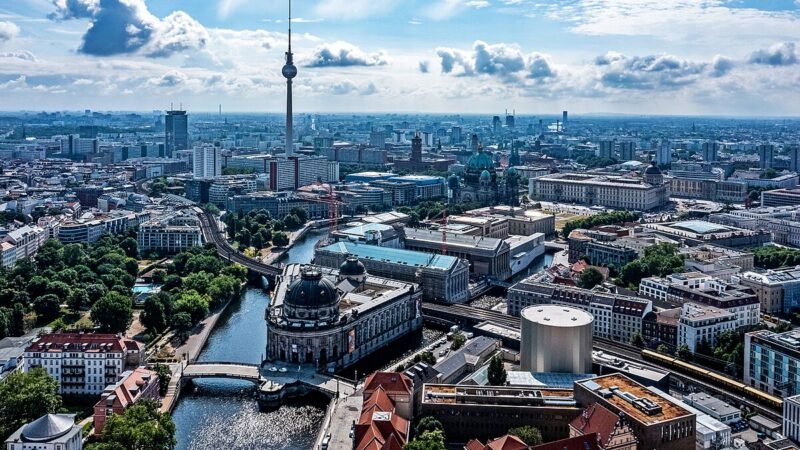
Berlin, the capital of Germany, is a city with profound historical significance and a complex political landscape in 1951, situated in the post-war occupied zone. The weather on this date was rainy, typical of autumn conditions in central Europe. The date falls under the zodiac sign of Virgo, and the moon was in its waxing gibbous phase, approaching full illumination.
On this day
The date saw two significant European moments in history. In 1939, German forces attacked Poland, including the locations of Wieluń and Westerplatte, marking the beginning of World War II in Europe. This military invasion would reshape the continent for years to come. Decades earlier, in 1804, German astronomer Karl Ludwig Harding discovered Juno, one of the largest main-belt asteroids, naming it after the Roman goddess.
Beyond Europe, 1 September has witnessed moments of global consequence. In 1973, a 76-hour multinational rescue effort off the coast of Ireland resulted in the deepest submarine rescue in history, demonstrating international cooperation in crisis response.
World Letter Writing Day
World Letter Writing Day falls on 1 September each year and encourages people to revive the tradition of handwritten correspondence. The day celebrates the art of letter writing as a personal and meaningful form of communication in an increasingly digital age. It has been observed for several decades, with particular emphasis in recent years as interest in traditional writing practices has resurged amongst those seeking alternatives to electronic messaging.
DayAtlas provides historical context for any date and location, displaying weather conditions, significant events, and notable births and deaths that occurred on that specific day. Users can explore how different places experienced weather patterns and historical moments across centuries.
Find out what's happening today in Berlin.
What the Weather Had in Store for Berlin on 28th November 2026
Mastery grows where precision and patience intersect, not in shortcuts.
Fortune of the Day
1st September in the Stars – Star Sign Virgo
Personality Profile
Personality Those born on September 1st blend Virgo's precision with the pioneering force of the number one. They are thoughtful thinkers with practical grounding who seek order and clarity in all things. Their minds work rapidly and systematically.
Strengths & Weaknesses Their strengths lie in analytical thinking, reliability, and constructive helpfulness. However, they tend toward overanalysis and can become overly critical of themselves and others, potentially straining relationships.
Love These individuals seek partners who share their intellectual demands and provide emotional stability. They express love through practical support and loyal devotion, though they need time to open emotionally.
Caree & Finance Their careers thrive in roles requiring precision and organization—science, finance, skilled trades. They manage finances conscientiously and build wealth through steady, methodical planning.
Health Those born this day should manage their tendency to overthink to prevent stress and anxiety disorders. Regular movement and mental relaxation support their sensitive nervous systems.
That night, the moon was in its waxing gibbous phase.
Chinese year of the Rabbit (Metal).
Fun Facts About 1st September
Name Days in Your Language: Debbie, Deborah, Debra, Edgar, Edgardo, Giles, Josh, Joshua, Josue, Ruth
Someone born on this day in 1951 would be 75 years old today — just 27,482 days into life, which is roughly 659,571 hours, 39,574,289 minutes, or 2,374,457,344 seconds spent on Earth so far.
It's the 244. day of the year. In 1951, 1st September falls on a Saturday.
There are 121 days still to come.
We’re currently in Week 35 — the year marches on.
Famous Birthdays on 1st September
On this day, 7 notable people were born on 1st September — spanning from 1948 to 1952. From world leaders to artists and scientists, discover who shares this birthday.
01/09/1952
Michael Massee, American actor (died 2016)
Michael Groo Massee was an American actor. Active on screen for three decades, he frequently portrayed villainous characters. His film roles include Funboy in the dark fantasy The Crow (1994), Newton in the horror anthology Tales from the Hood (1995), Andy in the neo-noir Lost Highway (1997), and the Gentleman in The Amazing Spider-Man (2012) and its 2014 sequel. Massee also voiced Bruce Banner in the first two entries of Marvel Animated Features in 2006. On television, he played Ira Gaines on the first season of the Fox action drama 24 (2001–2002), Isaiah Haden on the NBC fantasy mystery Revelations (2005), Dyson Frost on the ABC science fiction drama FlashForward (2009–2010), and Charles Hoyt on the TNT police procedural Rizzoli & Isles (2010–2013).
Juan Cruz Martínez, Mexican politician (died 2026)
Juan José Cruz Martínez was a Mexican politician. During his political career, he belonged to the Labour Party (PT), the Party of the Democratic Revolution (PRD) and, finally, the National Regeneration Movement (MORENA).
01/09/1951
Timothy Zahn, American Hugo Award-winning sci-fi and fantasy author
Timothy Zahn is an American writer of science fiction and fantasy. He is known best for his prolific collection of Star Wars books, chiefly the Thrawn trilogy, and has published several other series of sci-fi and fantasy novels of his own original creation, in addition to many works of short fiction. His books have been credited with helping revive interest in Star Wars after the franchise's movie branch ran into trouble with profitability and cross-generational interest.
01/09/1950
Mikhail Fradkov, Russian politician, 36th Prime Minister of Russia
Mikhail Yefimovich Fradkov is a Russian politician who served as Prime Minister of Russia from 2004 to 2007. An independent, he was the longest serving director of Russia's Foreign Intelligence Service from 2007 to 2016. Since 4 January 2017, Fradkov has been Director of the Russian Institute for Strategic Studies.
Phil McGraw, American psychologist, author and talk show host
Phillip Calvin McGraw, better known professionally as Dr. Phil, is an American television personality and author. He is best known for hosting the daytime talk show Dr. Phil (2002–2023). McGraw holds a doctorate in clinical psychology, though he ceased renewing his license to practice psychology in 2006.
01/09/1948
Greg Errico, American drummer and producer
Greg Errico is an American musician and record producer, best known as the drummer for the popular and influential psychedelic soul/funk band Sly and the Family Stone.
Józef Życiński, Polish archbishop and philosopher (died 2011)
Józef Mirosław Życiński was a Polish philosopher, publicist, the Roman Catholic metropolitan archbishop of the Archdiocese of Lublin and a professor of the Pontifical Academy of Theology in Rome, Pontifical University of John Paul II in Cracow and Catholic University of Lublin.
Lives Remembered on 1st September
On 1st September, 99 remarkable people passed away — from 870 to 2026. Remember the lives and legacies of those we lost on this day.
01/09/2026
Carla Jeffery, American actor and singer (born 1993)
Carla Jaran Jeffery was an American actress best known for playing the cheerleader Bree in Disney Channel's Zombies film franchise.
01/09/2025
Joe Bugner, Hungarian-British boxer and actor (born 1950)
József Kreul Bugner was a Hungarian-born British–Australian professional boxer, who competed in the heavyweight division, and actor. He held triple nationality, originally being a citizen of Hungary and becoming a naturalised citizen of both the United Kingdom and Australia.
01/09/2024
Linda Deutsch, American journalist (born 1943)
Linda Deutsch was an American journalist who worked for the Associated Press (AP) and covered court cases from 1967 until her retirement in 2014, including the high-profile trials of Charles Manson, Sirhan Sirhan, O. J. Simpson, and Michael Jackson.
01/09/2023
Jimmy Buffett, American singer-songwriter, musician, author and businessman (born 1946)
James William Buffett was an American singer-songwriter, author, and businessman. He was known for his tropical music sound blending country, rock, folk, calypso, and his persona, which often portrayed a lifestyle described as "island escapism." It promoted enjoying life and following passions. Buffett recorded many hit songs, including those known as "The Big 8": "Margaritaville" (1977), which is ranked 234th on the Recording Industry Association of America's list of "Songs of the Century"; "Come Monday" (1974); "Fins" (1979); "Volcano" (1979); "A Pirate Looks at Forty" (1974); "Cheeseburger in Paradise" (1978); "Why Don't We Get Drunk" (1973); and "Changes in Latitudes, Changes in Attitudes" (1977). His other popular songs include "Son of a Son of a Sailor" (1978), "One Particular Harbour" (1983), and "It's Five O'Clock Somewhere" with Alan Jackson (2003). Buffett formed the Coral Reefer Band in 1975.
01/09/2022
Barbara Ehrenreich, American writer and journalist (born 1941)
Barbara Ehrenreich was an American author and political activist. During the 1980s and early 1990s, she was a prominent figure in the Democratic Socialists of America. She was a widely read and award-winning columnist and essayist and the author of 21 books.
Yang Yongsong, Chinese major general (born 1919)
Yang Yongsong was a Chinese military officer, who was a founding major general in the People's Liberation Army. Born in Baihou in Dabu County, Guangdong, he joined the Communist Youth League of China and served in the Red Army from 1931. Yang fought in the fifth counter-encirclement campaign during the Chinese Civil War and was a participant in the Long March. He was present at the 1937 Battle of Pingxingguan and Battle of Xinkou during the Second Sino-Japanese War and was a representative at the 1945 7th National Congress of the Chinese Communist Party. After the war, he was promoted to major-general as one of the "founding generals" in 1955. He was the last surviving general appointed in that year.
01/09/2020
Erick Morillo, American disc jockey and music producer (born 1971)
Erick Morillo was an American house DJ, producer, and record label owner. He produced under a number of pseudonyms, including Ministers de la Funk, the Dronez, RAW, Smooth Touch, RBM, Deep Soul, Club Ultimate, and Li'l Mo Ying Yang.
01/09/2018
Randy Weston, American jazz pianist and composer (born 1926)
Randolph Edward "Randy" Weston was an American jazz pianist and composer whose creativity was inspired by his ancestral African connection.
01/09/2015
Gurgen Dalibaltayan, Armenian general (born 1926)
Gurgen Harutyun Dalibaltayan was an Armenian military commander. He was the Chief of General Staff of Armenian Armed Forces during the 1992 Battle of Shusha, a battle to capture the city from Azerbaijan. He is credited with devising a strategy to assault the strongly fortified town of Shusha using diversionary attacks against adjacent villages to draw out the defenders of the town while the commander of troops, Arkady Ter-Tatevosyan, encircled the town and cut off reinforcements. His strategy is generally considered impossible, or at least implausible, as he was originally outnumbered. General military tactics suggest a force of three times the defender's size to successfully storm and win.
Dean Jones, American actor and singer (born 1931)
Dean Carroll Jones was an American actor. He was best known as the Walt Disney Company's main leading man in the 1970s with his roles as Agent Zeke Kelso in That Darn Cat! (1965), Jim Douglas in the Herbie franchise (1969–1997), and with other film companies such as Dr. Herman Varnick in Beethoven (1992). He was nominated for a Golden Globe Award for his performance as Albert Dooley in The Million Dollar Duck (1971). In 1995, he was inducted as a Disney Legend for his film work.
Richard G. Hewlett, American historian and author (born 1923)
Richard Greening Hewlett was an American public historian best known for his work as the Chief Historian of the United States Atomic Energy Commission.
Ben Kuroki, American sergeant and pilot (born 1917)
Ben Kuroki was the only American of Japanese descent in the United States Army Air Forces to serve in combat operations in the Pacific theater of World War II. He flew a total of 58 combat missions over Europe, North Africa, and Japan during World War II. He was also an advocate for Japanese-Americans after World War II.
01/09/2014
Ahmed Abdi Godane, Somali militant leader (born 1977)
Ahmed Abdi Godane, also known as Mukhtar Abu Zubair, was a Somali militant leader who served as the second emir of al-Shabaab, an Islamist militant group based in Somalia. Godane, who received training and fought in Afghanistan, was designated by the United States as a terrorist. The exact date of Godane's rise to al-Shabaab's Emir is debated, although it seems he ascended to this position in December 2007.
Roger McKee, American baseball player (born 1926)
Roger Hornsby McKee was an American Major League Baseball pitcher who played from 1943–44 for the Philadelphia Phillies while still a teenager.
Joseph Shivers, American chemist and academic, developed spandex (born 1920)
Joseph Clois Shivers Jr. was an American textile chemist who was based in West Chester, Pennsylvania, best known for his role in the structural development of Spandex, a thermoplastic elastomer, in the 1950s, while employed at DuPont.
01/09/2013
Ignacio Eizaguirre, Spanish footballer and manager (born 1920)
Ignacio Eizaguirre Arregui was a Spanish footballer who played as a goalkeeper.
Tommy Morrison, American boxer and actor (born 1969)
Tommy David Morrison was an American professional boxer and mixed martial artist who competed from 1988 to 2009. Best known for having a great left hook and formidable punching power along with a weak chin, Morrison won the vacant World Boxing Organization heavyweight world title in 1993 with a unanimous decision victory over a 44-year-old George Foreman. He lost the title in his second defense to Michael Bentt that same year. The other major lowlight of Morrison's boxing career was his fight with Ray Mercer in 1991 in which Morrison was knocked out after receiving 18 unanswered punches. In 1995, he won the minor International Boxing Council heavyweight world title when he defeated Donovan Ruddock by technical knockout (TKO).
Gordon Steege, Australian soldier (born 1917)
Air Commodore Gordon Henry Steege, was a senior officer and pilot in the Royal Australian Air Force (RAAF). He became a fighter ace in World War II, credited with eight aerial victories, and led combat formations at squadron and wing level.
Margaret Mary Vojtko, American linguist and academic (born 1930)
Margaret Mary Vojtko was an American adjunct professor of French at Duquesne University. Her death caused controversy at Duquesne and prompted conversations about unions and the role of adjunct faculty at American universities.
Ken Wallis, English commander and pilot (born 1916)
Wing Commander Kenneth Horatio Wallis was a British aviator, engineer, and inventor. During the Second World War, Wallis served in the Royal Air Force and flew 28 bomber missions over Germany; after the war, he moved on to research and development, before retiring in 1964. He later became one of the leading exponents of autogyros and earned 34 world records, still holding eight of them at the time of his death in 2013.
01/09/2012
Sean Bergin, South African saxophonist, flute player, and composer (born 1948)
Sean Bergin was an avant-garde jazz saxophonist and flautist from South Africa.
Hal David, American songwriter and composer (born 1921)
Harold Lane David was an American lyricist. He was best known for his collaborations with composer Burt Bacharach and his association with Dionne Warwick.
Smarck Michel, Haitian businessman and politician, 6th Prime Minister of Haiti (born 1937)
Georges Jean-Jacques Smarck Michel or Smarck Michel was appointed prime minister of Haiti on October 27, 1994, occupying the post from November 8, 1994 to October 16, 1995. Smarck was President Aristide's third prime minister, and the first to be named after the President's return from exile.
William Petzäll, Swedish politician (born 1988)
William Nils Erich Petzäll was a Swedish politician, former member of the Sweden Democrats and Chairman of the Sweden Democratic Youth. At the 2010 Swedish general election he was elected to be the parliamentary representative for Dalarna County.
Arnaldo Putzu, Italian illustrator (born 1927)
Arnaldo Putzu was an Italian artist renowned for his film posters for Italian and British films, such as Get Carter and the Carry On films.
01/09/2010
Wakanohana Kanji I, Japanese sumo wrestler, the 45th Yokozuna (born 1928)
Wakanohana Kanji was a Japanese professional sumo wrestler. He was the sport's 45th yokozuna. He was a popular wrestler and was nicknamed the "Devil of the Dohyō" due to his great fighting spirit and endurance.
01/09/2008
Thomas J. Bata, Czech-Canadian businessman (born 1914)
Tomáš Jan Baťa,, also known as Thomas Bata Jr. and Tomáš Baťa ml., was a Czech and Canadian businessman and philanthropist. He ran the Bata Shoe Company from the 1940s until the 80s.
Jerry Reed, American singer-songwriter, guitarist, and actor (born 1937)
Jerry Reed Hubbard, known professionally as Jerry Reed, was an American country singer, guitarist, composer, songwriter, and actor who appeared in more than a dozen films. His signature songs included "Guitar Man", "U.S. Male", "A Thing Called Love", "Alabama Wild Man", "Amos Moses", "When You're Hot, You're Hot", "Ko-Ko Joe", "Lord, Mr. Ford", "East Bound and Down", "The Bird", and "She Got the Goldmine ".
01/09/2007
Roy McKenzie, New Zealand horse racer and philanthropist (born 1922)
Sir Roy Allan McKenzie was a New Zealand horse breeder and racer, and was well known for his philanthropy.
01/09/2006
György Faludy, Hungarian author and poet (born 1910)
György Faludy, sometimes anglicized as George Faludy, was a Hungarian poet, writer and translator.
Warren Mitofsky, American journalist (born 1934)
Warren J. Mitofsky was an American political pollster.
Bob O'Connor, American businessman and politician, 57th Mayor of Pittsburgh (born 1944)
Robert E. O'Connor Jr. was an American politician who was the Mayor of Pittsburgh, Pennsylvania from January 3, 2006, until his death.
Kyffin Williams, Welsh painter and educator (born 1918)
Sir John Kyffin Williams, was a Welsh landscape painter who lived at Pwllfanogl, Llanfairpwll, on the Island of Anglesey. Williams is widely regarded as the defining artist of Wales during the 20th century.
01/09/2005
R. L. Burnside, American singer-songwriter and guitarist (born 1926)
R. L. Burnside was an American hill country blues singer, songwriter, and guitarist. He played music for most of his life but received little recognition until 1995 when Burnside recorded and toured with Jon Spencer, garnering crossover appeal and introducing his music to a new fan base, particularly in the punk and garage rock scenes.
01/09/2004
Ahmed Kuftaro, Syrian religious leader, Grand Mufti of Syria (born 1915)
Ahmed Muhammad Amin Kuftaro was the Grand Mufti of Syria, the highest officially appointed Sunni Muslim representative of the Fatwa-Administration in the Syrian Ministry of Auqaf in Syria. Kaftaro was a Sunni Muslim of the Naqshbandi Sufi order.
Alastair Morton, South African businessman (born 1938)
Sir Robert Alastair Newton Morton was Chief Executive of Eurotunnel and Chairman of the Strategic Rail Authority, industrialist and the last chairman of the British Railways Board.
01/09/2003
Rand Brooks, American actor and producer (born 1918)
Arlington Rand Brooks Jr. was an American film and television actor, probably best known for playing Charles Hamilton in Gone With the Wind (1939).
Terry Frost, English painter and academic (born 1915)
Sir Terence Ernest Manitou Frost RA was a British abstract artist, who worked in Newlyn, Cornwall. Frost was renowned for his use of the Cornish light, colour and shape to start a new art movement in England. He became a leading exponent of abstract art and a recognised figure of the British art establishment.
01/09/1999
W. Richard Stevens, Zambian computer scientist and author (born 1951)
William Richard (Rich) Stevens was a Northern Rhodesia–born American author of computer science books, in particular books on Unix and TCP/IP.
01/09/1998
Józef Krupiński, Polish poet and author (born 1930)
Józef Krupiński was a Polish poet. He spent the last days of his life in Orzesze, Poland. Prizewinner of the Edward Stachura Award and member of the Association of Polish Writers in Katowice.
Cary Middlecoff, American golfer and sportscaster (born 1921)
Emmett Cary Middlecoff was an American professional golfer on the PGA Tour from 1947 to 1961. His 39 Tour wins place him tied for tenth all-time, and he won three major championships. Middlecoff graduated as a dentist, but gave up his practice at age 26 to become a full-time Tour golfer.
Osman F. Seden, Turkish director, producer, and screenwriter (born 1924)
Osman Fahir Seden, usually credited as Osman F. Seden, was a Turkish film director, screenwriter and film producer.
01/09/1997
Zoltán Czibor, Hungarian footballer (born 1929)
Zoltán Czibor was a Hungarian footballer who played for several Hungarian clubs, including Ferencváros and Budapest Honvéd, and the Hungary national team before joining CF Barcelona. Czibor played as a left-winger or striker and was notable for having a powerful shot, good pace and excellent ball control. During the 1950s he was part of the Magical Magyars, reaching the World Cup final with them in 1954. After the 1956 Hungarian Revolution he moved to Spain where he became a prominent member of the successful FC Barcelona team of the late 1950s. After three seasons at Barcelona, he joined their local rivals Español for the 1961–62 season. After brief spells at FC Basel, Austria Wien and Primo Hamilton FC, he retired as a professional footballer and returned to Hungary. He died there in 1997, aged 68.
01/09/1991
Otl Aicher, German graphic designer and typographer (born 1922)
Otto "Otl" Aicher was a German graphic designer and typographer. Aicher co-founded and taught at the influential Ulm School of Design. He is known for having led the design team of the 1972 Summer Olympics in Munich, and for overseeing the creation of its prominently used system of pictograms. Aicher also developed the Rotis typeface.
01/09/1990
Edwin O. Reischauer, American scholar and diplomat (born 1910)
Edwin Oldfather Reischauer was an American diplomat, educator, and professor at Harvard University. Born in Tokyo to American educational missionaries, he became a leading scholar of the history and culture of Japan and East Asia. Together with George M. McCune, a scholar of Korea and several Korean linguists, in 1939 he developed the McCune–Reischauer romanization of the Korean language.
01/09/1989
A. Bartlett Giamatti, American businessman and academic (born 1938)
Angelo Bartlett "Bart" Giamatti was an American professor of English Renaissance literature, the president of Yale University, and the seventh commissioner of Major League Baseball.
Kazimierz Deyna, Polish footballer (born 1947)
Kazimierz Deyna was a Polish professional footballer who played as an attacking midfielder in the playmaker role and was one of the most highly regarded players of his generation, due to his excellent vision. Throughout his career he played for such clubs as Legia Warsaw, Manchester City and San Diego Sockers.
Tadeusz Sendzimir, Polish-American engineer (born 1894)
Tadeusz Sendzimir was a Polish engineer and inventor of international renown. He held 120 patents in mining and metallurgy, 73 of which were awarded to him in the United States.
01/09/1988
Luis Walter Alvarez, American physicist and academic, Nobel Prize laureate (born 1911)
Luis Walter Alvarez was an American experimental physicist, inventor, and professor who was awarded the Nobel Prize in Physics in 1968 for his discovery of resonance states in particle physics using the hydrogen bubble chamber. In 2007 the American Journal of Physics commented, "Luis Alvarez was one of the most brilliant and productive experimental physicists of the twentieth century."
01/09/1986
Murray Hamilton, American actor (born 1923)
Murray Hamilton was an American stage, screen and television character actor who appeared in such acclaimed films as The Spirit of St. Louis, Anatomy of a Murder, The Hustler, The Graduate, The Way We Were, Jaws and The Amityville Horror.
01/09/1985
Stefan Bellof, German racing driver (born 1957)
Stefan Bellof was a German racing driver. Bellof was the winner of the Drivers' Championship in the 1984 FIA World Endurance Championship, driving for the factory Rothmans Porsche team. His lap record on the Nordschleife configuration at the Nürburgring, set while qualifying for the 1000 km race in 1983, stood for 35 years, when it was beaten by Timo Bernhard in 2018. He also competed in Formula One with Tyrrell Racing during 1984 and 1985. Bellof was killed in an accident during the 1985 1000 km of Spa, a round of the 1985 World Sportscar Championship.
01/09/1984
Madeleine de Bourbon-Busset, Duchess of Parma (born 1898)
Princess Madeleine, Duchess of Parma and Piacenza was the titular Duchess of Parma and Piacenza and was also Carlist Queen of Spain as the wife of Prince Xavier of Bourbon-Parma, the Carlist pretender to the Spanish throne.
01/09/1983
Henry M. Jackson, American lawyer and politician (born 1912)
Henry Martin "Scoop" Jackson was an American lawyer and politician who served as a U.S. representative (1941–1953) and U.S. senator (1953–1983) from the state of Washington. A Cold War liberal and anti-Communist member of the Democratic Party, Jackson supported higher military spending and a hard line against the Soviet Union, while also supporting social welfare programs, civil rights, and labor unions.
Larry McDonald, American physician and politician (born 1935)
Lawrence Patton McDonald was an American physician, politician and a member of the United States House of Representatives, representing Georgia's 7th congressional district as a Democrat from 1975 until he died as a passenger on board Korean Air Lines Flight 007 when it was shot down by Soviet interceptors.
01/09/1982
Haskell Curry, American mathematician and academic (born 1900)
Haskell Brooks Curry was an American mathematician and computer scientist. Curry is best known for his seminal work in combinatory logic. Although its initial concept was based on a paper by Moses Schönfinkel, Curry did much of the development. Curry is also known for Curry's paradox and the Curry–Howard correspondence. Named for him are the programming languages Haskell, Brook and Curry, and the concept of currying, a method to transform functions, used in mathematics and computer science.
Władysław Gomułka, Polish activist and politician (born 1905)
Władysław Gomułka was a Polish communist politician. He was the de facto leader of the Polish People's Republic from 1956 to 1970.
Isabel Cristina Mrad Campos, Brazilian student; honored by the Catholicism (born 1962)
Isabel Cristina Mrad Campos was a Brazilian Catholic laywoman. She served as a Vincentian in her parish, although she never formally joined the movement. In her spare time, she devoted herself to faith. She was often seen doing Eucharistic adoration and attending Mass. She wanted to study medicine and become a pediatrician to take care of underprivileged children, but was murdered in her apartment after an attempted rape.
01/09/1981
Ann Harding, American actress (born 1901)
Ann Harding was an American theatre, motion picture, radio, and television actress. Harding was a regular on Broadway and on tour in the 1920s. In the 1930s, Harding was one of the first actresses to gain fame in the new medium of "talking pictures," and she was nominated for the Academy Award for Best Actress in 1931 for her work in Holiday.
Albert Speer, German architect and author (born 1905)
Berthold Konrad Hermann Albert Speer was a German architect who served as Minister of Armaments and War Production in Nazi Germany during most of World War II. A close friend and ally of Adolf Hitler, he was convicted at the Nuremberg trials and served 20 years in prison.
01/09/1977
Ethel Waters, American singer and actress (born 1896)
Ethel Waters was an American singer and actress. Waters frequently performed jazz, swing, and pop music on the Broadway stage and in concerts. She began her career in the 1920s, by singing blues. Her notable recordings include "Dinah", "Stormy Weather", "Taking a Chance on Love", "Chlo-e, "Heat Wave", "Supper Time", "Am I Blue?", "Birmingham Bertha", "Cabin in the Sky", "I'm Coming Virginia", and her version of "His Eye Is on the Sparrow". Waters was the second African American to be nominated for an Academy Award, the first African American to star on her own television show, and the first African-American woman to be nominated for a Primetime Emmy Award.
01/09/1974
Gerd Neggo, Estonian dancer, dance teacher, and choreographer (born 1891)
Gerd Neggo was an Estonian dancer, dance teacher and choreographer. She studied the musical response methods of É. Jaques-Dalcroze, trained under Rudolf von Laban in Hamburg, Germany, and in 1924 established her own dance studio at Tallinn, Estonia, and promoted modern dance and mime based on classical ballet. During the Soviet occupation of Estonia, she and her husband Paul Olak migrated to Sweden. Her contributions to the cultural heritage of Estonia, as the founder of modern dance and mime in her country, is recognised via a scholarship, awarded annually since 2011.
01/09/1971
Alan Brown, English soldier (born 1909)
Brigadier Alan Ward Brown was a British Army tank officer of the Second World War.
01/09/1970
François Mauriac, French novelist, poet, and playwright, Nobel Prize laureate (born 1885)
François Charles Mauriac was a French novelist, dramatist, critic, poet, and journalist, a member of the Académie française, and laureate of the Nobel Prize in Literature (1952). He was awarded the Grand Cross of the Legion of Honour in 1958.
01/09/1969
Drew Pearson, American journalist and author (born 1897)
Andrew Russell Pearson was an American columnist, noted for his syndicated newspaper column "Washington Merry-Go-Round". He also had a program on NBC Radio titled Drew Pearson. He was known for his approach towards high-level politicians, such as senators, cabinet members, generals and American presidents.
01/09/1967
Siegfried Sassoon, English soldier and writer (born 1886)
Siegfried Loraine Sassoon was an English war poet, writer, and soldier. Decorated for bravery on the Western Front, he became one of the leading poets of the First World War. His poetry both described the horrors of the trenches and satirized the patriotic pretensions of those who, in Sassoon's view, were responsible for a jingoism-fuelled war. Sassoon became a focal point for dissent within the armed forces when he made a lone protest against the continuation of the war with his "Soldier's Declaration" of July 1917, which resulted in his being sent to the Craiglockhart War Hospital. During this period, Sassoon met and formed a friendship with Wilfred Owen, who was greatly influenced by him. Sassoon later won acclaim for his prose work, notably his three-volume, fictionalised autobiography, collectively known as the Sherston trilogy, which is made up of Memoirs of a Fox-Hunting Man (1928), Memoirs of an Infantry Officer (1930) and Sherston's Progress (1936). Sassoon is also known for his poetry collection The Old Huntsman (1917).
01/09/1951
Nellie McClung, Canadian author and suffragist (born 1873)
Nellie Letitia McClung was a Canadian author, politician, and social activist, who is regarded as one of Canada's most prominent suffragists. She began her career in writing with the 1908 book Sowing Seeds in Danny, and would eventually publish sixteen books, including two autobiographies. She played a leading role in the women's suffrage movement in Canada, helping to grant women the right to vote in Alberta and Manitoba in 1916. McClung was elected to the Legislative Assembly of Alberta in 1921, where she served until 1926.
01/09/1947
Frederick Russell Burnham, American soldier and adventurer (born 1861)
Frederick Russell Burnham was an American scout and world-traveling adventurer. He is known for his service to the British South Africa Company and to the British Army in colonial Africa, and for teaching woodcraft to Robert Baden-Powell in Rhodesia. Burnham helped inspire the founding of the international Scouting Movement.
01/09/1943
Charles Atangana, Cameroonian ruler (born 1880)
Charles Atangana, also known by his birth name, Ntsama, and his German name, Karl, was the paramount chief of the Ewondo people.
01/09/1930
Peeter Põld, Estonian scientist and politician, 1st Estonian Minister of Education (born 1878)
Peeter Siegfried Nikolaus Põld was an Estonian pedagogy specialist, school director, and politician, and the first Estonian Minister of Education. He was born in Puru, Kreis Wierland, Governorate of Estonia. As the curator of the University of Tartu (1918–1925), he oversaw the university's transition to instruction in Estonian in the newly independent country.
01/09/1924
Noe Khomeriki, Georgian Social Democrat politician (born 1883)
Noe Khomeriki was a Georgian politician involved in the Social Democrat movement who was arrested for anti-soviet activity and shot during an uprising against the Soviet state.
01/09/1922
Samu Pecz, Hungarian architect and academic (born 1854)
Samu Pecz was a Hungarian architect and academic.
01/09/1914
Martha, last known passenger pigeon (hatched 1885)
Martha was a passenger pigeon, the last known of her species; she was named "Martha" in honor of Martha Washington, the first lady of the United States from 1789 to 1797.
01/09/1868
Ferenc Gyulay, Hungarian-Austrian commander and politician (born 1799)
Count Ferenc Gyulay de Marosnémethi et Nádaska, also known as Ferencz Gyulai, Ferencz Gyulaj, or Franz Gyulai, was a Hungarian nobleman who served as Austrian Governor of Lombardy-Venetia and commanded the losing Austrian army at the Battle of Magenta.
01/09/1839
Izidor Guzmics, Hungarian theologian and educator (born 1786)
Izidor Guzmics was a Hungarian theologian
01/09/1838
William Clark, American soldier, explorer, and politician, 4th Governor of Missouri Territory (born 1770)
William Clark was an American explorer, soldier, Indian agent, and territorial governor. A native of Virginia, he grew up in pre-statehood Kentucky before later settling in what became the state of Missouri.
01/09/1715
François Girardon, French sculptor (born 1628)
François Girardon was a French sculptor of the Louis XIV style or French Baroque, best known for his statues and busts of Louis XIV and for his statuary in the gardens of the Palace of Versailles.
Louis XIV of France (born 1638)
Louis XIV, known as the "Sun King", was King of France from 14 May 1643 until his death in 1715. He is the longest-reigning monarch in history, reigning for 72 years and 110 days. His reign brought about a golden age in French history, marked by a great expansion of the French colonial empire and a flourishing of French culture throughout Europe. As an absolute monarch, Louis expanded monarchical rule and diminished the power of the nobility, developing a strong centralised state ruled from the Palace of Versailles that persisted until the French Revolution.
01/09/1706
Cornelis de Man, Dutch painter (born 1621)
Cornelis de Man was a Dutch Golden Age painter.
01/09/1687
Henry More, English priest and philosopher (born 1614)
Henry More was an English philosopher, Anglican priest, theologian, and poet, associated with the Cambridge Platonists. He sought to reconcile Platonism with Christian theology and responded critically to Cartesian philosophy. His metaphysical writings addressed the nature of spirit, matter, divine providence, and the soul, and he was a prominent voice in seventeenth-century religious and philosophical debates.
01/09/1685
Leoline Jenkins, Welsh lawyer, jurist, and politician, Secretary of State for the Northern Department (born 1625)
Sir Leoline Jenkins was a Welsh academic, diplomat involved in the negotiation of international treaties, jurist and politician. He was a clerical lawyer who served as Judge of the High Court of Admiralty from 1668 to 1685, and enjoyed a high reputation for judicial integrity. As a statesman he served as Secretary of State from 1680 to 1684.
01/09/1678
Jan Brueghel the Younger, Flemish painter (born 1601)
Jan Brueghel the Younger was a Flemish Baroque painter. He was the son of Jan Brueghel the Elder, and grandson of Pieter Bruegel the Elder, both prominent painters who contributed respectively to the development of Renaissance and Baroque painting in the Habsburg Netherlands. Taking over his father's workshop at an early age, he largely painted the same subjects as his father in a style which was similar to that of his father. He gradually was able to break away from his father's style by developing a broader, more painterly, and less structured manner of painting. He regularly collaborated with leading Flemish painters of his time.
01/09/1648
Marin Mersenne, French mathematician, theologian, and philosopher (born 1588)
Marin Mersenne, OM was a French polymath whose works touched a wide variety of fields. He is perhaps best known today among mathematicians for Mersenne prime numbers, those written in the form Mn = 2n − 1 for some integer n. He also developed Mersenne's laws, which describe the harmonics of a vibrating string, and his seminal work on music theory, Harmonie universelle, for which he is referred to as the "father of acoustics".
01/09/1646
Francis Windebank, English statesman (born 1582)
Sir Francis Windebank was an English politician who was Secretary of State under Charles I.
01/09/1615
Étienne Pasquier, French lawyer and jurist (born 1529)
Étienne Pasquier was a French lawyer and man of letters. By his own account he was born in Paris on 7 June 1529, but according to others he was born in 1528. He was called to the Paris bar in 1549.
01/09/1599
Cornelis de Houtman, Dutch explorer (born 1565)
Cornelis de Houtman was a Dutch merchant seaman who commanded the first Dutch expedition to the East Indies. Although the voyage was difficult and yielded only a modest profit, Houtman showed that the Portuguese monopoly on the spice trade was vulnerable. A flurry of Dutch trading voyages followed, eventually leading to the displacement of the Portuguese and the establishment of a Dutch monopoly on spice trading in the East Indies.
01/09/1581
Guru Ram Das, Sikh 4th of the Ten Gurus of Sikhism (born 1534)
Guru Ram Das, sometimes spelled as Guru Ramdas, was the fourth of the ten Sikh gurus. He was born to a family based in Lahore. His birth name was Jetha, and he was orphaned at age seven; he thereafter grew up with his maternal grandmother in a village.
01/09/1557
Jacques Cartier, French navigator and explorer (born 1491)
Jacques Cartier was a French maritime explorer from Brittany. Jacques Cartier was the first European to describe and map the Gulf of Saint Lawrence and the shores of the Saint Lawrence River, which he named "Canada" after the Iroquoian names for the two big settlements he saw at Stadacona and at Hochelaga.
01/09/1480
Ulrich V, Count of Württemberg (born 1413)
Ulrich V, nicknamed the Much-Loved, was Count of Württemberg from 1419 and then count of Württemberg-Stuttgart until his death in 1480.
01/09/1414
William de Ros, 6th Baron de Ros, English politician, Lord High Treasurer (born 1369)
William de Ros, 6th Baron Ros, was a medieval English nobleman, politician and soldier. The second son of Thomas de Ros, 4th Baron Ros, and Beatrice Stafford, William inherited his father's feudal barony and estates in 1394. Shortly afterwards, he married Margaret, daughter of John FitzAlan, 1st Baron Arundel. The Fitzalan family, like that of de Ros, was well-connected at the local and national level. They were implacably opposed to King Richard II, and this may have soured Richard's opinion of the young de Ros.
01/09/1375
Philip of Valois, Duke of Orléans (born 1336)
Philip of Orléans was a Duke of Orléans, Touraine, and Count of Valois, the fifth son of King Philip VI of France and Joan the Lame.
01/09/1339
Henry XIV, Duke of Bavaria (born 1305)
Henry XIV, Duke of Bavaria, was Duke of Lower Bavaria.
01/09/1327
Foulques de Villaret, Grand Master of the Knights Hospitaller
Foulques de Villaret, was the 25th Grand Master of the Knights Hospitaller. He led the successful conquest of Rhodes and survived an assassination attempt by members of his own order.
01/09/1256
Kujō Yoritsune, Japanese shōgun (born 1218)
Kujō Yoritsune , also known as Fujiwara no Yoritsune , was the fourth shōgun of the Kamakura shogunate of Japan. His father was kanpaku Kujō Michiie and his grandmother was a niece of Minamoto no Yoritomo. His wife was a granddaughter of Yoritomo and daughter of Minamoto no Yoriie. He was born in the year, month and on the day of the Tiger, and so was given the birth name Mitora.
01/09/1215
Otto, bishop of Utrecht
Otto van Gelre was bishop of Utrecht from 1212 to 1215.
01/09/1198
Dulce, Queen of Portugal (born 1160)
Dulce of Aragon also called Dulce of Barcelona, (1160–1198) was Queen of Portugal as the wife of King Sancho I of Portugal.
01/09/1159
Pope Adrian IV (born 1100)
Pope Adrian IV was head of the Catholic Church and ruler of the Papal States from 4 December 1154 until his death in 1159. He is the only pope to have been born in England and the first of two from an English-speaking country, alongside Pope Leo XIV.
01/09/1081
Bishop Eusebius of Angers
Eusebius (Bruno) of Angers was bishop of Angers, France.
01/09/0873
Thachulf, duke of Thuringia
Thacholf, Thachulf, Thaculf, or Thakulf was the Duke of Thuringia from 849 until his death. He held the titles of comes (count) and dux (duke) and he ruled over a marca (march). He may have been the son of Hadulf, son of Thankulf.
01/09/0870
Muhammad al-Bukhari, Persian scholar (born 810)
Abū ʿAbd Allāh Muḥammad ibn Ismāʿīl ibn Ibrāhīm al-Juʿfī al-Bukhārī, commonly known as al-Bukhārī, was a Persian Tajik 9th-century Muslim muhaddith and one of the foremost authorities on hadith, widely regarded as the most important hadith scholar in the history of Sunni Islam.
Celebrations & Special Days Worldwide on 1st September
Feast of Creation (Christianity)
The Feast of Creation, also known as the Feast of Creation in Christ, Creation Sunday, Creation Day or the World Day of Prayer for Creation, is celebrated in Christianity on September 1 or the subsequent Sunday to honour the creation of the universe by God and commemorate the "mystery of creation in Christ".
Christian feast day: Constantius (Costanzo) of Aquino
Saint Constantius of Aquino was a bishop of Aquino in Italy, noted for his gift of prophecy, and a saint. He is commemorated in the Roman Martyrology on Sept. 1.
Christian feast day: David Pendleton Oakerhater (Anglican Communion)
David Pendleton Oakerhater, also known as O-kuh-ha-tuh and Making Medicine, was a Cheyenne warrior and spiritual leader. He later became an artist and Episcopal deacon. In 1985, Oakerhater was the first Native American Anglican to be designated by the Episcopal Church as a saint.
Christian feast day: Giles
Giles the Hermit was a Greek Christian ascetic active in France, most likely in the 7th century. Revered as a saint, his cult became widely diffused but his hagiography is mostly legendary. A town that bears his name grew up around the monastery he purportedly founded, which became a pilgrimage centre and a stop on the Camino de Santiago.
Christian feast day: Blessed Giuliana of Collalto
Beatification is an act by which the Catholic Church formally recognizes that a deceased member of the faithful is believed to have entered Heaven and is capable of interceding on behalf of individuals who pray in their name, permitting a restricted, local form of public veneration.
Christian feast day: Isabel Cristina
Isabel Cristina Mrad Campos was a Brazilian Catholic laywoman. She served as a Vincentian in her parish, although she never formally joined the movement. In her spare time, she devoted herself to faith. She was often seen doing Eucharistic adoration and attending Mass. She wanted to study medicine and become a pediatrician to take care of underprivileged children, but was murdered in her apartment after an attempted rape.
Christian feast day: Loup (Lupus) of Sens
Saint Lupus of Sens was the nineteenth bishop of Sens.
Christian feast day: Nivard (Nivo)
Nivard was the Bishop of Reims during the Merovingian Dynasty from approximately 649 until 673. He was later venerated as a medieval Catholic Saint.
Christian feast day: Sixtus of Reims
Saint Sixtus of Reims is considered the first bishop of Reims. According to Hincmar, a 9th-century archbishop of Reims, Sixtus was sent from Rome by Pope Sixtus II to Gaul to assist in Christianizing the region. Another tradition makes him, anachronistically, the disciple of Saint Peter. According to tradition, Sixtus of Reims, along with his companion St. Sinicius (Sinice), established the Christian sees of Reims and Soissons. Sinicius would later succeed Sixtus as bishop of Reims. According to one source, “it would appear that Sixtus did not die as a martyr, despite the severity of the persecution during the era.”
Christian feast day: Terentian (Terrence)
Terentian(us) (Italian: San Terenziano) (died 118) was Bishop of Todi who was killed during the reign of Hadrian (117–138).
Christian feast day: Verena
Verena of Zurzach, also known as Saint Verena, was an Egyptian early Christian consecrated virgin and hermit. She is venerated as a saint in the Eastern Orthodox Church, Roman Catholic Church and Oriental Orthodox Churches. She is especially venerated in Switzerland, where her cult is attested in Bad Zurzach, the reported place of her burial, from at least the 5th century. Her feast is on 1 September.
Christian feast day: Vibiana
Vibiana is a third-century virgin martyr and saint of the Roman Catholic Church. She is a co-patroness of the Archdiocese of Los Angeles, along with Patrick and Emydius. Our Lady of the Angels is the principal patroness. Vibiana's liturgical feast day is 1 September, which begins four days of "celebration" through the 4th and the birthday of the City of Angels.
Christian feast day: The beginning of the new liturgical year (Eastern Orthodox Church and the Eastern Catholic Church) and Creationtide
The liturgical year, also called the church year, Christian year, ecclesiastical calendar, or kalendar, consists of the cycle of liturgical days and seasons that determines when feast days, including celebrations of saints, are to be observed, and which portions of scripture are to be read.
Christian feast day: September 1 (Eastern Orthodox liturgics)
September 1 in Eastern Orthodox liturgical calendars is a feast day and a day of commemoration of saints and martyrs. Although some Orthodox churches use the Revised Julian Calendar and others use the traditional Julian calendar, the fixed commemorations for their respective September 1 are broadly the same, no matter which calendar is used. September 1 is traditionally considered to be the first day of the Eastern Orthodox liturgical calendar year.
Knowledge Day (Former Soviet Union)
Knowledge Day, often simply called 1 September, is the day when the school year traditionally starts in Russia and many other former Soviet republics as well as other countries in the former Eastern Bloc and Israel.
Anniversary of Al Fateh Revolution (Gaddafists in Libya)
The 1969 Libyan revolution or coup d'état, also known as al-Fateh Revolution or 1 September Revolution, was a coup d'état and revolution carried out by the Free Officers movement, a group of Arab nationalist and Nasserist officers in the Libyan Army, which overthrew the Senussi monarchy of King Idris I and resulted in the formation of the Libyan Arab Republic. The Free Officers movement was led by Colonel Muammar Gaddafi.
Wattle Day (Australia)
Wattle Day is a day of celebration in Australia on the first day of September each year, which is the start of the Australian spring.
What Happened on 1st September?
47 significant events took place on Saturday, 1st September — stretching from -396 to 2008. Explore the moments that shaped history on this day.
01/09/2008
Iraq War: The United States Armed Forces transfers control of Anbar Province to the Iraqi Armed Forces.
The Iraq War, also referred to as the Second Gulf War, was a protracted armed conflict in Iraq from 2003 to 2011. It began in March 2003 with the invasion by a United States–led coalition, which resulted in the overthrow of the Ba'athist government of Saddam Hussein. During the US occupation of Iraq, the conflict persisted as an insurgency that arose against coalition forces and the newly established Iraqi government. US forces were officially withdrawn in 2011. In 2014, the US became re-engaged in Iraq, leading a new coalition under Combined Joint Task Force – Operation Inherent Resolve, as the conflict evolved into the ongoing Islamic State insurgency.
01/09/2004
The Beslan school siege begins when armed terrorists take schoolchildren and school staff hostage in North Ossetia, Russia; by the end of the siege, three days later, more than 385 people are dead (including hostages, other civilians, security personnel and terrorists).
The Beslan school siege, also referred to as the Beslan terror attack, the Beslan tragedy, or the Beslan massacre, was an Islamist terrorist attack that occurred from 1 September 2004 to 3 September 2004 in Beslan, North Ossetia, Russia. It lasted three days, and involved the imprisonment of more than 1,100 people as hostages, including 777 children. The hostages, primarily children, their parents, and school staff were held by terrorists in a building rigged with explosives under severe conditions; the terrorists did not provide them with food or water and denied them other basic necessities. The siege ended with the deaths of 334 people, 186 of them children, as well as 31 of the attackers. It is considered the deadliest school shooting in history.
01/09/1985
The wreck of the Titanic is discovered by an American-French expedition led by Robert Ballard and Jean-Louis Michel.
RMS Titanic was a British ocean liner that sank in the early hours of 15 April 1912 after striking an iceberg on her maiden voyage from Southampton, England, to New York City. Of the 2,208 passengers and crew aboard, approximately 1,500 died, making the incident one of the deadliest peacetime sinkings of a single ship.
01/09/1983
Cold War: Korean Air Lines Flight 007 is shot down by a Soviet jet fighter after the commercial aircraft strayed into Soviet airspace, killing all 269 on board, including Congressman Lawrence McDonald.
The Cold War was a period of international geopolitical rivalry between the United States (US) and the Soviet Union (USSR) and their respective allies, the capitalist Western Bloc and communist Eastern Bloc. It began in the aftermath of the Second World War and ended with the dissolution of the Soviet Union in 1991. The term cold war is used because there was no direct fighting between the two superpowers, though each supported opposing sides in regional conflicts known as proxy wars. In addition to the struggle for ideological and economic influence and an arms race in both conventional and nuclear weapons, the Cold War was expressed through technological rivalries such as the Space Race, espionage, propaganda campaigns, embargoes and sports diplomacy.
01/09/1982
The United States Air Force Space Command is founded.
United States Space Force Combat Forces Command (USSF CFC) is the United States Space Force's space operations, cyber operations, and intelligence field command. Headquartered at Peterson Space Force Base in Colorado Springs, Colorado, it consists of its mission deltas and garrison commands.
01/09/1981
Central African President David Dacko is ousted from power in a bloodless military coup led by General André Kolingba.
David Dacko was a Central African politician who served as the first President of the Central African Republic from 14 August 1960 to 31 December 1965 and as the third President of the Central African Republic from 21 September 1979 to 1 September 1981. He also served as Prime Minister of the Central African Republic from 1 May 1959 to 14 August 1960. After his second removal from power in a coup d'état led by General André Kolingba, he pursued an active career as an opposition politician and presidential candidate with many loyal supporters; Dacko was an important political figure in the country for over 50 years.
01/09/1974
The SR-71 Blackbird sets (and holds) the record for flying from New York to London in the time of one hour, 54 minutes and 56.4 seconds at a speed of 1,435.587 miles per hour (2,310.353 km/h).
The Lockheed SR-71 "Blackbird" is a retired long-range, high-altitude, Mach 3+ strategic reconnaissance aircraft that was developed and manufactured by the American aerospace company Lockheed Corporation. Its nicknames include "Blackbird" and "Habu".
01/09/1973
A 76-hour multinational rescue effort in the Celtic Sea results in the rescue of Roger Mallinson and Roger Chapman.
The Celtic Sea is the area of the Atlantic Ocean off the southern coast of Ireland bounded to the north by Saint George's Channel; other limits include the Bristol Channel, the English Channel, and the Bay of Biscay, as well as adjacent portions of Wales, Cornwall, parts of Devon and Brittany. The continental shelf, which drops away sharply, delimits the southern and western boundaries. The Iroise Sea off Brittany is entirely included within it. The Isles of Scilly are an archipelago of small islands in the sea.
01/09/1969
A coup in Libya brings Muammar Gaddafi to power.
The 1969 Libyan revolution or coup d'état, also known as al-Fateh Revolution or 1 September Revolution, was a coup d'état and revolution carried out by the Free Officers movement, a group of Arab nationalist and Nasserist officers in the Libyan Army, which overthrew the Senussi monarchy of King Idris I and resulted in the formation of the Libyan Arab Republic. The Free Officers movement was led by Colonel Muammar Gaddafi.
01/09/1967
Six-Day War: The Khartoum Resolution is issued at the Arab Summit, and eight countries adopt the "three 'no's against Israel".
The Six-Day War, or the 1967 Arab–Israeli war, was fought between Israel and a coalition of six Arab states, primarily Egypt, Syria, and Jordan, in the context of the Arab–Israeli conflict. The war, in which Israel conquered and occupied the Sinai Peninsula, the Gaza Strip, the West Bank of the Jordan River, East Jerusalem, and the Golan Heights, shaped the political and strategic landscape of the Middle East into the 21st century. Many of the war's consequences remain unresolved.
01/09/1961
TWA Flight 529 crashes shortly after takeoff from Midway Airport in Chicago, killing all 78 people on board. At the time, it was the deadliest single plane disaster in U.S. history.
TWA Flight 529 was a Lockheed Constellation L-049 propliner, registration N86511, operating as a scheduled passenger service from Boston, Massachusetts to Los Angeles, California. On September 1, 1961, at 02:05 CDT, the flight crashed into a field south of Clarendon Hills, Illinois shortly after takeoff from Midway Airport in Chicago, killing all 73 passengers and five crew on board; it was at the time the deadliest single plane disaster in U.S. history.
01/09/1944
World War II: Launch of Operation Ratweek, complicating German retreat.
World War II, or the Second World War, was a global conflict between two coalitions: the Allies and the Axis powers. Nearly all of the world's countries were involved, with many engaging in total war on an unprecedented scale. World War II was the deadliest conflict in history, causing the deaths of 60 to 75 million people, a majority of whom were civilians. Millions died as a result of massacres, starvation, disease and genocides. After the Allied victory, Germany, Austria, Japan and Korea were occupied, and German and Japanese leaders were tried for war crimes.
01/09/1939
World War II: Germany and Slovakia invade Poland, beginning the European phase of World War II.
World War II, or the Second World War, was a global conflict between two coalitions: the Allies and the Axis powers. Nearly all of the world's countries were involved, with many engaging in total war on an unprecedented scale. World War II was the deadliest conflict in history, causing the deaths of 60 to 75 million people, a majority of whom were civilians. Millions died as a result of massacres, starvation, disease and genocides. After the Allied victory, Germany, Austria, Japan and Korea were occupied, and German and Japanese leaders were tried for war crimes.
J. Robert Oppenheimer and his student Hartland Snyder publish the Oppenheimer–Snyder model, proving for the first time in contemporary physics how black holes could develop.
J. Robert Oppenheimer was an American theoretical physicist who served as the director of the Manhattan Project's Los Alamos Laboratory during World War II. He is often called the "Father of the Atomic Bomb" for his role in overseeing the development of the first nuclear weapons.
01/09/1923
The Great Kantō Earthquake devastates Tokyo and Yokohama, killing about 105,000 people.
The Great Kantō Earthquake was a megathrust earthquake that struck the Kantō Plain on the main Japanese island of Honshu at 11:58:32 JST on Saturday, 1 September 1923. It had an approximate magnitude of 8.0 on the moment magnitude scale (Mw), with its epicenter located some 100 km (62 mi) southwest of the capital Tokyo. The earthquake devastated Tokyo, the port city of Yokohama, and the surrounding prefectures of Kanagawa, Chiba, and Shizuoka, causing widespread damage throughout the Kantō region.
Los Solidarios rob a branch of the Bank of Spain in Xixón, stealing more than half a million pesetas to fund the purchase of rifles to fight the coming 1923 Spanish coup d'état.
Los Solidarios was a Spanish anarchist militant group, established in 1922 to combat the rise of pistolerismo and yellow syndicalism, which represented the interests of business owners. At first, the group organised the Catalan anarchist movement, stockpiled weapons and infiltrated the Spanish Armed Forces. Following the assassination of Salvador Seguí, the general secretary of the anarchist trade union centre, the Confederación Nacional del Trabajo (CNT), the group initiated its own campaign of targeted assassinations against officials who they held responsible for state terrorism. In 1923, Los Solidarios assassinated pistolero leader Ramón Laguía, the former governor of Biscay Fernando González Regueral, and the Archbishop of Zaragoza Juan Soldevila. As news began to spread of an impending military coup in the country, Los Solidarios sought to acquire weapons in order to resist the coup. The group robbed a branch of the Bank of Spain in Xixón and used the money to buy rifles, but were ultimately unable to stop the 1923 Spanish coup d'état, which resulted in the establishment of the dictatorship of Miguel Primo de Rivera.
01/09/1897
The Tremont Street Subway in Boston opens, becoming the first underground rapid transit system in North America.
The Tremont Street subway in Boston's MBTA subway system is the oldest subway tunnel in North America and the third-oldest still in use worldwide to exclusively use electric traction, opening on September 1, 1897. With the tunnels construction authorized by the General Court, its construction was supervised by Howard A. Carson as chief engineer. Its primary objective was to get streetcar lines off the traffic-clogged streets instead of as a true rapid transit line, and its construction was partially influenced by the blizzard of 1888 which resulted in transportation gridlock. It now forms the central part of the Green Line, connecting Boylston Street to Park Street and Government Center stations.
01/09/1894
Over 400 people die in the Great Hinckley Fire, a forest fire in Hinckley, Minnesota.
The Great Hinckley Fire was a conflagration in the pine forests of the U.S. state of Minnesota that ignited on September 1, 1894, which burned an area of at least 200,000 acres, including the town of Hinckley. The official death count was 418; the actual number of fatalities was likely higher. Other sources put the death toll at 476.
01/09/1880
The army of Mohammad Ayub Khan is routed by the British at the Battle of Kandahar, ending the Second Anglo-Afghan War.
Ghazi Mohammad Ayub Khan Barakzai, nicknamed the Victor of Maiwand, and as the Afghan Prince Charlie was, for a while, the governor of Herat Province in the Emirate of Afghanistan. He was briefly the Emir of Afghanistan, from 12 October 1879 to 31 May 1880. He also led the Afghan troops during the Second Anglo-Afghan War and defeated the British Indian Army at the Battle of Maiwand. Following his defeat at the Battle of Kandahar, Ayub Khan was deposed and exiled to British India. However, Ayub Khan fled to Persia. After negotiations in 1888 with Sir Mortimer Durand, the United Kingdom's ambassador at Tehran, Ayub Khan became a pensioner of the British Raj and traveled to British India in 1888, where he lived in Lahore, Punjab, until his death in 1914. He was buried in Peshawar and had eleven wives, fifteen sons, and ten daughters. Two of his grandsons, Sardar Hissam Mahmud el-Effendi and Sardar Muhammad Ismail Khan, served as brigadiers in the Pakistan Army.
01/09/1878
Emma Nutt becomes the world's first female telephone operator when she is recruited by Alexander Graham Bell to the Boston Telephone Dispatch Company.
Emma Nutt became the world's first female telephone operator on September 1, 1878, when she started working for the Edwin Holmes Telephone Despatch [sic] Company in Boston, Massachusetts, U.S.
01/09/1873
Cetshwayo ascends to the throne as king of the Zulu nation following the death of his father Mpande.
Cetshwayo kaMpande was the king of the Zulu Kingdom from 1873 to 1884 and its Commander in Chief during the Anglo-Zulu War of 1879. His name has been rendered as Cetywayo, Cetewayo or Cetshwayo. Cetshwayo consistently opposed the war, sought fruitlessly to make peace with the British, and was defeated and exiled following the Zulu defeat in the war. He was later allowed to return to Zululand, where he died in 1884.
01/09/1870
Franco-Prussian War: The Battle of Sedan is fought, resulting in a decisive Prussian victory.
The Franco-Prussian War, occasionally known as the Franco-German War, and sometimes referred to in France as the War of 1870, was a conflict between France and the North German Confederation led by Prussia. Lasting from 19 July 1870 to 28 January 1871, the conflict was caused primarily by France's determination to reassert its dominant position in continental Europe, which appeared in question following the decisive Prussian victory over Austria in 1866.
01/09/1864
American Civil War: The Battle of Jonesborough, alongside the overall Atlanta campaign, culminates in a Union victory for General William T. Sherman as Confederate General John Bell Hood orders the evacuation of Atlanta.
The Battle of Jonesborough was fought between Union Army forces led by William Tecumseh Sherman and Confederate forces under William J. Hardee during the Atlanta campaign in the American Civil War. On the first day, on orders from Army of Tennessee commander John Bell Hood, Hardee's troops attacked the Federals and were repulsed with heavy losses. That evening, Hood ordered Hardee to send half his troops back to Atlanta. On the second day, five Union corps converged on Jonesborough. For the only time during the Atlanta Campaign, a major Federal frontal assault succeeded in breaching the Confederate defenses. The attack took 900 prisoners, but the defenders were able to halt the breakthrough and improvise new defenses. Despite facing overwhelming odds, Hardee's corps escaped undetected to the south that evening.
01/09/1862
American Civil War: Confederate forces under General Stonewall Jackson inflict heavy casualties in the Battle of Chantilly during the Union withdrawal from the Northern Virginia campaign.
The American Civil War was fought in the United States between the Union and the Confederacy, which was formed in 1861 by Southern states that had seceded from the Union to preserve the institution of slavery. The South saw slavery as threatened because of the election of Abraham Lincoln as president in 1860, the abolitionist movement, and the growing electoral power of the North. The war ended with a Union victory, dissolution of the Confederacy and the national abolition of slavery, freeing four million African Americans.
01/09/1859
Carrington Event started - the most intense geomagnetic storm in recorded history.
The Carrington Event was the most intense geomagnetic storm in recorded history, peaking on 1–2 September 1859 during solar cycle 10. It created strong auroral displays that were reported globally and caused sparking and even fires in telegraph stations. The geomagnetic storm was most likely the result of a coronal mass ejection (CME) from the Sun colliding with Earth's magnetosphere.
01/09/1838
Saint Andrew's Scots School, the oldest school of British origin in South America, is established.
The Saint Andrew's Scots School, also referred to as Saint Andrew's, is an Argentine bilingual school in Olivos, Vicente López Partido, Buenos Aires Province.
01/09/1836
Narcissa Whitman, one of the first English-speaking white women to settle west of the Rocky Mountains, arrives at Walla Walla, Washington.
Narcissa Prentiss Whitman was an American missionary in the Oregon Country of what would become the state of Washington. On their way to found the Protestant Whitman Mission in 1836 with her husband, Marcus, near modern-day Walla Walla, Washington, she and Eliza Hart Spalding became the first documented European-American women to cross the Rocky Mountains.
01/09/1831
The Order of St. Gregory the Great is established by Pope Gregory XVI of the Vatican State to recognize high support for the Vatican or for the Pope, by a man or a woman, and not necessarily a Roman Catholic.
The Pontifical Equestrian Order of St. Gregory the Great was established on 1 September 1831, by Pope Gregory XVI, seven months after his election as Pope.
01/09/1804
3 Juno, one of the largest asteroids in the Main Belt, is discovered by the German astronomer Karl Ludwig Harding.
Juno is a large asteroid in the asteroid belt. Juno was the third asteroid discovered, in 1804, by German astronomer Karl Harding. It is tied with three other asteroids as the thirteenth largest asteroid, and it is one of the two largest stony (S-type) asteroids, along with 15 Eunomia. And it is estimated to contain 1% of the total mass of the asteroid belt.
01/09/1774
Massachusetts Bay colonists rise up in the bloodless Powder Alarm.
The Province of Massachusetts Bay was a colony in New England which became one of the thirteen original states of the United States. It was chartered on October 7, 1691, by William III and Mary II, the joint monarchs of the kingdoms of England, Scotland, and Ireland, and was based on the merging of several earlier British colonies in New England. The charter took effect on May 14, 1692, and included the Massachusetts Bay Colony, the Plymouth Colony, the Province of Maine, the Territory of Sagadahock, Martha's Vineyard, Nantucket, Nova Scotia, and New Brunswick; the Commonwealth of Massachusetts is the direct successor. Maine has been a separate state since 1820, and Nova Scotia and New Brunswick are now Canadian provinces, having been part of the colony only until 1697.
01/09/1772
The Mission San Luis Obispo de Tolosa is founded in San Luis Obispo, California.
Mission San Luis Obispo de Tolosa is a Spanish mission founded September 1, 1772 by Father Junípero Serra in San Luis Obispo, California. The mission was named after San Luis, obispo de Tolosa.
01/09/1763
Catherine the Great, Empress of Russia, endorses Ivan Betskoy's plans for a Foundling Home in Moscow.
Catherine II, known as Catherine the Great, was Empress of Russia from 9 July 1762 until her death in 1796. Before her accession, Catherine had been a royal consort as the wife of Emperor Peter III, whom she overthrew in a coup d'état. Her reign of over 34 years saw an era of prosperity during the Enlightenment in which many new cities, universities and theatres were established; large-scale immigration from the rest of Europe occurred; and the Russian Empire was recognised as a great power of Europe.
01/09/1715
At the age of five, Louis XV becomes king of France in succession to his great-grandfather, King Louis XIV.
Louis XV, known as Louis the Beloved, was King of France from 1 September 1715 until his death in 1774. He succeeded his great-grandfather Louis XIV at the age of five. Until he reached maturity in 1723, the kingdom was ruled by his grand-uncle Philippe II, Duke of Orléans, as Regent of France. Cardinal Fleury was chief minister from 1726 until his death in 1743, at which time the king took sole control of the kingdom.
01/09/1645
English Civil War: Scottish Covenanter forces abandon their month-long Siege of Hereford, a Cavalier stronghold, on news of Royalist victories in Scotland.
The English Civil War or Great Rebellion was a series of civil wars and political machinations between Royalists and Parliamentarians in the Kingdom of England from 1642 to 1651. Part of the wider 1639 to 1653 Wars of the Three Kingdoms, the struggle consisted of the First English Civil War and the Second English Civil War. The Anglo-Scottish war of 1650 to 1652 is sometimes referred to as the Third English Civil War. The English Civil War also had a significant influence on the development of the English language. The conflict popularized political terms that are still used today, such as "Cavalier" for supporters of King Charles I and "Roundhead" for supporters of Parliament. The 1640s also saw a massive increase in the production of pamphlets, newsbooks, and political tracts, which is considered one of the first examples of mass communication in English. This period helped expand political vocabulary and introduced new words related to democracy, liberty, and religious toleration into everyday English.
01/09/1644
Battle of Tippermuir: James Graham, 1st Marquess of Montrose defeats the Earl of Wemyss's Covenanters, reviving the Royalist cause.
The Battle of Tippermuir was the first battle James Graham, 1st Marquis of Montrose, fought for King Charles I in the Scottish theatre of the Wars of the Three Kingdoms. During the battle, Montrose's Royalist forces routed an army of the Covenanter-dominated Scottish government under John Wemyss, Lord Elcho. The government side took heavy losses. The battle was the last to involve the English longbow.
01/09/1610
Claudio Monteverdi's musical work Vespro della Beata Vergine (Vespers for the Blessed Virgin) is first published, printed in Venice and dedicated to Pope Paul V.
Claudio Giovanni Antonio Monteverdi was an Italian composer, choirmaster and string player. A composer of both secular and sacred music, and a pioneer in the development of opera, he is considered a crucial transitional figure between the Renaissance and Baroque periods of music history.
01/09/1604
Adi Granth, now known as Guru Granth Sahib, the holy scripture of Sikhs, is first installed at Harmandir Sahib.
The Guru Granth Sahib is the central holy religious scripture of Sikhism, regarded by Sikhs as the final, sovereign, and eternal Guru following the lineage of the ten human gurus of the religion.
01/09/1532
Lady Anne Boleyn is made Marquess of Pembroke by her fiancé, King Henry VIII of England.
Anne Boleyn was Queen of England from 1533 to 1536, as the second wife of King Henry VIII. The circumstances of her marriage and execution, by beheading for treason, made her a key figure in the political and religious upheaval that marked the start of the English Reformation.
01/09/1529
The Spanish fort of Sancti Spiritu, the first one built in modern Argentina, is destroyed by indigenous people.
Sancti Spiritu was a fortification established in 1527 near the Paraná River by the explorer Sebastian Cabot. It was the first European settlement in the territory of modern Argentina and was destroyed by Amerindians two years later.
01/09/1449
Tumu Crisis: The Mongols capture the Emperor of China.
The Tumu Crisis, also known as the Crisis of the Tumu Fortress, or the Jisi Incident, was a border conflict between the Oirat Mongols and the Ming dynasty of China. In July 1449, Esen Taishi, leader of the Oirat Mongols, launched a large-scale, three-pronged invasion of China. Despite having capable generals, Emperor Yingzong of Ming, under the influence of eunuch Wang Zhen who dominated the Ming court at the time, made the decision to personally lead his armies into battle against Esen. On 1 September, the Ming army suffered a crushing defeat at the hands of the much weaker Mongols, and the Emperor was captured. This defeat was one of the biggest military failures in the Ming dynasty's three centuries of existence, and it was largely attributed to the poor leadership of their army.
01/09/1355
King Tvrtko I of Bosnia writes In castro nostro Vizoka vocatum from the Old town of Visoki.
Stephen Tvrtko I was the first king of Bosnia. A member of the House of Kotromanić, he succeeded his uncle Stephen II as the ban of Bosnia in 1353. As he was a minor at the time, Tvrtko's father, Vladislav, briefly ruled as regent, followed by Tvrtko's mother, Jelena. Early in his personal rule, Tvrtko quarrelled with his country's Roman Catholic clergy but later enjoyed cordial relations with all the religious communities in his realm. After initial difficulties—the loss of large parts of Bosnia to his overlord, King Louis I of Hungary, and being briefly deposed by his magnates—Tvrtko's power grew considerably. He conquered some remnants of the neighbouring Serbian Empire in 1373, after the death of its last ruler and his distant relative, Uroš the Weak. In 1377, he had himself crowned king of Bosnia and Serbia, claiming to be the heir of Serbia's extinct Nemanjić dynasty.
01/09/1271
Election of pope Gregory X following the death of Clement IV three years prior.
The papal election that followed the death of Pope Clement IV lasted from 1 December 1268 to 1 September 1271 and was the longest in the history of the Catholic Church. This was due primarily to political infighting between the cardinals. The election of Teobaldo Visconti as Pope Gregory X was the first example of a papal election by "compromise", that is, by the appointment of a committee of six cardinals agreed to by the other ten. The election occurred more than a year after the magistrates of Viterbo locked the cardinals in, reduced their rations to bread and water, and removed the roof of the Palace of the Popes in Viterbo where the election took place.
01/09/1181
Election of pope Lucius III following the death of pope Alexander III in the previous month.
Pope Lucius III was head of the Catholic Church and sovereign of the Papal States from 1181 until his death in 1185. Born in the Holy Roman Empire to an aristocratic family, he emerged as an experienced papal diplomat. His papacy was marked by conflict with the Holy Roman Emperor Frederick I, culminating in his exile from Rome, and initial preparations for the Third Crusade.
01/09/1173
The widow Stamira sacrifices herself in order to raise the siege of Ancona by the forces of Emperor Frederick Barbarossa.
Stamira was, according to a long-standing tradition, a heroic self-sacrificing woman who saved the city of Ancona during the 1173 siege by Holy Roman Emperor Frederick Barbarossa. Her memory was later taken up prominently by Italian nationalism.
01/09/1145
The main altar of Lund Cathedral, at the time the seat of the archiepiscopal see of all the Nordic countries, is consecrated.
Lund Cathedral is a cathedral of the Lutheran Church of Sweden in Lund, Scania, Sweden. It is the seat of the Bishop of Lund and the main church of the Diocese of Lund. It was built as the Catholic cathedral of the archiepiscopal see of all the Nordic countries, dedicated to Saint Lawrence. It is one of the oldest stone buildings still in use in Sweden.
01/09/1057
Byzantine general Isaak Komnenos is crowned Byzantine Emperor by patriarch Cerularius at the Hagia Sophia.
Isaac I Komnenos or Comnenus was Byzantine emperor from 1057 to 1059, the first reigning member of the Komnenian dynasty.
02/09/2006
The Temple of Juno Regina (Aventine) is dedicated in Rome by Marcus Furius Camillus.
The Temple of Juno Regina was a temple on the Aventine Hill in Rome.