Saturday, 3rd September 1988 in Berlin
Welcome to your daily snapshot of Berlin! Explore 56 historical events, birthdays, deaths, and milestones that shaped this day in Berlin. From remarkable moments in local and world history to the people who left their mark — find out what makes today special. Today's weather in Berlin brings drizzly with temperatures between 12°C and 18°C. Tonight's moon is in its waxing crescent phase, and the zodiac sign of the day is Virgo. If you're curious about the history of a day — this page brings together everything worth knowing about this Saturday, 3rd September in Berlin, DE.
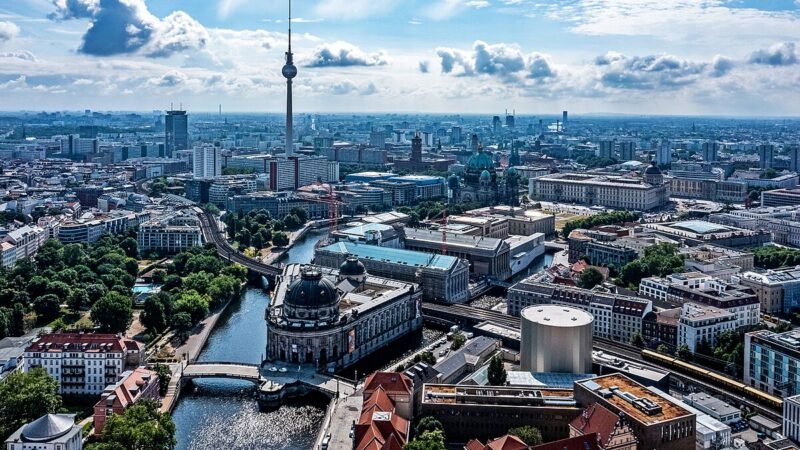
Berlin, the capital of Germany, is a major European city situated on the Spree River in northeastern Germany. On Saturday, 3 September 1988, the city experienced drizzly weather typical of early autumn conditions. Astrologically, this date falls under Virgo, the sixth sign of the zodiac, with the moon in its waxing crescent phase as it progressed towards its next full cycle.
On this day
On this date in 1991, a fire at a chicken processing plant in Hamlet, North Carolina claimed 25 lives. The workers were locked inside the burning building, a tragedy that exposed serious safety violations in industrial food production facilities across the United States and prompted subsequent investigations into workplace safety standards.
Fifty years earlier, on 3 September 1941, the mass expulsion of Soviet Germans from the Volga German ASSR began. This forced displacement, ordered by Stalin, removed an entire ethnic population from their historical homeland during the Second World War. British racing motorist Malcolm Campbell also features prominently in this date's history, becoming the first person to drive an automobile over 300 mph on the Bonneville Salt Flats in Utah in 1935, a record that stood as a major milestone in automotive engineering and speed trials.
DayAtlas provides comprehensive historical information for any date and location, displaying weather conditions, significant events, and notable births and deaths. Users can explore what happened on specific dates throughout history whilst viewing contemporary weather data for their chosen place.
Find out what's happening today in Berlin.
What the Weather Had in Store for Berlin on 28th November 2026
Three threads woven together hold what one alone cannot bear.
Fortune of the Day
3rd September in the Stars – Star Sign Virgo
Personality Profile
Personality Those born on September 3rd blend Virgo's analytical precision with the creative expression of numerology 3. They're communicative thinkers who naturally share their observations and ideas with others. Their curiosity drives them to explore details while maintaining perspective on broader patterns.
Strengths & Weaknesses Their strengths include clear communication, logical reasoning, and genuine helpfulness. They inspire others through honest, articulate expression. However, they risk overanalyzing situations and delivering criticism too bluntly, which can strain relationships and create unnecessary tension.
Love In relationships, these Virgos value intellectual connection and honest dialogue above all. They seek partners who appreciate their logical approach and share their interests. Emotional intimacy develops through reliability, transparency, and meaningful conversations.
Caree & Finance They excel in roles combining analysis with communication: consulting, writing, teaching, or media work. Their organizational skills make them dependable project managers. Financially prudent, they sometimes miss opportunities by being overly cautious.
Health Mental stimulation matters as much as physical activity for their wellbeing. They're prone to anxiety and benefit from stress-management practices. Consistent routines, adequate sleep, and creative outlets maintain their physical and mental balance effectively.
That night, the moon was in its waxing crescent phase.
Chinese year of the Dragon (Earth).
Fun Facts About 3rd September
Name Days in Your Language: Page, Paige, Phebe, Phoebe, Phoebus
Someone born on this day in 1988 would be 38 years old today — just 13,965 days into life, which is roughly 335,163 hours, 20,109,809 minutes, or 1,206,588,542 seconds spent on Earth so far.
It's the 247. day of the year. In 1988, 3rd September falls on a Saturday.
As this is a leap year, there are 119 days still to come.
We’re currently in Week 35 — the year marches on.
Famous Birthdays on 3rd September
On this day, 12 notable people were born on 3rd September — spanning from 1985 to 1990. From world leaders to artists and scientists, discover who shares this birthday.
03/09/1990
Mohammad Shami, Indian cricketer
Mohammed Shami Ahmed is an Indian international cricketer who plays as a right-arm fast-bowler for the India national cricket team, for the Bengal cricket team in domestic cricket, and for the Lucknow Super Giants in the Indian Premier League. He also plays for Mohun Bagan in domestic competitions of West Bengal.
03/09/1988
Jérôme Boateng, Ghanaian-German footballer
Jérôme Agyenim Boateng is a German former professional footballer who played as a centre-back.
Hana Makhmalbaf, Iranian director and producer
Hana Makhmalbaf is an Iranian filmmaker. She is the younger sister of filmmaker Samira Makhmalbaf and daughter of filmmakers Mohsen Makhmalbaf and Fatemeh Meshkini. She is known for her films Joy of Madness (2003), Buddha Collapsed Out of Shame (2007) and Green Days (2009). Makhmalbaf won the Lina Mangiacapre Award at the Venice Film Festival in 2003 for Joy of Madness (2003), which also won the Special Jury Prize at Tokyo Filmex. Makhmalbaf's film Buddha Collapsed Out of Shame won various awards as well, such as the Paolo Ungari UNICEF Prize at the Rome Film Festival and the Peace Film Award at the Berlin International Film Festival.
03/09/1987
Allie, Canadian wrestler
Laura Dennis is a Canadian professional wrestler. She is signed to Total Nonstop Action Wrestling (TNA), where she performs under the ring name Allie and is a member of DemonXBunny, alongside Rosemary
Modibo Maïga, Malian footballer
Modibo Maïga is a Malian professional footballer who plays as a striker.
Dawid Malan, English cricketer
Dawid Johannes Malan Jnr is an English cricketer who has played for Yorkshire and Middlesex in English domestic cricket and in multiple Twenty20 leagues, including for Punjab Kings in the Indian Premier League. He played for England in all formats from 2017 until his retirement from international cricket in 2024.
James Neal, Canadian ice hockey player
James Neal is a Canadian former professional ice hockey winger. He played 14 seasons in the National Hockey League (NHL) for the Dallas Stars, Pittsburgh Penguins, Nashville Predators, Vegas Golden Knights, Calgary Flames, Edmonton Oilers, and St. Louis Blues.
03/09/1986
Shaun White, American snowboarder, skateboarder, and guitarist
Shaun Roger White is an American former professional snowboarder and skateboarder. He is a five-time Olympian and a three-time Olympic gold medalist in half-pipe snowboarding. He holds the world record for the most X Games gold medals and most Olympic gold medals by a snowboarder. He has also won ten ESPY Awards throughout his career in various categories.
OMI, Jamaican singer
Omar Samuel Pasley, known professionally as Omi, is a Jamaican singer. He is best known for his 2012 single "Cheerleader", the remixed version of which was a worldwide hit. He was signed to Ultra Music, a part of Sony Music, and released his album Me 4 U in 2015.
Capitão Telhada, Brazilian politician
Rafael Henrique Cano Telhada, better known as Capitão Telhada, is a Brazilian politician serving as a member of the Legislative Assembly of São Paulo since 2023. He is the son of Coronel Telhada.
03/09/1985
Scott Carson, English footballer
Scott Paul Carson is an English former professional footballer who played as a goalkeeper.
Kelvin Wilson, English footballer
Kelvin James Wilson is an English professional footballer who plays as a centre back for Ilkeston Town.
Lives Remembered on 3rd September
On 3rd September, 5 remarkable people passed away — from 1985 to 1991. Remember the lives and legacies of those we lost on this day.
03/09/1991
Frank Capra, Italian-American director, producer, and screenwriter (born 1897)
Frank Russell Capra was an Italian-born American film director, producer, and screenwriter who was the creative force behind several major award-winning films of the 1930s and 1940s. Born in Italy and raised in Los Angeles from the age of five, his rags-to-riches story has led film historians such as Ian Freer to consider him the "American Dream personified".
03/09/1989
Gaetano Scirea, Italian footballer (born 1953)
Gaetano Scirea was an Italian professional footballer who is considered one of the greatest defenders in football history. He spent most of his career with Juventus.
03/09/1988
Ferit Melen, Turkish civil servant and politician, 14th Prime Minister of Turkey (born 1906)
Ferit Sadi Melen was a Turkish civil servant, politician and Prime Minister of Turkey.
03/09/1987
Morton Feldman, American composer and educator (born 1926)
Morton Feldman was an American composer. A major figure in 20th-century classical music, Feldman was an important exponent of indeterminacy in music, a development associated with the experimental New York School of composers also including John Cage, Christian Wolff, and Earle Brown. Feldman's works are characterized by notational innovations that he developed to create his characteristic sound: rhythms that seem to be free and floating, pitch shadings that seem softly unfocused, a generally quiet and slowly evolving music, and recurring asymmetric patterns. His later works, after 1977, also explore extremes of duration.
03/09/1985
Johnny Marks, American songwriter (born 1909)
John David Marks was an American songwriter. He specialized in Christmas songs and wrote many holiday standards, including "Rudolph the Red-Nosed Reindeer", "Rockin' Around the Christmas Tree", "A Holly Jolly Christmas", "Silver and Gold", and "I Heard the Bells on Christmas Day".
Celebrations & Special Days Worldwide on 3rd September
Christian feast day: Blessed Bartholomew Gutierrez
Beatification is an act by which the Catholic Church formally recognizes that a deceased member of the faithful is believed to have entered Heaven and is capable of interceding on behalf of individuals who pray in their name, permitting a restricted, local form of public veneration.
Christian feast day: Blessed Brigida Morello Zancano
Beatification is an act by which the Catholic Church formally recognizes that a deceased member of the faithful is believed to have entered Heaven and is capable of interceding on behalf of individuals who pray in their name, permitting a restricted, local form of public veneration.
Christian feast day: Mansuetus of Toul
Saint Mansuetus was the first Bishop of Toul.
Christian feast day: Marinus
Marinus is a Christian saint, who according to hagiographical accounts recorded centuries after his lifetime was the founder of a chapel and monastery in 301 from whose initial community the state of San Marino later grew.
Christian feast day: Phoebe
Phoebe was a first-century Christian deacon mentioned by the Apostle Paul in his Epistle to the Romans, verses 16:1–2. A notable woman in the church of Cenchreae, she was trusted by Paul to deliver his letter to the Romans. Paul refers to her both as a "deacon" and as a helper or patron of many. This is the only place in the New Testament where a woman is specifically referred to with these two distinctions. Paul introduces Phoebe as his emissary to the church in Rome and, because they are not acquainted with her, Paul provides them with her credentials.
Christian feast day: Pope Gregory I
Pope Gregory I, commonly known as Saint Gregory the Great, was the 64th Bishop of Rome from 3 September 590 until his death on 12 March 604.
Christian feast day: Remaclus
Remaclus was a Benedictine missionary bishop who is venerated as a saint.
Christian feast day: Prudence Crandall (Episcopal Church (USA))
Prudence Crandall was an American schoolteacher and activist. She ran the Canterbury Female Boarding School in Canterbury, Connecticut, which became the first known school for African American girls in the United States led by a white woman. She was the sister of Reuben Crandall, the defendant in the Trial of Reuben Crandall.
Christian feast day: September 3 (Eastern Orthodox liturgics)
September 3 in Eastern Orthodox liturgical calendars is a feast day and a day of commemoration of saints and martyrs. Although some Orthodox churches use the Revised Julian Calendar and others use the traditional Julian calendar, the fixed commemorations for their respective September 3 are broadly the same, no matter which calendar is used.
China's victory over Japan commemoration related observances: Armed Forces Day (Republic of China)
PLA Day, also known as Army Day, is a professional military holiday celebrated annually by the People's Liberation Army (PLA), the military of China, on 1 August. It commemorates the founding of the PLA during the 1927 Nanchang uprising. Six years later, on 30 June 1933, the Chinese Communist Party (CCP)'s Central Committee for Military Revolutionary Cases voted to declare 1 August an annual holiday, being solidified later on 11 July by the government of the Chinese Soviet Republic.
China's victory over Japan commemoration related observances: V-J Day (People's Republic of China)
Victory over Japan Day is the day on which Imperial Japan surrendered in World War II, in effect bringing the war to an end. The term has been applied to both of the days on which the initial announcement of Japan's surrender was made – 15 August 1945, in Japan, and because of time zone differences, 14 August 1945 – as well as to 2 September 1945, when the surrender document was signed, officially ending World War II.
Feast of San Marino and the Republic, celebrates the foundation of the Republic of San Marino in 301.
San Marino, officially the Republic of San Marino, is a landlocked country in Southern Europe, completely surrounded by Italy. Located on the northeastern slopes of the Apennine Mountains, it is the larger of two microstates within the Italian Peninsula, the other being Vatican City. San Marino is the fifth-smallest country in the world by area, with a land area of just over 61 km2 (24 sq mi). Its population was 34,042 as of 2025 and in 2026 dropped to 33,559. Its capital, the City of San Marino, sits atop Monte Titano, while its largest settlement is Dogana, in the municipality of Serravalle. San Marino claims to have been founded in AD 301 and to be the oldest extant sovereign state, and the oldest constitutional republic. It is named after Saint Marinus, a legendary stonemason from the Roman island of Rab, who is said to have fled persecution under Emperor Diocletian to have established a monastic community on Monte Titano, where he built a small chapel. The country has a rare constitutional structure: the Grand and General Council, a democratically elected legislature, selects two heads of state, the Captains Regent, every six months. They are chosen from opposing political parties, and serve concurrently with equal powers and preside over several institutions of state, including the Grand and General Council. Only the Federal Council of Switzerland follows this same structure, except with some modifications due to its immensely larger size.
Flag Day (Australia)
Australian National Flag Day has been celebrated in Australia since 3 September 1996. It commemorates the day in 1901 on which the Australian National Flag was first flown. Since 2008, the same day has also been commemorated as Merchant Navy Day, which allows the Australian Red Ensign to be flown on land on the occasion.
Independence Day, celebrates the second independence of Qatar from the United Kingdom in 1971.
An Independence Day is an annual event commemorating the anniversary of a nation's independence or statehood, usually after ceasing to be a group or part of another nation or state, or after the end of a military occupation, or after a major change in government. Many countries commemorate their independence from a colonial empire.
Levy Mwanawasa Day (Zambia)
Levy Patrick Mwanawasa was a Zambian politician who served as the third president of Zambia. He served as president from January 2002 until his death in August 2008. Mwanawasa is credited with having initiated a campaign to rid the corruption situation in Zambia during his term. Prior to Mwanawasa's election, he served as the fourth vice-president of Zambia from November 1991 to July 1994, whilst an elected Member of Parliament of Chifubu Constituency.
Merchant Navy Remembrance Day (Canada)
Canada, like several other Commonwealth nations, created the Canadian Merchant Navy in a large-scale effort during World War II. A total of 12,000 men and women served in Canada's Merchant Navy. By war's end, 1,500 Canadians had died, including eight women.
Merchant Navy Day (United Kingdom)
The Merchant Navy (MN) is the collective name given to British civilian ships and the officers and ratings that man them. Merchant Navy vessels mostly fly the Red Ensign and the ships and ship's companies' are regulated by the Maritime and Coastguard Agency (MCA), a specialist agency of the UK Department of Transport. British merchant ships are registered under the UK or Red Ensign group ship registries. British Merchant Navy deck officers and ratings are certificated and trained according to STCW Convention and the syllabus of the Merchant Navy Training Board in maritime colleges and other training institutes around the UK.
National Welsh Rarebit Day (United States)
This is a list of food days by country. Many countries have designated specific days as celebrations, commemorations, or acknowledgments of certain types of food and drink.
Tokehega Day (Tokelau, New Zealand)
Public holidays in Tokelau are described in the Interpretation Rules 2003 as "New Year's Day, Good Friday, Easter Monday, Mother's Day, Father's Day, Tokehega Day, White Sunday, Christmas Day, Boxing Day, and any day declared by a village to be a public holiday". Although some New Zealand public holidays, such as Waitangi Day and ANZAC Day are celebrated in Tokelau, these are not official holidays.
What Happened on 3rd September?
56 significant events took place on Saturday, 3rd September — stretching from -36 to 2017. Explore the moments that shaped history on this day.
03/09/2017
North Korea conducts its sixth and most powerful nuclear test.
North Korea, officially the Democratic People's Republic of Korea (DPRK), is a country in East Asia. It constitutes the northern half of the Korean Peninsula and borders China and Russia to the north at the Yalu (Amnok) and Tumen rivers, and South Korea to the south at the Korean Demilitarized Zone (DMZ). The country's western border is formed by the Yellow Sea, while its eastern border is defined by the Sea of Japan. Pyongyang is the capital and largest city.
03/09/2016
The U.S. and China, together responsible for 40% of the world's carbon emissions, both formally ratify the Paris global climate agreement.
China, officially the People's Republic of China (PRC), is a country in East Asia. It is divided into 33 province-level divisions, including two special administrative regions. Beijing is the capital, while Shanghai is the most populous city by urban area. Its geography features the Central Plain, major rivers such as the Yangtze and Yellow River, deserts, subtropical and temperate forests, plateaus, and mountain ranges such as the Himalayas. It is the world's second-most populous country after India, with a population exceeding 1.4 billion. Covering 9.6 million square kilometers (3,700,000 sq mi), it is the third largest country by area.
03/09/2010
After taking off from Dubai International Airport, UPS Airlines Flight 6 develops an in-flight fire in the cargo hold and crashes near Nad Al Sheba, killing both crew members on board.
Dubai International Airport is the primary international airport serving Dubai, United Arab Emirates, and is the world's busiest airport by international passenger traffic as of 2025. It is also the busiest airport in the Middle East as of 2025, the second-busiest airport in the world by passenger traffic as of 2025, the busiest airport for Airbus A380 and Boeing 777 movements, and the airport with the highest average number of passengers per flight. In 2025, the airport handled over 95.2 million passengers, over 2.2 million tonnes of cargo and registered over 454,000 aircraft movements.
03/09/2004
Beslan school siege ends, resulting in over 330 fatalities, including 186 children.
The Beslan school siege, also referred to as the Beslan terror attack, the Beslan tragedy, or the Beslan massacre, was an Islamist terrorist attack that occurred from 1 September 2004 to 3 September 2004 in Beslan, North Ossetia, Russia. It lasted three days, and involved the imprisonment of more than 1,100 people as hostages, including 777 children. The hostages, primarily children, their parents, and school staff were held by terrorists in a building rigged with explosives under severe conditions; the terrorists did not provide them with food or water and denied them other basic necessities. The siege ended with the deaths of 334 people, 186 of them children, as well as 31 of the attackers. It is considered the deadliest school shooting in history.
03/09/2001
In Belfast, Protestant loyalists begin a picket of Holy Cross, a Catholic primary school for girls.
Belfast is the capital, largest city and main port of Northern Ireland. It stands on the banks of the river Lagan, and is connected to the open sea through Belfast Lough and the North Channel. The city is the most populous in Northern Ireland and the second-largest, after Dublin, on the island of Ireland, with a recorded population in 2021 of 345,418 and of 704,406 for the greater metropolitan area.
03/09/1997
Vietnam Airlines Flight 815 (Tupolev Tu-134) crashes on approach into Phnom Penh airport, killing 64.
Vietnam Airlines is the flag carrier of Vietnam. The airline was founded in 1956 and later established as a state-owned enterprise in April 1989. Vietnam Airlines is headquartered in Long Biên district, Hanoi, with hubs at Noi Bai International Airport in Hanoi and Tan Son Nhat International Airport in Ho Chi Minh City. The airline flies 117 routes across 19 countries, excluding codeshared services.
03/09/1989
Cubana de Aviación Flight 9046 crashes into a residential area of Havana shortly after takeoff from José Martí International Airport, killing 150.
Cubana de Aviación Flight 9046 was a chartered Ilyushin Il-62M airliner operated by Cubana, which crashed on 3 September 1989, shortly after takeoff from José Martí International Airport.
Varig Flight 254 crashes in the Amazon rainforest near São José do Xingu in Brazil, killing 12.
Varig Flight 254 was a scheduled domestic passenger flight from São Paulo, Brazil, to Belém, capital city of the state of Pará in the country's North Region. On 3 September 1989, the Boeing 737-200 operating this flight had several intermediate stopovers, the last being in Marabá, Pará. Prior to takeoff from Marabá, the crew entered an incorrect heading into the flight computer, flying deep into a remote area of the Amazon jungle. Attempts to reach an alternative airport were unsuccessful and the plane eventually ran out of fuel, crashing during a belly landing in the jungle 1,700 kilometres northwest of Rio de Janeiro. Of the 54 passengers and crew, 12 passengers died and many more sustained serious injuries. The survivors were rescued two days later.
03/09/1987
In a coup d'état in Burundi, President Jean-Baptiste Bagaza is deposed by Major Pierre Buyoya.
The 1987 Burundian coup d'état was a bloodless military coup that took place in Burundi on 3 September 1987. Tutsi president Jean-Baptiste Bagaza was deposed whilst traveling abroad and succeeded by Tutsi Major Pierre Buyoya.
03/09/1981
The Convention on the Elimination of All Forms of Discrimination Against Women, an international bill of rights for women, is instituted by the United Nations.
The Convention on the Elimination of all Forms of Discrimination Against Women (CEDAW) is an international treaty adopted in 1979 by the United Nations General Assembly. Described as an international bill of rights for women, it was instituted on 3 September 1981 and has been ratified by 189 states. Over fifty countries that have ratified the convention have done so subject to certain declarations, reservations, and objections, including 38 countries who rejected the enforcement article 29, which addresses means of settlement for disputes concerning the interpretation or application of the convention. Australia's declaration noted the limitations on central government power resulting from its federal constitutional system. The United States and Palau have signed, but not ratified the treaty. The Holy See, Iran, Somalia, Sudan, and Tonga are not signatories to CEDAW.
03/09/1978
During the Rhodesian Bush War a group of ZIPRA guerrillas shot down civilian Vickers Viscount aircraft (Air Rhodesia Flight 825) with a Soviet-made SAM Strela-2; of 56 passengers and crew 38 people died in crash, 10 were massacred by the guerrillas at the site.
The Rhodesian Bush War, also known as the Rhodesian Civil War, the Second Chimurenga or the Zimbabwe War of Independence, was a civil conflict from July 1964 to December 1979 in the unrecognised state of Rhodesia.
03/09/1976
Viking program: The American Viking 2 spacecraft lands at Utopia Planitia on Mars.
The Viking program consisted of a pair of identical American space probes, Viking 1 and Viking 2 both launched in 1975, and landed on Mars in 1976. The mission effort began in 1968 and was managed by the NASA Langley Research Center. Each spacecraft was composed of two main parts: an orbiter spacecraft which photographed the surface of Mars from orbit, and a lander which studied the planet from the surface. The orbiters also served as communication relays for the landers once they touched down.
03/09/1971
Qatar becomes an independent state.
Qatar, officially the State of Qatar, is a country in West Asia. It occupies the Qatar Peninsula on the northeastern coast of the Arabian Peninsula in the Middle East; it shares its sole land border with Saudi Arabia to the south, with the rest of its territory surrounded by the Persian Gulf. The Gulf of Bahrain, an inlet of the Persian Gulf, separates Qatar from nearby Bahrain. The capital is Doha, home to over 80% of the country's inhabitants. Most of the land area is made up of flat, low-lying desert.
03/09/1967
Dagen H in Sweden: Traffic changes from driving on the left to driving on the right overnight.
Dagen H (H-day), typically known today as "Högertrafikomläggningen", was on 3 September 1967, the day where Sweden would switch from driving on the left-hand side of the road to the right. The "H" stands for "Högertrafik", the Swedish word for right-hand traffic. It was by far the largest logistical event in Sweden's history.
03/09/1954
The People's Liberation Army begins shelling the Republic of China-controlled islands of Quemoy, starting the First Taiwan Strait Crisis.
The People's Liberation Army (PLA) is the military wing of the Chinese Communist Party (CCP) and the primary armed forces of the People's Republic of China (PRC). It consists of four services—Ground Force, Navy, Air Force, and Rocket Force—and four arms—Aerospace Force, Cyberspace Force, Information Support Force, and Joint Logistics Support Force. It operates under the CCP's absolute control and is led by the Central Military Commission (CMC) with its chairman as commander-in-chief. Alongside the paramilitary People's Armed Police (PAP) and the Militia, the PLA forms the bulk of the country's armed forces.
03/09/1950
"Nino" Farina becomes the first Formula One Drivers' champion after winning the 1950 Italian Grand Prix.
Emilio Giuseppe "Nino" Farina was an Italian racing driver, who competed in Formula One from 1950 to 1956. Farina won the Formula One World Drivers' Championship in its inaugural 1950 season with Alfa Romeo, and won five Grands Prix across seven seasons.
03/09/1945
A three-day celebration begins in China, following the Victory over Japan Day on September 2.
Victory over Japan Day is the day on which Imperial Japan surrendered in World War II, in effect bringing the war to an end. The term has been applied to both of the days on which the initial announcement of Japan's surrender was made – 15 August 1945, in Japan, and because of time zone differences, 14 August 1945 – as well as to 2 September 1945, when the surrender document was signed, officially ending World War II.
03/09/1944
Holocaust: Diarist Anne Frank and her family are placed on the last transport train from the Westerbork transit camp to the Auschwitz concentration camp, arriving three days later.
A diary is a written or audiovisual memorable record, with discrete entries arranged by date reporting on what has happened over the course of a day or other period. Diaries have traditionally been handwritten but are now also often digital. A personal diary may include a person's experiences, thoughts, and/or feelings, excluding comments on current events outside the writer's direct experience. Someone who keeps a diary is known as a diarist. Diaries undertaken for institutional purposes play a role in many aspects of human civilization, including government records, business ledgers, and military records. In British English, the word may also denote a preprinted journal format.
03/09/1943
World War II: British and Canadian troops land on the Italian mainland. On the same day, Walter Bedell Smith and Giuseppe Castellano sign the Armistice of Cassibile, although it is not announced for another five days.
Operation Baytown was an Allied amphibious landing on the mainland of Italy that took place on 3 September 1943, part of the Allied invasion of Italy, itself part of the Italian Campaign, during the Second World War.
03/09/1942
World War II: In response to news of its coming liquidation, Dov Lopatyn leads an uprising in the Ghetto of Lakhva (present-day Belarus).
Łachwa Ghetto was a Nazi ghetto in Łachwa, Nazi German-occupied Poland during World War II. The ghetto was created with the aim of persecution and exploitation of the local Jews. The ghetto existed until September 1942. One of the first Jewish ghetto uprisings had happened there.
03/09/1941
The Holocaust: Karl Fritzsch, deputy camp commandant of the Auschwitz concentration camp, experiments with the use of Zyklon B in the gassing of Soviet POWs.
The Holocaust, known in Hebrew as the Shoah, was the genocide of European Jews during World War II. From 1941 to 1945, Nazi Germany and its collaborators systematically murdered around six million Jews across German-occupied Europe, approximately two-thirds of Europe's Jewish population. The murders were committed primarily through mass shootings across Eastern Europe and poison gas chambers in extermination camps, chiefly Auschwitz-Birkenau, Treblinka, Belzec, Sobibor, Chełmno and Majdanek death camps in occupied Poland. Concurrent Nazi persecutions killed millions of other non-Jewish civilians and prisoners of war (POWs); the term Holocaust is sometimes used to include the murder and persecution of non-Jewish groups, such as the Romani and Soviet POWs.
03/09/1939
World War II: France, the United Kingdom, New Zealand and Australia declare war on Germany after the invasion of Poland, forming the Allied nations. The Viceroy of India also declares war, but without consulting the provincial legislatures.
World War II, or the Second World War, was a global conflict between two coalitions: the Allies and the Axis powers. Nearly all of the world's countries were involved, with many engaging in total war on an unprecedented scale. World War II was the deadliest conflict in history, causing the deaths of 60 to 75 million people, a majority of whom were civilians. Millions died as a result of massacres, starvation, disease and genocides. After the Allied victory, Germany, Austria, Japan and Korea were occupied, and German and Japanese leaders were tried for war crimes.
World War II: The United Kingdom and France begin a naval blockade of Germany that lasts until the end of the war. This also marks the beginning of the Battle of the Atlantic.
The 1939 to 1945 blockade of Germany, part of the economic war of those years, involved operations carried out during World War II by the Allies of World War II in order to restrict the supplies of minerals, food and textiles needed by Nazi Germany – and later by other European Axis countries – in order to sustain the Axis war effort. The economic measures consisted mainly of a naval blockade, which formed part of the wider Battle of the Atlantic, but also included the bombing of economically important targets and the preclusive buying of war materials from neutral countries in order to prevent their sale to the Axis powers.The first period, from the beginning of European hostilities in September 1939 to the end of the "Phoney War", saw both the Allies and the Axis powers intercepting neutral merchant ships to seize deliveries en route to their respective enemies. Naval blockade at this time proved less than effective because the Axis could get crucial materials overland from the Soviet Union, while Berlin used harbours in Spain to import war materials into Germany. The second period began after the rapid Axis occupation of the majority of the European landmass in 1940–1941, resulting in Axis control of major centres of industry and agriculture. The third period started in December 1941 after the attack on Pearl Harbor by the Imperial Japanese Navy Air Service. The German declaration of war on the United States on 11 Dsecember 1941 brought the U.S. officially into the European war. The final period came after the tide of war finally turned against the Axis after heavy military defeats up to and after D-Day in June 1944, which led to gradual Axis withdrawals from the occupied territories in the face of the overwhelming Allied military offensives.
World War II: Passenger liner Athenia is torpedoed and sunk by German submarine U-30. She is the first British ship lost in World War II, with a reported 117 civillian passenger and crew killed out of 1,418 aboard.
SS Athenia was a steam turbine transatlantic passenger liner built in Glasgow, Scotland, in 1923 for the Anchor-Donaldson Line, which later became the Donaldson Atlantic Line. She worked between the United Kingdom and the east coast of Canada until 3 September 1939, when a torpedo from the German submarine U-30 sank her in the Western Approaches.
03/09/1935
Sir Malcolm Campbell reaches a speed of 304.331 miles per hour on the Bonneville Salt Flats in Utah, becoming the first person to drive an automobile over 300 mph.
Major Sir Malcolm Campbell was a British racing motorist and motoring journalist. He gained the world speed record on land and on water at various times, using vehicles called Blue Bird, including a 1921 Grand Prix Sunbeam. His son, Donald Campbell, carried on the family tradition by holding both land speed and water speed records.
03/09/1933
Yevgeniy Abalakov is the first man to reach the highest point in the Soviet Union, Communism Peak (now called Ismoil Somoni Peak and situated in Tajikistan) (7495 m).
Yevgeniy Mikhaylovich Abalakov was a Soviet mountaineer and sculptor.
03/09/1925
USS Shenandoah, the United States' first American-built rigid airship, is destroyed in a squall line over Noble County, Ohio. Fourteen of her 42-man crew perished, including her commander, Zachary Lansdowne.
USS Shenandoah was the first of four United States Navy rigid airships. It was constructed during 1922–1923 at Lakehurst Naval Air Station, and first flew in September 1923. It developed the U.S. Navy's experience with rigid airships and made the first crossing of North America by airship. On the 57th flight, Shenandoah was destroyed in a squall line over Ohio in September 1925.
03/09/1916
World War I: Leefe Robinson destroys the German airship Schütte-Lanz SL 11 over Cuffley, north of London; this is the first German airship to be shot down on British soil.
William Leefe Robinson VC was the first British pilot to shoot down a German airship over Britain during the First World War. For this, he was awarded the Victoria Cross (VC), the highest award for gallantry in the face of the enemy that can be awarded to British and Commonwealth forces. He was the first person to be awarded the VC for action in the UK.
03/09/1914
Wilhelm, Prince of Albania leaves the country after just six months due to opposition to his rule.
Wilhelm, Prince of Albania was sovereign of the Principality of Albania from 7 March to 3 September 1914. His reign officially came to an end on 31 January 1925, when the country was declared an Albanian Republic.
French composer Albéric Magnard is killed defending his estate against invading German soldiers.
Lucien Denis Gabriel Albéric Magnard was a French composer, somewhat influenced by César Franck and Vincent d'Indy. Magnard became a national hero in 1914 when he refused to surrender his property to German invaders and died defending it.
03/09/1911
A fire that started on Fraser's Million Dollar Pier destroys six to eight square blocks of Ocean Park, California.
Fraser's Million Dollar Pier was a 20th-century amusement park in Ocean Park, California in the United States. The pier was located between Pier Avenue and Marine Street, in a community situated between Santa Monica and Venice in Los Angeles County. Developed by Alexander R. Fraser, a booster in Ocean Park who had formerly been business partners with Abbot Kinney of Venice, the pier opened to the public on June 17, 1911 and was destroyed September 3, 1912 in a catastrophic fire that spread into the adjacent neighborhood and destroyed six to eight square blocks.
03/09/1895
John Brallier becomes the first openly paid professional American football player, when he was paid US$10 by David Berry, to play for the Latrobe Athletic Association in a 12–0 win over the Jeanette Athletic Association.
John Kinport "Sal" Brallier was one of the first professional American football players. He was nationally acknowledged as the first openly paid professional football player when he was given $10 to play for the Latrobe Athletic Association for a game against the Jeanette Athletic Association in 1895.
03/09/1879
Siege of the British Residency in Kabul: British envoy Sir Louis Cavagnari and 72 men of the Guides are massacred by Afghan troops while defending the British Residency in Kabul. Their heroism and loyalty became famous and revered throughout the British Empire.
The siege of the British Residency in Kabul was a military engagement of the Second Anglo-Afghan War. The British resident, Sir Louis Cavagnari, and his escort were massacred after an 8-hour siege by mutinous Afghan troops inside their Residency in Kabul. This event triggered the second phase of the war, during which an Anglo-Indian army invaded Afghanistan and captured Kabul.
03/09/1878
Over 640 die when the crowded pleasure boat Princess Alice collides with the Bywell Castle in the River Thames.
SS Princess Alice, formerly PS Bute, was a British passenger paddle steamer that sank on 3 September 1878 after a collision with the collier SS Bywell Castle on the River Thames. Between 600 and 700 people died, all from Princess Alice, the greatest loss of life of any British inland waterway shipping accident. No passenger list or headcount was made, so the exact figure of deaths has never been known.
03/09/1870
Franco-Prussian War: The Siege of Metz begins, resulting in a decisive Prussian victory on October 23.
The Franco-Prussian War, occasionally known as the Franco-German War, and sometimes referred to in France as the War of 1870, was a conflict between France and the North German Confederation led by Prussia. Lasting from 19 July 1870 to 28 January 1871, the conflict was caused primarily by France's determination to reassert its dominant position in continental Europe, which appeared in question following the decisive Prussian victory over Austria in 1866.
03/09/1861
American Civil War: Confederate General Leonidas Polk invades neutral Kentucky, prompting the state legislature to ask for Union assistance.
The American Civil War was fought in the United States between the Union and the Confederacy, which was formed in 1861 by Southern states that had seceded from the Union to preserve the institution of slavery. The South saw slavery as threatened because of the election of Abraham Lincoln as president in 1860, the abolitionist movement, and the growing electoral power of the North. The war ended with a Union victory, dissolution of the Confederacy and the national abolition of slavery, freeing four million African Americans.
03/09/1855
American Indian Wars: In Nebraska, 700 soldiers under United States General William S. Harney avenge the Grattan massacre by attacking a Sioux village and killing 100 men, women and children.
The American Indian Wars, also known as the American Frontier Wars, and the Indian Wars, were initially fought by European colonial empires, the United States, Confederate States and Republic of Texas against various American Indian tribes in North America. These conflicts occurred from the time of the earliest European colonial settlements in the 17th century until the end of the 19th century. The various conflicts resulted from a wide variety of factors, the most common being the desire of settlers and governments for tribal lands. The European powers and their colonies enlisted allied American Indian tribes to help them conduct warfare against each other's colonial settlements. After the American Revolution, many conflicts were local to specific states or regions and frequently involved disputes over land use; many involved retaliatory violence.
03/09/1843
King Otto of Greece is forced to grant a constitution following an uprising in Athens.
Otto was King of Greece from the establishment of the Kingdom on 7 May 1832, under the Convention of London, until he was deposed in October 1862.
03/09/1838
Future abolitionist Frederick Douglass escapes from slavery.
In the United States, abolitionism, the movement that sought to end chattel slavery in the country, was active from the colonial era until the American Civil War, the end of which brought about the abolition of American Chattel Slavery, except as punishment for a crime, through the Thirteenth Amendment to the United States Constitution.
03/09/1812
Twenty-four settlers are killed in the Pigeon Roost Massacre in Indiana.
Pigeon Roost State Historic Site is located between Scottsburg and Henryville, Indiana, United States. A one-lane road off U.S. Route 31 takes the visitor to the site of a village where Native Americans massacred 24 settlers shortly after the War of 1812 began.
03/09/1798
The week long battle of St. George's Caye begins between Spain and Britain off the coast of Belize.
The Battle of St. George's Caye was a military engagement that lasted from 3 to 10 September 1798, off the coast of British Honduras. However, the name is typically reserved for the final battle that occurred on 10 September in which the Spanish were defeated. The events of 10 September 1798 marked the final Spanish attempt to take over the area. In Belize, the Battle of St. George's Caye is a national public and bank holiday.
03/09/1783
American Revolutionary War: The war ends with the signing of the Treaty of Paris by the United States and the Kingdom of Great Britain.
The Treaty of Paris, signed by representatives of King George III of Great Britain and representatives of the United States on September 3, 1783, officially ended the War of American Independence and recognized the Thirteen Colonies, which had been part of colonial British America, to be free, sovereign, and independent unified states. It forms one treaty out of many that are collectively named the "Peace of Paris".
03/09/1777
American Revolutionary War: During the Battle of Cooch's Bridge, the Flag of the United States is flown in battle for the first time.
The American Revolutionary War, also known as the Revolutionary War or American War of Independence or simply the American Revolution, was the armed conflict that comprised the final eight years of the broader American Revolution, in which American Patriot forces organized as the Continental Army and, commanded by George Washington, defeated the British Army. The conflict was fought in North America, the Caribbean, and the Atlantic Ocean. The war's outcome seemed uncertain for most of the war, but Washington and the Continental Army's decisive victory in the Siege of Yorktown in 1781 led King George III and the Kingdom of Great Britain to negotiate an end to the war. In 1783, in the Treaty of Paris, the British Crown acknowledged the independence of the Thirteen Colonies, leading to the establishment of the United States as an independent and sovereign nation.
03/09/1666
The Royal Exchange burns down in the Great Fire of London.
The Royal Exchange is a building in central London, built to house the London Stock Exchange, which now operates elsewhere. Today, the Royal Exchange contains restaurants and luxury shops.
03/09/1658
The death of Oliver Cromwell; Richard Cromwell becomes Lord Protector of England.
Oliver Cromwell was an English statesman and soldier, widely regarded as one of the most important figures in British history. He came to prominence during the Wars of the Three Kingdoms, initially as a senior commander in the Parliamentarian army and later as a republican politician. A leading advocate of the execution of Charles I in January 1649, which led to the establishment of the Commonwealth of England, Cromwell ruled as Lord Protector from December 1653 until his death in September 1658.
03/09/1651
The Battle of Worcester is the last significant action in the Wars of the Three Kingdoms.
The Battle of Worcester took place on 3 September 1651 in and around the city of Worcester, England and was the last major battle of the 1642 to 1651 Wars of the Three Kingdoms. A Parliamentarian army of around 28,000 under Oliver Cromwell defeated a largely Scottish Royalist force of 16,000 led by Charles II of England and Scotland.
03/09/1650
Victory over the royalists in the Battle of Dunbar opens the way to Edinburgh for the New Model Army during the English invasion of Scotland.
The Battle of Dunbar was fought between the English New Model Army, under Oliver Cromwell, and a Scottish army commanded by David Leslie on 3 September 1650 near Dunbar, Scotland. The battle resulted in a decisive victory for the English. It was the first major battle of the 1650 invasion of Scotland.
03/09/1411
The Treaty of Selymbria is concluded between the Ottoman Empire and the Republic of Venice.
The Treaty of Selymbria was an agreement concluded on 3 September 1411 between the Republic of Venice and the Ottoman prince Musa Çelebi, ruler of the European portion of the Ottoman Empire (Rumelia), at Selymbria. The treaty largely repeated previous agreements between Venice and Ottoman rulers, and recognized the possessions of the Republic in Greece and Albania.
03/09/1335
At the congress of Visegrád Charles I of Hungary mediates a reconciliation between two neighboring monarchs, John of Bohemia and Casimir III of Poland.
Charles I, also known as Charles Robert (Hungarian: Károly Róbert; Croatian: Karlo Robert; Slovak: Karol Róbert; Italian: Caroberto;, was King of Hungary and Croatia from 1308 to his death. He was a member of the Capetian House of Anjou and the only son of Charles Martel, Prince of Salerno. His father was the eldest son of Charles II of Naples and Mary of Hungary. Mary laid claim to Hungary after her brother, Ladislaus IV of Hungary, died in 1290, but the Hungarian prelates and lords elected her cousin, Andrew III, king. Instead of abandoning her claim to Hungary, she transferred it to her son, Charles Martel, and after his death in 1295, to her grandson, Charles. On the other hand, her husband, Charles II of Naples, made their third son, Robert, heir to the Kingdom of Naples, thus disinheriting Charles.
03/09/1260
The Mamluks defeat the Mongols at the Battle of Ain Jalut in Palestine, marking their first decisive defeat and the point of maximum expansion of the Mongol Empire.
Mamluk, mamaluk, or mameluke were non-Arab, ethnically diverse enslaved mercenaries, slave-soldiers, and freed slaves who were assigned military and administrative duties in the Muslim world. They were purchased as military slaves, converted to Islam, and trained in martial and courtly skills. Upon completion of their training they were freed, but remained part of the ruling military caste, forming elite regiments and, in some periods and regions, rising to sovereign power.
03/09/1189
Richard I of England (a.k.a. Richard "the Lionheart") is crowned at Westminster.
Richard I, known as Richard the Lionheart or Richard Cœur de Lion because of his reputation as a great military leader and warrior, was King of England from 1189 until his death in 1199. He also ruled as Duke of Normandy, Aquitaine, and Gascony; Lord of Cyprus; Count of Poitiers, Anjou, Maine, and Nantes; and was overlord of Brittany at various times during the same period. He was the third of five sons of Henry II of England and Eleanor of Aquitaine and was therefore not expected to become king, but his two elder brothers predeceased their father.
03/09/0863
Major Byzantine victory under general Petronas at the Battle of Lalakaon against an Arab raid under emir Umar al-Aqta, who is killed in battle.
The Byzantine Empire, also known as the Eastern Roman Empire, was the continuation of the Eastern part of the Roman Empire centred on Constantinople during late antiquity and the Middle Ages. Having survived the fall of the Western Roman Empire in the 5th century AD, it endured until the fall of Constantinople to the Ottoman Empire in 1453. The term 'Byzantine Empire' was coined only after its demise; its citizens used the term 'Roman Empire' and called themselves 'Romans'.
03/09/0673
King Wamba of the Visigoths puts down a revolt by Hilderic, governor of Nîmes (France) and rival for the throne.
Wamba was the king of the Visigoths from 672 to 680. During his reign, the Visigothic kingdom encompassed all of Hispania and part of southern Gaul known as Septimania.
03/09/0590
Consecration of Pope Gregory I (Gregory the Great).
Pope Gregory I, commonly known as Saint Gregory the Great, was the 64th Bishop of Rome from 3 September 590 until his death on 12 March 604.
03/09/0301
San Marino, one of the smallest nations in the world and the world's oldest republic still in existence, is founded by Saint Marinus.
San Marino, officially the Republic of San Marino, is a landlocked country in Southern Europe, completely surrounded by Italy. Located on the northeastern slopes of the Apennine Mountains, it is the larger of two microstates within the Italian Peninsula, the other being Vatican City. San Marino is the fifth-smallest country in the world by area, with a land area of just over 61 km2 (24 sq mi). Its population was 34,042 as of 2025 and in 2026 dropped to 33,559. Its capital, the City of San Marino, sits atop Monte Titano, while its largest settlement is Dogana, in the municipality of Serravalle. San Marino claims to have been founded in AD 301 and to be the oldest extant sovereign state, and the oldest constitutional republic. It is named after Saint Marinus, a legendary stonemason from the Roman island of Rab, who is said to have fled persecution under Emperor Diocletian to have established a monastic community on Monte Titano, where he built a small chapel. The country has a rare constitutional structure: the Grand and General Council, a democratically elected legislature, selects two heads of state, the Captains Regent, every six months. They are chosen from opposing political parties, and serve concurrently with equal powers and preside over several institutions of state, including the Grand and General Council. Only the Federal Council of Switzerland follows this same structure, except with some modifications due to its immensely larger size.
01/01/1970
In the Battle of Naulochus, Marcus Vipsanius Agrippa, admiral of Octavian, defeats Sextus Pompey, son of Pompey, thus ending Pompeian resistance to the Second Triumvirate.
The naval Battle of Naulochus was fought on 3 September 36 BC between the fleets of Sextus Pompeius and Marcus Vipsanius Agrippa, off Naulochus, Sicily. The victory of Agrippa, admiral of Octavian, marked the end of the Pompeian resistance to the Second Triumvirate.