Saturday, 18th April 2026 in Lisbon
Welcome to your daily snapshot of Lissabon! It's World Heritage Day. Explore 46 historical events, birthdays, deaths, and milestones that shaped this day in Lissabon. From remarkable moments in local and world history to the people who left their mark — find out what makes today special. Today's weather in Lissabon brings cloudy with temperatures between 13°C and 26°C. Tonight's moon is in its full moon phase, and the zodiac sign of the day is Aries. If you're curious about the history of a day — this page brings together everything worth knowing about this Saturday, 18th April in Lissabon, PT.
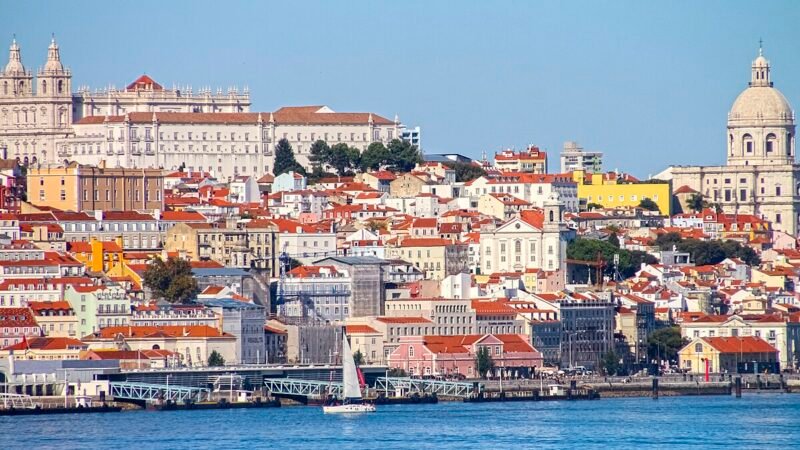
Lisbon, Portugal's capital, sits on the Tagus estuary on the western coast of the Iberian Peninsula, known for its distinctive hillside architecture and historic significance. On Saturday, 18 April 2026, the city experiences cloudy conditions. The date falls under the zodiac sign of Aries, and the moon is full, providing maximum lunar illumination across the night sky.
On this day
On 18 April 1775, American colonists Paul Revere and William Dawes began their celebrated midnight ride to warn residents of Lexington and Concord, Massachusetts, of the impending arrival of British troops. They were later joined by Samuel Prescott as they rode through the darkness, alerting the militia and townspeople to prepare for the confrontation that would spark the American Revolutionary War.
More than a century later, on 18 April 1949, the Republic of Ireland Act came into force, formally describing Ireland as a republic and ending its membership in the Commonwealth of Nations. This legislative moment represented a significant constitutional shift in Irish independence and sovereignty.
Poet Ezra Pound was released from St. Elizabeths Hospital in Washington, D.C., on 18 April 1958, after spending twelve years in psychiatric care. The controversial American poet's release marked the end of a prolonged incarceration that had sparked considerable debate over artistic freedom and mental health treatment.
World Heritage Day
World Heritage Day falls on 18 April each year, marking the anniversary of the founding of the International Council of Monuments and Sites (ICOMOS) in 1965. The day celebrates cultural and natural heritage sites around the world, raising awareness of their importance to humanity and the need for their preservation. UNESCO uses the occasion to highlight threatened sites and mobilise resources for their protection. The observance has been recognised globally since its establishment, encouraging governments and organisations to promote heritage conservation efforts.
DayAtlas provides comprehensive information for any date and location, displaying weather conditions, historical events, and notable births and deaths. Users can explore what happened on this day throughout history whilst learning about current atmospheric conditions and astronomical details.
Find out what's happening today in Lissabon.
What the Weather Had in Store for Lissabon on 18th April 2026
Each note exists only because silence came before it.
Fortune of the Day
18th April in the Stars – Star Sign Aries
Personality Profile
Personality People born on April 18 combine Aries directness with radiant vitality and self-expression. They naturally command presence and carry the rare Master Number 22, granting them visionary depth. Their temperament is vibrant, forward-thinking, and unusually profound for a fire sign.
Strengths & Weaknesses Strengths: Extraordinary courage, clear vision, and ability to manifest ideals into reality. These natives inspire others through authenticity. Weaknesses: Impulsivity and impatience can trigger hasty decisions; intense energy requires constructive outlets.
Love In relationships, those born April 18 are passionate and honest, sometimes bluntly direct and impatient. They seek partners sharing their vitality and visions. True fulfillment comes with people who understand their depth and embrace their unconventional nature.
Caree & Finance These individuals excel in leadership, entrepreneurship, and pioneering ventures. Master Number 22 empowers them for large-scale structural building. Financial success flows from bold initiatives; caution against impulsive investment decisions is wise.
Health April 18 natives require intense physical activity to channel their fire energy. Mental restlessness can trigger sleep disruption or stress. Regular challenging exercise and creative expression strongly support their overall wellbeing.
That night, the moon was in its full moon phase.
Chinese year of the Horse (Fire).
Fun Facts About 18th April
Name Days in Your Language: Anthea, Ayana, Ayanna, Warner, Werner
Someone born on this day would be just 46 days old today — roughly 1,106 hours, 66,402 minutes, or 3,984,146 seconds spent on Earth so far.
It's the 108. day of the year. In 2026, 18th April falls on a Saturday.
There are 257 days still to come.
We’re currently in Week 16 — the year marches on.
Famous Birthdays on 18th April
On this day, 136 notable people were born on 18th April — spanning from 359 to 1996. From world leaders to artists and scientists, discover who shares this birthday.
18/04/1996
Ski Mask the Slump God, American rapper
Stokeley Clevon Goulbourne, known professionally as Ski Mask the Slump God, is an American rapper. He is best known for his association with XXXTentacion, with whom he formed the hip hop collective Members Only in 2014. He is notable for his nostalgic-themed musical production and public image, often clad with multi-colored durags. He signed with Victor Victor Worldwide, an imprint of Republic Records to release his debut commercial mixtape You Will Regret (2017), which entered the Billboard 200 and spawned the platinum-certified singles "BabyWipe", "Take a Step Back", and "Catch Me Outside".
18/04/1995
Divock Origi, Belgian footballer
Divock Okoth Origi is a Belgian professional footballer who plays as a striker. He last played for Serie A club AC Milan.
18/04/1994
Aminé, American singer-songwriter
Adam Aminé Daniel is an American rapper, singer, and songwriter, from Portland, Oregon. He first gained notability for his commercial debut single, "Caroline", which peaked at number 11 on the US Billboard Hot 100 chart. Aminé released his debut studio album Good for You, on July 28, 2017, and his second studio album, Limbo, on August 7, 2020.
18/04/1993
Mika Zibanejad, Swedish ice hockey player
Mika Zibanejad is a Swedish professional ice hockey player who is a centre and alternate captain for the New York Rangers of the National Hockey League (NHL) and the Swedish national team. Zibanejad was selected sixth overall in the 2011 NHL entry draft by the Ottawa Senators. He made the Senators lineup out of training camp to start the 2011–12 season, but was returned to Djurgårdens IF in Sweden after scoring one point in nine NHL games with Ottawa. On 18 July 2016, after five seasons within the Senators organization, Zibanejad was traded to the Rangers.
18/04/1992
Chloe Bennet, American actress
Chloé Wang, known professionally as Chloe Bennet, is an American actress and singer. She starred as Daisy Johnson / Quake in the ABC superhero drama series Agents of S.H.I.E.L.D. (2013–2020) and voiced Yi in the animated film Abominable (2019) and the television series Abominable and the Invisible City (2022–2023).
18/04/1990
Wojciech Szczęsny, Polish footballer
Wojciech Tomasz Szczęsny is a Polish professional footballer who plays as a goalkeeper for La Liga club Barcelona.
18/04/1989
Alia Shawkat, American actress
Alia Martine Shawkat is an American actress. She is known for her performances as Maeby Fünke in the Fox/Netflix television sitcom Arrested Development, Dory Sief in the TBS and HBO Max dark comedy series Search Party (2016–2022), and Gertie Michaels in the 2015 horror-comedy film The Final Girls, as well as her roles in State of Grace (2001–2002) and The Old Man starring Jeff Bridges (2022–2024). She has also guest starred as historical figures Frances Cleveland, Virginia Hall, and Alexander Hamilton on Comedy Central's Drunk History (2014–2016).
18/04/1988
Vanessa Kirby, English actress
Vanessa Nuala Kirby is an English actress. She rose to international prominence with her portrayal of Princess Margaret in the Netflix drama series The Crown (2016–2017), for which she won the BAFTA for Best Supporting Actress. For her performance in the film Pieces of a Woman (2020), she won the Volpi Cup for Best Actress and received a nomination for the Academy Award for Best Actress.
18/04/1986
Tina Bru, Norwegian politician
Tina Bru is a Norwegian politician for the Conservative Party. From 2020 to 2021, she served as the Minister of Petroleum and Energy. She was a member of the Storting for Rogaland from 2013 to 2025 and was a member of the Standing Committee on Energy and the Environment. She was reelected to the Storting for the period 2017–2021, and continued as a member of the Standing Committee on Energy and the Environment.
18/04/1985
Łukasz Fabiański, Polish footballer
Łukasz Marek Fabiański is a Polish professional footballer who plays as a goalkeeper for EFL Championship club West Ham United.
18/04/1984
America Ferrera, American actress
America Georgina Ferrera is an American actress, director and television producer. She has received numerous accolades, including a Primetime Emmy Award, a Golden Globe Award, and a Screen Actors Guild Award, in addition to a nomination for an Academy Award. In 2007 and 2024, Time named her one of the 100 most influential people in the world and in 2023, she was named in BBC's 100 Women list.
18/04/1983
Miguel Cabrera, Venezuelan baseball player
José Miguel Cabrera Torres, nicknamed Miggy, is a Venezuelan former professional baseball first baseman, third baseman, and designated hitter who played 21 seasons in Major League Baseball (MLB) for the Florida Marlins and Detroit Tigers. Debuting in 2003, he was a two-time American League (AL) Most Valuable Player (MVP) award winner, a four-time AL batting champion, and a 12-time MLB All-Star. Although he primarily played in left and right field before 2006, he spent the majority of his major league career at first and third base. He claimed the 17th MLB Triple Crown in 2012, the first to do so in 45 seasons. Cabrera is one of three players in MLB history to have a career batting average above .300, 500 home runs, and 3,000 hits, joining Hank Aaron and Willie Mays. Cabrera is regarded as one of the greatest hitters of all time.
18/04/1981
Audrey Tang, Taiwanese Minister of Digital Affairs and programmer
Tang Feng, also known by her English name Audrey, is a Taiwanese politician and free software programmer who served as the first Minister of Digital Affairs of Taiwan from August 2022 to May 2024. She has been described as one of the "ten greatest Taiwanese computing personalities". In August 2016, Tang was invited to join Taiwan's Executive Yuan as a minister without portfolio, making her the first transgender person and the first non-binary gender official in the top executive cabinet. Tang has identified as "post-gender" and accepts "whatever pronoun people want to describe me with online." Tang is a leader of the Haskell and Perl programming language communities, and is the core member of g0v.
18/04/1979
Matt Cooper, Australian rugby league player
Matt Cooper is an Australian former professional rugby league footballer who played in the 2000s and 2010s. A New South Wales State of Origin and Australia international representative centre, he played his entire National Rugby League career for the St. George Illawarra Dragons, with whom he won the 2010 NRL grand final.
Kourtney Kardashian, American television personality
Kourtney Kardashian Barker is an American media personality, socialite and businesswoman. In 2007, she and her family began starring in the reality television series Keeping Up with the Kardashians. Its success led to the creation of spin-offs including Kourtney and Kim Take Miami and Kourtney and Kim Take New York. After she and her family made the decision to end their show after 20 seasons in 2021, they began appearing in an all new reality television series titled The Kardashians on Hulu in 2022.
18/04/1976
Melissa Joan Hart, American actress
Melissa Joan Hart is an American actress, director and producer. She had starring roles as the title characters in the sitcoms Clarissa Explains It All, Sabrina the Teenage Witch, and Melissa & Joey, and she appeared as Liz in No Good Nick. She has also appeared in the films Drive Me Crazy (1999), Nine Dead (2009), and God's Not Dead 2 (2016).
Andrew Ng, British-born American artificial intelligence researcher
Andrew Yan-Tak Ng is a British-American computer scientist and technology entrepreneur focusing on machine learning and artificial intelligence (AI). Ng was a cofounder and head of Google Brain and was the former Chief Scientist at Baidu.
18/04/1974
Edgar Wright, English filmmaker
Edgar Howard Wright is an English filmmaker. He is known for his fast-paced and kinetic, satirical genre films, which feature extensive use of expressive popular music, Steadicam tracking shots, dolly zooms and a signature editing style that includes transitions, whip pans and wipes. He first made independent short films before making his first feature film A Fistful of Fingers in 1995. Wright created and directed the comedy series Asylum in 1996, written with David Walliams. After directing several other television shows, Wright directed the sitcom Spaced (1999–2001), which aired for two series and starred frequent collaborators Simon Pegg and Nick Frost.
18/04/1973
Derrick Brooks, American football player
Derrick Dewan Brooks is an American former professional football player who was a linebacker for his entire 14-year career in the National Football League (NFL) with the Tampa Bay Buccaneers. Brooks played college football for the Florida State Seminoles, earning consensus All-American honors twice. He was selected by the Buccaneers in the first round of the 1995 NFL draft. An 11-time Pro Bowl selection and five-time first-team All-Pro, Brooks was the NFL Defensive Player of the Year in 2002 en route to winning the franchise's first Super Bowl title in Super Bowl XXXVII. He was inducted to the Pro Football Hall of Fame in 2014 and the College Football Hall of Fame in 2016.
Haile Gebrselassie, Ethiopian runner
Haile Gebrselassie is an Ethiopian former long-distance track, road running athlete, and businessman. He won two Olympic gold medals and four World Championship titles over the 10,000 metres. Haile triumphed in the Berlin Marathon four times consecutively and also had three straight wins at the Dubai Marathon. He also earned four world titles indoors and was the 2001 World Half Marathon Champion. He is considered to be one of the greatest long distance runners of all time.
18/04/1972
Rosa Clemente, American journalist and activist
Rosa Alicia Clemente is an American community organizer, independent journalist, and hip-hop activist. She was the vice presidential running mate of Green Party presidential candidate Cynthia McKinney in the 2008 U.S. presidential election.
Eli Roth, American actor, director, producer, and screenwriter
Eli Raphael Roth is an American filmmaker and actor. As a director and producer, he is most closely associated with the horror genre, namely splatter films, having directed the films Cabin Fever (2002) and Hostel (2005).
18/04/1971
David Tennant, Scottish actor
David John Tennant is a Scottish actor. He is best known for portraying the lead character in Doctor Who, headlining the show as the Tenth Doctor from 2005–2010, and returning as the Fourteenth Doctor in 2023. His other notable screen roles include portraying Barty Crouch Jr. in Harry Potter and the Goblet of Fire (2005), DI Alec Hardy in Broadchurch (2013–2017), Crowley in Good Omens (2019–2026), and various fictionalised versions of himself in Staged (2020–2022).
18/04/1970
Saad Hariri, Saudi Arabian-Lebanese businessman and politician, 33rd Prime Minister of Lebanon
Saad El-Din Rafik Al-Hariri is a Lebanese businessman and politician who served as the prime minister of Lebanon from 2009 to 2011 and 2016 to 2020. The son of Rafic Hariri, he founded and has been leading the Future Movement party since 2007. He is seen as "the strongest figurehead" of the March 14 Alliance.
Willie Roaf, American football player
William Layton Roaf, nicknamed "Nasty", is an American former professional football player who was an offensive tackle in the National Football League (NFL) for 13 seasons. He played college football for Louisiana Tech Bulldogs, where he earned consensus All-American honors. He was a first-round pick in the 1993 NFL draft, and played professionally for the New Orleans Saints and Kansas City Chiefs of the NFL. An 11-time Pro Bowl selection and nine-time All-Pro, he was enshrined in the Pro Football Hall of Fame in 2012 and the College Football Hall of Fame in 2014.
18/04/1969
Keith DeCandido, American author
Keith Robert Andreassi DeCandido is an American science fiction and fantasy writer, martial artist, and musician, who works on comic books, novels, role-playing games and video games, including numerous media tie-in books for properties such as Star Trek, Buffy the Vampire Slayer, Doctor Who, Supernatural, Andromeda, Farscape, Leverage, Spider-Man, X-Men, Sleepy Hollow, and Stargate SG-1.
18/04/1964
Niall Ferguson, Scottish historian and academic
Sir Niall Campbell Ferguson is a British and American historian who is the Milbank Family Senior Fellow at the Hoover Institution and a senior fellow at the Belfer Center for Science and International Affairs at Harvard University. Previously, he was a professor at Harvard University, the London School of Economics, New York University, a visiting professor at the New College of the Humanities, and a senior research fellow at Jesus College, Oxford. He was a visiting lecturer at the London School of Economics for the 2023/2024 academic year and at Tsinghua University in China from 2019 to 2020.
18/04/1963
Conan O'Brien, American television host, comedian, and writer
Conan Christopher O'Brien is an American television host, comedian, writer, actor, and podcaster. He is best known for having hosted late-night talk shows, beginning with Late Night with Conan O'Brien (1993–2009) and The Tonight Show with Conan O'Brien (2009–2010) on the NBC television network, and Conan (2010–2021) on the cable channel TBS. Before his hosting career, O'Brien was a writer for the NBC sketch comedy series Saturday Night Live from 1988 to 1991, and the Fox animated sitcom The Simpsons from 1991 to 1993. He has hosted the podcast series Conan O'Brien Needs a Friend since 2018, and starred in the 2024 travel show Conan O'Brien Must Go on HBO Max.
18/04/1962
Jeff Dunham, American ventriloquist and comedian
Jeffrey Douglas Dunham is an American ventriloquist, stand-up comedian and actor who has also appeared on numerous television shows, including Late Show with David Letterman, Comedy Central Presents, The Tonight Show, and Sonny with a Chance. He has seven specials that run on Comedy Central as well as two Netflix specials among others. He also starred in The Jeff Dunham Show, a series that ran in 2009. He has a star on the Hollywood Walk of Fame and holds the Guinness Book of World Records record for "Most tickets sold for a stand-up comedy tour" for his Spark of Insanity tour.
18/04/1961
Jane Leeves, English actress and dancer
Jane Elizabeth Leeves is an English actress, best known for her role as Daphne Moon on the NBC sitcom Frasier (1993–2004), for which she was nominated for an Emmy Award for Outstanding Supporting Actress in a Comedy Series at the 50th Primetime Emmy Awards and a Golden Globe Award for Best Supporting Actress in a Series, Miniseries or Television Film at the 52nd Golden Globe Awards. She also played Joy Scroggs on TV Land's sitcom Hot in Cleveland.
John Podhoretz, American journalist and author
John Mordecai Podhoretz is an American journalist and conservative political commentator. The son of writers Norman Podhoretz and Midge Decter, he has been the editor of the magazine Commentary since 2009, a post his father held for over 30 years. Before that, Podhoretz ran the editorial page of the New York Post, was a deputy editor of The Weekly Standard, and contributed to numerous other publications. He served as a speechwriter for President Ronald Reagan, worked in the George H. W. Bush administration, and has authored several books on politics.
18/04/1960
Yelena Zhupiyeva-Vyazova, Ukrainian runner
Olena Zhupiieva-Viazova or Olena Zhupiyeva-Vyazova or Yelena Zhupiyeva-Vyazova, née Yelena Zhupiyeva, is a retired track and field athlete from Ukraine, who competed mainly in the 10,000 metres. Competing for the Soviet Union as Yelena Zhupiyeva, she won a silver medal in the 10,000 m at the 1987 World Championships in Rome and a bronze medal in the 10,000m at the 1988 Seoul Olympics. As Yelena Vyazova, she won the 1992 CIS Athletics Championships 10,000 m title, and competed at the 1992 Barcelona Olympics.
18/04/1959
Susan Faludi, American journalist, author and feminist
Susan Charlotte Faludi is an American feminist, journalist, and author. She won a Pulitzer Prize for Explanatory Journalism in 1991, for a report on the leveraged buyout of Safeway Stores, Inc., a report that the Pulitzer Prize committee commended for depicting the "human costs of high finance". She was also awarded the Kirkus Prize in 2016 for In the Darkroom, which was also a finalist for the 2017 Pulitzer Prize in biography.
18/04/1958
Gabi Delgado-López, Spanish-German singer, co-founder of D.A.F. (died 2020)
Gabriel Delgado-López, commonly known as Gabi Delgado, was a Spanish-born German composer, lyricist and producer, best known as singer and co-founder, with Robert Görl, of the German electronic band Deutsch Amerikanische Freundschaft.
Malcolm Marshall, Barbadian cricketer and coach (died 1999)
Malcolm Denzil Marshall was a Barbadian international cricketer who is widely regarded as one of the greatest fast bowlers of all time. He is often acknowledged as the greatest West Indian fast bowler of all time, and one of the most complete fast bowlers in the history of cricket. His Test bowling average of 20.94 is the second best of anyone who has taken 200 or more wickets.
18/04/1954
Robert Greenberg, American pianist and composer
Robert M. Greenberg is an American composer, pianist, and musicologist who was born in Brooklyn, New York. He has composed more than 50 works for a variety of instruments and voices, and has recorded a number of lecture series on music history and music appreciation for The Great Courses.
18/04/1953
Rick Moranis, Canadian-American actor, comedian, singer and screenwriter
Frederick Allan Moranis is a Canadian comedian and actor, famous for roles in several feature films in the 1980s. He appeared in the sketch comedy series Second City Television (SCTV) in the 1980s. He then starred in several Hollywood films, including Strange Brew (1983), Streets of Fire (1984), Ghostbusters (1984) and its sequel Ghostbusters II (1989), Little Shop of Horrors (1986), Spaceballs (1987), Honey, I Shrunk the Kids, Parenthood (1989), My Blue Heaven (1990), and The Flintstones (1994).
Sk. Mujibur Rahman, Bengali politician
Sheikh Mujibur Rahman is an Indian politician belonging to the Communist Party of India (Marxist). He was the MLA of Moyna Assembly constituency in the West Bengal Legislative Assembly.
18/04/1950
Grigory Sokolov, Russian pianist and composer
Grigory Lipmanovich Sokolov is a Russian and Spanish pianist. He is among the most esteemed of living pianists, with his repertoire spanning composers from the Baroque period such as Bach, Couperin or Rameau up to Schoenberg and Arapov. He regularly tours Europe.
18/04/1948
Régis Wargnier, French director, producer, and screenwriter
Régis Wargnier is a French film director, film producer, screenwriter and film score composer. His 1986 film The Woman of My Life won the César Award for Best First Film at the 12th César Awards. His 1992 film Indochine won the Academy Award for Best Foreign Language Film at the 65th Academy Awards. His 1995 A French Woman was entered into the 19th Moscow International Film Festival where he won the Silver St. George for the Direction.
18/04/1947
Moses Blah, Liberian general and politician, 23rd President of Liberia (died 2013)
Moses Zeh Blah was a Liberian politician. He served as the 28th vice president of Liberia under President Charles Taylor and became the 23rd president of Liberia on 11 August 2003, following Taylor's resignation. He served as president for two months, until 14 October 2003, when a United Nations-backed transitional government, headed by Gyude Bryant, was established.
Jerzy Stuhr, Polish actor, director, and screenwriter (died 2024)
Jerzy Oskar Stuhr was a Polish film and theatre actor. Considered one of the most popular, influential and versatile Polish actors and an icon of Polish cinema, he also worked as a screenwriter, film director, voice actor and drama professor. He served as the rector of the Ludwik Solski Academy for the Dramatic Arts in Kraków for two terms: from 1990 to 1996 and again from 2002 to 2008.
James Woods, American actor and producer
James Howard Woods is an American actor. Known for fast-talking, intense roles on screen and stage, he has received numerous accolades, including three Emmy Awards and a Golden Globe Award, as well as nominations for two Academy Awards and three Screen Actors Guild Awards. He started his career in minor roles on and off-Broadway before making his Broadway debut in The Penny Wars (1969), followed by Borstal Boy (1970), The Trial of the Catonsville Nine (1971) and Moonchildren (1972). Woods' early film roles include The Visitors (1972), The Way We Were (1973) and The Gambler (1974). He starred in the NBC miniseries Holocaust (1978) opposite Meryl Streep.
18/04/1946
Hayley Mills, English actress
Hayley Catherine Rose Vivien Mills is a British actress. A daughter of Sir John Mills and Mary Hayley Bell and younger sister of actress Juliet Mills, she began her acting career as a child and was hailed as a promising newcomer, winning the BAFTA Award for Most Promising Newcomer for her performance in the British crime drama film Tiger Bay (1959), the Academy Juvenile Award for Disney's Pollyanna (1960) and Golden Globe Award for New Star of the Year – Actress in 1961.
18/04/1945
Bernard Arcand, Canadian anthropologist and author (died 2009)
Bernard Arcand was a French-Canadian anthropologist, author and communicator. He was for several decades a professor of the anthropology department of Laval University.
18/04/1944
Kathy Acker, American author and poet (died 1997)
Kathy Acker was an American experimental novelist, poet, playwright, essayist, critic, performance artist, and postmodernist writer, known for her idiosyncratic and transgressive writing that dealt with complex themes such as childhood trauma, sexuality, language, identity, and rebellion. Her writing incorporates pastiche and the cut-up technique, involving cutting-up and scrambling passages and sentences; she also defined her writing as existing in the post-nouveau roman European tradition. In her texts, she combines biographical elements, power, sex and violence.
Philip Jackson, Scottish sculptor and photographer
Philip Henry Christopher Jackson CVO DL is a Scottish sculptor, noted for his modern style and emphasis on form. Acting as Royal Sculptor to Queen Elizabeth II, his sculptures appear in numerous UK cities, as well as Argentina and Switzerland.
18/04/1942
Michael Beloff, English lawyer and academic
Michael Jacob Beloff, KC is an English barrister, arbitrator and writer. A member of Blackstone Chambers, he practises in a number of areas including human rights, administrative law and sports law.
Robert Christgau, American journalist and critic
Robert Thomas Christgau is an American music journalist and essayist. Among the most influential music critics, he began his career in the late 1960s as one of the earliest professional rock critics and later became an early proponent of musical movements such as hip hop, riot grrrl, and the import of African popular music in the West. He was the chief music critic and senior editor for The Village Voice for 37 years, during which time he created and oversaw the annual Pazz & Jop critics poll. He has also covered popular music for Esquire, Creem, Newsday, Playboy, Rolling Stone, Billboard, NPR, Blender, and MSN Music; he was a visiting arts teacher at New York University. CNN senior writer Jamie Allen has called Christgau "the E. F. Hutton of the music world—when he talks, people listen."
Jochen Rindt, German-Austrian racing driver (died 1970)
Karl Jochen Rindt was a racing driver who competed under the Austrian flag in Formula One from 1964 to 1970. Rindt won the Formula One World Drivers' Championship in 1970 with Lotus, and remains the only driver to have won the World Drivers' Championship posthumously, following his death at the Italian Grand Prix; he won six Grands Prix across seven seasons. In endurance racing, Rindt won the 24 Hours of Le Mans in 1965 with NART.
18/04/1941
Michael D. Higgins, Irish sociologist and politician, 9th President of Ireland
Michael Daniel Higgins is an Irish politician, poet and broadcaster who served as the president of Ireland from November 2011 to November 2025. Entering national politics through the Labour Party, he served as a senator from 1973 to 1977 and a Teachta Dála (TD) from 1981 to 1982, returning to the Seanad from 1983 to 1987 and the Dáil from 1987 to 2011. He served as minister for arts, culture and the Gaeltacht from 1993 to 1997 and as mayor of Galway from 1981 to 1982 and 1990 to 1991.
18/04/1940
Joseph L. Goldstein, American biochemist and geneticist, Nobel Prize laureate
Joseph Leonard Goldstein ForMemRS is an American biochemist. He received the Nobel Prize in Physiology or Medicine in 1985, along with fellow University of Texas Southwestern researcher, Michael Brown, for their studies regarding cholesterol. They discovered that human cells have low-density lipoprotein (LDL) receptors that remove cholesterol from the blood and that when LDL receptors are not present in sufficient numbers, individuals develop hypercholesterolemia and become at risk for cholesterol related diseases, notably coronary heart disease. Their studies led to the development of statin drugs.
Mike Vickers, English guitarist, saxophonist, and songwriter
Michael Graham Vickers is an English musician who came to prominence as the guitarist, flautist, and saxophonist with the 1960s band Manfred Mann.
18/04/1939
Glen Hardin, American pianist and arranger
Glen Dee Hardin is an American piano player and arranger. He has performed and recorded with such artists as Roy Orbison, Elvis Presley, Emmylou Harris, John Denver, and Ricky Nelson.
Thomas J. Moyer, American lawyer and judge (died 2010)
Thomas Joseph Moyer was an American jurist and the chief justice of the Ohio Supreme Court from 1987 to 2010. A member of the Republican Party, he formerly served as a justice of the 10th district of the Ohio District Courts of Appeals from 1979 to 1987. The Thomas J. Moyer Ohio Judicial Center, headquarters of the Ohio Supreme Court, was named in his honor in 2011.
18/04/1937
Keiko Abe, Japanese marimba player and composer
Keiko Abe is a Japanese composer and marimba player. She has been a primary figure in the development of the marimba, in terms of expanding both technique and repertoire, and through her collaboration with the Yamaha Corporation, developed the modern five-octave concert marimba.
Jan Kaplický, Czech architect, designed the Selfridges Building (died 2009)
Jan Kaplický was a Neofuturistic Czech architect who spent a significant part of his life in the United Kingdom. He was the leading architect behind the innovative design office, Future Systems. He was best known for the neofuturistic Selfridges Building in Birmingham, England, and the Media Centre at Lord's Cricket Ground in London.
18/04/1936
Roger Graef, American-English criminologist, director, and producer (died 2022)
Roger Arthur Graef OBE was an American-born British documentary filmmaker and theatre director. Born in New York City, he moved to Britain in 1962, where he began a career producing documentary films investigating previously closed institutions, including Government ministries and court buildings.
Vladimir Hütt, Estonian physicist and philosopher (died 1997)
Vladimir Hütt was an Estonian philosopher.
18/04/1935
Costas Ferris, Egyptian-Greek actor, director, producer, and screenwriter
Costas Ferris is a Greek film director, writer, actor, and producer. He wrote the lyrics of Aphrodite's Child's album 666. His 1983 film Rembetiko won the Silver Bear at the 34th Berlin International Film Festival.
18/04/1934
James Drury, American actor (died 2020)
James Child Drury Jr. was an American actor. He is best known for having played the title role in the 90-minute weekly Western television series The Virginian, which was broadcast on NBC from 1962 to 1971.
George Shirley, African-American tenor and educator
George Irving Shirley is an American operatic tenor, and was the first African-American tenor to perform a leading role at the Metropolitan Opera in New York City.
18/04/1931
Bill Miles, American director and producer (died 2013)
William Miles was an American filmmaker. Born in Harlem, New York, he used his deep knowledge and experience of that iconic neighborhood to produce films that tell unique and often inspiring stories of Harlem's history. Based at Thirteen/WNET in New York City, William Miles produced many films dedicated to the African-American experience that have been broadcast nationwide.
18/04/1930
Clive Revill, New Zealand actor and singer (died 2025)
Clive Selsby Revill was a New Zealand actor and singer, best known for his performances in musical theatre and the London stage. A veteran of the Royal Shakespeare Company, he also starred in numerous films and television programmes, often in character parts. He was a two-time Tony Award nominee, as Best Featured Actor in a Musical for Irma La Douce and Best Actor in a Musical for Oliver!.
Jean Guillou, French organist (died 2019)
Jean Victor Arthur Guillou was a French composer, organist, pianist, and pedagogue. Principal Organist at Saint Eustache in Paris, from 1963 to 2015, he was widely known as a composer of instrumental and vocal music focused on the organ, as an improviser, and as an adviser to organ builders. For several decades he held regular master classes in Zurich and in Paris.
18/04/1929
Peter Hordern, English soldier and politician (died 2024)
Sir Peter Maudslay Hordern, DL, PC was a British Conservative Party politician.
18/04/1928
Karl Josef Becker, German cardinal and theologian (died 2015)
Karl Josef Becker S.J. was a German Catholic theologian and consultor for the Congregation for the Doctrine of the Faith since 15 September 1977. He taught at the Pontifical Gregorian University in Rome.
Otto Piene, German sculptor and academic (died 2014)
Otto Piene was a German-American artist specializing in kinetic and technology-based art, often working collaboratively. He lived and worked in Düsseldorf, Germany; Cambridge, Massachusetts; and Groton, Massachusetts.
18/04/1927
Samuel P. Huntington, American political scientist, author, and academic (died 2008)
Samuel Phillips Huntington was an American political scientist, adviser, and academic. He was the Albert J. Weatherhead III University Professor at Harvard University, where he directed the Weatherhead Center for International Affairs.
Tadeusz Mazowiecki, Polish journalist and politician, Prime Minister of Poland (died 2013)
Tadeusz Mazowiecki was a Polish author, journalist, philanthropist and politician, formerly one of the leaders of the Solidarity movement, and the first non-communist Polish prime minister since 1946, having held the post from 1989 to 1991.
18/04/1926
Doug Insole, English cricketer (died 2017)
Douglas John Insole was an English cricketer, who played for Cambridge University, Essex and in nine Test matches for England, five of them on the 1956–57 tour of South Africa, where he was vice-captain to Peter May. After retiring from playing, he was prominent in cricket administration, and served as chairman of the England selectors and as President of the Marylebone Cricket Club (MCC).
18/04/1925
Marcus Schmuck, Austrian mountaineer and author (died 2005)
Marcus Schmuck was an Austrian mountaineer. In 1957, together with Hermann Buhl he organized the expedition, firstly envisaged and initiated by Buhl, to climb the world's 12th highest peak, the Broad Peak (8,047 metres) in the Karakoram in Pakistan. The other members of the expedition were: Fritz Wintersteller and Kurt Diemberger. In his later years, he successfully organized and led 74 expeditions to the high mountains around the world.
18/04/1924
Clarence "Gatemouth" Brown, American singer-songwriter and guitarist (died 2005)
Clarence "Gatemouth" Brown was an American singer and multi-instrumentalist from Louisiana. He was best-known as a blues performer, but his music was often eclectic and also touched on genres including country, jazz and rock and roll. Brown won a Grammy Award for Best Traditional Blues Album in 1983 for his album, Alright Again!
18/04/1922
Barbara Hale, American actress (died 2017)
Barbara Hale was an American actress who portrayed legal secretary Della Street in the dramatic television series Perry Mason (1957–1966), earning her a 1959 Emmy Award for Outstanding Supporting Actress in a Drama Series. She reprised the role in 30 Perry Mason made-for-television movies (1985–1995).
18/04/1921
Jean Richard, French actor and singer (died 2001)
Jean Richard was a French actor, comedian, and circus entrepreneur. He is best remembered for his role as Georges Simenon's Maigret in the eponymous French television series, which he played for more than twenty years, and for his circus activities.
18/04/1920
John F. Wiley, American football player and coach (died 2013)
John Franklin "Smiling Jack" Wiley was an American football player and coach. He played professionally a tackle for the Pittsburgh Steelers of the National Football League (NFL) from 1946 to 1950. Willey served as the head football coach at his alma mater, Waynesburg College—now known as Waynesburg University—in Waynesburg, Pennsylvania, from 1951 to 1954, compiling a record of 22–9–1.
18/04/1919
Virginia O'Brien, American actress and singer (died 2001)
Virginia Lee O'Brien was an American actress, singer, and radio personality known for her comedic singing roles in Metro-Goldwyn-Mayer musicals of the 1940s.
Esther Afua Ocloo, Ghanaian entrepreneur and pioneer of microlending (died 2002)
Esther Afua Ocloo was a Ghanaian businesswoman and pioneer of microlending, a programme of making small loans in order to stimulate businesses.
18/04/1918
Gabriel Axel, Danish-French actor, director, and producer (died 2014)
Axel Gabriel Erik Mørch better known as Gabriel Axel was a Danish film director, actor, writer and producer, best known for Babette's Feast (1987), which he wrote and directed.
André Bazin, French critic and theorist (died 1958)
André Bazin was a renowned and influential French film critic and film theorist. He started to write about movies in 1943 and was a co-founder of the renowned film magazine Cahiers du cinéma in 1951 alongside Jacques Doniol-Valcroze and Joseph-Marie Lo Duca.
Shinobu Hashimoto, Japanese director, producer, and screenwriter (died 2018)
Shinobu Hashimoto was a Japanese screenwriter, director and producer. A frequent collaborator of Akira Kurosawa, he wrote the scripts for critically acclaimed films such as Rashomon and Seven Samurai, as well as the Samurai films Harakiri (1962) and Hitokiri (1969).
Clifton Hillegass, American publisher, founded CliffsNotes (died 2001)
Clifton K. Hillegass was the creator and publisher of CliffsNotes.
Tony Mottola, American guitarist and composer (died 2004)
Anthony C. "Tony" Mottola was an American jazz guitarist who released dozens of solo albums. He was born in Kearny, New Jersey, and died in Denville.
18/04/1916
Carl Burgos, American illustrator (died 1984)
Carl Burgos was an American comic book and advertising artist best known for creating the original Human Torch in Marvel Comics #1, during the period historians and fans call the Golden Age of comic books.
18/04/1915
Joy Davidman, Polish-Ukrainian American poet and author (died 1960)
Helen Joy Davidman was an American poet and writer. Often referred to as a child prodigy, she earned a master's degree from Columbia University in English literature at age twenty in 1935. For her book of poems, Letter to a Comrade, she won the Yale Series of Younger Poets Competition in 1938 and the Russell Loines Award for Poetry in 1939. She was the author of several books, including two novels.
18/04/1914
Claire Martin, Canadian author (died 2014)
Claire Martin, was the pseudonym of the Canadian writer Claire Montreuil. She wrote mainly in French. Her novels often have themes of women's liberation and erotic relationships. Martin frequently revealed her devotions toward the "Frenchness" and Quebec nationalism as saying "I prefer to be of Quebec." or "I feel closer to love as a French-Canadian." In her works, Quebec and French-Canadian are portrayed as well-educated and living well. Martin focused her writing style on risks and illnesses of love, and wrote with prejudice and social conventions. Her works are characterized by purity and crafty use of language.
18/04/1911
Maurice Goldhaber, Ukrainian-American physicist and academic (died 2011)
Maurice Goldhaber was an American physicist and director of Brookhaven National Laboratory. He is known for the discovery that deuteron is made of a neutron and a proton, for first measuring the mass of the neutron and for th Goldhaber experiment that first determined that neutrinos have negative helicity.
18/04/1907
Miklós Rózsa, Hungarian-American composer and conductor (died 1995)
Miklós Rózsa was a Hungarian-American composer trained in Germany (1925–1931) and active in France (1931–1935), the United Kingdom (1935–1940), and the United States (1940–1995), with extensive sojourns in Italy from 1953 onward. Best known for his nearly one hundred film scores, he nevertheless maintained a steadfast allegiance to absolute concert music throughout what he called his "double life".
18/04/1905
Sydney Halter, Canadian lawyer and businessman (died 1990)
Gerald Sydney Halter, was a Canadian sports executive and lawyer. He served as the first commissioner of the Canadian Football League from 1958 to 1966, and was president of the Amateur Athletic Union of Canada from 1938 to 1946.
George H. Hitchings, American physician and pharmacologist, Nobel Prize laureate (died 1998)
George Herbert Hitchings was an American medical doctor who shared the 1988 Nobel Prize in Physiology or Medicine with Sir James Black and Gertrude Elion "for their discoveries of important principles for drug treatment", Hitchings specifically for his work on chemotherapy.
18/04/1904
Pigmeat Markham, African-American comedian, singer, and dancer (died 1981)
Dewey "Pigmeat" Markham was an American entertainer. Though best known as a comedian, Markham was also a singer, dancer, and actor. His nickname came from a stage routine, in which he declared himself to be "Sweet Poppa Pigmeat". He was sometimes credited in films as Pigmeat "Alamo" Markham.
18/04/1902
Waldemar Hammenhög, Swedish author (died 1972)
Per Waldemar Hammenhög was a Swedish writer and novelist. The trivial, petty bourgeois urban environment forms the basis of many of his early realistic novels, whereas his later works turned towards religious and moral issues. Writing more than 40 novels, Hammenhög is probably best known for Pettersson & Bendel (1931), a humorous novel adapted twice to screen.
Giuseppe Pella, Italian politician, 32nd Prime Minister of Italy (died 1981)
Giuseppe Pella was an Italian Christian Democratic politician and statesman who served as the 31st prime minister of Italy from 1953 to 1954. He was also Minister of Treasury, Budget and of Foreign Affairs during the 1950s and early 1960s. Pella served as President of the European Parliament from 1954 to 1956 after the death of Alcide De Gasperi.
18/04/1901
Al Lewis, American songwriter (died 1967)
Al Lewis was an American lyricist, songwriter and music publisher. He is thought of mostly as a Tin Pan Alley era lyricist; however, he did write music on occasion as well. Professionally he was most active during the 1920s working into the 1950s. During this time, he most often collaborated with songwriters such as Al Sherman and Abner Silver. Among his most famous songs are "Blueberry Hill" and "You Gotta Be a Football Hero".
László Németh, Hungarian dentist, author, and playwright (died 1975)
László Németh was a Hungarian writer, dramatist and essayist.
18/04/1900
Bertha Isaacs, Bahamian teacher, tennis player, politician and women's rights activist (died 1997)
Dame Albertha Magdelina Isaacs DBE was a Bahamian teacher, tennis player, women's rights activist and politician. After a career as an elementary school teacher, she played on the international tennis circuit, winning both singles and doubles titles in the 1930s.
18/04/1898
Patrick Hennessy, Irish soldier and businessman (died 1981)
Sir Patrick Hennessy was an Irish-born British industrialist, originally from County Cork. During the First World War he served in the British Army, between 1914 and 1918, with the Royal Inniskilling Fusiliers.
18/04/1897
Ardito Desio, Italian geologist and cartographer (died 2001)
Count Ardito Desio was an Italian explorer, mountain climber, geologist, and cartographer.
18/04/1892
Eugene Houdry, French-American mechanical engineer and inventor (died 1962)
Eugène Jules Houdry was a mechanical engineer who graduated from École Nationale Supérieure d'Arts et Métiers in 1911.
18/04/1889
Jessie Street, Australian activist (died 1970)
Jessie Mary Grey Street was an Australian diplomat, suffragette, and a campaigner for Indigenous Australian rights. She was referred to as "Red Jessie" by the Australian media, due to her support for the Soviet Union through World War II and the Cold War, as she organised the "Sheepskins for Russia" campaign during World War II, and she was notably one of two Australians to attend Stalin's funeral.
18/04/1884
Jaan Anvelt, Estonian educator and politician (died 1937)
Jaan Anvelt, was an Estonian Bolshevik revolutionary and writer. He served the Russian SFSR, was a leader of the Communist Party of Estonia, the first premier of the Soviet Executive Committee of Estonia, and the chairman of the Council of the Commune of the Working People of Estonia. Imprisoned during Joseph Stalin's Great Purge in 1937, he died from the injuries sustained during a beating by Aleksandr Langfang while in NKVD custody.
18/04/1883
Aleksanteri Aava, Finnish poet (died 1956)
Aleksanteri Aava, born Aleksanteri (Santeri) Kuparinen, was a Finnish poet and smallholder.
18/04/1882
Isaac Babalola Akinyele, Nigerian ruler (died 1964)
Oba Sir Isaac Babalola Akinyele, KBE was the first educated Olubadan of Ibadan, and the second Christian to ascend the throne.
Leopold Stokowski, English conductor (died 1977)
Leopold Anthony Stokowski was a British conductor. One of the leading conductors of the early and mid-20th century, he is best known for his long association with the Philadelphia Orchestra. He was especially noted for his free-hand conducting style that spurned the traditional baton and for obtaining a characteristic sound from the orchestras he directed.
18/04/1880
Sam Crawford, American baseball player, coach, and umpire (died 1968)
Samuel Earl Crawford, nicknamed "Wahoo Sam", was an American outfielder in Major League Baseball (MLB). Crawford batted and threw left-handed, stood 6 ft 0 in (1.83 m) tall and weighed 190 pounds (86 kg). Born in Wahoo, Nebraska, he had a short minor league baseball career before rapidly rising to the majors with the Cincinnati Reds in 1899. He played for the Reds until 1902.
18/04/1879
Korneli Kekelidze, Georgian philologist and scholar (died 1962)
Korneli Kekelidze was a Soviet and Georgian philologist, scholar of Georgian literature, and one of the founding fathers of the Tbilisi State University where he chaired the Department of the History of Old Georgian Literature from 1918 until his death.
18/04/1877
Vicente Sotto, Filipino lawyer and politician (died 1950)
Vicente Yap Sotto, Sr. was a Filipino playwright, journalist, and politician who served as a senator from 1946 to 1950. He also served in the House of Representatives from 1922 to 1925, representing Cebu's 2nd district. He was the main author of the Press Freedom Law.
18/04/1874
Ivana Brlić-Mažuranić, Croatian author and poet (died 1938)
Ivana Brlić-Mažuranić, also spelled Ivana Berlic-Mazuranic in English, was a Croatian writer. She has been praised as the best Croatian writer for children.
18/04/1864
Richard Harding Davis, American journalist and author (died 1916)
Richard Harding Davis was an American journalist and writer of fiction and drama, known foremost as the first American war correspondent to cover the Spanish–American War, the Second Boer War, and World War I. His writing greatly assisted the political career of Theodore Roosevelt. He also played a major role in the evolution of the American magazine. His influence extended to the world of fashion, and he is credited with making the clean-shaven look popular among men at the turn of the 20th century.
18/04/1863
Count Leopold Berchtold, Austrian-Hungarian politician and diplomat, Joint Foreign Minister of Austria-Hungary (died 1942)
Leopold Anton Johann Sigismund Josef Korsinus Ferdinand Graf Berchtold von und zu Ungarschitz, Frättling und Püllütz was an Austro-Hungarian politician, diplomat and statesman who served as Imperial Foreign Minister at the outbreak of World War I.
Linton Hope, English sailor and architect (died 1920)
Linton Chorley Hope FRAes was a sailor from Great Britain, who represented his country at the 1900 Summer Olympics in Meulan, France. With Lorne Currie as helmsman and fellow crewmembers John Gretton and Algernon Maudslay, Hope took first places in both the race of the .5 to 1 ton class and the Open class.
Siegfried Bettmann, founder of the Triumph Motorcycle Company and Mayor of Coventry (died 1955)
Siegfried Bettmann was a bicycle, motorcycle and car manufacturer and founder of the Triumph Motorcycle Company. In 1914 he established the Annie Bettmann Foundation to help young people start businesses. Triumph became one of the most famous motorcycle trade-names in the world. Bettmann was also Mayor of Coventry from 1913 to 1914.
18/04/1858
Dhondo Keshav Karve, Indian educator and activist, Bharat Ratna Awardee (died 1962)
Dhondo Keshav Karve, popularly known as Maharshi Karve, was a social reformer in India in the field of women's welfare. He advocated widow remarriage, and he himself remarried a widow as a widower. Karve was a pioneer in promoting widows' education. He founded the first women's university in India, the SNDT Women's University in 1916. The Government of India awarded him with the highest civilian award, the Bharat Ratna, in 1958, the year of his 100th birthday. He organized a conference against the practice of devdasi. He started 'Anath balikashram' an orphanage for girls. His intention was to give education to all women and make them stand on their own feet. Through his efforts, the first women university was set up in 20th century. In addition to his work in women's education, he actively campaigned against the caste system and played a key role in founding societies aimed at advancing primary education in rural areas.
Alexander Shirvanzade, Armenian playwright and author (died 1935)
Alexander Minasi Movsisian, better known by his pen name Alexander Shirvanzade was an Armenian playwright and novelist. He was one of the main representatives of the realist movement in Armenian literature.
18/04/1857
Clarence Darrow, American lawyer (died 1938)
Clarence Seward Darrow was an American lawyer and politician who became famous in the 19th century for high-profile representations of trade union causes, and in the 20th century for several criminal matters, including the Leopold and Loeb murder trial, the Scopes "monkey" trial, and the Ossian Sweet defense. He was a leading member of the American Civil Liberties Union and a prominent advocate for Georgist economic reform, as well as a noted public speaker, debater, and writer.
18/04/1854
Ludwig Levy, German architect (died 1907)
Ludwig Levy was a German Jewish architect of the Historicist school. He designed a number of synagogues, amongst which was the huge Neue Synagoge in Strasbourg, as well as official buildings such as the ministries of Alsace-Lorraine on the Kaiserplatz in that same town.
18/04/1838
Paul-Émile Lecoq de Boisbaudran, French chemist and academic (died 1912)
Paul-Émile Lecoq de Boisbaudran, also called François Lecoq de Boisbaudran, was a self-taught French chemist known for his discoveries of the chemical elements gallium, samarium and dysprosium. He developed methods for separation and purification of the rare earth elements and was one of the pioneers of the science of spectroscopy.
18/04/1819
Carlos Manuel de Céspedes, Cuban lawyer and activist (died 1874)
Carlos Manuel de Céspedes del Castillo was a Cuban revolutionary hero and First President of Cuba in Arms in 1868. Céspedes, who was a plantation owner in Cuba, freed his slaves and made the declaration of Cuban independence in 1868 which started the Ten Years' War (1868–1878). This was the first of three wars of independence, the third of which, the Cuban War of Independence led to the end of Spanish rule in 1898 and Cuba's independence in 1902.
Franz von Suppé, Austrian composer and conductor (died 1895)
Franz von Suppé, born Francesco Ezechiele Ermenegildo de Suppé was an Austrian composer of light operas and other theatre music. He came from the Kingdom of Dalmatia, Austro-Hungarian Empire. A composer and conductor of the Romantic period, he is notable for his four dozen operettas, including the first operetta to a German libretto. Some of them remain in the repertory, particularly in German-speaking countries, and he composed a substantial quantity of church music, but he is now chiefly known for his overtures, which remain popular in the concert hall and on record. Among the best-known are Poet and Peasant, Light Cavalry, Morning, Noon, and Night in Vienna and Pique Dame.
18/04/1813
James McCune Smith, African-American physician, apothecary, abolitionist, and author (died 1865)
James McCune Smith was an American physician, apothecary, abolitionist and author. He was the first African American to earn a medical degree. His M.D. was awarded by the University of Glasgow in Glasgow, Scotland, where a building has been dedicated to him. After his return to the United States, he also became the first African American to run a pharmacy in the nation.
18/04/1794
William Debenham, English founder of Debenhams (died 1863)
William Debenham was the founder of Debenhams, once one of the largest retailers in the United Kingdom.
18/04/1772
David Ricardo, British economist and politician (died 1823)
David Ricardo was a British economist and politician. He is recognized as one of the most influential classical economists, alongside figures such as Thomas Malthus, Adam Smith and James Mill.
18/04/1771
Karl Philipp, Prince of Schwarzenberg (died 1820)
Karl Philipp, Fürst zu Schwarzenberg was an Austrian Generalissimo and former Field Marshal. He first entered military service in 1788 and fought against the Turks. During the French Revolutionary War, he fought on the allied side against France and in that period rose through the ranks of the Imperial Army. During the Napoleonic Wars, he fought in the Battle of Wagram (1809), which the Austrians lost decisively against Napoleon. He had to fight for Napoleon in the battles of Gorodechno and Wolkowisk (1812) against the Russians and won. During the War of the Sixth Coalition, he was in command of the allied army that decisively defeated Napoleon in the Battle of Leipzig (1813). He participated in the Battle of Paris (1814), which forced Napoleon to abdicate.
18/04/1759
Jacques Widerkehr, French cellist and composer (died 1823)
Jacques Christian Michel Widerkehr l'aîné was a French composer and cellist from Alsace during the classical era.
18/04/1740
Sir Francis Baring, 1st Baronet, English banker and politician (died 1810)
Sir Francis Baring, 1st Baronet was an English merchant banker, a member of the Baring family, later becoming the first of the Baring baronets.
18/04/1666
Jean-Féry Rebel, French violinist and composer (died 1747)
Jean-Féry Rebel was an innovative French Baroque composer and violinist.
18/04/1605
Giacomo Carissimi, Italian priest and composer (died 1674)
(Gian) Giacomo Carissimi was an Italian composer and music teacher. He is one of the most celebrated masters of the early Baroque or, more accurately, the Roman School of music. Carissimi established the characteristic features of the Latin oratorio and was a prolific composer of masses, motets, and cantatas. He was highly influential in musical developments in northern European countries through his pupils, like Kerll in Germany and Charpentier in France, and the wide dissemination of his music.
18/04/1590
Ahmed I, Ottoman Emperor (died 1617)
Ahmed I was the sultan of the Ottoman Empire from 1603 to 1617. Ahmed's reign is noteworthy for marking the first breach in the Ottoman tradition of royal fratricide; henceforth, Ottoman rulers would no longer systematically execute their brothers upon accession to the throne. He is also well known for his construction of the Blue Mosque, one of the most famous mosques in Turkey.
18/04/1580
Thomas Middleton, English Jacobean playwright and poet (died 1627)
Thomas Middleton was an English Jacobean playwright and poet. He, with John Fletcher and Ben Jonson, was among the most successful and prolific of playwrights at work in the Jacobean period, and among the few to gain equal success in comedy and tragedy. He was also a prolific writer of masques and pageants.
18/04/1534
William Harrison, English clergyman (died 1593)
William Harrison was an English clergyman, whose Description of England was produced as part of the publishing venture of a group of London stationers who produced Raphael Holinshed's Chronicles. His contribution to Holinshed's work drew heavily on the earlier work of John Leland.
18/04/1503
Henry II of Navarre (died 1555)
Henry II, nicknamed Sangüesino because he was born in Sangüesa, was the King of Navarre from 1517. The kingdom had been reduced to a small territory north of the Pyrenees mountains by the Spanish conquest of 1512. Henry succeeded his mother, Queen Catherine, upon her death. His father was her husband and co-ruler, King John III, who died in 1516.
18/04/1480
Lucrezia Borgia, daughter of Pope Alexander VI (died 1519)
Lucrezia Borgia was an Italian noblewoman of the House of Borgia who was the illegitimate daughter of Pope Alexander VI and Vannozza dei Cattanei. She was a former governor of Spoleto.
18/04/1446
Ippolita Maria Sforza, Italian noble (died 1484)
Ippolita Maria Sforza was an Italian noblewoman, a member of the Sforza family which ruled the Duchy of Milan from 1450 until 1535. She was the first wife of the Duke of Calabria, who later reigned as King Alfonso II of Naples. Ippolita was described as very intelligent and cultured.
18/04/0812
Al-Wathiq, Abbasid caliph (died 847)
Abū Jaʿfar Hārūn ibn Muḥammad al-Wathiq bi'Llah, commonly known by his regnal name al-Wathiq bi'Llah, was an Abbasid caliph who reigned from 842 until his death in 847.
18/04/0588
K'an II, Mayan ruler (died 658)
Kʼan II was a Maya ruler of Caracol. He reigned AD 618–658.
18/04/0359
Gratian, Roman emperor (died 383)
Gratian was emperor of the Western Roman Empire from 367 to 383. The eldest son of Valentinian I, Gratian was raised to the rank of Augustus as a child and inherited the West after his father's death in 375. He nominally shared the government with his infant half-brother Valentinian II, who was also acclaimed emperor in Pannonia on Valentinian's death. The East was ruled by his uncle Valens, who was later succeeded by Theodosius I.
Lives Remembered on 18th April
On 18th April, 67 remarkable people passed away — from 727 to 2024. Remember the lives and legacies of those we lost on this day.
18/04/2024
Dickey Betts, American guitarist, singer, songwriter and composer (born 1943)
Forrest Richard "Dickey" Betts was an American rock guitarist and vocalist, best known as a longtime member of the Allman Brothers Band. A co-founder of the band when it formed in 1969, he was central to the group's greatest commercial success in the mid-1970s, and was the writer and vocalist on the Allmans' hit single "Ramblin' Man". The Allman Brothers Band broke up and re-formed twice, always with Betts in the lineup, until he left the group in 2000.
Mandisa, American gospel singer (born 1976)
Mandisa Lynn Hundley, known mononymously as Mandisa, was an American gospel and contemporary Christian recording artist. She began her solo career as a contestant in the fifth season of American Idol finishing in ninth place. Her album Overcomer won the Grammy Award for Best Contemporary Christian Music Album; she was the fifth American Idol contestant to win a Grammy.
18/04/2022
Harrison Birtwistle, British composer (born 1934)
Sir Harrison Birtwistle was an English composer of contemporary classical music best known for his operas, often based on mythological subjects. Among his many compositions, his better known works include The Triumph of Time (1972) and the operas The Mask of Orpheus (1986), Gawain (1991), and The Minotaur (2008). The last of these was ranked by music critics at The Guardian in 2019 as the third-best piece of the 21st century. Even his compositions that were not written for the stage often showed a theatrical approach. A performance of his saxophone concerto Panic during the BBC's Last Night of the Proms caused "national notoriety". He received many international awards and honorary degrees.
18/04/2019
Lyra McKee, Irish journalist (born 1990)
Lyra Catherine McKee was a journalist from Northern Ireland who wrote for several publications about the consequences of the Troubles. She also served as an editor for Mediagazer, a news aggregator website. On 18 April 2019, McKee was fatally shot while observing rioting in the Creggan area of Derry.
18/04/2014
Guru Dhanapal, Indian director and producer (born 1959)
Guru Dhanapal was an Indian film director, who worked in Tamil cinema, mostly with actor Sathyaraj and Karthik (actor).
Sanford Jay Frank, American screenwriter and producer (born 1954)
Sanford Jay "Sandy" Frank, also known as Sandy Frank, was a television writer who was known as a writer for Late Night with David Letterman. He wrote for Letterman's NBC show for four years, during which the show won four Emmy Awards for comedy-variety writing. Frank had a bachelor's degree in mathematics and a law degree from Harvard and had written for The Harvard Lampoon.
Brian Priestman, English conductor and academic (born 1927)
Brian Priestman was a British conductor and music educator.
18/04/2013
Goran Švob, Croatian philosopher and author (born 1947)
Goran Švob was a Croatian philosopher, logician, and author. He was an associate professor at the Department of Philosophy of Faculty of Humanities and Social Sciences, University of Zagreb where he taught logic and the philosophy of language, being employed there since 1975.
Anne Williams, English activist (born 1951)
Anne Elizabeth Williams was a campaigner for the victims of the Hillsborough disaster of 1989, in which 97 Liverpool football fans, including her son Kevin Williams, died at Hillsborough Stadium in Sheffield.
18/04/2012
Dick Clark, American television host and producer, founded Dick Clark Productions (born 1929)
Richard Wagstaff Clark was an American television and radio personality and television producer who hosted American Bandstand from 1956 to 1989. He also hosted five incarnations of the Pyramid game show from 1973 to 1988 and Dick Clark's New Year's Rockin' Eve, which broadcast New Year's Eve celebrations in New York City's Times Square.
René Lépine, Canadian businessman and philanthropist (born 1929)
René G. Lépine was a Canadian real estate developer and philanthropist. Lépine was the chairman of Groupe Lépine, a real estate development and investment firm he founded in 1953. He is widely considered one of the most influential French Canadian real estate developers of his time. His companies developed over $5 billion of real estate in Canada and the United States since the 1960s. He also owned a portfolio of multifamily and retail properties in Montreal and Ottawa. Lépine developed many buildings considered landmarks in Montreal, including the Olympic Village and Le Sanctuaire du Mont-Royal. Lépine is also credited with having developed the first condominiums in Montreal in 1981.
Robert O. Ragland, American musician (born 1931)
Robert Oliver Ragland was an American film score composer, best known for his soundtracks to numerous genre films ranging from blaxploitation (Abby), to horror, to monster movies, to thrillers and action films. Throughout his career, he worked with cult filmmakers including William Girdler, Menahem Golan, Larry Cohen, and J. Lee Thompson.
K. D. Wentworth, American author (born 1951)
Kathy Diane Wentworth, known as K. D. Wentworth, was an American science fiction author. A University of Tulsa graduate, she got her start winning the Writers of the Future Contest in 1988, and then later won Field Publications' "Teachers as Writers" Award in 1991. Wentworth served two terms as secretary of the Science Fiction and Fantasy Writers of America in the early 2000s. She served as the editor for the Writers of the Future Contest from 2009 until her death. One of her novelettes, "Kaleidoscope" (2008), and three of her short stories, "Burning Bright" (1997). "Tall One" (1998), and "Born Again" (2005) have been Nebula Award finalists. Wentworth died on April 18, 2012, from complications with pneumonia and cervical cancer.
18/04/2008
Germaine Tillion, French ethnologist and anthropologist (born 1907)
Germaine Tillion was a French ethnologist, known for her work in Algeria in the 1950s on behalf of the Government of France. A member of the French Resistance in World War II, she spent time in Ravensbrück concentration camp.
18/04/2004
Kamisese Mara, Fijian politician, 2nd President of Fiji (born 1920)
Ratu Sir Kamisese Mara, was a Fijian politician who served as Chief Minister from 1967 to 1970, when Fiji gained its independence from the United Kingdom, and, apart from one brief interruption in 1987, as the first Prime Minister from 1970 to 1992. He subsequently served as president from 1993 to 2000.
18/04/2002
Thor Heyerdahl, Norwegian ethnographer and explorer (born 1914)
Thor Heyerdahl KStJ was a Norwegian adventurer and ethnographer with a background in biology with specialization in zoology, botany and geography.
18/04/1995
Arturo Frondizi, Argentinian lawyer and politician, 32nd President of Argentina (born 1908)
Arturo Frondizi Ércoli was an Argentine lawyer, journalist, teacher, statesman, and politician. He was elected president of Argentina and governed from May 1, 1958, to March 29, 1962, when he was overthrown in a military coup. His government was characterized by its strong developmentalist policies, that was less promoted by the State and more oriented to the development of heavy industry as a consequence of the entry of multinational companies.
18/04/1988
Oktay Rıfat Horozcu, Turkish poet and playwright (born 1914)
Ali Oktay Rifat, better known as Oktay Rifat, was a Turkish writer and playwright, and one of the forefront poets of modern Turkish poetry since the late 1930s. He was the founder of the Garip movement, together with Orhan Veli and Melih Cevdet.
18/04/1974
Marcel Pagnol, French author, playwright, and director (born 1895)
Marcel Paul Pagnol was a French novelist, playwright, and filmmaker. Regarded as an auteur, in 1946, he became the first filmmaker elected to the Académie française. Pagnol is generally regarded as one of France's greatest 20th-century writers and is notable for his mastery of multiple literary genres —memoir, novel, theatre and film.
18/04/1965
Guillermo González Camarena, Mexican engineer (born 1917)
Guillermo González Camarena was a Mexican electrical engineer who invented an early field-sequential version of color television.
18/04/1964
Ben Hecht, American director, producer, and screenwriter (born 1894)
Ben Hecht was an American screenwriter, director, producer, playwright, journalist, and novelist. A journalist in his youth, he went on to write 35 books and some of the most enjoyed screenplays and plays in America. He received screen credits, alone or in collaboration, for the stories or screenplays of some seventy films, including six Academy Award nominations and two wins.
18/04/1963
Meyer Jacobstein, American academic and politician (born 1880)
Meyer Jacobstein was an American educator and politician who served three terms as a member of the United States House of Representatives from New York from 1923 to 1929.
18/04/1958
Maurice Gamelin, Belgian-French general (born 1872)
Maurice Gustave Gamelin was a French general who served as head of the French Army from 1935 and as Commander-in-Chief of the Allied Armies in France from the outbreak of the Second World War to his dismissal during the Battle of France in May 1940. The strategic choices Gamelin made ultimately left France vulnerable to a lightning offensive through the Ardennes and have been extensively criticised by historians.
18/04/1955
Albert Einstein, German-American physicist, engineer, and academic (born 1879)
Albert Einstein was a German-born theoretical physicist best known for developing the theory of relativity. Einstein also made important contributions to quantum theory. His mass–energy equivalence formula E = mc2, which arises from special relativity, has been called "the world's most famous equation". He received the 1921 Nobel Prize in Physics for "his services to theoretical physics, and especially for his discovery of the law of the photoelectric effect".
18/04/1951
Óscar Carmona, Portuguese field marshal and politician, 11th President of Portugal (born 1869)
António Óscar de Fragoso Carmona was a Portuguese army officer and politician who served as president of Portugal from 1926 until his death in 1951. Before his presidency, he served as prime minister of Portugal from 1926 to 1928, he previously served as minister of war in late 1923 and in 1926, and as minister of foreign affairs in 1926.
18/04/1947
Jozef Tiso, Slovak priest and politician, President of Slovakia (born 1887)
Jozef Gašpar Tiso was a Slovak politician, dictator, and Catholic priest who served as president of the First Slovak Republic, a client state of Nazi Germany during World War II, from 1939 to 1945. After the war, in 1947, he was convicted of treason and executed in Bratislava.
18/04/1945
John Ambrose Fleming, English physicist and engineer, invented the vacuum tube (born 1849)
Sir John Ambrose Fleming was a British electrical engineer and physicist. He is known for inventing the vacuum tube radio transmitter—with which the first transatlantic radio transmission was made—and establishing the right-hand rule used in physics.
Ernie Pyle, American journalist and soldier (born 1900)
Ernest Taylor Pyle was an American journalist and war correspondent who is best known for his stories about ordinary American soldiers during World War II. Pyle is also notable for the columns he wrote as a roving human-interest reporter from 1935 through 1941 for the Scripps-Howard newspaper syndicate that earned him wide acclaim for his simple accounts of ordinary people across North America. When the United States entered World War II, he lent the same distinctive, folksy style of his human-interest stories to his wartime reports from the European theater (1942–44) and Pacific theater (1945). Pyle won the Pulitzer Prize in 1944 for his newspaper accounts of "dogface" infantry soldiers from a first-person perspective. He was killed by enemy fire on Iejima during the Battle of Okinawa.
18/04/1943
Isoroku Yamamoto, Japanese admiral (born 1884)
Isoroku Yamamoto was an admiral of the Imperial Japanese Navy (IJN) and the commander of the Combined Fleet during World War II. He commanded the fleet from 1939 until his death in 1943, overseeing the start of the Pacific War in 1941 and Japan's initial successes and defeats before his plane was shot down by U.S. fighter aircraft over New Guinea.
18/04/1942
Aleksander Mitt, Estonian speed skater (born 1903)
Aleksander Mitt was an Estonian speed skater who competed at the 1928 and 1936 Winter Olympics.
Gertrude Vanderbilt Whitney, American heiress, sculptor and art collector, founded the Whitney Museum of American Art (born 1875)
Gertrude Vanderbilt Whitney was an American sculptor, art patron and collector, and founder in 1931 of the Whitney Museum of American Art in New York City. She was a prominent social figure and hostess, who was born into the wealthy Vanderbilt family and married into the Whitney family.
18/04/1938
George Bryant, American archer (born 1878)
George Philip "Phil" Bryant was an American archer who competed in the 1904 Summer Olympics. He won two gold medals in Archery at the 1904 Summer Olympics in the double York and American rounds. In the team competition he won the bronze medal as part of the Boston Archery Club team. Bryant had not won any major titles before the Olympics, but later won national championships in 1905, 1909, 1911, and 1912.
18/04/1936
Milton Brown, American singer and bandleader (born 1903)
Milton Brown was an American band leader and vocalist who co-founded the genre of Western swing. His band was the first to fuse hillbilly hokum, jazz, and pop together into a unique, distinctly American hybrid, thus giving him the nickname, "Father of Western Swing". The birthplace of Brown's upbeat "hot-jazz hillbilly" string band sound was developed at the Crystal Springs Dance Hall in Fort Worth, Texas, from 1931 to 1936.
Ottorino Respighi, Italian composer and conductor (born 1879)
Ottorino Respighi was an Italian composer, violinist, teacher, and musicologist and one of the leading Italian composers of the early 20th century. His compositions range over operas, ballets, orchestral suites, choral songs, chamber music, and transcriptions of Italian compositions of the 16th–18th centuries, but his best known and most performed works are his three orchestral tone poems which brought him international fame: Fountains of Rome (1916), Pines of Rome (1924), and Roman Festivals (1928).
18/04/1923
Savina Petrilli, Italian religious leader (born 1851)
Savina Petrilli was an Italian Catholic professed religious who founded the Sisters of the Poor of Saint Catherine of Siena upon receiving the encouragement of Pope Pius IX.
18/04/1917
Vladimir Serbsky, Russian psychiatrist and academic (born 1858)
Vladimir Petrovich Serbsky was a Russian psychiatrist and one of the founders of forensic psychiatry in Russia. The author of The Forensic Psychopathology, Serbsky thought delinquency to have no congenital basis, considering it to be caused by social reasons.
18/04/1912
Martha Ripley, American physician (born 1843)
Martha George Rogers Ripley was an American physician, suffragist, and professor of medicine. Founder of the Maternity Hospital in Minneapolis, Minnesota, Ripley was one of the most outspoken activists for disadvantaged female rights. A prominent leader in the American Woman Suffrage Association, Ripley also served six years as president of the Minnesota Woman Suffrage Association.
18/04/1906
Luis Martín, Spanish religious leader, 24th Superior-General of the Society of Jesus (born 1846)
Luis Martín García was a Spanish Jesuit, elected the twenty-fourth Superior General of the Society of Jesus.
18/04/1898
Gustave Moreau, French painter and academic (born 1826)
Gustave Moreau was a French artist and an important figure in the Symbolist movement. Jean Cassou called him "the Symbolist painter par excellence". He was an influential forerunner of symbolism in the visual arts in the 1860s, and at the height of the symbolist movement in the 1890s, he was among the most significant painters. Art historian Robert Delevoy wrote that Moreau "brought symbolist polyvalence to its highest point in Jupiter and Semele." He was a prolific artist who produced over 15,000 paintings, watercolors, and drawings. Moreau painted allegories and traditional biblical and mythological subjects favored by the fine art academies. J. K. Huysmans wrote, "Gustave Moreau has given new freshness to dreary old subjects by a talent both subtle and ample: he has taken myths worn out by the repetitions of centuries and expressed them in a language that is persuasive and lofty, mysterious and new." The female characters from the Bible and mythology that he so frequently depicted came to be regarded by many as the archetypical symbolist woman. His art fell from favor and received little attention in the early 20th century but, beginning in the 1960s and 70s, he has come to be considered among the most paramount of symbolist painters.
18/04/1890
Paweł Bryliński, Polish sculptor (born 1814)
Paweł Bryliński was a Polish folk-sculptor. He is perhaps best known for a series of works concerning Holy Week.
18/04/1873
Justus von Liebig, German chemist and academic (born 1803)
Justus Freiherr von Liebig was a German scientist who made major contributions to the theory, practice, and pedagogy of chemistry, as well as to agricultural and biological chemistry; he is considered one of the principal founders of organic chemistry. As a professor at the University of Giessen, he devised the modern laboratory-oriented teaching method, and for such innovations, he is regarded as one of the most outstanding chemistry teachers of all time. He has been described as the "father of the fertilizer industry" for his emphasis on nitrogen and minerals as essential plant nutrients, and his popularization of the law of the minimum, which states that plant growth is limited by the scarcest nutrient resource, rather than the total amount of resources available. He also developed a manufacturing process for beef extracts, and with his consent a company, called Liebig Extract of Meat Company, was founded to exploit the concept; it later introduced the Oxo brand beef bouillon cube. He popularized an earlier invention for condensing vapors, which came to be known as the Liebig condenser.
18/04/1864
Juris Alunāns, Latvian philologist and linguist (born 1832)
Juris Alunāns was a Latvian writer and philologist in the Russian Empire. He was one of the first contributors of the Latvian language. He was one of the members of the Young Latvia movement.
18/04/1859
Tatya Tope, Indian general (born 1814)
Tantia Tope was an Indian general in the Indian Rebellion of 1857 against the British East India Company.
18/04/1832
Jeanne-Elisabeth Chaudet, French painter (born 1761)
Jeanne-Elisabeth Chaudet was a French painter and the wife of the sculptor Antoine Denis Chaudet, who had also been her teacher.
18/04/1802
Erasmus Darwin, English physician and botanist (born 1731)
Erasmus Robert Darwin was an English physician. One of the key thinkers of the Midlands Enlightenment, he was also a natural philosopher, physiologist, abolitionist, inventor, freemason, and poet.
18/04/1796
Johan Wilcke, Swedish physicist and academic (born 1732)
Johan Carl Wilcke was a Swedish physicist.
18/04/1794
Charles Pratt, 1st Earl Camden, English lawyer, judge, and politician, Lord Chancellor of Great Britain (born 1714)
Charles Pratt, 1st Earl Camden, PC was an English lawyer, judge and Whig politician who was first to hold the title of Earl Camden. As a lawyer and judge he was a leading proponent of civil liberties, championing the rights of the jury, and limiting the powers of the State in leading cases such as Entick v Carrington.
18/04/1763
Marie-Josephte Corriveau, Canadian murderer (born 1733)
Marie-Josephte Corriveau, better known as "la Corriveau", is a well-known figure in Québécois folklore. She lived in New France, and was sentenced to death in 1763 by a British court martial for the murder of her second husband. She was hanged, and her body was placed in a gibbet on public display in Lévis. Her story has become a legend in Quebec, and she is the subject of many books and plays.
18/04/1742
Arvid Horn, Swedish general and politician (born 1664)
Count Arvid Bernhard Horn af Ekebyholm was a Swedish general, diplomat and politician, a member of the noble Horn family. He served twice as president of the privy council chancellery and was one of the leading figures of the Swedish Age of Liberty.
18/04/1732
Louis Feuillée, French astronomer, geographer, and botanist (born 1660)
Louis Éconches Feuillée was a French member of the Order of the Minims, explorer, astronomer, geographer and botanist.
18/04/1689
George Jeffreys, 1st Baron Jeffreys, Welsh judge and politician, Lord Chancellor of Great Britain (born 1648)
George Jeffreys, 1st Baron Jeffreys was a Welsh judge and politician. He became notable during the reign of King James II, rising to the position of Lord Chancellor. His conduct as a judge was to enforce royal policy, resulting in a historical reputation for severity and bias, earning Jeffreys the nickname of "the Hanging Judge".
18/04/1674
John Graunt, English demographer and statistician (born 1620)
John Graunt has been regarded as the founder of demography. Graunt was one of the first demographers, and perhaps the first epidemiologist, though by profession he was a haberdasher. He was bankrupted later in life by losses suffered during Great Fire of London and the discrimination he faced following his conversion to Catholicism.
18/04/1650
Simonds d'Ewes, English lawyer and politician (born 1602)
Sir Simonds d'Ewes, 1st Baronet was an English antiquary and politician. He was bred for the bar, was a member of the Long Parliament and left notes on its transactions. D'Ewes took the Puritan side in the Civil War. His Journal of all the Parliaments of Elizabeth is of value; he left an Autobiography and Correspondence.
18/04/1636
Julius Caesar, English judge and politician (born 1557)
Sir Julius Caesar was an English lawyer, judge and politician who sat in the House of Commons at various times between 1589 and 1622. He was also known as Julius Adelmare.
18/04/1587
John Foxe, English historian and author (born 1516)
John Foxe was an English clergyman, theologian, and historian, notable for his martyrology Foxe's Book of Martyrs, telling of Christian martyrs throughout Western history, but particularly the sufferings of English Protestants and "proto-Protestants" from the 14th century and in the reign of Mary I. The book was widely owned and read by English Puritans and helped to mould British opinion on the Catholic Church for several centuries.
18/04/1567
Wilhelm von Grumbach, German adventurer (born 1503)
Wilhelm von Grumbach was a German adventurer, chiefly known through his connection with the so-called "Grumbach Feud", the last attempt of the Imperial Knights to prevail against the power of the territorial Princes of the Holy Roman Empire.
18/04/1556
Luigi Alamanni, Italian poet and politician (born 1495)
Luigi Alamanni was an Italian poet and statesman. He was regarded as a prolific and versatile poet. He was credited with introducing the epigram into Italian poetry.
18/04/1555
Polydore Vergil, English historian (born 1470)
Polydore Vergil or Virgil, widely known as Polydore Vergil of Urbino, was an Italian humanist scholar, historian, priest and diplomat, who spent much of his life in England. He is particularly remembered for his works the Proverbiorum libellus (1498), a collection of Latin proverbs; De inventoribus rerum (1499), a history of discoveries and origins; and the Anglica Historia, an influential history of England. He has been dubbed the "Father of English History".
18/04/1552
John Leland, English poet and historian (born 1502)
John Leland or Leyland was an English poet and antiquary.
18/04/1430
John III, Count of Nassau-Siegen, German count
Count John III the Younger of Nassau-Siegen, German: Johann III. der Jüngere Graf von Nassau-Siegen, succeeded, with his brothers, his father in 1416 as Count of Nassau-Siegen. With his brothers, he inherited the County of Vianden in 1417, and also inherited half of the County of Diez in 1420. He descended from the Ottonian Line of the House of Nassau.
18/04/1176
Galdino della Sala, Italian archdeacon and saint
Galdino della Sala, Galdinus or Galdimus, was a Roman Catholic saint from Milan in northern Italy. He was a cardinal elevated in 1165 and he also served as Archbishop of Milan from 1166 to his death in 1176. He was a staunch supporter both of Pope Alexander III, and of Milan and its neighbours in Lombardy, in their joint and parallel struggles against the Antipope Victor IV, supported by Holy Roman Emperor Frederick I Barbarossa.
18/04/1161
Theobald of Bec, French-English archbishop (born 1090)
Theobald of Bec was a Norman archbishop of Canterbury from 1139 to 1161. His exact birth date is unknown. Some time in the late 11th or early 12th century Theobald became a monk at the Abbey of Bec, rising to the position of abbot in 1137. King Stephen of England chose him to be Archbishop of Canterbury in 1138. Canterbury's claim to primacy over the Welsh ecclesiastics was resolved during Theobald's term of office when Pope Eugene III decided in 1148 in Canterbury's favour. Theobald faced challenges to his authority from a subordinate bishop, Henry of Blois, Bishop of Winchester and King Stephen's younger brother, and his relationship with King Stephen was turbulent. On one occasion, Stephen forbade him from attending a papal council, but Theobald defied the king, which resulted in the confiscation of his property and temporary exile. Theobald's relations with his cathedral clergy and the monastic houses in his archdiocese were also difficult.
18/04/0963
Stephen Lekapenos, co-emperor of the Byzantine Empire
Stephen Lekapenos or Lecapenus was the second son of the Byzantine emperor Romanos I Lekapenos, and co-emperor from 924 to 945. With his younger brother Constantine, he deposed Romanos I in December 944, but they were overthrown and exiled a few weeks later by their brother in law, the legitimate emperor Constantine VII. Stephen lived out his life in exile on the island of Lesbos, where he died on Easter 963.
18/04/0943
Fujiwara no Atsutada, Japanese nobleman and poet (born 906)
Fujiwara no Atsutada was a mid-Heian waka and Japanese nobleman.
18/04/0909
Dionysius II, Syriac Orthodox patriarch of Antioch
Dionysius II was the Patriarch of Antioch and head of the Syriac Orthodox Church from 896/897 until his death in 908/909.
18/04/0850
Perfectus, Spanish monk and martyr
Saint Perfectus (Santo Perfecto) (died 18 April 850) was one of the Martyrs of Córdoba whose martyrdom was recorded by Saint Eulogius in the Memoriale sanctorum.
18/04/0727
Agallianos Kontoskeles, Byzantine commander and rebel leader
Year 727 (DCCXXVII) was a common year starting on Wednesday of the Julian calendar. The denomination 727 for this year has been used since the early medieval period, when the Anno Domini calendar era became the prevalent method in Europe for naming years.
Celebrations & Special Days Worldwide on 18th April
Christian feast day: Anthusa of Constantinople
Anthusa of Constantinople commonly known as Saint Anthusa of Constantinople and in Orthodox usage as Saint Anthousa the Younger is a saint venerated in the Eastern Orthodox Church and the Catholic Church. Anthusa's feast days in the Orthodox Church are 12 and 18 April, while her feast in the Catholic Church is 18 April. In the Catholic Church, Anthusa is patroness of convents and abbeys. She was the daughter of Byzantine Emperor Constantine V.
Christian feast day: Cyril VI of Constantinople (Eastern Orthodox Church)
Cyril VI of Constantinople, lay name Konstantinos Serpentzoglou, was the Ecumenical Patriarch of Constantinople between the years 1813 and 1818.
Christian feast day: Eleutherius and Antia
Eleutherius, also written as Eleutherus, Eleuterus and Eleftherios ; and his mother Antia, or Anthia are venerated as Christian saints and martyrs in Albania, Greece and Cyprus, and Italy.
Christian feast day: Galdino della Sala
Galdino della Sala, Galdinus or Galdimus, was a Roman Catholic saint from Milan in northern Italy. He was a cardinal elevated in 1165 and he also served as Archbishop of Milan from 1166 to his death in 1176. He was a staunch supporter both of Pope Alexander III, and of Milan and its neighbours in Lombardy, in their joint and parallel struggles against the Antipope Victor IV, supported by Holy Roman Emperor Frederick I Barbarossa.
Christian feast day: Blessed Marie of the Incarnation
Beatification is a recognition accorded by the Catholic Church of a deceased person's entrance into Heaven and capacity to intercede on behalf of individuals who pray in their name. Beati is the plural form, referring to those who have undergone the process of beatification; they possess the title of "Blessed" before their names and are often referred to in English as "a Blessed" or, plurally, "Blesseds".
Christian feast day: Molaise of Leighlin
Saint Molaise of Leighlin, also Laisrén or Laserian, was an early Irish saint and abbot of Lethglenn or Leithglenn, now Old Leighlin in County Carlow, who is supposed to have lived in the 6th and 7th centuries. In Scotland, he is known as "Molaise" while in Ireland he is revered as "Laserian".
Christian feast day: Perfectus
Saint Perfectus (Santo Perfecto) (died 18 April 850) was one of the Martyrs of Córdoba whose martyrdom was recorded by Saint Eulogius in the Memoriale sanctorum.
Christian feast day: Blessed Savina Petrilli
Beatification is a recognition accorded by the Catholic Church of a deceased person's entrance into Heaven and capacity to intercede on behalf of individuals who pray in their name. Beati is the plural form, referring to those who have undergone the process of beatification; they possess the title of "Blessed" before their names and are often referred to in English as "a Blessed" or, plurally, "Blesseds".
Christian feast day: April 18 (Eastern Orthodox liturgics)
April 17 - Eastern Orthodox liturgical calendar - April 19
Army Day (Iran)
An Armed Forces Day, alongside its branch-specific variants often referred to as Army or Soldier's Day, Navy or Sailor's Day, and Air Force or Aviator's Day, is a holiday dedicated to honoring the armed forces, or one of their branches, of a sovereign state, including their personnel, history, achievements, and sacrifices. It's often patriotic or nationalistic in nature, carrying information value outside of the conventional boundaries of a military's subculture and into the wider civilian society. Many nations around the world observe this day. It is usually distinct from a Veterans or Memorial Day, as the former is dedicated to those who previously served and the latter is dedicated to those who perished in the fulfillment of their duties.
Coma Patients' Day (Poland)
Holidays in Poland are regulated by the Non-working Days Act of 18 January 1951. The Act, as amended in 2010, currently defines fourteen public holidays.
Friend's Day (Brazil)
Friendship Day is an international holiday dedicated to friendship and the celebration of it. Its date varies greatly by country and region. The idea of a World Friendship Day was first proposed on July 20, 1958 by Artemio Bracho during a dinner with friends in Puerto Pinasco, Paraguay.
Independence Day (Zimbabwe)
The following is a list of holidays in Zimbabwe:
International Day For Monuments and Sites
The International Day for Monuments and Sites, also known as World Heritage Day, is an international observance held on April 18 each year around the world with different types of activities, including visits to monuments and heritage sites, conferences, round tables, and newspaper articles. Each year the International Council on Monuments and sites elects a theme, for example sustainable tourism in 2017 and rural landscapes in 2019.
Invention Day (Japan)
Japanese patent law is based on the first-to-file principle and is mainly given force by the Patent Act of Japan. Article 2 defines an invention as "the highly advanced creation of technical ideas utilizing the law of nature".
Victory over the Teutonic Knights in the Battle of the Ice (Russia; Julian Calendar)
The Days of Military Honour are special memorable dates in the Russian Armed Forces dedicated to the most outstanding victories won by Russia. Some of these dates are state holidays but the majority of them are celebrated purely in the armed forces, while 7 November is marked by parades in Moscow and Samara.
World Amateur Radio Day
The International Amateur Radio Union (IARU) is an international confederation of national organisations that allows a forum for common matters of concern to amateur radio operators worldwide, and collectively represents matters to the International Telecommunication Union (ITU). The International Amateur Radio Union was founded in 1925 and, as of July 2021, it is composed of 174 national member societies.
What Happened on 18th April?
46 significant events took place on Tuesday, 18th April — stretching from 796 to 2026. Explore the moments that shaped history on this day.
18/04/2026
Seven people are killed and fourteen others are injured in a mass shooting in Kyiv, Ukraine
On 18 April 2026, a mass shooting occurred in the Demiivka neighborhood of the Holosiivskyi District of Kyiv, Ukraine, when a man opened fire on his neighbours and passers-by in the street before taking hostages inside a supermarket. He was shot and killed by police in a shootout when the Rapid Operational Response Unit (KORD) stormed the supermarket. Eight people were killed, including the perpetrator, and thirteen others were injured.
18/04/2019
A redacted version of the Mueller report is released to the United States Congress and the public.
Report On The Investigation Into Russian Interference In The 2016 Presidential Election, more commonly known as the Mueller report, is the official report documenting the findings and conclusions of former Special Counsel Robert Mueller's investigation into Russian efforts to interfere in the 2016 United States presidential election, allegations of conspiracy or coordination between Donald Trump's presidential campaign and Russia, and allegations of obstruction of justice. The report was submitted to Attorney General William Barr on March 22, 2019, and a redacted version of the 448-page report was publicly released by the Department of Justice (DOJ) on April 18, 2019. It is divided into two volumes. The redactions from the report and its supporting material were placed under a temporary "protective assertion" of executive privilege by then-President Trump on May 8, 2019, preventing the material from being passed to Congress, despite earlier reassurance by Barr that Trump would not exert privilege.
18/04/2018
King Mswati III of Swaziland announces that his country's name will change to Eswatini.
The King of Eswatini, officially Ngwenyama, is the title of the male monarch and head of state of Eswatini. The King (Ngwenyama) reigns together with the Queen Mother (Indlovukazi), a spiritual leadership position held by the Ngwenyama's mother or another female royal of high status.
Anti-government protests start in Nicaragua.
Protests against Daniel Ortega, Co-president of Nicaragua, began in 2014, when the construction of the Nicaragua Canal was about to begin, and several hundred protesters blocked roads and clashed with police during the groundbreaking of the canal. Tens of thousands of Nicaraguans began to protest against Ortega for what they believe to be a corrupt electoral system.
18/04/1996
The Israeli military commits the Qana massacre in a deliberate shelling of a United Nations compound near the village of Qana in southern Lebanon, killing 106 Lebanese civilians who were taking shelter there and wounding over 100 more.
The Qana massacre took place on April 18, 1996, near Qana, a village in then Israeli-occupied Southern Lebanon, when the Israeli military fired artillery shells at a United Nations compound, which was sheltering around 800 Lebanese civilians, killing 106 and injuring around 116. Four Fijian United Nations Interim Force in Lebanon soldiers were also seriously injured.
18/04/1988
The United States launches Operation Praying Mantis against Iranian naval forces in the largest naval battle since World War II.
Operation Praying Mantis was the 18 April 1988 attack by the United States on Iranian naval targets in the Persian Gulf in retaliation for the mining of a U.S. warship four days earlier. It took place during the US presidency of Ronald Reagan and the rule of Supreme Leader of Iran Ruhollah Khomeini.
In Israel John Demjanjuk is sentenced to death for war crimes committed in World War II, although the verdict is later overturned.
John Demjanjuk, was a Trawniki and Nazi camp guard at Sobibor extermination camp, Majdanek, and Flossenbürg. Demjanjuk became the center of global media attention in the 1980s, when he was tried and convicted in Israel after being identified as "Ivan the Terrible", a notoriously cruel watchman at Treblinka extermination camp. Demjanjuk was sentenced to death by hanging in 1988. In 1993, the verdict was overturned. Shortly before his death, he was tried and convicted in the Federal Republic of Germany as an accessory to the 28,060 murders that occurred during his service at Sobibor.
18/04/1980
The Republic of Zimbabwe (formerly Rhodesia) comes into being, with Canaan Banana as the country's first President. The Zimbabwean dollar replaces the Rhodesian dollar as the official currency.
Zimbabwe, officially the Republic of Zimbabwe, is a landlocked country in Southeast Africa, between the Zambezi and Limpopo River, bordered by South Africa to the south, Botswana to the southwest, Zambia to the north, and Mozambique to the east. The capital and largest city is Harare, and the second largest is Bulawayo.
The town of Elmore City, Oklahoma holds its first dance in the town's history.
Elmore City is a town in Garvin County, Oklahoma, United States. This town is 58 miles south of Oklahoma City. The population was 738 at the time of the 2020 census, up from 697 at the 2010 census. It was named after J. O. Elmore.
18/04/1972
East African Airways Flight 720 crashes during a rejected takeoff from Addis Ababa Bole International Airport in Addis Ababa, Ethiopia, killing 43.
East African Airways Flight 720 (EC720) was an international scheduled passenger flight, operated by jointly operated East African Airways, routing from Kenya via Ethiopia and Italy to the United Kingdom with a Vickers VC10. On 18 April 1972, the aircraft burst into flames and crashed while taking off from Addis Ababa Bole International Airport, killing 43 out of 107 occupants on board. It is the third deadliest aircraft accident on Ethiopian soil.
18/04/1955
Twenty-nine nations meet at Bandung, Indonesia, for the first Asian-African Conference.
Bandung is the capital city of the West Java province of Indonesia. Located on the western highland of Java island, it has one of the coolest climates compared to other provincial capitals in Indonesia, situated 708 meters above sea level, approximately 135 kilometres southeast of Jakarta. Bandung lies in a river basin surrounded by volcanic mountains that provide a natural defense system, which was the primary reason for the Dutch East Indies government's plan to move the capital from Batavia to Bandung.
18/04/1954
Gamal Abdel Nasser seizes power in Egypt.
Gamal Abdel Nasser Hussein was an Egyptian military officer and revolutionary who served as the second president of Egypt from 1954 until his death in 1970. Nasser led the Egyptian revolution of 1952 and introduced far-reaching land reforms the following year. Following a 1954 assassination attempt by a Muslim Brotherhood member, he cracked down on the organization, put President Mohamed Naguib under house arrest and assumed executive office. He was formally elected president in June 1956.
18/04/1949
The Republic of Ireland Act comes into force, declaring Éire to be a republic and severing Ireland's "association" with the Commonwealth of Nations.
The Republic of Ireland Act 1948 is an Act of the Oireachtas which declares that the description of Ireland is the Republic of Ireland, and vests in the president of Ireland the power to exercise the executive authority of the state in its external relations, on the advice of the Government of Ireland. The Act was signed into law on 21 December 1948 and came into force on 18 April 1949, Easter Monday, the 33rd anniversary of the beginning of the Easter Rising.
18/04/1947
The Operation Big Bang, the largest non-nuclear man-made explosion to that time, destroys bunkers and military installations on the North Sea island of Heligoland, Germany.
Operation Big Bang or British Bang was the explosive destruction of bunkers and other military installations on the island of Heligoland. The explosion used 7400 tons of surplus World War II ammunition, which was placed in various locations around the island and detonated at 1 p.m. on 18 April 1947 by the Royal Navy. The energy released was 13 terajoule, or about 3.2 kilotons of TNT equivalent making it the largest artificial non-nuclear explosion at that time. The objective of the blast was to destroy the bunkers and military installations on the North Sea island of Heligoland, but due to the enormous amount of explosives it was foreseen that the entire island might be destroyed. The porous sandstone that makes up the island allowed the blast wave to escape so only the southern tip of the island was destroyed, but there was considerable damage to the northern tip.
18/04/1946
The International Court of Justice holds its inaugural meeting in The Hague, Netherlands.
The International Court of Justice, or colloquially the World Court, is the principal judicial organ of the United Nations (UN). It settles legal disputes submitted to it by states and provides advisory opinions on legal questions referred to it by other UN organs and specialized agencies. The ICJ is the only international court that adjudicates general disputes between countries, with its rulings and opinions serving as primary sources of international law. It is one of the six principal organs of the United Nations.
Jackie Robinson makes his regular season debut for the Montreal Royals of the International League, to make them the first integrated modern professional baseball team.
Jack Roosevelt Robinson was an American professional baseball player who was the first African American to play in Major League Baseball (MLB) in the modern era. Robinson broke the color line when he started at first base for the Brooklyn Dodgers on April 15, 1947. The Dodgers signing Robinson heralded the end of racial segregation in professional baseball, which had relegated black players to the Negro leagues since the 1880s.
18/04/1945
World War II: Over 1,000 bombers attack the small island of Heligoland, Germany.
A bomber is a military combat aircraft that utilizes air-to-ground weaponry to drop bombs, launch torpedoes, or deploy air-launched cruise missiles.
Italian resistance movement: In Turin, despite the harsh repressive measures adopted by Nazi-fascists, a great pre-insurrectional strike begins.
The Italian Resistance, or simply La Resistenza, consisted of all the Italian resistance groups who fought the occupying forces of Nazi Germany and the fascist collaborationists of the Italian Social Republic (RSI) in Italy during the latter part of the Second World War, from 1943 to 1945. As a diverse anti-fascist and anti-Nazist movement and organisation, the Resistenza opposed Nazi Germany and its Fascist puppet state regime, the Italian Social Republic, which the Germans created following the Nazi German invasion and military occupation of Italy by the Wehrmacht and the Waffen-SS from 8 September 1943 until 25 April 1945.
18/04/1943
World War II: Operation Vengeance, Admiral Isoroku Yamamoto is killed when his aircraft is shot down by U.S. fighters over Bougainville Island.
Operation Vengeance was the American military operation to kill Admiral Isoroku Yamamoto of the Imperial Japanese Navy on 18 April 1943 during the Solomon Islands campaign in the Pacific Theater of World War II. Yamamoto, commander of the Combined Fleet of the Imperial Japanese Navy, was killed near Bougainville Island when his G4M1 transport aircraft was shot down by United States Army Air Forces fighter aircraft operating from Kukum Field on Guadalcanal.
18/04/1942
World War II: The Doolittle Raid on Japan: Tokyo, Yokohama, Kobe and Nagoya are bombed.
World War II, or the Second World War, was a global conflict between two coalitions: the Allies and the Axis powers. Nearly all of the world's countries participated. Tanks and aircraft played major roles, the latter enabling the strategic bombing of cities and delivery of the only nuclear weapons used in war. World War II was the deadliest conflict in history, causing the death of 60 to 75 million people. Millions died as a result of massacres, starvation, disease, and genocides, including the Holocaust. After the Allied victory, Germany, Austria, Japan, and Korea were occupied, and German and Japanese leaders were tried for war crimes.
Pierre Laval becomes Prime Minister of Vichy France.
Pierre Jean Marie Laval was a French politician. He served as Prime Minister of France three times: 1931–1932 and 1935–1936 during the Third Republic, and 1942–1944 during Vichy France. After the war, Laval was tried as a Nazi collaborator and executed for treason.
18/04/1939
Robert Menzies, who became Australia's longest-serving prime minister, is elected as leader of the United Australia Party after the death of Prime Minister Joseph Lyons.
Sir Robert Gordon Menzies was an Australian politician and lawyer who served as the 12th prime minister of Australia from 1939 to 1941 and from 1949 to 1966. He held office as the leader of the United Australia Party (UAP) in his first term, and subsequently as the inaugural leader of the Liberal Party of Australia in his second. He was the member of parliament (MP) for the Victorian division of Kooyong from 1934 to 1966. He is the longest-serving prime minister in Australian history.
18/04/1938
Superman debuts in Action Comics #1 (cover dated June 1938).
Superman is a superhero created by writer Jerry Siegel and artist Joe Shuster, first appearing in issue #1 of Action Comics, published in the United States on April 18, 1938. Superman has been regularly published in American comic books published by DC Comics since then, and has been adapted to other media including radio serials, novels, films, television shows, theater, and video games. Superman is the archetypal superhero: he wears an outlandish costume, uses a codename, and fights evil and averts disasters with the aid of extraordinary abilities. Although there are earlier characters who arguably fit this definition, it was Superman who popularized the superhero genre and established its conventions. He was the best-selling superhero in American comic books up until the 1980s and remains the highest grossing superhero if one considers the entire history of the genre.
18/04/1930
A fire kills 118 people at a wooden church in the small Romanian town of Costești, most of them schoolchildren, after starting during Good Friday services.
In 1930, a devastating fire destroyed the wooden church in Costești, a small town in Argeș County, Romania, and killed 118 people, mostly primary school and high school students, the youngest of them being an 8-year-old girl. The event was also known in Romanian press as the Black Easter.
18/04/1916
World War I: During a mine warfare in high altitude on the Dolomites, the Italian troops conquer the Col di Lana held by the Austrian army.
The mines on the Italian front during the First World War comprised a series of underground explosive charges of varying sizes, secretly planted between 1916 and 1918 by Austro-Hungarian and Italian tunneling units beneath their enemy's lines along the Italian front in the Dolomite section of the Alps.
18/04/1915
World War I: French pilot Roland Garros is shot down and glides to a landing on the German side of the lines.
World War I, or the First World War, also known as the Great War, was a global conflict between two coalitions: the Allies and the Central Powers. Major areas of conflict included Europe and the Middle East, as well as parts of Africa and the Asia-Pacific. The war saw important developments in weaponry including tanks, aircraft, artillery, machine guns, and chemical weapons. One of the deadliest conflicts in history, it resulted in an estimated 15 to 22 million military and civilian casualties and genocide. The movement of large numbers of people was a major factor in the deadly Spanish flu pandemic.
18/04/1912
The Cunard liner RMS Carpathia brings 705 survivors from the RMS Titanic to New York City.
The Cunard Line is a British shipping company and an international cruise line based at Carnival House at Southampton, England, operated by Carnival UK and owned by Carnival Corporation. Since 2011, Cunard and its four ships have been registered in Hamilton, Bermuda.
18/04/1909
Joan of Arc is beatified in Rome.
Joan of Arc is a patron saint of France, honored as a defender of the French nation for her role in the siege of Orléans and her insistence on the coronation of Charles VII of France during the Hundred Years' War. Stating that she acted under divine guidance, she became a military leader who gained recognition as a savior of France.
18/04/1906
The 7.9 Mw earthquake and fire destroy much of San Francisco, California, killing more than 3,000 people, making one of the worst natural disasters in American history.
The 1906 San Francisco earthquake was a major earthquake which struck the coast of Northern California at 05:12 am Pacific Standard Time on Wednesday, April 18, 1906. With an estimated moment magnitude of 7.9 and a maximum Mercalli intensity of XI (Extreme), it created high-intensity shaking from Eureka on the North Coast to the Salinas Valley, an agricultural region to the south of the San Francisco Bay Area.
18/04/1902
The 7.5 Mw Guatemala earthquake shakes Guatemala with a maximum Mercalli intensity of VIII (Severe), killing between 800 and 2,000.
The 1902 Guatemala earthquake occurred on April 18 at 8:23 pm with a moment magnitude of 7.5 and a maximum Mercalli intensity of VIII (Severe). The rupture was initiated at a depth of 25 km (16 mi) and the duration was 1 to 2 minutes.
18/04/1899
The St. Andrew's Ambulance Association is granted a royal charter by Queen Victoria.
St Andrew's First Aid is a charity based in Scotland. Founded in 1882, St Andrew's Ambulance Association was Scotland's first ambulance service. From 1967, the St. Andrew's Scottish Ambulance Service was the sole contractor for the provision of the ambulance service, until 1974, when the National Health Service (NHS) was reorganised and St Andrew's ambulance role was absorbed into the Scottish Ambulance Service. The St Andrew's association continued as a provider of first aid services and training, changing their trading name.
18/04/1897
The Greco-Turkish War is declared between Greece and the Ottoman Empire.
The Greco-Turkish War of 1897 or the Ottoman-Greek War of 1897 was fought between the Kingdom of Greece and the Ottoman Empire. Its immediate cause involved the status of the Ottoman province of Crete, whose Greek-majority population had long desired union with Greece. Despite the Ottoman victory on the field, an autonomous Cretan State under Ottoman suzerainty was established the following year, with Prince George of Greece and Denmark as its first High Commissioner.
18/04/1864
Battle of Dybbøl: A Prussian-Austrian army defeats Denmark and gains control of Schleswig. Denmark surrenders the province in the following peace settlement.
The Battle of Dybbøl was the key battle of the Second Schleswig War, fought between Denmark and Prussia. The battle was fought on the morning of 18 April 1864, following a siege that began on 2 April. Denmark suffered a severe defeat which – with the Prussian capture of the island of Als – ultimately decided the outcome of the war, forcing Danish cession of the duchies of Schleswig and Holstein.
18/04/1857
The Spirits Book by Allan Kardec is published, marking the birth of Spiritualism in France.
The Spirits' Book is part of the Spiritist Codification, and is regarded as one of the five fundamental works on Spiritism. It was published by the French educator Hippolyte Léon Denizard Rivail, under the pen name of Allan Kardec on April 18, 1857. It was the first and remains the most important Spiritist book, because it addresses in first hand all questions developed subsequently by Allan Kardec.
18/04/1847
American victory at the battle of Cerro Gordo opens the way for invasion of Mexico.
The Battle of Cerro Gordo, or Battle of Sierra Gordo, was an engagement in the Mexican–American War on April 18, 1847. The battle saw Winfield Scott's United States troops outflank Antonio López de Santa Anna's larger Mexican army, driving it from a strong defensive position.
18/04/1831
The University of Alabama is founded in Tuscaloosa, Alabama.
The University of Alabama is a public research university in Tuscaloosa, Alabama, United States. Established in 1820 and opened to students in 1831, the University of Alabama is the oldest and largest of the public universities in Alabama as well as the University of Alabama System. It is classified among "R1: Doctoral Universities – Very high research activity".
18/04/1797
War of the First Coalition: The Peace of Leoben is signed by Napoleon Bonaparte and Maximilian, Count of Merveldt, creating an armistice between France and Austria, setting the stage for the Treaty of Campo Formio and ending the War of the First Coalition.[citation needed]
The War of the First Coalition was a set of wars between a coalition of several European powers and France fought between 1792 and 1797. The coalition was only loosely allied and fought without much coordination; each power wanted to annex a different part of France should they defeat the French, something that never occurred.
18/04/1783
Three-Fifths Compromise: The first instance of black slaves in the United States of America being counted as three-fifths of persons (for the purpose of taxation), in a resolution of the Congress of the Confederation. This was later adopted in the 1787 Constitution.
The Three-fifths Compromise, also known as the Constitutional Compromise of 1787, was an agreement reached during the 1787 United States Constitutional Convention over the inclusion of slaves in counting a state's total population. This count would determine the number of seats in the House of Representatives, the number of electoral votes each state would be allocated, and how much money the states would pay in taxes. Slave states wanted their entire population to be counted to determine the number of Representatives those states could elect and send to Congress. Free states wanted to exclude the counting of slave populations in slave states, since those slaves had no voting rights. A compromise was struck to resolve this impasse. The compromise counted three-fifths of each state's slave population toward that state's total population for the purpose of apportioning the House of Representatives, effectively giving the Southern United States more power in the House relative to the Northern United States. It also gave slaveholders similarly enlarged powers in Southern legislatures; this was an issue in the secession of West Virginia from Virginia in 1863. Free black people and indentured servants were not subject to the compromise, and each was counted as one full person for representation.
18/04/1775
American Revolution: The British Army advances up the Charles River in Massachusetts to destroy supplies of American militias, while Paul Revere and other riders rapidly warn the countryside.
The American Revolution (1765–1789) was a political movement in the Thirteen Colonies of Great Britain. The movement began as a rebellion and evolved into a revolution resulting in the sovereign United States. These changes were the outcome of the associated American Revolutionary War. The Second Continental Congress, as the provisional government, established the Continental Army and appointed George Washington as its commander-in-chief in 1775. The following year, the Congress passed the Lee Resolution on July 2nd, then unanimously adopted the Declaration of Independence on the Fourth of July. Throughout most of the war, the outcome appeared uncertain. However, in 1781, a decisive victory by Washington and the Continental Army in the Siege of Yorktown led King George III and the Fox–North coalition in government to negotiate the cessation of colonial rule and the acknowledgment of American sovereignty, formalized in the Treaty of Paris in 1783. The Constitution took effect in 1789 and the Bill of Rights was ratified in 1791.
18/04/1738
Real Academia de la Historia ("Royal Academy of History") is founded in Madrid.
The Royal Academy of History is a Spanish institution in Madrid that studies history "ancient and modern, political, civil, ecclesiastical, military, scientific, of letters and arts, that is to say, the different branches of life, of civilisation, and of the culture of the Spanish people". Spanish people in this regard are understood to be citizens of the Kingdom of Spain or the indigenous people of its predecessors, or their descendants. The academy was established by royal decree of Philip V of Spain on 18 April 1738. Its official publication is the Boletín de la Real Academia de la Historia.
18/04/1689
Bostonians rise up in rebellion against Sir Edmund Andros.
Boston is the capital and most populous city of the U.S. state of Massachusetts. It serves as a cultural and financial center of New England, a region of the Northeastern United States. Boston has an area of 48.4 sq mi (125 km2) and a population of 675,647 as of the 2020 census, making it the third-most populous city in the Northeastern United States after New York City and Philadelphia. The larger Greater Boston metropolitan statistical area had a population of 4.9 million in 2023, making it the largest metropolitan area in New England and the eleventh-largest in the United States.
18/04/1521
Trial of Martin Luther begins its second day during the assembly of the Diet of Worms. He refuses to recant his teachings despite the risk of excommunication.
Martin Luther was a German priest, theologian, author, hymnwriter, professor, and former Augustinian friar. Luther was the seminal figure of the Protestant Reformation, and his theological beliefs form the basis of Lutheranism. He is considered one of the most influential figures in Western and Christian history.
18/04/1518
Bona Sforza is crowned as queen consort of Poland.
Bona Sforza was Queen of Poland and Grand Duchess of Lithuania as the second wife of Sigismund the Old, and Duchess of Bari and Rossano by her own right. She was a surviving member of the powerful House of Sforza, which had ruled the Duchy of Milan since 1450.
18/04/1506
The cornerstone of the current St. Peter's Basilica is laid.
A cornerstone is the first stone set in the construction of a masonry foundation. All other stones will be set in reference to this stone, thus determining the position of the entire structure.
18/04/1428
Peace of Ferrara between Republic of Venice, Duchy of Milan, Republic of Florence and House of Gonzaga: ending of the second campaign of the Wars in Lombardy fought until the Treaty of Lodi in 1454, which will then guarantee the conditions for the development of the Italian Renaissance.
The Republic of Venice, officially the Most Serene Republic of Venice and traditionally known as La Serenissima, was a sovereign state and maritime republic with its capital in Venice, on the northeastern coast of Italy. Founded, according to tradition, in 697 by Paolo Lucio Anafesto, over the course of its 1,100 years of history it established itself as one of the major European commercial and naval powers. Initially extended in the Dogado area, during its history it annexed a large part of Northeast Italy, Istria, Dalmatia, the coasts of present-day Montenegro and Albania as well as numerous islands in the Adriatic and eastern Ionian seas. At the height of its expansion, between the 13th and 16th centuries, it also governed Crete, Cyprus, the Peloponnese, a number of Greek islands, as well as several cities and ports in the eastern Mediterranean.
18/04/0796
King Æthelred I of Northumbria is murdered in Corbridge by a group led by his ealdormen, Ealdred and Wada. The patrician Osbald is crowned, but abdicates within 27 days.
Æthelred, was the king of Northumbria from 774 to 779 and again from 790 until he was murdered in 796. He was the son of Æthelwald Moll and Æthelthryth and possibly became king while still a child after Alhred was deposed.