Saturday, 7th June 2025 in London
Welcome to your daily snapshot of London! It's World Food Safety Day. Explore 52 historical events, birthdays, deaths, and milestones that shaped this day in London. From remarkable moments in local and world history to the people who left their mark — find out what makes today special. Today's weather in London brings rainy with temperatures between 11°C and 17°C. Tonight's moon is in its waning crescent phase, and the zodiac sign of the day is Gemini. If you're curious about the history of a day — this page brings together everything worth knowing about this Saturday, 7th June in London, GB.
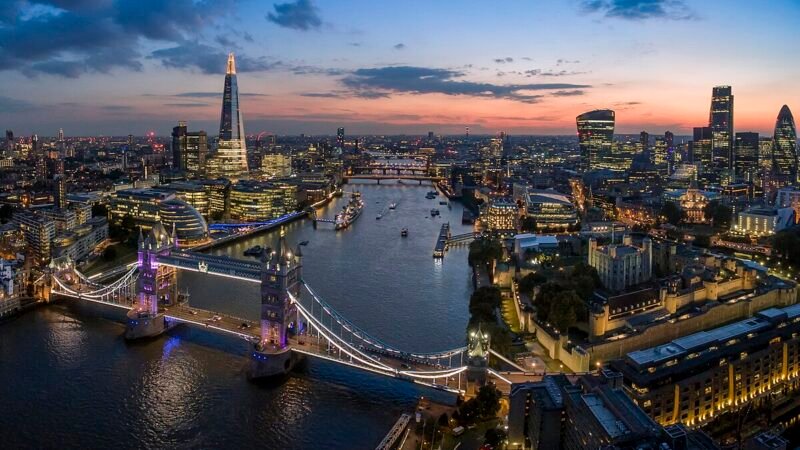
London, the capital of the United Kingdom, is experiencing rainy weather on this Saturday. The date falls under the zodiac sign of Gemini, whilst the moon is in its waning crescent phase.
On this day
On 7 June 1969, the rock supergroup Blind Faith held their inaugural and only UK concert at London's Hyde Park, performing before approximately 100,000 fans. The ensemble, which featured Eric Clapton, Steve Winwood and Ginger Baker, represented a significant moment in rock music history as a rare gathering of established musicians.
The date carries considerable weight in constitutional history. In 1832, the Reform Act received royal assent, an achievement widely credited with establishing the foundations of modern democracy in the United Kingdom by expanding the electorate and reforming parliamentary representation. More than a century earlier, on the same date in 1628, the Petition of Right had received royal assent from King Charles I, cementing another milestone in the protection of individual liberties and constitutional governance in England.
World Food Safety Day
World Food Safety Day raises awareness of the importance of safe food handling and production practices globally. Established by the United Nations in 2018, the day falls on 7 June each year to coincide with the founding of the Codex Alimentarius Commission, which sets international food safety standards. The day emphasises the role of food safety in preventing foodborne illnesses and protecting public health across all nations.
DayAtlas provides weather conditions, historical events, and notable births and deaths for any selected date and location worldwide.
Find out what's happening today in London.
What the Weather Had in Store for London on 7th June 2025
Scars on stone testify to endurance, never to breaking.
Fortune of the Day
7th June in the Stars – Star Sign Gemini
Personality Profile
Personality People born on June 7th embody the classic Gemini spirit: lively, curious, and constantly in motion. They thrive on conversation and fresh ideas, with their restlessness driving them from one interest to the next. The numerology 4 imparts an underlying craving for structure that subtly balances their chaotic Mercury temperament.
Strengths & Weaknesses Their greatest strengths are flexibility, quick wit, and excellent communication skills. Those born on June 7th can scatter their energy too easily, tend toward superficiality, and struggle with sustained focus. Nervousness and indecision arise when pursuing too many options simultaneously.
Love In relationships, these people need intellectual stimulation and open dialogue. They seek partners who share their curiosity and grant independence. Bonds form through engaging conversation and shared intellectual adventure rather than emotional depth alone.
Caree & Finance June 7th natives thrive in careers offering variety and flexibility: journalism, sales, education, or technology. Their versatility enables rapid advancement, yet inconsistency can interrupt careers. Financially, they need structure to curb impulsive spending habits.
Health These individuals benefit from mental activity and physical movement like running or cycling. Nervous tension may surface as sleep issues or restlessness, making meditation breaks essential. Regular routines help channel their restless energy constructively and sustainably.
That night, the moon was in its waning crescent phase.
Chinese year of the Snake (Wood).
Fun Facts About 7th June
Name Days in Your Language: Keenan, Melody, Nidia, Nydia, Nylene, Whitney
Someone born on this day would be just 358 days old today — roughly 8,596 hours, 515,819 minutes, or 30,949,197 seconds spent on Earth so far.
It's the 158. day of the year. In 2025, 7th June falls on a Saturday.
There are 207 days still to come.
We’re currently in Week 23 — the year marches on.
Famous Birthdays on 7th June
On this day, 107 notable people were born on 7th June — spanning from 1003 to 2000. From world leaders to artists and scientists, discover who shares this birthday.
07/06/2000
Ōnosato Daiki, Japanese professional sumo wrestler and the 75th yokozuna
Ōnosato Daiki is a Japanese professional sumo wrestler and the 75th yokozuna. After a successful amateur career at university level, where he was called "the most eagerly awaited prospect to come out of collegiate sumo in decades", he joined the Nishonoseki stable under the tutelage of the former yokozuna Kisenosato and began his professional career at the rank of makushita 10 via the makushita tsukedashi system. He reached the top makuuchi division in January 2024 after competing in just four tournaments, and in May of the same year won his first top-division championship in a record seven tournaments.
07/06/1997
David Montgomery, American football player
David Montgomery, nicknamed Knuckles, is an American professional football running back for the Houston Texans of the National Football League (NFL). He played college football for the Iowa State Cyclones and was selected by the Chicago Bears in the third round of the 2019 NFL draft.
07/06/1996
Christian McCaffrey, American football player
Christian Jackson McCaffrey is an American professional football running back for the San Francisco 49ers of the National Football League (NFL). He played college football for the Stanford Cardinal and was selected by the Carolina Panthers eighth overall in the 2017 NFL draft. As a sophomore in 2015, McCaffrey was named AP College Football Player of the Year and was a finalist for the Heisman Trophy. He holds the NCAA record for most all-purpose yards in a season (3,864).
07/06/1993
George Ezra, English singer-songwriter
George Ezra Barnett is an English musician, singer-songwriter, and podcaster. After releasing two EPs, Did You Hear the Rain? (2013) and Cassy O' (2014), Ezra rose to prominence with the release of his hit single "Budapest", which reached number one in several countries. His debut studio album, Wanted on Voyage, was released in June 2014, reaching number one in the UK and the top ten in seven other countries. It was also the third-best-selling album of 2014 in the UK.
Swae Lee, American rapper
Khalif Malik Ibn Shaman Brown, known professionally as Swae Lee, is an American rapper and singer from Inglewood, California. Known for his wide-ranged, reverb-heavy vocals and genre-blending, Lee is one half of the Mississippi-based hip-hop duo Rae Sremmurd, which he formed in 2010 with his older brother Slim Jxmmi.
07/06/1992
Jordan Clarkson, Filipino-American basketball player
Jordan Taylor Clarkson is an American and Filipino professional basketball player for the New York Knicks of the National Basketball Association (NBA). He played college basketball for two seasons with the Tulsa Golden Hurricane before transferring to Missouri, where he earned second-team all-conference honors in the Southeastern Conference (SEC). After forgoing his senior year in college to enter the 2014 NBA draft, Clarkson was selected by the Washington Wizards in the second round with the 46th overall pick and was immediately traded to the Los Angeles Lakers. He was named to the NBA All-Rookie First Team. Clarkson was traded to the Cavaliers in 2018. In December 2019 he was traded to the Jazz. On March 24, 2015, Clarkson along with Jeremy Lin, became the first Asian-American starting back court in NBA history. In 2021, Clarkson was named the NBA Sixth Man of the Year.
07/06/1991
Rasmus Vestergaard Madsen, Danish politician
Rasmus Vestergaard Madsen is a Danish politician and Member of the Folketing. A member of the Red–Green Alliance, he has represented South Jutland since March 2026.
Emily Ratajkowski, American model and actress
Emily O'Hara Ratajkowski, known occasionally as EmRata, is an American model and actress. Born in London, England, to American parents and raised in Encinitas, California, United States, she signed to Ford Models at a young age. Her modeling debut was on the cover of the March 2012 issue of the erotic magazine treats!, which led to her appearance in several music videos, including Robin Thicke's "Blurred Lines", which catapulted her to global fame.
Fetty Wap, American rapper, singer, and songwriter
Willie Junior Maxwell II, better known by his stage name Fetty Wap, is an American rapper, singer, and songwriter. He quickly rose to mainstream prominence after his 2014 song "Trap Queen" peaked at number two on the Billboard Hot 100 and led him to sign with 300 Entertainment, an imprint of Atlantic Records. Two of his 2015 singles, "679" and "My Way", peaked within the top ten of the chart; all three—as well as the top 40 single "Again"—preceded his eponymous debut studio album (2015), which peaked atop the Billboard 200. During this time, he became distinctive for his melodic blending of singing and rapping, lighthearted lyrics, "bouncy" production, and exclamation of various catchphrases such as "1738!"
07/06/1990
Iggy Azalea, Australian rapper, singer, songwriter, and model
Amethyst Amelia Kelly, known professionally as Iggy Azalea, is an Australian former rapper and songwriter. Born in Sydney, Azalea moved to the United States at the age of 16 to pursue a career in music. She earned public recognition after releasing the music videos for her songs "Pussy" and "Two Times" on YouTube. Shortly after releasing those two songs, she released her debut mixtape, Ignorant Art (2011), and subsequently signed a recording contract with American rapper T.I.'s Grand Hustle label.
07/06/1988
Michael Cera, Canadian actor and musician
Michael Austin Cera is a Canadian actor and musician. Over his career he has received nominations for a British Academy Film Award, three Critics' Choice Movie Awards, four Screen Actors Guild Awards, and a Tony Award.
07/06/1978
Bill Hader, American actor, comedian, and screenwriter
William Thomas Hader Jr. is an American actor, comedian, and filmmaker. He was a cast member on the NBC sketch comedy series Saturday Night Live from 2005 to 2013, for which he received four Primetime Emmy Award nominations and a Peabody Award. He became known for his impressions and especially for his work on the Weekend Update segments, where he played Stefon, a flamboyant New York City nightclub tour guide.
07/06/1975
Allen Iverson, American basketball player
Allen Ezail Iverson is an American former professional basketball player. Nicknamed "the Answer", he played 14 seasons in the National Basketball Association (NBA) as both a shooting guard and point guard. As an NBA rookie with the Philadelphia 76ers in 1997, Iverson was named NBA Rookie of the Year. He was an 11-time NBA All-Star, won the All-Star Game MVP Award in 2001 and 2005, and was the NBA's Most Valuable Player (MVP) in 2001. He was inducted into the Naismith Memorial Basketball Hall of Fame in 2016. In October 2021, he was named to the NBA 75th Anniversary Team. Iverson is regarded as one of the game's greatest scorers, ball handlers, guards, and among the most influential athletes in all of American sports.
07/06/1974
Bear Grylls, English adventurer, author, and television host
Edward Michael "Bear" Grylls is a British adventurer, television presenter and former SAS trooper. He holds several world records in hostile environments, and appeared in numerous wilderness survival television series including Man vs. Wild (2006–2011), Running Wild with Bear Grylls (2014-2023) and The Island with Bear Grylls (2014-2019).
07/06/1970
Cafu, Brazilian footballer
Marcos Evangelista de Morais, known as Cafu, is a Brazilian former professional footballer who played as a right-back. Widely regarded as one of the greatest full-backs of all time, he is known for his pace and energetic attacking runs along the right flank. He is the most-capped player for the Brazil national team with 142 appearances.
07/06/1967
Dave Navarro, American musician
David Michael Navarro is an American musician and songwriter. He is best known as a member of the rock band Jane's Addiction, appearing on all four studio albums. Between 1993 and 1998 during their first breakup, Navarro was the guitarist of Red Hot Chili Peppers, recording one studio album, One Hot Minute (1995), before departing. He has also released one solo album to date, Trust No One (2001). Navarro has also been a member of Jane's Addiction-related bands Deconstruction and the Panic Channel.
07/06/1965
Damien Hirst, English painter and art collector
Damien Steven Hirst is an English artist and art collector. He was one of the Young British Artists (YBAs) who dominated the art scene in the UK during the 1990s. He is reportedly the United Kingdom's richest living artist, with his wealth estimated at US$384 million in the 2020 Sunday Times Rich List. During the 1990s his career was closely linked with the collector Charles Saatchi, but increasing frictions came to a head in 2003 and the relationship ended.
Mick Foley, American wrestler
Michael Francis Foley is an American comedian, author, and retired professional wrestler. He is signed to All Elite Wrestling (AEW).
07/06/1962
Lance Reddick, American actor (died 2023)
Lance Solomon Reddick was an American actor. He portrayed Cedric Daniels in The Wire (2002–2008), Phillip Broyles in Fringe (2008–2013), and Chief Irvin Irving in Bosch (2014–2020). In film, he played Charon in the John Wick franchise (2014–2025) and General Caulfield in White House Down (2013).
07/06/1960
Jim Hartung, American gymnast (died 2026)
James Nicholas Hartung was an American gymnast. He was a member of the United States men's national artistic gymnastics team and won a gold medal at the 1984 Summer Olympics.
07/06/1959
Mike Pence, 48th Vice President of the United States, 50th Governor of Indiana
Michael Richard Pence is an American politician and lawyer who served as the 48th vice president of the United States from 2017 to 2021 under President Donald Trump. A member of the Republican Party, he previously served as the 50th governor of Indiana from 2013 to 2017, and as a member of the U.S. House of Representatives from Indiana from 2001 to 2013.
07/06/1958
Prince, American singer-songwriter, multi-instrumentalist, producer, and actor (died 2016)
Prince Rogers Nelson, known mononymously as Prince, was an American singer, songwriter, musician, dancer, actor, and filmmaker. Often being credited as one of the greatest musicians of his generation, he pioneered the Minneapolis sound and was influential in the evolution of various other genres.
07/06/1957
Juan Luis Guerra, Dominican singer, composer, and record producer
Juan Luis Guerra Seijas is a Dominican musician, singer, composer, and record producer. Throughout his career, he has won numerous awards including 31 Latin Grammy Awards, three Grammy Awards, and one Latin Billboard Music Award. He won three Latin Grammy Awards in 2010, including Album of the Year. In 2012, he won the Latin Grammy Award for Producer of the Year. He has sold 15 million records worldwide, making him one of the best-selling Latin music artists.
07/06/1954
Louise Erdrich, American novelist and poet
Karen Louise Erdrich is an American author of novels, short stories, poetry, and children's books featuring Native American characters and settings. She is an enrolled citizen of the Turtle Mountain Band of Chippewa Indians of North Dakota, a federally recognized Ojibwe people.
07/06/1952
Liam Neeson, Irish-American actor
William John Neeson is an actor from Northern Ireland. He has received several accolades, including nominations for an Academy Award, a BAFTA Award, three Golden Globe Awards, two Tony Awards and one Volpi Cup. With a film career spanning more than forty years, Neeson is regarded as one of Ireland's greatest film actors. Films in which he has appeared have grossed over $11.7 billion worldwide. Neeson was appointed Officer of the Order of the British Empire (OBE) in 2000.
Orhan Pamuk, Turkish-American novelist, screenwriter, and academic, Nobel Prize laureate
Ferit Orhan Pamuk is a Turkish novelist, screenwriter, academic, and recipient of the 2006 Nobel Prize in Literature. One of Turkey's most prominent novelists, he has sold over 13 million books in 63 languages, making him the country's best-selling writer.
07/06/1947
Thurman Munson, American baseball player (died 1979)
Thurman Lee Munson was an American professional baseball catcher who played 11 seasons in Major League Baseball (MLB) with the New York Yankees, from 1969 until his death in 1979. A seven-time All-Star, Munson had a career batting average of .292 with 113 home runs and 701 runs batted in (RBIs). Known for his outstanding fielding, he won the Gold Glove Award in three consecutive years (1973–1975).
07/06/1946
Zbigniew Seifert, Polish musician (died 1979)
Zbigniew Seifert was a Polish jazz violinist.
07/06/1945
Wolfgang Schüssel, Austrian lawyer and politician, 26th Chancellor of Austria
Wolfgang Schüssel is a retired Austrian politician. He was Chancellor of Austria for two consecutive terms from February 2000 to January 2007. While being recognised as a rare example of an active reformer in contemporary Austrian politics, his governments were also highly controversial from the beginning, starting with the fact that he formed a coalition government with Jörg Haider's Freedom Party of Austria (FPÖ) on both occasions. In 2011, he retired from being an active member of parliament due to a multitude of charges of corruption against members of his governments.
07/06/1943
Nikki Giovanni, American poet, writer and activist (died 2024)
Yolande Cornelia "Nikki" Giovanni Jr. was an American poet, writer, commentator, activist and educator. One of the world's best-known African-American poets, her work includes poetry anthologies, poetry recordings, and nonfiction essays, and covers topics ranging from race and social issues to children's literature. She won numerous awards, including the Langston Hughes Medal and the NAACP Image Award. She was nominated for a 2004 Grammy Award for her poetry album, The Nikki Giovanni Poetry Collection. Additionally, she was named as one of Oprah Winfrey's 25 "Living Legends". Giovanni was a member of The Wintergreen Women Writers Collective.
"Superstar" Billy Graham, American wrestler (died 2023)
Eldridge Wayne Coleman Jr., better known by his ring name "Superstar" Billy Graham, was an American professional wrestler. He gained recognition for his tenure as the WWWF Heavyweight Champion from 1977 to 1978. He was a three-time world champion in major professional wrestling promotions. As an award-winning bodybuilder, he was a training partner and close friend of Arnold Schwarzenegger. He was most remembered for revolutionizing the interview and physique aspects of the professional wrestling industry, and for his charismatic performance style.
07/06/1941
Lady Elizabeth Shakerley, British party planner, writer and socialite (died 2020)
Lady Elizabeth Georgiana Shakerley was a British party planner, writer and socialite from the Anson family. She was a first cousin once removed of Queen Elizabeth II and sister of Patrick Anson, 5th Earl of Lichfield.
07/06/1940
Tom Jones, Welsh singer and actor
Sir Thomas Jones Woodward is a Welsh singer. His career began with a string of top 10 hits in the 1960s and he has since toured regularly, with appearances in Las Vegas from 1967 to 2011. His voice has been described by AllMusic as a "full-throated, robust baritone".
Ronald Pickup, English actor (died 2021)
Ronald Alfred Pickup was an English actor. He was active in television, film, and theatre, beginning with a 1964 appearance in Doctor Who. Theatre critic Michael Billington described him as "a terrific stage star and an essential member of Laurence Olivier's National Theatre company". His major screen roles included the title role in The Life of Verdi (1982) and Prince Yakimov in Fortunes of War (1987).
07/06/1939
Yuli Turovsky, Russian-Canadian cellist, conductor and educator (died 2013)
Yuli Turovsky OC CQ was a Soviet-born Canadian cellist, conductor and music educator, known for founding the I Musici de Montréal Chamber Orchestra.
07/06/1938
Ian St John, Scottish international footballer and manager (died 2021)
John "Ian" St John was a Scottish professional football player, coach and broadcaster. St John played as a forward for Liverpool throughout most of the 1960s. Signed by Bill Shankly in 1961, St John was a key member of the Liverpool team that emerged from the second tier of English football to win two league titles and one FA Cup—in which he scored the winner in the 1965 final—to cement a position as one of the country's top sides. He played for Scotland 21 times, scoring nine goals.
07/06/1936
Bert Sugar, American author and boxing historian (died 2012)
Herbert Randolph Sugar was an American sportswriter known for his work covering boxing and baseball. As the author of over 80 books, The New York Times called Sugar an "accomplished raconteur with a bottomless sack of anecdotes" who was always seen with his trademark fedora and cigar. He was inducted into the International Boxing Hall of Fame in 2005.
Pippo Baudo, Italian television presenter (died 2025)
Giuseppe Raimondo Vittorio "Pippo" Baudo was an Italian television presenter. One of the most notable in his native country, he had a career spanning six decades, which included 13 editions of the Sanremo Music Festival – the highest number for a single presenter.
07/06/1935
Harry Crews, American novelist, playwright, short story writer, and essayist (died 2012)
Harry Eugene Crews was an American novelist, short story writer, and essayist. He often made use of violent, grotesque characters and set them in regions of the Deep South.
07/06/1932
Per Maurseth, Norwegian historian, academic, and politician (died 2013)
Per Maurseth was a Norwegian historian and politician for the Socialist Left Party.
07/06/1931
Virginia McKenna, English actress and author
Dame Virginia Anne McKenna is a British actress. She is best known for the films The Cruel Sea (1953), A Town Like Alice (1956), Carve Her Name with Pride (1958), Born Free (1966), and Ring of Bright Water (1969), as well as her work with the Born Free Foundation.
07/06/1929
John Turner, Canadian lawyer and politician, 17th Prime Minister of Canada (died 2020)
John Napier Wyndham Turner was the 17th prime minister of Canada, serving from June to September 1984. He served as leader of the Liberal Party and leader of the Opposition from 1984 to 1990.
07/06/1928
James Ivory, American director, producer, and screenwriter
James Francis Ivory is an American film director, screenwriter, and producer. He was a principal in Merchant Ivory Productions along with Indian film producer Ismail Merchant and screenwriter Ruth Prawer Jhabvala. The trio made film adaptations of stories by authors such as E.M. Forster and Henry James. Their body of work is celebrated for its elegance, sophistication, literary fidelity, strong performances, complex themes, and rich characters.
07/06/1927
Paul Salamunovich, American conductor and educator (died 2014)
Paul Salamunovich was a Grammy-nominated American conductor and educator.
Herbert R. Axelrod, American tropical fish expert, publisher of pet books, and entrepreneur (died 2017)
Herbert Richard Axelrod was an American tropical fish expert, a publisher of pet books, and an entrepreneur. In 2005 he was sentenced in U.S. court to 18 months in prison for tax fraud.
07/06/1926
Jean-Noël Tremblay, Canadian lawyer and politician (died 2020)
Jean-Noël Tremblay, was a Canadian politician, who made career at both the federal and the provincial levels.
07/06/1925
Ernestina Herrera de Noble, Argentine publisher and executive (died 2017)
Ernestina Laura Herrera de Noble was a prominent Argentine publisher and executive. She was the largest shareholder of the Grupo Clarín media conglomerate and director of the flagship Clarín newspaper. She was the first woman to become director of a mainstream newspaper in South America.
07/06/1923
Jules Deschênes, Canadian lawyer and judge (died 2000)
Jules Deschênes, was a Canadian Quebec Superior Court judge.
07/06/1920
Georges Marchais, French mechanic and politician (died 1997)
Georges René Louis Marchais was the head of the French Communist Party (PCF) from 1972 to 1994, and a candidate in the 1981 French presidential election.
07/06/1917
Gwendolyn Brooks, American poet (died 2000)
Gwendolyn Elizabeth Brooks was an American poet, author, and teacher. Her work often dealt with the personal celebrations and struggles of ordinary people in her community. She won the Pulitzer Prize for Poetry on May 1, 1950, for Annie Allen, making her the first African American to receive a Pulitzer Prize.
Dean Martin, American singer, actor, and producer (died 1995)
Dean Martin was an American singer, actor, comedian and television host. Nicknamed the "King of Cool", he is regarded as one of the most popular entertainers of the 20th century.
07/06/1912
Jacques Hélian, French bandleader (died 1986)
Jacques Mikaël Der Mikaëlian better known as Jacques Hélian, was a famous French orchestra conductor for French music-hall.
07/06/1911
Brooks Stevens, American engineer and designer, designed the Wienermobile (died 1995)
Clifford Brooks Stevens was an American industrial designer of home furnishings, appliances, automobiles, passenger railroad cars, and motorcycles, as well as a graphic designer and stylist. Stevens founded Brooks Stevens, Inc., headquartered in Allenton, Wisconsin.
07/06/1910
Arthur Gardner, American actor and producer (died 2014)
Arthur Gardner was an American actor and film producer. He was known for his television western, The Rifleman. He was a voting member of the Academy of Motion Picture Arts and Sciences.
Til Kiwe, German actor and screenwriter (died 1995)
Jan Heinrich Tilman Kiwe, also known as Til Kiver or Till Kiwe, was a German actor, voice actor and screenwriter who also was an ethnologist and highly decorated army officer and POW. Thus, he often played soldiers, like a German guard in The Great Escape in 1963.
Mike Sebastian, American football player and coach (died 1989)
Michael John "Lefty" Sebastian was an American football halfback in the National Football League (NFL) for the Cincinnati Reds, Boston Redskins, Philadelphia Eagles, Pittsburgh Pirates, and the Cleveland Rams. Nicknamed the Rose of Sharon, he also played for the Rams while they were still members of the second American Football League (AFL) as well as the AFL's Rochester Tigers. Before his professional career, Sebastian played college football at the University of Pittsburgh. At Pitt, he played under coach Jock Sutherland, who had declared Sebastian the best passer that he had seen in "many days."
Bradford Washburn, American mountaineer, photographer, and cartographer (died 2007)
Henry Bradford Washburn Jr. was an American explorer, mountaineer, photographer, and cartographer. He established the Boston Museum of Science, served as its director from 1939–1980, and from 1985 until his death served as its Honorary Director. Bradford married Barbara Polk in 1940 and honeymooned in Alaska, making the first ascent of Mount Bertha together.
Marion Post Wolcott, American photographer (died 1990)
Marion Post Wolcott was an American photographer who worked for the Farm Security Administration during the Great Depression, documenting poverty, the Jim Crow South, and deprivation.
Bluey, Australian cattle dog, second-oldest recorded dog (died 1939)
Bluey was a female Australian Cattle Dog owned by Les and Rosalie Hall of Rochester, Victoria. She holds the Guinness World Record as the oldest verified dog to have ever lived. The record was briefly disputed by Bobi, but Bobi's certification was revoked by Guinness due to the lacking evidence, after veterinarians came forward challenging Bobi's claimed age. Additionally, Bluey's title was also challenged by many other dogs including Max, Chilla, Maggie, and Bella, though they were never verified.
07/06/1909
Virginia Apgar, American anesthesiologist and pediatrician, developed the Apgar test (died 1974)
Virginia Apgar was an American physician, obstetrical anesthesiologist and medical researcher, best known as the inventor of the Apgar score, a way to quickly assess the health of a newborn child immediately after birth in order to combat infant mortality. In 1952, she developed the 10-point Apgar score to assist physicians and nurses in assessing the status of newborns. Given at one minute and five minutes after birth, the Apgar test measures a child's breathing, skin color, reflexes, motion, and heart rate. A friend said, "She probably did more than any other physician to bring the problem of birth defects out of back rooms." She was a leader in the fields of anesthesiology and teratology, and introduced obstetrical considerations to the established field of neonatology.
Peter W. Rodino, American lawyer, and politician (died 2005)
Peter Wallace Rodino Jr. was an American politician who was a member of the United States House of Representatives from 1949 to 1989. A liberal Democrat, he represented parts of Newark, New Jersey and surrounding Essex and Hudson. He was the longest-serving member of the House of Representatives from New Jersey until passed by Chris Smith in 2021.
Jessica Tandy, English-American actress (died 1994)
Jessie Alice Tandy, known professionally as Jessica Tandy, was an English and American actress. She appeared in over 100 stage productions and had more than 60 roles in film and TV, receiving an Academy Award, four Tony Awards, a BAFTA Award, a Golden Globe Award, and a Primetime Emmy Award. Tandy is one of few performers to achieve Triple Crown of Acting status.
07/06/1907
Sigvard Bernadotte, Count of Wisborg (died 2002)
Sigvard Oscar Fredrik, Prince Bernadotte, Count of Wisborg born as, and until 1934 known as, Prince Sigvard of Sweden, Duke of Uppland, was a member of the Swedish Royal Family and a successful industrial designer.
07/06/1905
James J. Braddock, American world heavyweight boxing champion (died 1974)
James Walter Braddock was an American boxer who was the world heavyweight champion from 1935 to 1937.
07/06/1902
Georges Van Parys, French composer (died 1971)
Georges Van Parys was a French composer of film music and operettas. Among his musical influences were the group Les Six, Maurice Ravel, and Claude Debussy. Later in his career he served as vice-president of the Société des auteurs, compositeurs et éditeurs de musique. He is buried in the cemetery at Villiers-sur-Marne.
Herman B Wells, American banker, author, and academic (died 2000)
Herman B Wells, a native of Boone County, Indiana, was the eleventh president of Indiana University Bloomington and its first university chancellor. He was pivotal in the transformation of Indiana University from a small, locally oriented college into a world-class institution of higher learning through expanded enrollment, recruitment of new faculty, construction of new buildings, new program offerings, and campus beautification projects. He remained steadfast in his support of IU's faculty and students, especially in the areas of academic freedom and civil rights.
07/06/1900
Glen Gray, American saxophonist and bandleader (died 1963)
Glenn Gray Knoblauch, known professionally as Glen Gray, was an American jazz saxophonist and leader of the Casa Loma Orchestra.
07/06/1899
Elizabeth Bowen, Anglo-Irish author and critic (died 1973)
Elizabeth Dorothea Cole Bowen was an Anglo-Irish novelist and short story writer notable for her books about "the Big House" of Irish landed Protestants as well as her fiction about life in wartime London.
07/06/1897
George Szell, Hungarian-American conductor and composer (died 1970)
George Szell, originally György Széll, György Endre Széll, or Georg Szell, was an Austro-Hungarian-born American conductor, composer and pianist. Considered one of the twentieth century's greatest conductors, he was music director of the Cleveland Orchestra of Cleveland, Ohio, and recorded much of the standard classical repertoire in Cleveland and with other orchestras.
07/06/1896
Douglas Campbell, American lieutenant and pilot (died 1990)
Douglas Campbell was an American aviator and World War I flying ace. He was the first American aviator flying in an American-trained air unit to achieve the status of ace.
Robert S. Mulliken, American physicist and chemist, Nobel Prize laureate (died 1986)
Robert Sanderson Mulliken was an American physical chemist, primarily responsible for the early development of molecular orbital theory, i.e. the elaboration of the molecular orbital method of computing the structure of molecules. Mulliken received the Nobel Prize in Chemistry in 1966 and the Priestley Medal in 1983.
Imre Nagy, Hungarian soldier and politician, 44th Prime Minister of Hungary (died 1958)
Imre Nagy was a Hungarian communist politician who served as Chairman of the Council of Ministers of the Hungarian People's Republic from 1953 to 1955. In 1956 Nagy became leader of the Hungarian Revolution of 1956 against the Soviet-backed government, for which he was sentenced to death and executed two years later. He was not related to previous agrarianist Prime Minister Ferenc Nagy.
07/06/1894
Alexander P. de Seversky, Georgian-American pilot and engineer, co-designed the Republic P-47 Thunderbolt (died 1974)
Alexander Nikolayevich Prokofiev de Seversky was a Russian-American aviation pioneer, inventor, and influential advocate of strategic air power. He was also a World War I flying ace.
07/06/1893
Gillis Grafström, Swedish figure skater and architect (died 1938)
Gillis Emanuel Grafström was a Swedish figure skater. He was born in Stockholm, Sweden. He won three successive Olympic gold medals in Men's Figure Skating as well as an Olympic silver medal in the same event in 1932, and three World Championships. Grafström is one of the few athletes who have competed in both the Summer and Winter Olympic games. He and Eddie Eagan are the only athletes to have won gold medals at both the Summer and Winter Olympic Games, although Eagan remains the only one to have managed the feat in different disciplines. He is one of the oldest figure skating Olympic champions.
07/06/1892
Leo Reise, Canadian ice hockey player (died 1975)
Leopold Adolph Emile Reise, Sr. was a Canadian hockey player who played 8 seasons in the National Hockey League (NHL) for the Hamilton Tigers, New York Americans and New York Rangers. Prior to turning professional in 1920 he played several years for the amateur Hamilton Tigers, joining the professional version when they started and staying for four seasons. He also spent three seasons with the Saskatoon Crescents of the Western Canada Hockey League, and returned to the NHL in 1926 with the New York Americans, spending four seasons with them before finishing his time in the NHL with the New York Rangers. Reise spent two additional seasons in the minor International Hockey League before retiring in 1932. His son, Leo Reise, Jr., also played in the NHL.
07/06/1890
Karl Lashley, American psychologist and behaviorist (died 1958)
Karl Spencer Lashley was an American psychologist and behaviorist remembered for his contributions to the study of learning and memory. A Review of General Psychology survey, published in 2002, ranked Lashley as the 61st most cited psychologist of the 20th century.
07/06/1888
Clarence DeMar, American runner and educator (died 1958)
Clarence Harrison DeMar was a U.S. marathoner, winner of seven Boston Marathons, and Bronze medalist at the 1924 Paris Olympics. He was known by the nickname "Mr. DeMarathon."
07/06/1886
Henri Coandă, Romanian engineer, designed the Coandă-1910 (died 1972)
Henri Marie Coandă was a Romanian inventor, aerodynamics pioneer, and builder of an experimental aircraft, the Coandă-1910, which never flew. He invented a great number of devices, designed a "flying saucer" and discovered the Coandă effect of fluid dynamics.
07/06/1884
Ester Claesson, Swedish landscape architect (died 1931)
Ester Laura Matilda Claesson was a Swedish landscaping pioneer and is considered the first female landscape architect in Sweden.
07/06/1883
Sylvanus Morley, American archaeologist and scholar (died 1948)
Sylvanus Griswold Morley was an American archaeologist and epigrapher who studied the pre-Columbian Maya civilization in the early 20th century. Morley led extensive excavations of the Maya site of Chichen Itza on behalf of the Carnegie Institution and published several large compilations and treatises on Maya hieroglyphic writing. He also wrote popular accounts on the Maya for a general audience.
07/06/1879
Knud Rasmussen, Danish anthropologist and explorer (died 1933)
Knud Johan Victor Rasmussen was a Greenlandic-Danish polar explorer and anthropologist. He has been called the "father of Eskimology" and was the first European to cross the Northwest Passage via dog sled. He remains well known in Greenland, Denmark and among Canadian Inuit.
Joan Voûte, Dutch astronomer and academic (died 1963)
Joan George Erardus Gijsbertus Voûte was a Dutch astronomer.
07/06/1877
Roelof Klein, Dutch-American rower and engineer (died 1960)
Roelof Klein was a Dutch rower who competed at the 1900 Summer Olympics in Paris. Klein was part of the Dutch eight team that won a bronze medal with Hermanus Brockmann as the coxswain. Brockmann also steered the boat of Klein and François Brandt in the coxed pairs semifinal, which they lost to France. The pair realized that the 60 kg weight of Brockmann puts them in disadvantage; they replaced him with a local boy of 33 kg and won the final, narrowly beating the French team.
07/06/1868
Charles Rennie Mackintosh, Scottish painter and architect (died 1928)
Charles Rennie Mackintosh was a Scottish architect, designer, water colourist and artist. His artistic approach had much in common with European Symbolism. His work, alongside that of his wife Margaret Macdonald, was influential on European design movements such as Art Nouveau and Secessionism and praised by great modernists such as Josef Hoffmann. Mackintosh was born in Glasgow, Scotland and died in London, England. He is among the most important figures of the Modern Style.
07/06/1863
Bones Ely, American baseball player and manager (died 1952)
William Frederick "Bones" Ely was an American shortstop in Major League Baseball. He was born in North Girard, Pennsylvania.
07/06/1862
Philipp Lenard, Slovak-German physicist and academic, Nobel Prize laureate (died 1947)
Philipp Eduard Anton von Lenard was a Hungarian–German experimental physicist who received the Nobel Prize in Physics in 1905 for his work on cathode rays. This work led to his experimental realization of the photoelectric effect, discovering that the energy (speed) of the electrons ejected from a cathode depends only on the frequency and not the intensity of light.
07/06/1861
Robina Nicol, New Zealand photographer and suffragist (died 1942)
Robina Nicol was a Scottish-born New Zealand photographer and suffragist.
07/06/1851
Ture Malmgren, Swedish journalist and politician (died 1922)
Ture Robert Ferdinand Malmgren was a Swedish journalist, book publisher, and municipal politician. A prominent figure in his hometown of Uddevalla, Malmgren became a colorful and well-known part of the city's history through, among other things, his long-lasting ownership of the newspaper Bohusläningen, work in the local political scene, eccentric and extravagant lifestyle, and faux-medieval Tureborg Castle.
07/06/1848
Paul Gauguin, French painter and sculptor (died 1903)
Eugène Henri Paul Gauguin was a French painter, sculptor, printmaker, ceramist, and writer, whose work has been primarily associated with the Post-Impressionist and Symbolist movements. He was also an influential practitioner of wood engraving and woodcuts as art forms. While only moderately successful during his lifetime, Gauguin has since been recognized for his experimental use of color and Synthetist style that were distinct from Impressionism.
07/06/1847
George Washington Ball, American legislator from Iowa (died 1915)
George Washington Ball was an American lawyer and politician from the state of Iowa. He served in the Iowa General Assembly as Representative of Johnson County and later as State Senator. He also served on the city council of Iowa City from 1881 to 1883, and was mayor of the city from 1905 to 1909.
07/06/1845
Leopold Auer, Hungarian violinist, composer, and conductor (died 1930)
Leopold von Auer was a Hungarian violinist, academic, conductor, composer, and instructor. Many of his students went on to become prominent concert performers and teachers.
07/06/1840
Carlota of Mexico (died 1927)
Charlotte of Belgium, known by the Spanish version of her name, Carlota, was by birth a princess of Belgium and member of the House of Wettin in the branch of Saxe-Coburg and Gotha. As the wife of Archduke Maximilian of Austria, Viceroy of Lombardy–Venetia and later Emperor of Mexico, she became Archduchess of Austria and Empress of Mexico. She was the daughter, granddaughter, sister, sister-in-law, cousin and wife of reigning or deposed sovereigns throughout Europe and Mexico.
07/06/1837
Alois Hitler, Austrian civil servant (died 1903)
Alois Hitler was an Austrian civil servant in the customs service and the father of Adolf Hitler, dictator of Nazi Germany.
07/06/1831
Amelia Edwards, English journalist and author (died 1892)
Amelia Ann Blanford Edwards, also known as Amelia B. Edwards, was an English novelist, journalist, traveller and Egyptologist. Her literary successes included the ghost story "The Phantom Coach" (1864), the novels Barbara's History (1864) and Lord Brackenbury (1880), and the travelogue of Egypt A Thousand Miles up the Nile (1877). She also edited a poetry anthology published in 1878.
07/06/1811
James Young Simpson, Scottish obstetrician (died 1870)
Sir James Young Simpson, 1st Baronet was a Scottish obstetrician and a significant figure in the history of medicine. He was the first physician to demonstrate the anaesthetic properties of chloroform in humans and helped to popularize its use in medicine.
07/06/1778
Beau Brummell, English cricketer and fashion designer (died 1840)
George Bryan "Beau" Brummell was an important figure in Regency England, and for many years he was the arbiter of British men's fashion. At one time, he was a close friend of the Prince Regent, the future King George IV, but after the two quarrelled and Brummell got into debt, he had to take refuge in France. Eventually, he died from complications of neurosyphilis in Caen.
07/06/1770
Robert Jenkinson, 2nd Earl of Liverpool, English politician, Prime Minister of the United Kingdom (died 1828)
Robert Banks Jenkinson, 2nd Earl of Liverpool, was a British Tory statesman who served as Prime Minister of the United Kingdom from 1812 to 1827. Before becoming prime minister he had been foreign secretary, home secretary and secretary of state for war and the colonies. He held the constituency of Rye from 1790 until 1803, when he was elevated to the House of Lords, where he was Leader 1803–1806 and 1807–1827.
07/06/1761
John Rennie the Elder, Scottish engineer (died 1821)
John Rennie was a Scottish civil engineer who designed many bridges, canals, docks and warehouses, and a pioneer in the use of structural cast-iron.
07/06/1757
Georgiana Cavendish, Duchess of Devonshire (died 1806)
Georgiana Cavendish, Duchess of Devonshire, was an English aristocrat, socialite, political organiser, author, and activist. Born into the Spencer family and married into the Cavendish family, she was the first wife of William Cavendish, 5th Duke of Devonshire, and the mother of the 6th Duke of Devonshire.
07/06/1702
Louis George, Margrave of Baden-Baden (died 1761)
Louis George, Margrave of Baden-Baden was a German nobleman and the Margrave of Baden-Baden from 1707 until his death in 1761. From 1707 to 1727, his mother Sibylle of Saxe-Lauenburg was the regent of Baden-Baden. He was succeeded by his younger brother, Augustus George. He was nicknamed Jägerlouis because of his passion for hunting.
07/06/1687
Gaetano Berenstadt, Italian actor and singer (died 1734)
Gaetano Berenstadt was an Italian alto castrato who is best remembered for his association with the composer George Frideric Handel. Berenstadt created roles in three of Handel's operas. Berenstadt's parents were German and his father was timpanist to the Grand Duke of Tuscany. By the end of his 27-year-long career Berenstadt had sung in 55 dramatic works, 33 of which were newly composed.
07/06/1561
John VII, Count of Nassau-Siegen, German count and military theorist (died 1623)
Count John VII the Middle of Nassau-Siegen, German: Johann VII. der Mittlere Graf von Nassau-Siegen, official titles: Graf zu Nassau, Katzenelnbogen, Vianden und Diez, Herr zu Beilstein, was since 1606 Count of Nassau-Siegen, a part of the County of Nassau, and the progenitor of the House of Nassau-Siegen, a cadet branch of the Ottonian Line of the House of Nassau.
07/06/1529
Étienne Pasquier, French lawyer and jurist (died 1615)
Étienne Pasquier was a French lawyer and man of letters. By his own account he was born in Paris on 7 June 1529, but according to others he was born in 1528. He was called to the Paris bar in 1549.
07/06/1502
John III of Portugal (died 1557)
John III, nicknamed The Pious, was the King of Portugal and the Algarve from 1521 until he died in 1557. He was the son of King Manuel I and Maria of Aragon, the third daughter of the Catholic Monarchs of Spain, Ferdinand II of Aragon and Isabella I of Castile. John succeeded his father in 1521 at the age of nineteen.
07/06/1422
Federico da Montefeltro, Italian condottiero (died 1482)
Federico da Montefeltro, also known as Federico III da Montefeltro KG, was one of the most successful mercenary captains (condottieri) of the Italian Renaissance. He became the lord of Urbino in 1444, and ruled the city as its duke from 1474 until his death. In addition to his considerable reputation for martial skill and honour, he was a renowned intellectual humanist and civic leader. Montefeltro commissioned the construction of a great library, perhaps the largest of Italy after the Vatican's, complete with a team of scribes in its scriptorium. He also assembled a large humanistic court in his Ducal Palace, designed by Luciano Laurana and Francesco di Giorgio Martini.
07/06/1402
Ichijō Kaneyoshi, Japanese noble (died 1481)
Ichijō Kaneyoshi , also known as Ichijō Kanera, was the son of regent Tsunetsugu. He was a kugyō or Japanese court noble of the Muromachi period (1336–1573). He held regent positions sesshō in 1432, and kampaku from 1447 to 1453 and from 1467 to 1470. Norifusa and Fuyuyoshi were his sons. One of his daughters, Keishi (経子), married Takatsukasa Masahira.
07/06/1003
Emperor Jingzong of Western Xia (died 1048)
Emperor Jingzong of Western Xia, born Li Yuanhao or Tuoba Yuanhao, also known as Zhao Yuanhao (趙元昊), Weiming Yuanhao (嵬名元昊) and Weiming Nangxiao (嵬名曩霄), was the founding emperor of the Western Xia dynasty of China, reigning from 1038 to 1048. He was the eldest son of the Tangut ruler Li Deming.
Lives Remembered on 7th June
On 7th June, 71 remarkable people passed away — from 555 to 2025. Remember the lives and legacies of those we lost on this day.
07/06/2025
Uriah Rennie, English Association Football Referee (born 1959)
Uriah Duddley Rennie was a British football referee. He was the first black referee to officiate in the Premier League, and officiated over 300 Premier League matches between 1997 and 2008. Outside of football, he was a magistrate in Sheffield and briefly served as chancellor of Sheffield Hallam University in 2025.
07/06/2024
William Anders, American astronaut and lunar explorer (born 1933)
William Alison Anders was a United States Air Force (USAF) major general, electrical engineer, nuclear engineer, NASA astronaut, and businessman. In December 1968, he was a member of the crew of Apollo 8, the first three people to leave low Earth orbit and travel to the Moon. Along with fellow astronauts Frank Borman and Jim Lovell, he circled the Moon ten times, and broadcast live images and commentary back to Earth, including the Christmas Eve Genesis reading. During one of the mission's lunar orbits, he took the iconic Earthrise photograph.
07/06/2023
The Iron Sheik, Iranian-American wrestler and actor (born 1942)
Hossein Khosrow Ali Vaziri, better known by his ring name the Iron Sheik, was an Iranian-American professional wrestler, amateur wrestler and actor. To date he is the only Iranian champion in WWE history, having won the WWF World Heavyweight Championship in 1983.
07/06/2015
Christopher Lee, English actor (born 1922)
Sir Christopher Frank Carandini Lee was an English actor and singer. In a career spanning over 60 years, he became known as an actor with tremendous screen presence and a deep and commanding voice who often portrayed villains in horror and franchise films. Lee was knighted for services to drama and charity in June 2009 by Charles Prince of Wales, and received the BAFTA Fellowship in 2011 and received the BFI Fellowship in 2013.
07/06/2013
Pierre Mauroy, French educator and politician, Prime Minister of France (born 1928)
Pierre Mauroy was a French politician who was Prime Minister of France from 1981 to 1984 under President François Mitterrand. Mauroy also served as Mayor of Lille from 1973 to 2001 and President of the Socialist International from 1992 to 1999. At the time of his death, Mauroy was the emeritus mayor of the city of Lille.
Richard Ramirez, American serial killer and sex offender (born 1960)
Ricardo Leyva Muñoz Ramirez, better known as Richard Ramirez, was an American serial killer, sex offender and burglar whose killing spree occurred in Greater Los Angeles and the San Francisco Bay Area in the state of California. From April 1984 to August 1985, Ramirez murdered at least fifteen people during various break-ins. With his crimes usually taking place after dark, Ramirez was dubbed the Night Stalker, the Walk-In Killer, and the Valley Intruder. He was convicted and sentenced to death in 1989 and died while awaiting execution in 2013.
07/06/2012
Phillip V. Tobias, South African paleontologist and academic (born 1925)
Phillip Vallentine Tobias was a South African palaeoanthropologist and Professor Emeritus at the University of the Witwatersrand in Johannesburg. He was best known for his work at South Africa's hominid fossil sites. He was also an activist for the eradication of apartheid and gave numerous anti-apartheid speeches at protest rallies and also to academic audiences.
07/06/2006
Abu Musab al-Zarqawi, Jordanian militant (born 1966)
Abu Musab al-Zarqawi, born Ahmad Fadeel Nazal al-Khalayleh, was a Jordanian militant jihadist who ran a training camp in Afghanistan. He became known after going to Iraq and masterminding a series of bombings, beheadings, and other attacks during the Iraq War, reportedly "turning an insurgency against U.S. troops" in Iraq into a Shia–Sunni civil war. He was sometimes known by his supporters as the "Sheikh of the slaughterers".
07/06/2002
Signe Hasso, Swedish-American actress (born 1915)
Signe Eleonora Cecilia Hasso was a Swedish actress.
07/06/2001
Víctor Paz Estenssoro, Bolivian politician, 52nd President of Bolivia (born 1907)
Ángel Víctor Paz Estenssoro was a Bolivian politician who served as the 45th president of Bolivia for three nonconsecutive and four total terms from 1952 to 1956, 1960 to 1964 and 1985 to 1989. He ran for president eight times and was victorious in 1951, 1960, 1964 and 1985. His 1951 victory was annulled by a military junta led by Hugo Ballivián, and his 1964 victory was interrupted by the 1964 Bolivian coup d'état.
Betty Neels, English nurse and author (born 1910)
Betty Neels was a prolific British writer of over 134 romance novels, beginning in 1969 and continuing until her death. Her work is known for being particularly chaste.
07/06/1995
Hsuan Hua, Chinese monk and educator (born 1918)
Hsuan Hua, also known as An Tzu, Tu Lun and Master Hua by his Western disciples, was a Chinese monk of Chan Buddhism and a contributing figure in bringing Chinese Buddhism to the United States in the late 20th century.
07/06/1992
Bill France Sr., American race car driver and businessman, co-founded NASCAR (born 1909)
William Henry Getty France was an American businessman and racing driver. He was also known as Bill France Sr. or Big Bill. He is best known for founding and managing NASCAR, a sanctioning body of American-based stock car racing.
07/06/1987
Cahit Zarifoğlu, Turkish poet and author (born 1940)
Abdurrahman Cahit Zarifoğlu was a Turkish poet and writer.
07/06/1985
Klaudia Taev, Estonian opera singer and educator (born 1906)
Klaudia Taev was an Estonian vocal pedagogue.
07/06/1980
Elizabeth Craig, Scottish journalist and economist (born 1883)
Elizabeth Josephine Craig, MBE, FRSA was a Scottish journalist, home economist and a notable author on cookery.
Philip Guston, Canadian-American painter and educator (born 1913)
Philip Guston was a Canadian and American painter, printmaker, muralist and draftsman. "Guston worked in a number of artistic modes, from Renaissance-inspired figuration to formally accomplished abstraction," and is now regarded as one of the "most important, powerful, and influential American painters of the last 100 years". He frequently depicted racism, antisemitism, fascism and American identity, as well as—especially in his later most cartoonish and mocking work—the banality of evil. In 2013, Guston's painting To Fellini set an auction record at Christie's when it sold for US$25.8 million.
Henry Miller, American novelist and essayist (born 1891)
Henry Valentine Miller was an American novelist, short story writer and essayist. He broke with existing literary forms and developed a new type of semi-autobiographical novel that blends character study, social criticism, philosophical reflection, stream of consciousness, explicit language, sex, surrealist free association, and mysticism. His most characteristic works of this kind are Tropic of Cancer, Black Spring, Tropic of Capricorn, and the trilogy The Rosy Crucifixion, which are based on his experiences in New York City and Paris, and all of which were banned in the United States until 1961. He also wrote travel memoirs and literary criticism and painted watercolors.
07/06/1978
Ronald George Wreyford Norrish, English chemist and academic, Nobel Prize laureate (born 1897)
Ronald George Wreyford Norrish FRS was a British chemist who was awarded the Nobel Prize in Chemistry in 1967.
07/06/1970
E. M. Forster, English novelist, short story writer, essayist (born 1879)
Edward Morgan Forster was an English author. He is best known for his novels, particularly A Room with a View (1908), Howards End (1910) and A Passage to India (1924). He also wrote numerous short stories, essays, speeches and broadcasts, as well as biographies and pageant plays. His short story "The Machine Stops" (1909) is often viewed as the beginning of technological dystopian fiction. He also co-authored the libretto to Benjamin Britten's opera Billy Budd (1951). Many of his novels examine class differences and hypocrisy. His views as a humanist are at the heart of his work.
07/06/1968
Dan Duryea, American actor and singer (born 1907)
Dan Duryea was an American actor in film, stage, and television. Known for portraying villains, he had a long career in a variety of leading and secondary roles.
07/06/1967
Anatoly Maltsev, Russian mathematician and academic (born 1909)
Anatoly Ivanovich Maltsev was born in Misheronsky, near Moscow, and died in Novosibirsk, USSR. He was a mathematician noted for his work on the decidability of various algebraic groups. Malcev algebras, as well as Malcev Lie algebras are named after him.
Dorothy Parker, American poet, short story writer, critic, and satirist (born 1893)
Dorothy Parker was an American poet, literary critic and writer of fiction. Based in New York, she was known for her caustic wisecracks, and eye for 20th-century urban foibles.
07/06/1966
Jean Arp, German-French sculptor, painter, and poet (born 1886)
Hans Peter Wilhelm Arp, better known as Jean Arp in English, was a German-French sculptor, painter and poet. He was known as a Dadaist and an abstract artist.
07/06/1965
Judy Holliday, American actress and singer (born 1921)
Judy Holliday was an American actress, comedian, singer, and songwriter.
07/06/1956
John Willcock, Australian politician, 15th Premier of Western Australia (born 1879)
John Collings Willcock was an Australian politician. He was the premier of Western Australia from 1936 to 1945, holding office as state leader of the Australian Labor Party (ALP). He was a member of the Western Australian Legislative Assembly from 1916 to 1947, representing the seat of Geraldton. Prior to entering politics he was a railways worker and train driver.
07/06/1954
Alan Turing, English mathematician and computer scientist (born 1912)
Alan Mathison Turing was an English mathematician, computer scientist, logician, cryptanalyst, philosopher and theoretical biologist. He was highly influential in the development of theoretical computer science, providing a formalisation of the concepts of algorithm and computation with the Turing machine, which can be considered a model of a general-purpose computer. Turing is widely considered to be the father of theoretical computer science.
07/06/1945
Kitaro Nishida, Japanese philosopher and academic (born 1870)
Kitarō Nishida was a Japanese moral philosopher, philosopher of mathematics and science, and religious scholar. He was the founder of what has been called the Kyoto School of philosophy. He graduated from the University of Tokyo during the Meiji period in 1894 with a degree in philosophy. He was named professor of the Fourth Higher School in Ishikawa Prefecture in 1899 and later became professor of philosophy at Kyoto University. Nishida retired in 1927. In 1940, he was awarded the Order of Culture. He participated in establishing the Chiba Institute of Technology (千葉工業大学) from 1940.
07/06/1942
Alan Blumlein, English engineer (born 1903)
Alan Dower Blumlein was an English electronics engineer, notable for his many inventions in telecommunications, sound recording, stereophonic sound, television and radar. He received 128 patents and was considered one of the most significant engineers and inventors of his time.
07/06/1937
Jean Harlow, American actress and singer (born 1911)
Jean Harlow was an American actress. Known for her portrayal of "bad girl" characters, she was the leading sex symbol of the early 1930s and one of the defining figures of the pre-Code era of American cinema. Often nicknamed the "Blonde Bombshell" and the "Platinum Blonde,” Harlow was popular for her "Laughing Vamp" screen persona. Harlow was in the film industry for only nine years, but she became one of Hollywood's biggest movie stars, whose image has endured in the public eye. In 1999, the American Film Institute ranked Harlow number 22 on its greatest female screen legends list.
07/06/1936
Stjepan Seljan, Croatian explorer (born 1875)
Mirko Seljan and Stjepan Seljan were Croatian explorers.
07/06/1933
Dragutin Domjanić, Croatian lawyer, judge, and poet (born 1875)
Dragutin Milivoj Domjanić was a Croatian poet. He is well known for his work of Domjanic and the poems Fala and Popevke sam slagal.
07/06/1932
John Verran, English-Australian politician, 26th Premier of South Australia (born 1856)
John Verran was an Australian politician and trade unionist. He served as premier of South Australia from 1910 to 1912, the second member of the Australian Labor Party (ALP) to hold the position.
07/06/1927
Archie Birkin, English motorcycle racer (born 1905)
Charles Archibald Cecil Birkin was an English motorcycle racer, brother of Tim Birkin, one of the "Bentley Boys" of the 1920s.
Edmund James Flynn, Canadian lawyer and politician, 10th Premier of Quebec (born 1847)
Edmund James Flynn was a Canadian lawyer, politician and the tenth premier of Quebec, from 1896 to 1897.
07/06/1924
William Pirrie, 1st Viscount Pirrie, Irish businessman and politician, Lord Mayor of Belfast (born 1847)
William James Pirrie, 1st Viscount Pirrie was a leading British shipbuilder and businessman. He was chairman of Harland & Wolff, shipbuilders, between 1895 and 1924, and also served as Lord Mayor of Belfast between 1896 and 1898. He was ennobled as Baron Pirrie in 1906, appointed a Knight of the Order of St Patrick in 1908 and made Viscount Pirrie in 1921. Lord Pirrie was involved in the building of the Olympic-class ocean liners, along with his nephew Thomas Andrews. In Belfast, he was already a controversial figure: a Protestant employer associated as a leading Liberal with a policy of Home Rule for Ireland.
07/06/1921
Patrick Maher, executed Irish republican (born 1889)
Patrick Maher was a member of the Irish Republican Army executed in Mountjoy Prison. He was 32 years old at the time of his death.
Edmond Foley, executed Irish republican (born 1897)
Edmond Foley, sometimes known as Edmund or Edward, was a member of the Irish Republican Army (IRA) who was hanged in Mountjoy Prison on 7 June 1921. Together with nine other men executed by hanging during the War of Independence, he was one of The Forgotten Ten.
07/06/1916
Émile Faguet, French author and critic (born 1847)
Auguste Émile Faguet was a French author and literary critic.
07/06/1915
Charles Reed Bishop, American banker and politician, founded the First Hawaiian Bank (born 1822)
Charles Reed Bishop was an American businessman, politician, and philanthropist in Hawaii. Born in Glens Falls, New York, he sailed to Hawaii in 1846 at the age of 24, and made his home there, marrying into the royal family of the kingdom. He served several monarchs in appointed positions in the kingdom, before its overthrow in 1893 by Americans from the United States and organization as the Territory of Hawaii.
07/06/1911
Maurice Rouvier, French politician, Prime Minister of France (born 1842)
Maurice Rouvier was a French statesman of the "Opportunist" faction, who twice served as the Prime Minister of France. He is best known for his financial policies and his unpopular policies designed to avoid a rupture with Germany.
07/06/1896
Pavlos Carrer, Greek composer (born 1829)
Pavlos Carrer or Pavlos Carreris, was a Greek composer, one of the leaders of the Ionian art music school and the first to create national operas and national songs on Greek plots, Greek librettos and verses, as well as melodies inspired by the folk and the urban popular musical tradition of modern Greece.
07/06/1879
William Tilbury Fox, English dermatologist and academic (born 1836)
William Tilbury Fox was an English dermatologist.
07/06/1866
Chief Seattle, American tribal chief (born 1780)
Seattle was a leader of the Duwamish and Suquamish peoples. A leading figure among his people, he pursued a path of accommodation to white settlers, forming a personal relationship with Doc Maynard. The city of Seattle, in the U.S. state of Washington, was named after him. A widely publicized speech arguing in favor of ecological responsibility and respect for Native Americans' land rights has been attributed to him.
07/06/1863
Antonio Valero de Bernabé, Latin American liberator (born 1790)
Antonio Vicente Miguel Valero de Bernabé Pacheco, a.k.a. The Liberator from Puerto Rico, was a Puerto Rican military leader. Trained in Spain, he fought with the Spanish Army to expel the French leader, Napoleon, from Spain and was promoted to colonel during these years. A variant of his name, Manuel Antonio Valero, has been adopted by some historians, but it is not present in official documentation nor was it used by him.
07/06/1861
Patrick Brontë, Anglo-Irish priest and author (born 1777)
Patrick Brontë was an Irish Anglican clergyman and author who spent most of his adult life in England. One of ten children from a very poor family, he managed to secure a scholarship to study theology at St John's College, Cambridge, and went on to take holy orders. In 1811 he published a collection of poetry, Cottage Poems. He continued to write and publish throughout his life. In 1812 he married Maria Branwell, and they had six children, including the writers Charlotte, Emily and Anne Brontë, and Branwell Brontë, their only son.
07/06/1859
David Cox, English painter (born 1783)
David Cox was an English landscape painter, one of the most important members of the Birmingham School of landscape artists and an early precursor of Impressionism.
07/06/1854
Charles Baudin, French admiral (born 1792)
Charles Baudin, was a French admiral, whose naval service extended from the First Empire through the early days of the Second Empire.
07/06/1853
Norbert Provencher, Canadian missionary and bishop (born 1787)
Joseph-Norbert Provencher was a Canadian clergyman and missionary and one of the founders of the modern province of Manitoba. He was the first Bishop of Saint Boniface and was an important figure in the history of the Franco-Manitoban community.
07/06/1843
Friedrich Hölderlin, German lyric poet and author (born 1770)
Johann Christian Friedrich Hölderlin was a German poet and philosopher. Described by Norbert von Hellingrath as "the most German of Germans", Hölderlin was a key figure of German Romanticism. Particularly due to his early association with and philosophical influence on Georg Wilhelm Friedrich Hegel and Friedrich Wilhelm Joseph Schelling, he was also an important thinker in the development of German Idealism.
07/06/1840
Frederick William III of Prussia (born 1770)
Frederick William III was King of Prussia from 16 November 1797 until his death in 1840. He was concurrently Elector of Brandenburg in the Holy Roman Empire until 6 August 1806, when the empire was dissolved.
07/06/1826
Joseph von Fraunhofer, German optician, physicist, and astronomer (born 1787)
Joseph Ritter von Fraunhofer was a German physicist and optical lens manufacturer. He made optical glass, an achromatic telescope, and objective lenses. He developed diffraction grating and also invented the spectroscope. In 1814, he discovered and studied the dark absorption lines in the spectrum of the sun now known as Fraunhofer lines.
07/06/1810
Luigi Schiavonetti, Italian engraver and etcher (born 1765)
Luigi Schiavonetti was an Italian reproductive engraver and etcher.
07/06/1792
Benjamin Tupper, American general and surveyor (born 1738)
Benjamin Tupper was an American soldier in the French and Indian War, and an officer of the Continental Army during the American Revolutionary War, achieving the rank of brevet brigadier general. Subsequently, he served as a Massachusetts legislator, and he assisted Gen. William Shepard in stopping Shays' Rebellion. Benjamin Tupper was a co-founder of the Ohio Company of Associates, and was a pioneer to the Ohio Country, involved in establishing Marietta as the first permanent settlement in the Northwest Territory.
07/06/1779
William Warburton, English bishop and critic (born 1698)
William Warburton was an English writer, literary critic and churchman, Bishop of Gloucester from 1759 until his death. He edited editions of the works of his friend Alexander Pope, and of William Shakespeare.
07/06/1740
Alexander Spotswood, Moroccan-American colonial and politician, Lieutenant Governor of Virginia (born 1676)
Major-General Alexander Spotswood was a British army officer, explorer and colonial administrator who served as the governor of Virginia from 1710 to 1722. After an unsatisfactory military career, in 1710 he was appointed as Virginia's governor, a post he held for twelve years. During that period, Spotswood engaged in the exploration of the territories beyond the western border, of which he was the first to see the economic potentials. In 1716 he organised and led an expedition west of the mountains, known as Knights of the Golden Horseshoe Expedition, with which he established the Crown's dominion over the territory between the Blue Ridge Mountains and the Shenandoah Valley, thus taking a decisive step for the future British expansion to the West.
07/06/1711
Henry Dodwell, Irish scholar and theologian (born 1641)
Henry Dodwell was an Anglo-Irish scholar, theologian and controversial writer.
07/06/1660
George II Rákóczi, Prince of Transylvania (born 1621)
George II Rákóczi, was a Hungarian nobleman, Prince of Transylvania (1648–1660), the eldest son of George I and Zsuzsanna Lorántffy.
07/06/1618
Thomas West, 3rd Baron De La Warr, English politician, Colonial Governor of Virginia (born 1577)
Thomas West, 3rd Baron De La Warr was an English colonial administrator for whom the bay, the river, and, consequently, a Native American people and U.S. state, all later called "Delaware", were named. A member of the House of Lords from the death of his father in 1602 until his own death in 1618, he served as the governor of Virginia from 1610 to 1611.
07/06/1594
Rodrigo Lopez, physician of Queen Elizabeth I (born 1525)
Roderigo Lopes was a Portuguese physician who served as a physician-in-chief to Queen Elizabeth I of England from 1581 until his death by execution, having been found guilty of plotting to poison her. A Portuguese converso or New Christian of Jewish ancestry, he is the only royal doctor in English history to have been executed, and may have inspired the character of Shylock in Shakespeare's The Merchant of Venice, which was written within four years of his death.
07/06/1492
Casimir IV Jagiellon, Grand Duke of Lithuania from 1440 and King of Poland from 1447 (born 1427)
Casimir IV Jagiellon was Grand Duke of Lithuania from 1440 and King of Poland from 1447 until his death in 1492. He was one of the most active Polish-Lithuanian rulers; under him, Poland defeated the Teutonic Knights in the Thirteen Years' War and recovered Pomerania.
07/06/1394
Anne of Bohemia, English queen (born 1366)
Anne of Bohemia, also known as Anne of Luxembourg, was Queen of England as the first wife of King Richard II. A member of the House of Luxembourg, she was the daughter of Charles IV, Holy Roman Emperor and King of Bohemia, and Elizabeth of Pomerania. Her death at the age of 28 was believed to have been caused by plague.
07/06/1358
Ashikaga Takauji, Japanese shōgun (born 1305)
Ashikaga Takauji also known as Minamoto no Takauji was a Japanese samurai, daimyo and the founder and first shōgun of the Ashikaga shogunate. His rule began in 1338, beginning the Muromachi period of Japan, and ended with his death in 1358. He was a male-line descendant of the samurai of the (Minamoto) Seiwa Genji line who had settled in the Ashikaga area of Shimotsuke Province, in present-day Tochigi Prefecture.
07/06/1341
An-Nasir Muhammad, Egyptian sultan (born 1285)
Al-Malik an-Nasir Nasir ad-Din Muhammad ibn Qalawun, commonly known as an-Nasir Muhammad, or by his kunya: Abu al-Ma'ali or as Ibn Qalawun (1285–1341) was the ninth Mamluk sultan of the Bahri dynasty who ruled Egypt between 1293–1294, 1299–1309, and 1310 until his death in 1341. During his first reign, he was dominated by Kitbugha and al-Shuja‘i, while during his second reign he was dominated by Baibars and Salar. Not wanting to be dominated or deprived of his full rights as a sultan by his third reign, an-Nasir executed Baibars and accepted the resignation of Salar as vice Sultan.
07/06/1337
William I, Count of Hainaut (born 1286)
William the Good was count of Hainaut, Avesnes, Holland, and Zeeland from 1304 to his death.
07/06/1329
Robert the Bruce, Scottish king (born 1274)
Robert I, popularly known as Robert the Bruce, was King of Scots from 1306 until his death in 1329. Robert led Scotland during the First War of Scottish Independence against England. He fought successfully during his reign to restore Scotland to an independent kingdom and is regarded in Scotland as a national hero. Robert was a fourth-great-grandson of King David I of Scotland, and his grandfather, Robert de Brus, 5th Lord of Annandale, was one of the claimants to the Scottish throne during the "Great Cause".
07/06/0951
Lu Wenji, Chinese chancellor (born 876)
Lu Wenji, courtesy name Zichi (子持), was a Chinese official who served the Later Liang, Later Tang, Later Jin, Later Han, and Later Zhou dynasties. He was a chancellor during the reign of the Later Tang's last emperor, Li Congke.
07/06/0940
Qian Hongzun, heir apparent of Wuyue (born 925)
Qian Hongzun (錢弘僔), formally Heir Apparent Xiaoxian, was an heir apparent to the throne of the Chinese Five Dynasties and Ten Kingdoms Period state Wuyue during most of the reign of his father Qian Yuanguan, but did not inherit the throne on account of his predeceasing his father.
07/06/0929
Ælfthryth, Countess of Flanders (born 877)
Ælfthryth of Wessex, also known as Elftrudis , was an English princess and a countess consort of Flanders to Baldwin II.
07/06/0862
Al-Muntasir, Abbasid caliph (born 837)
Abu Ja'far Muḥammad ibn Ja'far ibn Muḥammad ibn Hārūn al-Muntasir biʾLlāh, better known by his regnal title al-Muntasir biʾLlāh was the caliph of the Abbasid Caliphate from 861 to 862, during the "Anarchy at Samarra". The power struggle between al-Muntasir and his brother, al-Mu'tazz, backed by different factions, climaxed with the Turkic leaders plotting the murder of his father al-Mutawakkil. Following the assassination in 861, al-Muntasir assumed the caliphate with Turkic support.
07/06/0555
Vigilius, first pope of the Byzantine Papacy (born 500)
Pope Vigilius was the bishop of Rome from 29 March 537 to his death on 7 June 555. He is considered the first pope of the Byzantine papacy. Born into Roman aristocracy, Vigilius served as a deacon and papal apocrisiarius in Constantinople. He allied with Empress Theodora, who sought his help to establish Monophysitism, and was made pope after the deposition of Silverius. After he refused to sign Emperor Justinian I's edict condemning the Three Chapters, Vigilius was arrested in 545 and taken to Constantinople. He died in Sicily while returning to Rome.
Celebrations & Special Days Worldwide on 7th June
Christian feast day: Blessed Anne of Saint Bartholomew
Anne of Saint Bartholomew was a Spanish Discalced Carmelite and companion to Teresa of Ávila who established new monasteries in France and the Low Countries. Anne sometimes struggled with her superiors as she set about setting new convents and holding her position as a prioress. She later settled in the Spanish Netherlands and opened a house, remaining there until her death in 1626. Pope Benedict XV beatified her in 1917.
Christian feast day: Antonio Maria Gianelli
Antonio Maria Gianelli was an Italian Roman Catholic prelate who served as the Bishop of Bobbio from 1837 until his death. He was also the founder of the Figlie di Nostra Signora del Giardino and the Missionaries of Saint Alphonsus. Gianelli was dedicated to the educational needs of his people and catered to their spiritual and material needs as well; he was on hand to aid the ill and the poor and made evangelization a focus to his episcopal mission. He likewise preached missions and became known for his charisma and his eloquence.
Christian feast day: Colmán of Dromore
Saint Colmán of Dromore, also known by the pet form Mocholmóc, was a 6th-century Irish saint.
Christian feast day: Gottschalk
Gottschalk, sometimes rendered as Godescalc, was a prince of the Obotrite confederacy from 1043 to 1066. He established a Polabian Slavic kingdom on the Elbe in the mid-11th century. His object in life seems to have been to collect the scattered tribes of the Slavs into one kingdom, and to make that kingdom Christian.
Christian feast day: Landulf of Yariglia (Asti)
Landulf of Yariglia was Benedictine Bishop of Asti, Italy.
Christian feast day: Meriasek
Saint Meriasek was a 6th-century Cornish and Breton saint. The legends of his life are known through Beunans Meriasek, a Cornish language play known from a single surviving manuscript copy dated 1504, and a few other sources. He is the patron saint of Camborne, and according to his legendary will his feast day is the first Friday in June.
Christian feast day: Paul I of Constantinople
Paul I of Constantinople or Saint Paul the Confessor, was the sixth bishop of Constantinople, elected first in 337. Paul I became involved in the Arian controversy which drew in the Emperor of the West, Constans, and his counterpart in the East, his brother Roman emperor Constantius II. Paul I was installed and deposed three times from the See of Constantinople between 337 and 350. He was murdered by strangulation during his third and final exile in Cappadocia. His feast day is on 6 November.
Christian feast day: Robert of Newminster
Robert of Newminster was a priest, abbot, and a saint of the Catholic Church. He was born in Gargrave in Yorkshire, England. He was one of the monks who founded Fountains Abbey and is named from the abbey he founded in Morpeth, Northumberland.
Christian feast day: Chief Seattle (Lutheran Church)
Seattle was a leader of the Duwamish and Suquamish peoples. A leading figure among his people, he pursued a path of accommodation to white settlers, forming a personal relationship with Doc Maynard. The city of Seattle, in the U.S. state of Washington, was named after him. A widely publicized speech arguing in favor of ecological responsibility and respect for Native Americans' land rights has been attributed to him.
Christian feast day: Blessed Marie-Thérèse de Soubiran La Louvière
Sophie-Thérèse de Soubiran La Louvière French pronunciation: [maʁi teʁɛz d subiʁã la luvjɛʁ] was a French Roman Catholic nun who established the Sisters of Marie-Auxiliatrice. She adopted the name of Marie of the Sacred Heart in 1877 after she had become a nun.
Christian feast day: Commemoration Day of St John the Forerunner (Armenian Apostolic Church)
The Nativity of John the Baptist (or Birth of John the Baptist, or Nativity of the Forerunner, or colloquially Johnmas or St. John's Day is a Christian feast day. It is observed annually on 24 June. The Nativity of John the Baptist is a high-ranking liturgical feast, kept in the Catholic Church, Eastern Orthodox Church, Anglicanism, and Lutheranism. The sole biblical account of the birth of John the Baptist comes from the Gospel of Luke.
Christian feast day: Pioneers of the Episcopal Anglican Church of Brazil (Episcopal Church (USA))
The Anglican Episcopal Church of Brazil is the 19th province of the Anglican Communion, covering the country of Brazil. It is composed of nine dioceses and one missionary district, each headed by a bishop, among whom one is elected as the Primate of Brazil. The current Primate is Marinez Rosa dos Santos Bassotto. IEAB is the oldest non-Catholic church in Brazil, originating from the Treaty of Commerce and Navigation signed in 1810 between Portugal and the United Kingdom which allowed the Church of England to establish chapels in the former Portuguese colony. In 1890 American missionaries from the Episcopal Church established themselves in the country aiming to create a national church; unlike the English chapels, they celebrated services in Portuguese and converted Brazilians. The Anglican community of Brazil was a missionary district of the Episcopal Church until 1965, when it gained its ecclesiastical independence and became a separate province of the Anglican Communion. Twenty years later, IEAB began to ordain women. It preaches a social gospel, being known for its commitment to fight against problems that affect vast portions of the Brazilian society, such as social inequality, land concentration, domestic violence, racism, homophobia and xenophobia. Its stance as an Inclusive Church has caused both schisms and the arrival of former Catholics and Evangelicals in search of acceptance.
Christian feast day: June 7 (Eastern Orthodox liturgics)
June 6 - Eastern Orthodox Church calendar - June 8
Battle of Arica Day (Arica y Parinacota Region, Chile)
The Battle of Arica, also known as Assault and Capture of Cape Arica, was a battle in the War of the Pacific. It was fought on 7 June 1880, between the forces of Chile and Peru.
Flag Day (Peru)
A flag day is a flag-related holiday, a day designated for flying a certain flag or a day set aside to celebrate a historical event such as a nation's adoption of its flag.
Journalist Day (Argentina)
The Gazeta de Buenos-Ayres (sic) was a newspaper originating in Buenos Aires, United Provinces of the Río de la Plata, in 1810. It was initially used to give publicity to the government actions of the Primera Junta, the first post-colonial Argentine government. In the beginning it was written by Mariano Moreno, with the aid of the priest Manuel Alberti; Manuel Belgrano and Juan José Castelli were also part of its staff.
Anniversary of the Memorandum of the Slovak Nation (Slovakia)
Remembrance Days in Slovakia are working days.
Birthday of Prince Joachim (Denmark)
Public holidays in Denmark are the holidays recognised in law in Denmark. The Danish closure law, or Lukkeloven, requires larger retail stores to be closed on all public holidays, as well as Constitution Day, Christmas Eve and New Year's Eve after 15:00, but those three additional days are not considered public holidays, as non-retail employees do not get a day off.
Sette Giugno (Malta)
Sette Giugno is a Maltese national holiday celebrated annually on 7 June. It commemorates riots which occurred in the Crown Colony of Malta on 7 June 1919 over a cost-of-living crisis in the colony. British troops eventually managed to suppress the riots, killing four in the process. The riots and the British colonial government's response to them led to increased anti-colonial sentiments among the Maltese public, while Fascist Italy and ethnic Italians in the colony viewed the riots as an opportunity to promote Italian irredentism in Malta.
Union Dissolution Day (Independence Day of Norway)
The Union Dissolution Day, observed in Norway on 7 June, is marked in remembrance of the Norwegian parliament's 1905 declaration of dissolution of the union with Sweden, a personal union which had existed since 1814. The day is celebrated in Norway as the Independence Day and is an official flag flying day, and is observed with ordinary salute at Akershus Fortress. The Independence Day, however, has few traditions of celebration beyond that.
Tourette Syndrome Awareness Day
Tourette syndrome (TS), or simply Tourette's, is a motor disorder that begins in childhood or adolescence. It is characterized by multiple movement (motor) tics and at least one vocal (phonic) tic. Common tics are blinking, coughing, throat clearing, sniffing, and facial movements. Tics are typically preceded by an unwanted urge or sensation in the affected area known as a premonitory urge, can sometimes be suppressed temporarily, and characteristically change in location, strength, and frequency. Tourette's is at the more severe end of the spectrum of tic disorders. The tics often go unnoticed by casual observers.
What Happened on 7th June?
52 significant events took place on Wednesday, 7th June — stretching from 421 to 2017. Explore the moments that shaped history on this day.
07/06/2017
A Myanmar Air Force Shaanxi Y-8 crashes into the Andaman Sea near Dawei, Myanmar, killing all 122 aboard.
The Myanmar Air Force is the aerial branch of the Tatmadaw, the armed forces of Myanmar. The primary mission of the Myanmar Air Force (MAF) since its inception has been to provide air bases force protection, anti-aircraft warfare, close air support (CAS), logistical, and transport to the Myanmar Army in counterinsurgency operations. It is mainly used in internal conflicts in Myanmar, and, on a smaller scale, in relief missions, especially after the deadly Cyclone Nargis of May 2008.
07/06/2000
The United Nations defines the Blue Line as the border between Israel and Lebanon.
The United Nations (UN) is a global intergovernmental organization established by the signing of the UN Charter on 26 June 1945 with the articulated mission of maintaining international peace and security, to develop friendly relations among states, to promote international cooperation, and to serve as a centre for harmonizing the actions of states in achieving those goals.
07/06/1991
Mount Pinatubo erupts, generating an ash column 7 kilometres (4.3 mi) high.
Mount Pinatubo is an active stratovolcano in the Zambales Mountains in Luzon in the Philippines. Located on the tripoint of Zambales, Tarlac and Pampanga provinces, most people were unaware of its eruptive history before the pre-eruption volcanic activity in early 1991. Dense forests, which supported a population of several thousand indigenous Aetas, heavily eroded and obscured Pinatubo.
07/06/1989
Surinam Airways Flight 764 crashes on approach to Paramaribo-Zanderij International Airport in Suriname because of pilot error, killing 176 of 187 aboard.
Surinam Airways Flight 764 was an international scheduled passenger flight from Amsterdam Airport Schiphol in the Netherlands to Paramaribo-Zanderij International Airport in Suriname on a Surinam Airways DC-8-62. On 7 June 1989, the flight crashed during approach to Paramaribo-Zanderij, killing 178 of the 187 on board. It is the deadliest aviation disaster in Suriname's history.
07/06/1982
Priscilla Presley opens Graceland to the public; the bathroom where Elvis Presley died five years earlier is kept off-limits.
Priscilla Ann Presley is an American businesswoman and actress. She was married to Elvis Presley from 1967 to 1973. Presley later co-founded and chaired Elvis Presley Enterprises (EPE), which oversaw the public opening of Graceland as a museum. As an actress, she portrayed Jane Spencer in the Naked Gun film series (1988–1994) and Jenna Wade on the television series Dallas (1983–1988).
07/06/1981
The Israeli Air Force destroys Iraq's Osiraq nuclear reactor during Operation Opera.
The Israeli Air Force operates as the aerial and space warfare branch of the Israel Defense Forces (IDF). It was founded on May 28, 1948, shortly after the Israeli Declaration of Independence. As of May 2026, Aluf Omer Tischler has been serving as the Air Force commander.
07/06/1977
Five hundred million people watch the high day of the Silver Jubilee of Queen Elizabeth II begin on television.
The Silver Jubilee of Elizabeth II marked the 25th anniversary of the accession of Queen Elizabeth II on 6 February 1977. It was celebrated with large-scale parties and parades throughout London and the Commonwealth throughout 1977, culminating in June with the official "Jubilee Days", held to coincide with the Queen's Official Birthday. The anniversary date itself was commemorated in church services across the land on 6 February 1977, and continued to be for the rest of that month. In March, preparations started for large parties in every major of the city, as well as for smaller ones for countless individual streets throughout the country.
07/06/1975
Sony launches Betamax, the first videocassette recorder format.
Sony Group Corporation, commonly referred to as Sony, is a Japanese multinational conglomerate headquartered at Sony City in Minato, Tokyo, Japan. The Sony Group encompasses various businesses, including electronics, imaging and sensing, film and television, music, video games, and others.
07/06/1971
The United States Supreme Court overturns the conviction of Paul Cohen for disturbing the peace, setting the precedent that vulgar writing is protected under the First Amendment to the United States Constitution.
Cohen v. California, 403 U.S. 15 (1971), is a landmark decision of the US Supreme Court holding that the First Amendment prevented the conviction of Paul Robert Cohen for the crime of disturbing the peace by wearing a jacket displaying "Fuck the Draft" in the public corridors of a California courthouse.
The Alcohol, Tobacco, and Firearms Division of the U.S. Internal Revenue Service raids the home of Ken Ballew for illegal possession of hand grenades.
The Bureau of Alcohol, Tobacco, Firearms and Explosives (ATF), unofficially abbreviated as BATFE, is a federal law enforcement agency under the United States Department of Justice. Its responsibilities include the investigation and prevention of federal offenses involving the unlawful use, manufacture, and possession of firearms and explosives; acts of arson and bombings; and illegal trafficking and tax evasion of alcohol and tobacco products.
Allegheny Airlines Flight 485 crashes on approach to Tweed New Haven Airport in New Haven, Connecticut, killing 28 of 31 aboard.
Allegheny Airlines Flight 485 was a regularly scheduled domestic passenger flight between Washington, D.C. and Newport News, Virginia, United States, with three stop-overs, two in Connecticut and a third in Pennsylvania. On June 7, 1971, the Allegheny Airlines Convair CV-580 operating the flight crashed on approach to Tweed New Haven Regional Airport, New Haven County, Connecticut.
07/06/1967
Six-Day War: Israeli soldiers enter Jerusalem.
The Six-Day War, or the 1967 Arab–Israeli war, was fought between Israel and a coalition of Arab states, primarily Egypt, Syria, and Jordan, in the context of the Arab–Israeli conflict. In the war, Israel captured and occupied the West Bank from Jordan, the Gaza Strip and the Sinai Peninsula from Egypt, and the Golan Heights from Syria.
07/06/1965
The Supreme Court of the United States hands down its decision in Griswold v. Connecticut, prohibiting the states from criminalizing the use of contraception by married couples.
The Supreme Court of the United States (SCOTUS) is the highest court in the federal judiciary of the United States. It has ultimate appellate jurisdiction over all U.S. federal court cases, and over state court cases that turn on questions of U.S. constitutional or federal law. It also has original jurisdiction over a narrow range of cases, specifically "all Cases affecting Ambassadors, other public Ministers and Consuls, and those in which a State shall be Party". In 1803, the court asserted itself the power of judicial review, the ability to invalidate a statute for violating a provision of the Constitution. It is also able to strike down presidential directives for violating either the Constitution or statutory law.
07/06/1962
The Organisation Armée Secrète (OAS) sets fire to the University of Algiers library building, destroying about 500,000 books.
The Organisation armée secrète was a far-right dissident French paramilitary organisation during the Algerian War, founded in 1961 by Raoul Salan, Pierre Lagaillarde and Jean-Jacques Susini. The terrorist movement was particularly active in the final phase of the Algerian War and wanted to prevent Algeria's independence from French colonial rule by all means. The OAS carried out bombings, assassinations, and acts of torture that resulted in over 2,000 deaths. Its motto was L’Algérie est française et le restera.
07/06/1955
Lux Radio Theatre signs off the air permanently. The show launched in New York in 1934, and featured radio adaptations of Broadway shows and popular films.
Lux Radio Theatre, sometimes spelled Lux Radio Theater, a classic radio anthology series, was broadcast on the NBC Blue Network (1934–35) ; CBS Radio network (1935–54), and NBC Radio (1954–55). Initially, the series adapted Broadway plays during its first two seasons before it began adapting films. These hour-long radio programs were performed live before studio audiences. The series became the most popular dramatic anthology series on radio, broadcast for more than 20 years and continued on television as the Lux Video Theatre through most of the 1950s. The primary sponsor of the show was Unilever through its Lux Soap brand.
07/06/1948
Anti-Jewish riots in Oujda and Jerada take place.
Anti-Jewish riots occurred on June 7–8, 1948, in the towns of Oujda and Jerada, in the French protectorate of Morocco in response to the 1948 Arab–Israeli War ensuing the declaration of the establishment of the State of Israel on May 14. The two towns—located near the border with Algeria—were departure points for Moroccan Jews seeking to migrate to Israel; at the time they were not permitted to do so from within Morocco. In the events, 47 Jews and one Frenchman were killed, many were injured, and property was damaged.
Edvard Beneš resigns as President of Czechoslovakia rather than signing the Ninth-of-May Constitution, making his nation a Communist state.
Edvard Beneš was a Czech politician and statesman who served as the president of Czechoslovakia from 1935 to 1938, and again from 1939 to 1948. During the first six years of his second stint, he led the Czechoslovak government-in-exile during World War II.
07/06/1946
The United Kingdom's BBC returns to broadcasting its television service, which has been off air for seven years because of World War II.
The British Broadcasting Corporation (BBC) is a British public service broadcaster that serves as the primary national public broadcasting company of the United Kingdom, headquartered at Broadcasting House in London, England. Originally established in 1922 as the British Broadcasting Company, it evolved into its current state with its current name on 1 January 1927. It is the oldest and largest local and global broadcaster by stature and by number of employees, with a total staff of 21,000.
07/06/1945
King Haakon VII of Norway returns from exactly five years in exile during World War II.
Haakon VII was King of Norway from 1905 until his death in 1957, having reigned for nearly 52 years.
07/06/1944
World War II: Battle of Normandy: At Ardenne Abbey, members of the SS Division Hitlerjugend massacre 23 Canadian prisoners of war.
Operation Overlord was the codename for the Battle of Normandy, the Allied operation that launched the successful liberation of German-occupied Western Europe during World War II. The operation was launched on 6 June 1944 (D-Day) with the Normandy landings. A 1,200-plane airborne assault preceded an amphibious assault involving more than 5,000 vessels. Nearly 160,000 troops crossed the English Channel on 6 June, and more than two million Allied troops were in France by the end of August.
07/06/1942
World War II: The Battle of Midway ends in American victory.
World War II, or the Second World War, was a global conflict between two coalitions: the Allies and the Axis powers. Nearly all of the world's countries participated. Tanks and aircraft played major roles, the latter enabling the strategic bombing of cities and delivery of the only nuclear weapons used in war. World War II was the deadliest conflict in history, causing the death of 60 to 75 million people. Millions died as a result of massacres, starvation, disease, and genocides, including the Holocaust. After the Allied victory, Germany, Austria, Japan, and Korea were occupied, and German and Japanese leaders were tried for war crimes.
World War II: Aleutian Islands Campaign: Imperial Japanese soldiers begin occupying the American islands of Attu and Kiska, in the Aleutian Islands off Alaska.
The Aleutian Islands campaign was a military campaign fought between 3 June 1942 and 15 August 1943 on and around the Aleutian Islands, part of the US Territory of Alaska, in the American Theater of World War II during the Pacific War. It was the only military campaign of World War II fought on North American soil.
07/06/1940
King Haakon VII, Crown Prince Olav and the Norwegian government leave Tromsø and go into exile in London. They return exactly five years later.
Haakon VII was King of Norway from 1905 until his death in 1957, having reigned for nearly 52 years.
07/06/1938
The Douglas DC-4E makes its first test flight.
The Douglas DC-4E was an American experimental airliner that was developed before World War II. The DC-4E never entered production due to being superseded by an entirely new design, the Douglas DC-4/C-54, which proved very successful.
Second Sino-Japanese War: The Chinese Nationalist government creates the 1938 Yellow River flood to halt Japanese forces. Five hundred thousand to nine hundred thousand civilians are killed.
The Second Sino-Japanese War, known in China as the War of Resistance Against Japan, was fought between the Republic of China and the Empire of Japan and its puppet states between 1937 and 1945, following a period of war localized to Manchuria that started in 1931. It is often regarded as the beginning of World War II in Asia, as the wars became heavily intertwined after Japan's entry into World War II. It was the largest Asian war in the 20th century.
07/06/1929
The Lateran Treaty is ratified, bringing Vatican City into existence.
The Lateran Treaty was one component of the Lateran Pacts of 1929, agreements between Italy under King Victor Emmanuel III and Duce Benito Mussolini and the Holy See under Pope Pius XI to settle the long-standing Roman question.
07/06/1919
Sette Giugno: Nationalist riots break out in Valletta, the capital of Malta. British soldiers fire into the crowd, killing four people.
Sette Giugno is a Maltese national holiday celebrated annually on 7 June. It commemorates riots which occurred in the Crown Colony of Malta on 7 June 1919 over a cost-of-living crisis in the colony. British troops eventually managed to suppress the riots, killing four in the process. The riots and the British colonial government's response to them led to increased anti-colonial sentiments among the Maltese public, while Fascist Italy and ethnic Italians in the colony viewed the riots as an opportunity to promote Italian irredentism in Malta.
07/06/1917
World War I: Battle of Messines: Allied soldiers detonate a series of mines underneath German trenches at Messines Ridge, killing 10,000 German troops.
World War I, or the First World War, also known as the Great War, was a global conflict between two coalitions: the Allies and the Central Powers. Major areas of conflict included Europe and the Middle East, as well as parts of Africa and the Asia-Pacific. The war saw important developments in weaponry including tanks, aircraft, artillery, machine guns, and chemical weapons. One of the deadliest conflicts in history, it resulted in an estimated 15 to 22 million military and civilian casualties and genocide. The movement of large numbers of people was a major factor in the deadly Spanish flu pandemic.
07/06/1906
Cunard Line's RMS Lusitania is launched from the John Brown Shipyard, Glasgow (Clydebank), Scotland.
The Cunard Line is a British shipping company and an international cruise line based at Carnival House at Southampton, England, operated by Carnival UK and owned by Carnival Corporation. Since 2011, Cunard and its four ships have been registered in Hamilton, Bermuda.
07/06/1905
Norway's parliament dissolves its union with Sweden. The vote was confirmed by a national plebiscite on August 13 of that year.
The dissolution of the union between the kingdoms of Norway and Sweden under the House of Bernadotte, was set in motion by a resolution of the Storting on 7 June 1905. Following some months of tension and fear of an outbreak of war between the neighbouring kingdoms – and a Norwegian plebiscite held on 13 August which overwhelmingly backed dissolution – negotiations between the two governments led to Sweden's recognition of Norway as an independent constitutional monarchy on 26 October 1905. On that date, King Oscar II renounced his claim to the Norwegian throne, effectively dissolving the United Kingdoms of Sweden and Norway, and this event was swiftly followed, on 18 November, by the accession to the Norwegian throne of Prince Carl of Denmark, taking the name of Haakon VII.
07/06/1899
American Temperance crusader Carrie Nation begins her campaign of vandalizing alcohol-serving establishments by destroying the inventory in a saloon in Kiowa, Kansas.
The temperance movement in the United States, which sought to curb the consumption of alcohol, had a large influence on American politics and American society in the nineteenth and twentieth centuries, culminating in the prohibition of alcohol, through the Eighteenth Amendment to the United States Constitution, from 1920 to 1933. Today, there are organizations that continue to promote the cause of temperance.
07/06/1892
Homer Plessy is arrested for refusing to leave his seat in the "whites-only" car of a train; he lost the resulting court case, Plessy v. Ferguson.
Homer Adolph Plessy was an American shoemaker and activist who was the plaintiff in the United States Supreme Court decision Plessy v. Ferguson. He staged an act of civil disobedience to challenge one of Louisiana's racial segregation laws and bring a test case to force the U.S. Supreme Court to rule on the constitutionality of segregation laws. The Court decided against Plessy. The resulting "separate but equal" legal doctrine determined that state-mandated segregation did not violate the Fourteenth Amendment to the United States Constitution as long as the facilities provided for both black and white people were putatively "equal". The legal precedent set by Plessy v. Ferguson lasted into the mid-20th century, until a series of landmark Supreme Court decisions concerning segregation, beginning with Brown v. Board of Education in 1954.
07/06/1880
War of the Pacific: The Battle of Arica, the assault and capture of Morro de Arica (Arica Cape), ends the Campaña del Desierto (Desert Campaign).
The War of the Pacific, also known by multiple other names, was a war between Chile and a Bolivian–Peruvian alliance from 1879 to 1884. Fought over Chilean claims on coastal Bolivian territory in the Atacama Desert, the war ended with victory for Chile, which gained a significant amount of resource-rich territory from Peru and Bolivia. The war demonstrated Chile's military-technological superiority over its opponents at the time.
07/06/1866
One thousand eight hundred Fenian raiders are repelled back to the United States after looting and plundering the Saint-Armand and Frelighsburg areas of Canada East.
The Fenian raids were a series of incursions carried out by the Fenian Brotherhood, an Irish republican organization based in the United States, on military fortifications, customs posts, and other targets in Canada in 1866, and again from 1870 to 1871. A number of separate incursions by the Fenian Brotherhood into Canada were undertaken to bring pressure on the British government to withdraw from Ireland, although none of these raids achieved their aims.
07/06/1862
The United States and the United Kingdom agree in the Lyons–Seward Treaty to suppress the African slave trade.
The United Kingdom of Great Britain and Northern Ireland, commonly known as the United Kingdom (UK) or Britain, is a country in northwestern Europe, off the coast of the continental mainland. It comprises England, Scotland, Wales and Northern Ireland, with a population of over 69 million in 2024. The UK includes the island of Great Britain, the north-eastern part of the island of Ireland, and most of the smaller islands within the British Isles, covering 94,354 square miles (244,376 km2). It shares a land border with the Republic of Ireland and is surrounded by the Atlantic Ocean, the North Sea, the English Channel, the Celtic Sea and the Irish Sea, while maintaining sovereignty over the Crown Dependencies and the British Overseas Territories. The capital and largest city of England and the UK is London; Edinburgh, Cardiff and Belfast are the national capitals of Scotland, Wales and Northern Ireland, respectively.
07/06/1832
The Great Reform Act of England and Wales receives royal assent.
The Representation of the People Act 1832, also known as the Reform Act 1832, Great Reform Act or First Reform Act, was an act of the Parliament of the United Kingdom to reform the electoral system in England and Wales and to expand the franchise. The measure was brought forward by the Whig government of Prime Minister Charles Grey, 2nd Earl Grey.
Asian cholera reaches Quebec, brought by Irish immigrants, and kills about 6,000 people in Lower Canada.
The second cholera pandemic (1826–1837), also known as the Asiatic cholera pandemic, was a cholera pandemic that reached from India across Western Asia to Europe, Great Britain, and the Americas, as well as east to China and Japan. Cholera caused more deaths than any other epidemic disease in the 19th century, and as such, researchers consider it a defining epidemic disease of the century. The medical community now believes cholera to be exclusively a human disease, spread through many means of travel during the time, and transmitted through warm fecal-contaminated river waters and contaminated foods. During the second pandemic, the scientific community varied in its beliefs about the causes of cholera.
07/06/1810
The newspaper Gazeta de Buenos Ayres is first published in Argentina.
The Gazeta de Buenos-Ayres (sic) was a newspaper originating in Buenos Aires, United Provinces of the Río de la Plata, in 1810. It was initially used to give publicity to the government actions of the Primera Junta, the first post-colonial Argentine government. In the beginning it was written by Mariano Moreno, with the aid of the priest Manuel Alberti; Manuel Belgrano and Juan José Castelli were also part of its staff.
07/06/1800
David Thompson reaches the mouth of the Saskatchewan River in Manitoba.
David Thompson was a British fur trader, surveyor, and cartographer, known to some native people as "Koo-Koo-Sint" or "the Stargazer". Over Thompson's career, he travelled 90,000 kilometres (56,000 mi) across North America, mapping 4.9 million square kilometres of the continent along the way. For this historic feat, Thompson has been described as the "greatest practical land geographer that the world has produced".
07/06/1788
French Revolution: Day of the Tiles: Civilians in Grenoble toss roof tiles and various objects down upon royal troops.
The French Revolution was a period of political and societal change in France that began with the Estates General of 1789 and ended with the Coup of 18 Brumaire on 9 November 1799. Many of the revolution's ideas are considered fundamental principles of liberal democracy, and its values remain central to modern French political discourse. It was caused by a combination of social, political, and economic factors which the existing regime proved unable to manage.
07/06/1776
Richard Henry Lee presents the "Lee Resolution" to the Continental Congress. The motion is seconded by John Adams and will lead to the United States Declaration of Independence.
Richard Henry Lee was an American statesman and Founding Father from Virginia, best known for the June 1776 Lee Resolution, the motion in the Second Continental Congress calling for the colonies' independence from Great Britain leading to the United States Declaration of Independence, which he signed. Lee also served a one-year term as the president of the Continental Congress, proposed and was a signatory to the Continental Association, signed the Articles of Confederation, and was a United States senator from Virginia from 1789 to 1792, serving part of that time as the second president pro tempore of the upper house. He was a member of the Lee family, a historically influential family in Virginia politics.
07/06/1692
Port Royal, Jamaica, is hit by a catastrophic earthquake; in just three minutes, 1,600 people are killed and 3,000 are seriously injured.
Port Royal was a town located at the end of the Palisadoes, at the mouth of Kingston Harbour, in southeastern Jamaica. Founded in 1494 by the Spanish, it was once the largest and most prosperous city in the Caribbean, functioning as the centre of shipping and commerce in the Caribbean Sea by the latter half of the 17th century. It was destroyed by an earthquake on 7 June 1692 and its accompanying tsunami, leading to the establishment of Kingston, which would later become the capital and the most populated city in Jamaica. Severe hurricanes have regularly damaged the area. Another severe earthquake occurred in 1907.
07/06/1654
Louis XIV is crowned King of France.
Louis XIV was King of France from 14 May 1643 until his death in 1715. He is a symbol of the Age of Absolutism in Europe for styling himself as "The Sun King", which portrayed him as supreme leader. He presided over a great expansion of the French colonial empire and a patronage of arts in his court at the Palace of Versailles that defined the Baroque style of French architecture. His reign of 72 years and 110 days remains the longest of any sovereign monarch in history.
07/06/1640
Corpus de Sang in Barcelona: Catalan reapers rioted against Spanish Royal soldiers and officers, killing the Viceroy of Catalonia, Dalmau de Queralt. Escalation of hostilities between the Principality of Catalonia and the Spanish Monarchy, leading to the Reapers' War.
The Corpus de Sang was a riot which took place in Sant Andreu de Palomar and later in Barcelona on 7–10 June 1640, during Corpus Christi, which marked a turning point in the development of the Reapers' War.
07/06/1628
The Petition of Right, a major English constitutional document, is granted royal assent by Charles I and becomes law.
The Petition of Right, passed on 7 June 1628, is an English constitutional document setting out specific individual protections against the state, reportedly of equal value to Magna Carta and the Bill of Rights 1689. It was part of a wider conflict between Parliament and the Stuart monarchy that led to the 1639 to 1653 Wars of the Three Kingdoms, ultimately resolved in the 1688–89 Glorious Revolution.
07/06/1614
The second parliament of James I of England ends after two months of deadlock and without passing any bills.
The Parliament of 1614 was the second Parliament of England of the reign of James VI and I and sat between 5 April and 7 June 1614. Lasting only two months and two days, it saw no bills pass and was not even regarded as a parliament by contemporaries. However, for its failure it has been known to posterity as the Addled Parliament.
07/06/1494
Spain and Portugal sign the Treaty of Tordesillas which divides the New World between the two countries.
Spain, officially the Kingdom of Spain, is a country in Southern and Western Europe with territories in North Africa. Featuring the southernmost point of continental Europe, it is the largest country in Southern Europe and the fourth-most populous European Union (EU) member state. Spanning the majority of the Iberian Peninsula, its territory also includes the Canary Islands, in the Eastern Atlantic Ocean; the Balearic Islands, in the Western Mediterranean Sea; and the autonomous cities of Ceuta and Melilla, in mainland Africa. Peninsular Spain is bordered to the north by France, Andorra, and the Bay of Biscay; to the east and south by the Mediterranean Sea and Gibraltar and Morocco, through its exclaves in North Africa; and to the west by Portugal and the Atlantic Ocean. Spain's capital and largest city is Madrid; other major urban areas include Barcelona, Valencia, Seville, Zaragoza, Málaga, Murcia, and Palma de Mallorca.
07/06/1420
Troops of the Republic of Venice capture Udine, ending the independence of the Patria del Friuli.
The Republic of Venice, officially the Most Serene Republic of Venice and traditionally known as La Serenissima, was a sovereign state and maritime republic with its capital in Venice, on the northeastern coast of Italy. Founded, according to tradition, in 697 by Paolo Lucio Anafesto, over the course of its 1,100 years of history it established itself as one of the major European commercial and naval powers. Initially extended in the Dogado area, during its history it annexed a large part of Northeast Italy, Istria, Dalmatia, the coasts of present-day Montenegro and Albania as well as numerous islands in the Adriatic and eastern Ionian seas. At the height of its expansion, between the 13th and 16th centuries, it also governed Crete, Cyprus, the Peloponnese, a number of Greek islands, as well as several cities and ports in the eastern Mediterranean.
07/06/1099
First Crusade: The Siege of Jerusalem begins.
The First Crusade (1096–1099) was the first of a series of religious wars, or Crusades, which were initiated, supported and at times directed by the Latin Church in the Middle Ages. Their aim was to return the Holy Land—which had been conquered by the Rashidun Caliphate in the 7th century—to Christian rule. By the 11th century, although Jerusalem had then been ruled by Muslims for hundreds of years, the practices of the Seljuk rulers in the region began to threaten local Christian populations, pilgrimages from the West and the Byzantine Empire itself. The earliest impetus for the First Crusade came in 1095 when Byzantine emperor Alexios I Komnenos sent ambassadors to the Council of Piacenza to request military support in the empire's conflict with the Seljuk-led Turks. This was followed later in the year by the Council of Clermont, at which Pope Urban II gave a speech supporting the Byzantine request and urging faithful Christians to undertake an armed pilgrimage to Jerusalem.
07/06/1002
Henry II, a cousin of Emperor Otto III, is elected and crowned King of Germany.
Henry II, also known as Saint Henry, Obl. S. B., was Holy Roman Emperor from 1014. He died without an heir in 1024 and was the last ruler of the Ottonian line. As Duke of Bavaria, appointed in 995, Henry became King of the Romans following the sudden death of his second cousin, Emperor Otto III in 1002, was made King of Italy in 1004, and crowned emperor by Pope Benedict VIII in 1014.
07/06/0879
Pope John VIII recognises the Duchy of Croatia under Duke Branimir as an independent state.
Pope John VIII was the bishop of Rome and ruler of the Papal States from 14 December 872 to his death. He is often considered one of the most able popes of the 9th century.
07/06/0421
Emperor Theodosius II marries Aelia Eudocia at Constantinople (Byzantine Empire).
Theodosius II, called "the Calligrapher", was Roman emperor from 402 to 450. He was proclaimed Augustus as an infant and ruled as the Eastern Empire's sole emperor after the death of his father Arcadius in 408. His reign was marked by the promulgation of the Theodosian law code and the construction of the Theodosian walls of Constantinople. He also presided over the outbreak of two great Christological controversies, Nestorianism and Eutychianism.