Tuesday, 12th May 2026 in Rome
Welcome to your daily snapshot of Rom! It's International Nurses Day and Fibromyalgia Awareness Day. Explore 55 historical events, birthdays, deaths, and milestones that shaped this day in Rom. From remarkable moments in local and world history to the people who left their mark — find out what makes today special. Today's weather in Rom brings drizzly with temperatures between 16°C and 22°C. Tonight's moon is in its waxing gibbous phase, and the zodiac sign of the day is Taurus. If you're curious about the history of a day — this page brings together everything worth knowing about this Tuesday, 12th May in Rom, IT.
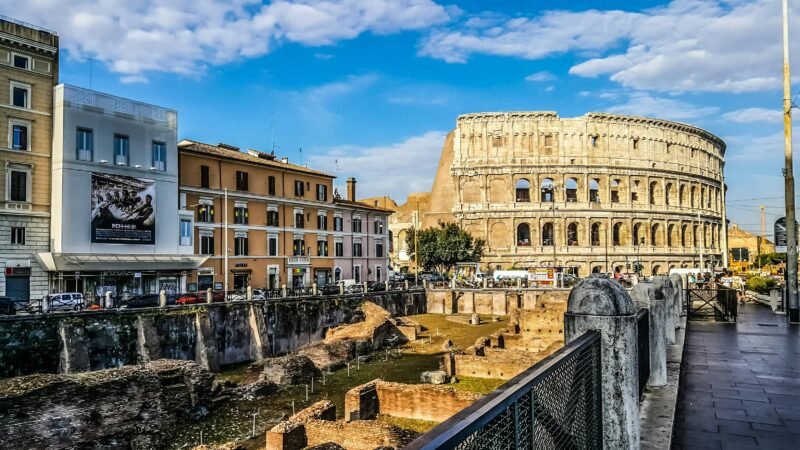
Rome, the capital of Italy, sits on the Tiber River and serves as both a modern administrative centre and repository of ancient ruins spanning over two millennia. On Tuesday, 12 May 2026, the city experiences drizzly conditions typical of late spring weather patterns. Astrologically, this date falls within Taurus, and the moon is in its waxing gibbous phase, approaching fullness.
On this day
On this date in 2022, the Event Horizon Telescope released the first direct image of Sagittarius A*, the supermassive black hole at the centre of the Milky Way. The groundbreaking photograph, produced through international collaboration among scientists, confirmed decades of theoretical predictions and represented a watershed moment in observational astronomy.
In 1982, two significant but contrasting events occurred in Europe. The Coppergate Helmet, the best preserved of only six known Anglo-Saxon helmets, was discovered in York, England, providing invaluable insight into early medieval craftsmanship and warrior culture. On the same day, Juan María Fernández y Krohn attempted to assassinate Pope John Paul II with a bayonet at the Sanctuary of Fátima in Portugal, an attack that shocked the world and underscored ongoing security concerns for the pontiff.
International Nurses Day
International Nurses Day falls on 12 May each year to commemorate the birth of Florence Nightingale in 1820, the founder of modern nursing. The day recognises the vital contribution nurses make to healthcare systems worldwide and raises awareness of nursing challenges and achievements. It has been observed since 1965 when the International Committee of the Red Cross established the date to honour Nightingale's legacy.
Fibromyalgia Awareness Day
Fibromyalgia Awareness Day is observed on 12 May to increase public understanding of this chronic condition characterised by widespread musculoskeletal pain and fatigue. The date was chosen to coincide with Florence Nightingale's birthday, as she is believed to have suffered from fibromyalgia. The awareness day has grown significantly since its establishment in the early 2000s, with organisations worldwide using it to promote research funding and patient support.
DayAtlas provides comprehensive information for any date and location, displaying historical events, notable births and deaths, current weather conditions, and relevant observances or awareness days. The platform enables users to explore what happened on specific dates while understanding the contextual conditions of those moments.
Find out what's happening today in Rom.
What the Weather Had in Store for Rom on 12th May 2026
Boundaries exist only when one stops questioning them.
Fortune of the Day
12th May in the Stars – Star Sign Taurus
Personality Profile
Personality Those born on May 12 blend Taurus stability with Mercury's intellectual agility. They're practical, sensory-oriented, and possess genuine curiosity about ideas and communication. This combination creates engaging, thoughtful individuals with earthy wisdom.
Strengths & Weaknesses Their strengths include reliability, patience, and sharp analytical minds. They can become stubborn and overly attached to material comfort. Resistance to change sometimes limits adaptability and spontaneity.
Love These individuals seek grounded, intellectually stimulating partnerships. They value loyalty and sensual connection equally, refusing superficial romance. Mercury's influence fosters honest dialogue, deepening emotional bonds considerably.
Caree & Finance With numerology 8, they pursue financial success and professional achievement passionately. Their analytical skills shine in administration, communication, and finance sectors. Patience and practicality create sustainable, impressive career trajectories.
Health These natives thrive with consistent exercise and balanced nutrition. Their pleasure-seeking tendencies require mindful awareness around indulgence. Nature exposure and creative pursuits effectively manage stress and nurture vitality.
That night, the moon was in its waxing gibbous phase.
Chinese year of the Horse (Fire).
Fun Facts About 12th May
Name Days in Your Language: Achilla, Achilles, Grady, Grant, Kelby, Kellen
Someone born on this day would be just 20 days old today — roughly 491 hours, 29,478 minutes, or 1,768,692 seconds spent on Earth so far.
It's the 132. day of the year. In 2026, 12th May falls on a Tuesday.
There are 233 days still to come.
We’re currently in Week 20 — the year marches on.
Famous Birthdays on 12th May
On this day, 136 notable people were born on 12th May — spanning from 1325 to 2006. From world leaders to artists and scientists, discover who shares this birthday.
12/05/2006
Vasilije Adžić, Montenegrin footballer
Vasilije Adžić is a Montenegrin professional footballer who plays as a midfielder for Serie A club Juventus and the Montenegro national team.
12/05/2005
Zach Benson, Canadian ice hockey player
Zachary Ruben Benson is a Canadian professional ice hockey player who is a winger for the Buffalo Sabres of the National Hockey League (NHL). He was drafted 13th overall by the Sabres in the 2023 NHL entry draft.
12/05/2001
Issa Kaboré, Burkinabé footballer
Issa Kaboré is a Burkinabé professional footballer who plays as a right-back or right wing-back for EFL Championship club Wrexham, on loan from Premier League club Manchester City, and the Burkina Faso national team.
12/05/1999
Hiroki Itō, Japanese footballer
Hiroki Ito is a Japanese professional footballer who plays as a centre-back, left-back and defensive midfielder for Bundesliga club Bayern Munich and the Japan national team.
12/05/1998
Mo Bamba, American-Ivorian basketball player
Mohamed Fakaba Bamba is an Ivorian-American professional basketball player who last played for the Utah Jazz of the National Basketball Association (NBA). He played college basketball for the Texas Longhorns. He was highly regarded by scouts due to his 7 ft 10 in (2.39 m) wingspan and shooting ability. He attended Cardigan Mountain School in Canaan, New Hampshire, and Westtown School in West Chester, Pennsylvania, and was considered one of the top high school prospects for the class of 2017.
12/05/1997
Frenkie de Jong, Dutch footballer
Frenkie de Jong is a Dutch professional footballer who plays as a midfielder for La Liga club Barcelona and the Netherlands national team.
12/05/1996
Fabrice Olinga, Cameroonian footballer
Fabrice Olinga Essono, known as Olinga, is a Cameroonian professional footballer who plays as a forward.
Kostas Tsimikas, Greek footballer
Konstantinos "Kostas" Tsimikas is a Greek professional footballer who plays as a left-back for Serie A club Roma, on loan from Premier League club Liverpool, and the Greece national team.
12/05/1993
Timo Horn, German footballer
Timo Phil Horn is a German professional footballer who plays as a goalkeeper for 2. Bundesliga club VfL Bochum. He began his professional career with 1. FC Köln, where he spent over a decade as the club's first-choice goalkeeper and made more than 300 appearances. After leaving Köln in 2023, he had a brief spell with Red Bull Salzburg before returning to Germany with VfL Bochum in 2024.
12/05/1992
Erik Durm, German footballer
Erik Durm is a German former professional footballer who played as a full-back.
12/05/1990
Florent Amodio, French figure skater
Florent Amodio is a French figure skating coach and former competitor. He is the 2011 European champion, a four-time French national champion, and the 2008 JGP Final champion. He has represented France at two Winter Olympics.
Etika, American YouTuber and live streamer (died 2019)
Desmond Daniel Amofah, better known as Etika, was an American YouTuber and live streamer. Amofah became known online for his dramatic reactions to Super Smash Bros. character trailers, Nintendo Direct presentations, and for playing and reacting to various games. He resided in the Brooklyn borough of New York City; his father is the Ghanaian politician Owuraku Amofah and his granduncle is the former Ghanaian president Nana Akufo-Addo. Starting his online career in 2007, Amofah created his main YouTube channel, "EWNetwork", in 2012. His fanbase was dubbed the "JOYCONBOYZ" in reference to the Nintendo Switch controller, the Joy-Con. He garnered popularity following the release of Super Smash Bros. 4, primarily stemming from his reaction videos of news surrounding the game. His content consisted of playthroughs of various video games, reaction videos, and pre-recorded material. Across his multiple YouTube channels, he amassed over 1 million subscribers and 146 million views.
12/05/1989
Eleftheria Eleftheriou, Greek Cypriot singer, musician, and actress
Eleftheria Eleftheriou is a Greek Cypriot singer. She came to prominence through her participation in the second season of the Greek version of The X Factor. Shortly after her elimination, Sony Music Greece signed her and submitted her as a candidate to represent Greece in the Eurovision Song Contest 2010. She was later disqualified from the national final, following the leak of her song onto the internet by an unknown party.
12/05/1988
Marcelo, Brazilian footballer
Marcelo Vieira da Silva Júnior, known as Marcelo, is a Brazilian former professional footballer who played as a left-back. Widely regarded as one of the greatest left-backs of all time, he is known for his attacking capabilities. He spent most of his career with La Liga club Real Madrid and is one of the club’s most decorated players, winning 25 trophies.
12/05/1987
Lance Lynn, American baseball player
Michael Lance Lynn is an American former professional baseball pitcher. Between 2011 and 2024, he played 13 seasons in Major League Baseball (MLB) for the St. Louis Cardinals, Minnesota Twins, New York Yankees, Texas Rangers, Chicago White Sox, and Los Angeles Dodgers.
Kieron Pollard, Trinidadian cricketer
Kieron Adrian Pollard is a Trinidadian cricketer, who captained the West Indies cricket team in limited overs cricket. He used to play in various T20 leagues around the globe as an all-rounder. He also used to captain MI Cape Town, MI Emirates and MI New York in the SA20, ILT20 and MLC respectively. He is currently playing for the Trinbago Knight Riders in the Caribbean Premier League. He is also the batting coach of the Mumbai Indians in the Indian Premier League and was the assistant coach of the England cricket team for the ICC Men's T20 World Cup 2024. He was part of the 2012 ICC World Twenty20 winning team for West Indies. During his period, he was one of the most aggressive batsmen and he also has the record of six 6s in an over against Sri Lanka.
Darren Randolph, Irish footballer
Darren Edward Andrew Randolph is an Irish former professional footballer who played as a goalkeeper. He represented the Republic of Ireland national team in football, and Ireland at basketball.
12/05/1986
Emily VanCamp, Canadian actress
Emily Irene VanCamp is a Canadian actress. She gained acclaim and international recognition for portraying the lead role of Emily Thorne on the ABC series Revenge (2011–2015). She also starred on the Fox medical drama series The Resident (2018–2021).
12/05/1983
Domhnall Gleeson, Irish actor
Domhnall Gleeson is an Irish actor and screenwriter. The son of actor Brendan Gleeson, he studied media arts at the Dublin Institute of Technology. He began his career by directing and writing short films, and garnered a Tony Award nomination in 2006 for his role in the Broadway production The Lieutenant of Inishmore. He had a supporting role in Never Let Me Go (2010) and became known to a wider audience for his portrayal of Bill Weasley in the Harry Potter film series (2010–2011).
Yujiro Kushida, Japanese wrestler and mixed martial artist
Yujiro Kushida is a Japanese professional wrestler and former mixed martial artist, better known by his mononymous ring name Kushida. He is signed to New Japan Pro-Wrestling (NJPW), and also makes appearances for Major League Wrestling (MLW), where he is a member of Contra Unit.
12/05/1981
Rami Malek, American actor
Rami Said Malek is an American actor. He gained recognition for portraying Queen lead singer Freddie Mercury in the biographical film Bohemian Rhapsody (2018), for which he won numerous accolades, including the Academy Award for Best Actor in 2019, becoming the first actor of Egyptian heritage to win in that category. He played computer hacker Elliot Alderson in the USA Network television series Mr. Robot (2015–2019), for which he received the Primetime Emmy Award for Outstanding Lead Actor in a Drama Series.
12/05/1980
Rishi Sunak, English politician, Prime Minister of the United Kingdom
Rishi Sunak is a British politician who served as Prime Minister of the United Kingdom and Leader of the Conservative Party from 2022 to 2024. Following his defeat to Keir Starmer's Labour Party in the 2024 general election, he became Leader of the Opposition, serving in this role from July to November 2024. He previously held two Cabinet positions under Boris Johnson, latterly as Chancellor of the Exchequer from 2020 to 2022. Sunak is the Member of Parliament (MP) for Richmond and Northallerton, previously Richmond (Yorks), since 2015.
12/05/1979
Steve Smith Sr., American football player
Stevonne Latrall Smith Sr., better known as Steve Smith, is an American former professional football wide receiver who played in the National Football League (NFL) for 16 seasons, primarily with the Carolina Panthers. He played college football for the Utah Utes and was selected by the Panthers in the third round of the 2001 NFL draft. Smith spent 13 seasons in Carolina and three with the Baltimore Ravens. After retiring from the NFL, Smith became a sports analyst and show host for NFL Network.
12/05/1978
Malin Åkerman, Swedish-Canadian model, actress, and singer
Malin Maria Åkerman, often anglicised to Malin Akerman, is a Swedish-American actress. She first appeared in smaller parts in both Canadian and American productions, including The Utopian Society (2003) and Harold & Kumar Go to White Castle (2004). Following a main role on the HBO mockumentary series The Comeback (2005), Akerman co-starred in the commercially successful romantic comedies The Heartbreak Kid (2007) and 27 Dresses (2008). She gained wider recognition for her role as Silk Spectre II in the 2009 superhero film Watchmen, for which she received a Saturn Award nomination for Best Supporting Actress.
Jason Biggs, American actor and comedian
Jason Matthew Biggs is an American actor. He is best known for his lead role as Jim Levenstein in the American Pie film series (1999–2012). His other notable lead credits include Loser (2000), Saving Silverman (2001), Anything Else (2003), My Best Friend's Girl (2008), Life Happens (2011), Grassroots (2012), and Best. Christmas. Ever! (2023).
12/05/1977
Graeme Dott, Scottish snooker player and coach
Graeme Dott is a Scottish former professional snooker player from Glasgow. He turned professional in 1994, first entered the top 16 in 2001, and reached his first world final at the 2004 World Championship, losing 8–18 to Ronnie O'Sullivan. Two years later, he defeated Peter Ebdon 18–14 in the final of the 2006 World Championship, winning his first world title and first ranking title. He claimed his second ranking title at the 2007 China Open, defeating Jamie Cope 9–5 in the final, and reached his career highest ranking of second in the 2007–08 rankings.
Maryam Mirzakhani, Iranian mathematician (died 2017)
Maryam Mirzakhani was an Iranian mathematician and a professor of mathematics at Stanford University. Her research topics included Teichmüller theory, hyperbolic geometry, ergodic theory, and symplectic geometry. On 13 August 2014, Mirzakhani was honored with the Fields Medal, the most prestigious award in mathematics, becoming the first woman to win the prize, as well as the first Iranian. The award committee cited her work in "the dynamics and geometry of Riemann surfaces and their moduli spaces". Mirzakhani was considered a leading force in the fields of hyperbolic geometry, topology and dynamics.
12/05/1976
Bruno Lage, Portuguese football manager
Bruno Miguel Silva do Nascimento, known as Bruno Lage, is a Portuguese football manager who last managed Primeira Liga club Benfica.
12/05/1975
Jonah Lomu, New Zealand rugby player (died 2015)
Jonah Tali Lomu was a New Zealand professional rugby union player. He is widely regarded as one of the greatest and most influential players in the history of the sport, and as one of the most talented sportsmen of all time. Lomu is widely considered to have been the first true global superstar of rugby, and consequently had a huge impact on the game.
12/05/1972
Rhea Seehorn, American actress
Deborah Rhea Seehorn is an American actress and director. She is best known for playing attorney Kim Wexler in the AMC legal crime drama series Better Call Saul (2015–2022) and novelist Carol Sturka in the Apple TV science fiction thriller series Pluribus (2025–present).
12/05/1970
Jim Furyk, American golfer
James Michael Furyk is an American professional golfer who plays on the PGA Tour and the PGA Tour Champions. In 2010, he was the FedEx Cup champion and PGA Tour Player of the Year. He has won one major championship, the 2003 U.S. Open. Furyk holds the record for the lowest score in PGA Tour history, a round of 58 which he shot during the final round of the 2016 Travelers Championship, and has earned notoriety for his unorthodox golf swing.
Samantha Mathis, American actress
Samantha Mathis is an American actress and trade union leader who served as the Vice President, Actors/Performers of SAG-AFTRA from 2015 to 2019. The daughter of actress Bibi Besch, Mathis made her film debut in Pump Up the Volume (1990), and later co-starred or appeared in such films as FernGully: The Last Rainforest (1992), Super Mario Bros. (1993), The Thing Called Love (1993), Little Women (1994), The American President (1995), Jack and Sarah (1995), Broken Arrow (1996), American Psycho (2000), The Punisher (2004), and Atlas Shrugged: Part II (2012). She has also had recurring roles on The Strain as New York City Councilwoman Justine Feraldo, and on Billions as Taylor Mason Capital COO Sara Hammon.
Mike Weir, Canadian golfer
Michael Richard Weir, is a Canadian professional golfer. He currently plays on the PGA Tour Champions. He spent over 110 weeks in the top-10 of the Official World Golf Ranking between 2001 and 2005. He plays golf left-handed and is best known for winning the Masters Tournament in 2003, making him the only Canadian man to ever win a major championship.
12/05/1969
Kim Fields, American actress
Kim Fields Morgan is an American actress and director. She first gained fame as a child actress on the television series Good Times (1978–1979), and rose to greater prominence for her role as Dorothy "Tootie" Ramsey on the NBC sitcom Diff'rent Strokes (1979–1981), as well as its spin-off The Facts of Life (1979–1988).
12/05/1968
Tony Hawk, American skateboarder and actor
Anthony Frank Hawk, nicknamed Birdman, is an American professional skateboarder, entrepreneur, and the owner of the skateboard company Birdhouse. A pioneer of modern vertical skateboarding, Hawk completed the first documented "900" skateboarding trick in 1999. He also licensed a skateboarding video game series named after him, published by Activision that same year. Hawk, who retired from competing professionally in 2003, is widely regarded as one of the greatest and most influential skateboarders of all time.
12/05/1967
Bill Shorten, Australian politician
William Richard Shorten is an Australian former politician and trade unionist who served as the leader of the Opposition and the leader of the Labor Party from 2013 to 2019, and served as a cabinet minister in the Gillard, Rudd and Albanese governments.
12/05/1966
Stephen Baldwin, American actor
Stephen Andrew Baldwin is an American actor. He has appeared in the films Born on the Fourth of July (1989), Posse (1993), 8 Seconds, Threesome, The Usual Suspects (1995), Bio-Dome (1996) and The Flintstones in Viva Rock Vegas (2000). Baldwin also starred in the television series The Young Riders (1989–1992) and as himself in the reality shows Celebrity Big Brother 7, in which he placed 9th in the United Kingdom, and The Celebrity Apprentice. In 2004, he directed Livin' It, a Christian-themed skateboarding DVD. He is the youngest of the four Baldwin brothers.
12/05/1965
Mark Thomas, British sprinter
Mark Thomas is a British former sprinter specializing in the 400 metres. He was the 1988 AAA Indoor Championships winner in his event, and he won the silver medal representing the U.K. at the 1987 World Athletics Championships by virtue of running in the heats and semi-finals.
12/05/1962
Emilio Estevez, American actor
Emilio Estevez is an American actor and filmmaker. The son of actor Martin Sheen and the older brother of Charlie Sheen, he made his film debut with an uncredited role in Badlands (1973). He later received his first credited appearance with a supporting role in the coming-of-age film Tex (1982).
Brett Gurewitz, American guitarist and songwriter
Brett W. Gurewitz, nicknamed Mr. Brett, is an American musician and record producer, best known as the co-founder and guitarist of the punk band Bad Religion. He is also the owner of the music label Epitaph Records and a number of sister labels. He has produced albums for Bad Religion as well as Epitaph Records labelmates NOFX, Rancid, and Pennywise, among others. Gurewitz also had a project called Error, which also featured Atticus Ross, Leopold Ross, and Greg Puciato. He is also the co-founder of comic book and graphic novel publisher, Black Mask Studios.
12/05/1959
Ving Rhames, American actor
Irving Rameses Rhames is an American actor. Born and raised in Harlem, New York City, he studied drama at SUNY Purchase before transferring to the Juilliard School, graduating with a Bachelor of Fine Arts in 1983. After early stage work in Shakespeare and contemporary plays, he made his screen debut in 1985 and gained attention through roles in Jacob's Ladder (1990), The People Under the Stairs (1991), and as Marsellus Wallace in Quentin Tarantino’s Pulp Fiction (1994). Rhames achieved further recognition as Luther Stickell in the Mission: Impossible film series, appearing in all eight installments.
12/05/1957
Lou Whitaker, American baseball player
Louis Rodman Whitaker Jr., nicknamed "Sweet Lou", is an American former professional baseball second baseman. Whitaker spent his entire career with the Detroit Tigers. From 1977 to 1995, he appeared in 2,390 games for the Tigers, third most in franchise history behind Ty Cobb and Al Kaline. He helped the Tigers win the 1984 World Series, was selected as an American League All-Star five consecutive years (1983–1987) and won four Silver Slugger Awards and three Gold Glove Awards (1983–1985). The Tigers retired his No. 1 jersey in August 2022.
12/05/1952
Domingos Maubere, East Timorese Catholic priest and activist (died 2025)
Domingos da Silva Soares, popularly known as Padre Maubere or Amu Du, was an East Timorese Roman Catholic priest, activist, and independence leader. Born in Letefoho in what was then Portuguese Timor, he attended seminary in Portugal and was ordained in 1978. In 1980, he returned to East Timor and became involved in the resistance against the Indonesian occupation (1975–1999), often supporting the guerrillas and coordinating with the movement's leaders. As a pastor in Timor-Leste, he served in parishes in Ossu, Letefoho, Ermera, Suai, and Becora, Dili.
12/05/1951
George Karl, American basketball player and coach
George Matthew Karl is an American former professional basketball coach and player. After spending five years as a player for the San Antonio Spurs, he became an assistant with the team before being appointed as a head coach in 1980 with the Montana Golden Nuggets of the Continental Basketball Association (CBA). Three years later, Karl became one of the youngest National Basketball Association (NBA) head coaches in history when he was named coach of the Cleveland Cavaliers at age 33. By the time his coaching career came to an end in 2016, Karl coached nine different teams in three different leagues, which included being named Coach of the Year three combined times with one championship roster in the FIBA Saporta Cup. He is one of nine coaches in NBA history to have won 1,000 NBA games and was named NBA Coach of the Year for the 2012–13 season. While he never won an NBA championship, Karl made the postseason 22 times with five different teams, which included a trip to the 1996 NBA Finals with the Seattle SuperSonics.
12/05/1950
Bruce Boxleitner, American actor and author
Bruce William Boxleitner is an American actor and science fiction and suspense writer. He is known for his leading roles in the television series: How the West Was Won, Bring 'Em Back Alive, Scarecrow and Mrs. King and Babylon 5 . He is also known for his dual role as the characters Alan Bradley and Tron in the 1982 Walt Disney Pictures film Tron, a role which he reprised in the 2003 video game Tron 2.0, the 2006 Square-Enix/Disney crossover game Kingdom Hearts II, the 2010 film sequel, Tron: Legacy and the animated series Tron: Uprising. He co-starred in most of the Gambler films with Kenny Rogers, where his character provided comic relief. He also voiced General Moss in the films AniMen: Triton Force and AniMen: The Galactic Battle.
Gabriel Byrne, Irish actor, director, and producer
Gabriel James Byrne is an Irish actor. He has received a Golden Globe Award as well as nominations for a Grammy Award, two Primetime Emmy Awards and two Tony Awards. Byrne was awarded the Irish Film and Television Academy Lifetime Achievement Award in 2018 and was listed at number 17 on The Irish Times list of Ireland's greatest film actors in 2020. In 2009 The Guardian named him one of the best actors never to have received an Academy Award nomination.
Billy Squier, American singer-songwriter and guitarist
William Haislip Squier is an American rock musician, singer, and songwriter who had a string of hits in the early 1980s. His best-known songs include "The Stroke", "Lonely Is the Night", "My Kinda Lover", "In the Dark", "Rock Me Tonite", "Everybody Wants You", "Emotions in Motion", "Love Is the Hero", and "Don't Say You Love Me". Squier's best-selling album, 1981's Don't Say No, is considered a landmark release of arena rock, bridging the gap between power pop and hard rock.
12/05/1948
Dave Heineman, American politician, 39th Governor of Nebraska
David Eugene Heineman is an American politician who served as the 39th governor of Nebraska from 2005 to 2015. A member of the Republican Party, he was the 39th treasurer of Nebraska from 1995 to 2001 and 37th lieutenant governor of Nebraska from 2001 to 2005 under governor Mike Johanns. Heineman took over the governorship after Johanns resigned to become the U.S. Secretary of Agriculture.
Steve Winwood, English singer-songwriter and multi-instrumentalist
Stephen Lawrence Winwood is an English musician and songwriter whose genres include blue-eyed soul, rhythm and blues, blues rock, and pop rock. Though primarily a keyboard player, guitarist, and vocalist prominent for his distinctive soulful high tenor voice, Winwood also plays instruments including mandolin, electric bass, saxophone, flute, drums and percussion.
12/05/1947
Michael Ignatieff, Canadian journalist and politician
Michael Grant Ignatieff is a Canadian author, academic and former politician who served as leader of the Liberal Party and leader of the Opposition from 2008 until 2011. Known for his work as a historian, Ignatieff has held senior academic posts at the universities of Cambridge, Oxford, Harvard, and Toronto. Most recently, he was rector and president of Central European University; he held this position from 2016 to 2021.
12/05/1946
Daniel Libeskind, American architect, designed the Imperial War Museum North and Jewish Museum
Daniel Libeskind is a Polish and American architect, artist, professor, and set designer. Libeskind founded Studio Daniel Libeskind in 1989 with his wife, Nina, and is its principal design architect. He is known for the design and completion of the Jewish Museum in Berlin, Germany, that opened in 2001. In 2003, Libeskind received further international attention after he won the competition to be the master plan architect for the reconstruction of the World Trade Center site in Lower Manhattan.
12/05/1945
Alan Ball, Jr., English footballer and manager (died 2007)
Alan James Ball was an English professional football player and manager. He won the 1966 World Cup with England and scored more than 180 league goals in a career spanning 22 years. After retiring as a player, he had a 15-year career as a manager which included spells in the top flight of English football with Portsmouth, Southampton and Manchester City. One of the best midfielders of his generation, he was inducted in the English Football Hall of Fame in 2003.
Ian McLagan, English keyboard player and songwriter (died 2014)
Ian Patrick McLagan was an English keyboardist, best known as a member of the rock bands Small Faces and Faces. He also collaborated with the Rolling Stones and led his own band from the late 1970s. He was inducted into the Rock and Roll Hall of Fame in 2012.
12/05/1944
Chris Patten, English academic and politician, 28th Governor of Hong Kong
Christopher Francis Patten, Baron Patten of Barnes, is a British politician who was the Chairman of the Conservative Party from 1990 to 1992, and the 28th and last Governor of Hong Kong from 1992 to 1997. He was made a life peer in 2005 and served as Chancellor of the University of Oxford from 2003 to 2024. He is one of two living former governors of Hong Kong, alongside David Wilson.
12/05/1942
Ian Dury, English singer-songwriter (died 2000)
Ian Robins Dury was an English singer, songwriter and actor best remembered as the frontman of Ian Dury and the Blockheads. Described by The Guardian as "one of few true originals of the English music scene", Dury drew from music hall and punk traditions, often incorporating observational humour and word play in his lyrics.
12/05/1940
Norman Whitfield, American songwriter and producer (died 2008)
Norman Jesse Whitfield was an American songwriter, composer, and producer, who worked with Berry Gordy's Motown labels during the 1960s. He has been credited as one of the creators of the Motown Sound and of the late-1960s subgenre of psychedelic soul.
12/05/1939
Reg Gasnier, Australian rugby league player, coach, and sportscaster (died 2014)
Reginald William Gasnier was an Australian rugby league footballer and coach. He played centre for the St. George Dragons from 1959 to 1967 and represented Australia in a then record 36 Tests and three World Cup games. He was the captain of the national side on eight occasions between 1962 and 1967.
12/05/1937
Beryl Burton, English cyclist (died 1996)
Beryl Burton OBE was an English racing cyclist who dominated the women's sport, winning more than 90 domestic championships and seven world titles, and setting numerous national records. In 1967, she set a world record for the 12-hour time-trial which exceeded the men's record for two years.
George Carlin, American comedian, actor, and author (died 2008)
George Denis Patrick Carlin was an American stand-up comedian, social critic, actor and author. He was known for his dark comedy and reflections on politics, English, psychology, religion, and taboo subjects.
12/05/1936
Guillermo Endara, Panamanian lawyer and politician, 32nd President of Panama (died 2009)
Guillermo David Endara Galimany was a Panamanian politician who served as the president of Panama from 1989 to 1994.
Tom Snyder, American journalist and talk show host (died 2007)
Thomas James Snyder was an American television personality, news anchor, and radio personality best known for his late night talk shows Tomorrow, on NBC in the 1970s and 1980s, and The Late Late Show, on CBS in the 1990s. Snyder was also the pioneer anchor of the prime time NBC News Update, in the 1970s and early 1980s, which was a one-minute capsule of news updates.
Frank Stella, American painter and sculptor (died 2024)
Frank Philip Stella was an American painter, sculptor, and printmaker, noted for his work in the areas of minimalism and post-painterly abstraction. He lived and worked in New York City for much of his career before moving his studio to Rock Tavern, New York. Stella's work catalyzed the minimalist movement in the late 1950s. He moved to New York City in the late 1950s, where he created works which emphasized the picture-as-object. These were influenced by the abstract expressionist work of artists like Franz Kline and Jackson Pollock.
12/05/1935
Felipe Alou, Dominican-American baseball player, coach, and manager
Felipe Rojas Alou is a Dominican former professional outfielder, first baseman, coach and manager in Major League Baseball (MLB). He managed the Montreal Expos (1992–2001) and the San Francisco Giants (2003–2006). The first Dominican to play regularly in the major leagues, he is the most prominent member of one of the sport's most notable families of the late 20th century: he was the oldest of the trio of baseball-playing brothers that included Matty and Jesús, who were both primarily outfielders, and his son Moisés was also primarily an outfielder; all but Jesús have been named All-Stars at least twice. His son Luis, in turn, managed the New York Mets.
Johnny Bucyk, Canadian ice hockey player
John Paul "Chief" Bucyk is a Canadian former professional ice hockey left winger and member of the Hockey Hall of Fame. Having played most of his career with the Boston Bruins, he has been associated in one capacity or another with the Bruins' organization since the late 1950s. Bucyk was named one of the '100 Greatest NHL Players' in 2017.
12/05/1930
Jesús Franco, Spanish director and screenwriter (died 2013)
Jesús Franco Manera, also commonly known as Jess Franco, was a Spanish filmmaker, composer, and actor, known as a highly prolific director of low-budget exploitation and B-movies. He worked in many different genres during his career, but was best known for his horror and erotic films, often incorporating surrealist elements.
12/05/1929
Sam Nujoma, Namibian politician, 1st President of Namibia (died 2025)
Samuel Shafiishuna Daniel Nujoma was a Namibian revolutionary, anti-apartheid activist and politician who served three terms as the first president of Namibia, from 1990 to 2005. Nujoma was a founding member and the first president of the South West Africa People's Organisation (SWAPO) in 1960.
12/05/1928
Burt Bacharach, American singer-songwriter, pianist, and producer (died 2023)
Burt Freeman Bacharach was an American composer, songwriter, record producer, and pianist, widely regarded as one of the most important and influential figures of 20th-century popular music. A significant figure in orchestral pop and easy listening, he composed hundreds of songs, many in collaboration with lyricist Hal David, and arranged, conducted, and produced much of his recorded output. His music often contained atypical chord progressions and time signature changes, influenced by his background in jazz, and uncommon selections of instruments for small orchestras.
12/05/1927
Barbara Dane, American folk, blues and jazz singer (died 2024)
Barbara Jean Spillman, known professionally as Barbara Dane, was an American folk, blues and jazz singer, guitarist, record producer, and political activist. She co-founded Paredon Records with Irwin Silber.
12/05/1925
Yogi Berra, American baseball player, coach, and manager (died 2015)
Lawrence Peter "Yogi" Berra was an American professional baseball catcher who later took on the roles of manager and coach. He played 19 seasons in Major League Baseball (MLB), all but the last for the New York Yankees. He was an 18-time All-Star and won 10 World Series championships as a player—more than any other player in MLB history. Berra had a career batting average of .285, while hitting 358 home runs and 1,430 runs batted in. He is one of only six players to win the American League (AL) Most Valuable Player Award three times. He is widely regarded as one of the greatest catchers in baseball history, and was elected to the Baseball Hall of Fame in 1972.
12/05/1924
Tony Hancock, English actor, producer, and screenwriter (died 1968)
Anthony John Hancock was an English comedian and actor.
12/05/1922
Roy Salvadori, English racing driver and manager (died 2012)
Roy Francesco Salvadori was a British racing driver and motorsport executive, who competed in Formula One from 1952 to 1962. In endurance racing, Salvadori won the 24 Hours of Le Mans in 1959 with Aston Martin.
12/05/1921
Joseph Beuys, German sculptor and illustrator (died 1986)
Joseph Heinrich Beuys was a German artist, teacher, performance artist, and art theorist whose work reflected concepts of humanism and sociology. With Heinrich Böll, Johannes Stüttgen, Caroline Tisdall, Robert McDowell, and Enrico Wolleb, Beuys created the Free International University for Creativity & Interdisciplinary Research (FIU). Through his talks and performances, he also formed The Party for Animals and The Organisation for Direct Democracy. He was a member of a Dadaist art movement Fluxus and singularly inspirational in developing of Performance Art, called Kunst Aktionen, alongside Wiener Aktionismus that Allan Kaprow and Carolee Schneemann termed Art Happenings.
Farley Mowat, Canadian environmentalist and author (died 2014)
Farley McGill Mowat was a Canadian writer and environmentalist. His works were translated into 52 languages, and he sold more than 17 million books. He achieved fame with the publication of his books on the Canadian north, such as People of the Deer (1952) and Never Cry Wolf (1963). The latter, an account of his experiences with wolves in the Arctic, was made into a film of the same name released in 1983. For his body of work as a writer he won the annual Vicky Metcalf Award for Children's Literature in 1970.
12/05/1918
Mary Kay Ash, American businesswoman, founded Mary Kay Cosmetics (died 2001)
Mary Kay Ash was an American businesswoman and founder of direct sales company Mary Kay Cosmetics, Inc. At the time of her death, she had a fortune of $98 million, and her company had more than $1.2 billion in sales with a sales force of more than 800,000 in at least three dozen countries.
Julius Rosenberg, American spy (died 1953)
Julius Rosenberg and Ethel Rosenberg were an American married couple who were convicted of spying for the Soviet Union, including providing top-secret information about American radar, sonar, jet propulsion engines, and nuclear weapon designs. They were executed by the federal government of the United States in 1953 using New York's state execution chamber in Sing Sing in Ossining, New York, becoming the first American civilians to be executed for such charges and the first to be executed during peacetime.
12/05/1914
Howard K. Smith, American journalist and actor (died 2002)
Howard Kingsbury Smith was an American journalist, radio reporter, television anchorman, political commentator, and film actor. He was one of the original members of the team of war correspondents known as the Murrow Boys.
12/05/1911
Charles Biro, American author and illustrator (died 1972)
Charles Biro was an American comic book creator and cartoonist. He created the comic book characters Airboy and Steel Sterling, and worked on Daredevil Comics and Crime Does Not Pay at Lev Gleason Publications.
12/05/1910
Johan Ferrier, Surinamese educator and politician, first President of Suriname (died 2010)
Johan Henri Eliza Ferrier was a Surinamese politician who served as the first president of Suriname from 1975 to 1980. He was also the country's last governor-general before independence, serving from 1968 to 1975, before becoming the first president upon independence from the Kingdom of the Netherlands in 1975 and also served as the fifth prime minister from 1955 to 1958.
Dorothy Hodgkin, English biochemist, crystallographer, and academic, Nobel Prize laureate (died 1994)
Dorothy Mary Crowfoot Hodgkin was an English chemist who advanced the technique of X-ray crystallography to determine the structure of biomolecules, which became essential for structural biology. She received the 1964 Nobel Prize in Chemistry, and is the only British woman scientist to have been awarded a Nobel Prize.
12/05/1908
Nicholas Kaldor, Hungarian-English economist (died 1986)
Nicholas Kaldor, Baron Kaldor, born Káldor Miklós, was a Hungarian-born British economist. He developed the "compensation" criteria called Kaldor–Hicks efficiency for welfare comparisons (1939), derived the cobweb model, and argued for certain regularities observable in economic growth, which are called Kaldor's growth laws. Kaldor worked alongside Gunnar Myrdal to develop the key concept Circular Cumulative Causation, a multicausal approach where the core variables and their linkages are delineated.
12/05/1907
Leslie Charteris, English author and screenwriter (died 1993)
Leslie Charteris, was a British-Chinese author of adventure fiction, as well as a screenwriter. He was best known for his many books chronicling the adventures of his hero Simon Templar, alias "The Saint".
Katharine Hepburn, American actress (died 2003)
Katharine Houghton Hepburn was an American actress whose career as a leading lady on stage and screen spanned six decades. Known for her headstrong independence, spirited personality, and outspokenness, she cultivated a screen persona that matched this public image, and regularly played strong-willed, sophisticated women. She worked in a varied range of genres, from screwball comedy to literary drama. Her accolades include a record four Academy Awards for Best Actress, two British Academy Film Awards and a Primetime Emmy Award, in addition to nominations for two Tony Awards, two Grammy Awards and eight Golden Globe Awards.
12/05/1903
Wilfrid Hyde-White, English actor (died 1991)
Wilfrid Hyde-White was an English actor. Described by Philip French as a "classic British film archetype", Hyde-White often portrayed droll and urbane upper-class characters. He had an extensive stage and screen career in both the United Kingdom and the United States, and portrayed over 160 film and television roles between 1935 and 1987. He was twice nominated for a Tony Award for Best Actor in a Play, in 1957 for The Reluctant Debutante and in 1973 for The Jockey Club Stakes.
12/05/1900
Helene Weigel, Austrian-German actress (died 1971)
Helene Weigel was an Austrian actress and artistic director. She was the second and last wife of Bertolt Brecht until his death in 1956; together they had two children.
12/05/1899
Indra Devi, pioneer of Yoga (died 2002)
Eugenie Peterson, known as Indra Devi, was a pioneering teacher of yoga as exercise, and an early disciple of the "father of modern yoga", Tirumalai Krishnamacharya.
12/05/1897
Earle Nelson, American serial killer and rapist (died 1928)
Earle Leonard Nelson, also known as the Gorilla Man, the Gorilla Killer, and the Dark Strangler, was an American serial killer, rapist, and necrophile who killed at least twenty women in various U.S. states and two in Canada between 1926 and 1927. He is perhaps the first known serial sex murderer of the twentieth century.
12/05/1895
William Giauque, Canadian-American chemist and academic, Nobel Prize laureate (died 1982)
William Francis Giauque was a Canadian-born American chemist and Nobel laureate. He was recognized in 1949, for his studies in the properties of matter, at temperatures close to absolute zero. He spent virtually all of his educational and professional career at the University of California, Berkeley.
Jiddu Krishnamurti, Indian-American philosopher and author (died 1986)
Jiddu Krishnamurti was an Indian spiritual figure, speaker, and writer. Adopted by members of the Theosophical Society as a child, Krishnamurti was raised to fill the mantle of the prophesied World Teacher, a role tasked with aiding humankind's spiritual evolution. In 1922, he began to suffer from painful, seizure-like mystical episodes that would produce a lasting change in his perception of reality. In 1929, he broke from the Theosophy movement and disbanded the Order of the Star in the East which had been formed around him. He spent the rest of his life speaking to groups and individuals around the world, hoping to contribute a radical transformation of mankind.
12/05/1892
Fritz Kortner, Austrian-German actor and director (died 1970)
Fritz Kortner was an Austrian stage and film actor and theatre director.
12/05/1889
Abelardo L. Rodríguez, substitute president of Mexico (died 1967)
Abelardo Rodríguez Luján, commonly known as Abelardo L. Rodríguez was a Mexican military officer, businessman and politician who served as Substitute President of Mexico from 1932 to 1934. He completed the term of President Pascual Ortiz Rubio after his resignation, during the period known as the Maximato, when Former President Plutarco Elías Calles held considerable de facto political power, without being president himself. Rodríguez was, however, more successful than Ortiz Rubio had been in asserting presidential power against Calles's influence.
Otto Frank, German-Swiss businessman and Holocaust survivor; father of diarist Anne Frank (died 1980)
Otto Heinrich Frank was a German businessman, and the father of Anne Frank. He edited and published the first edition of her diary in 1947 and advised on its later theatrical and cinematic adaptations. In the 1950s and the 1960s, he established European charities in his daughter's name and founded the trust which preserved his family's wartime hiding place, the Anne Frank House, in Amsterdam.
12/05/1886
Ernst A. Lehmann, German captain and pilot (died 1937)
Captain Ernst August Lehmann was a German Zeppelin captain. He was one of the most famous and experienced figures in German airship travel. The Pittsburgh Press called Lehmann the best airship pilot in the world; although, he was criticized by Hugo Eckener for often making dangerous maneuvers that compromised the airships. He was a victim of the Hindenburg disaster in 1937.
12/05/1885
Paltiel Daykan, Lithuanian-Israeli lawyer and jurist (died 1969)
Paltiel Daykan was an Israeli jurist.
12/05/1880
Lincoln Ellsworth, American explorer (died 1951)
Lincoln Ellsworth was an American polar explorer, engineer, surveyor, and writer. He led the first Arctic and Antarctic air crossings.
12/05/1875
Charles Holden, English architect, designed the Bristol Central Library (died 1960)
Charles Henry Holden was an English architect best known for designing many London Underground stations during the 1920s and 1930s, the Underground Electric Railways Company of London's headquarters at 55 Broadway, for the University of London's Senate House and for Bristol Central Library. He created many war cemeteries in Belgium and northern France for the Imperial War Graves Commission.
12/05/1874
Clemens von Pirquet, Austrian pediatrician and immunologist (died 1929)
Clemens Peter Freiherr von Pirquet was an Austrian scientist and pediatrician best known for his contributions to the fields of bacteriology and immunology.
12/05/1873
J. E. H. MacDonald, English-Canadian painter (died 1932)
James Edward Hervey MacDonald was an English-born Canadian artist, best known as a member of the Group of Seven who asserted a distinct national identity combined with a common heritage stemming from early modernism in Europe in the early twentieth century. He was the father of the illustrator, graphic artist and designer Thoreau MacDonald.
12/05/1872
Anton Korošec, Slovenian priest and politician, tenth Prime Minister of Yugoslavia (died 1940)
Anton Korošec was a Slovene Yugoslav politician, a prominent member of the conservative People's Party, a Roman Catholic priest and a noted orator.
12/05/1869
Carl Schuhmann, German gymnast, wrestler, and weightlifter (died 1946)
Carl August Berthold Schuhmann was a German athlete who won four Olympic titles in gymnastics and wrestling at the 1896 Summer Olympics in Athens, becoming the most successful athlete at the inaugural Olympics of the modern era. He also competed in weightlifting.
12/05/1867
Hugh Trumble, Australian cricketer and accountant (died 1938)
Hugh Trumble was an Australian cricketer who played 32 Test matches as a bowling all-rounder between 1890 and 1904. He captained the Australian team in two Tests, winning both. Trumble took 141 wickets in Test cricket—a world record at the time of his retirement—at an average of 21.78 runs per wicket. He is one of only four bowlers to twice take a hat-trick in Test cricket. Observers in Trumble's day, including the authoritative Wisden Cricketers' Almanack, regarded him as ranking among the great Australian bowlers of the Golden Age of cricket. He was named as one of the Wisden Cricketers of the Year in 1897 and the Australian Cricket Hall of Fame, established in 1996, inducted him in 2004.
12/05/1863
Upendrakishore Ray Chowdhury, Bengali writer, painter, violin player and composer, technologist and entrepreneur (died 1915)
Upendrakishore Ray Chowdhury was a Bengali writer, painter and entrepreneur. He was the son-in-law of reformer Dwarkanath Ganguly.
12/05/1859
William Alden Smith, American lawyer and politician (died 1932)
William Alden Smith was a U.S. representative and U.S. senator from the state of Michigan. After the 1912 sinking of the Titanic, Smith chaired the Senate hearings into the disaster. His report led to major reforms in maritime safety.
Frank Wilson, English-Australian politician, ninth Premier of Western Australia (died 1918)
Frank Wilson, was the ninth Premier of Western Australia, serving on two separate occasions – from 1910 to 1911 and then again from 1916 to 1917.
12/05/1850
Henry Cabot Lodge, American historian and politician (died 1924)
Henry Cabot Lodge was an American politician, historian, lawyer, and statesman from Massachusetts. A member of the Republican Party, he served in the United States Senate from 1893 to 1924 and is best known for his positions on foreign policy. He voted in favor of American entry into World War I and his successful crusade against Woodrow Wilson's Treaty of Versailles ensured that the United States never joined the League of Nations. His penned conditions against that treaty, known collectively as the Lodge reservations, influenced the structure of the modern United Nations.
Frederick Holder, Australian politician, 19th Premier of South Australia (died 1909)
Sir Frederick William Holder was an Australian politician who served as the first speaker of the Australian House of Representatives from 1901 to 1909. A member of the Free Trade Party and later an independent, he served twice as the 19th premier of South Australia from June to October 1892 and again from 1899 to 1901. He was a prominent member of federation movement and the first Parliament of Australia, following Federation in 1901.
12/05/1845
Gabriel Fauré, French pianist, composer, and educator (died 1924)
Gabriel Urbain Fauré was a French composer, organist, pianist and teacher. He was one of the foremost French composers of his generation, and his musical style influenced many 20th-century composers. Among his best-known works are his Pavane, Requiem, Sicilienne, nocturnes for piano and the songs "Après un rêve" and "Clair de lune". Although his best-known and most accessible compositions are generally his earlier ones, Fauré composed many of his most highly regarded works in his later years, in a more harmonically and melodically complex style.
12/05/1842
Jules Massenet, French composer (died 1912)
Jules Émile Frédéric Massenet was a French composer of the Romantic era best known for his operas, of which he wrote more than thirty. The two most frequently staged are Manon (1884) and Werther (1892). He also composed oratorios, ballets, orchestral works, incidental music, piano pieces, songs and other music.
12/05/1840
Alejandro Gorostiaga, Chilean colonel (died 1912)
Alejandro Gorostiaga Orrego, was a Chilean military officer born in La Serena. He joined the Escuela Militar de Chile in 1857 until his retirement in 1878. Alejandro Gorostiaga was of Basque descent.
12/05/1839
Tôn Thất Thuyết, Vietnamese mandarin (died 1913)
Tôn Thất Thuyết, Courtesy name Đàm Phu (談夫), was the regent and leading mandarin of Emperor Tự Đức of Vietnam's Nguyễn dynasty. Thuyết later led the Cần Vương movement which aimed to restore Vietnamese independence under Emperor Hàm Nghi. He fled to China seeking political refuge after Hàm Nghi's capture by France, and later died in Longzhou, Guangxi.
12/05/1829
Pavlos Carrer, Greek composer and educator (died 1896)
Pavlos Carrer or Pavlos Carreris, was a Greek composer, one of the leaders of the Ionian art music school and the first to create national operas and national songs on Greek plots, Greek librettos and verses, as well as melodies inspired by the folk and the urban popular musical tradition of modern Greece.
12/05/1828
Dante Gabriel Rossetti, English poet and painter (died 1882)
Gabriel Charles Dante Rossetti, generally known as Dante Gabriel Rossetti, was an English poet, illustrator, painter and translator. He founded the Pre-Raphaelite Brotherhood in 1848 with William Holman Hunt and John Everett Millais. Rossetti inspired many contemporary artists and writers, such as Algernon Charles Swinburne, William Morris, and Edward Burne-Jones. His work also influenced the European Symbolists and was a major precursor of the Aesthetic movement.
12/05/1825
Orélie-Antoine de Tounens, French lawyer and explorer (died 1878)
Orélie-Antoine de Tounens was a French avoué and adventurer who proclaimed by two decrees on 17 and 20 November 1860 that Araucanía and Patagonia did not depend of any other states and that he himself was King of Araucanía and Patagonia. On 5 January 1862, he was arrested by the Chilean army and imprisoned. He was declared insane by the court of Santiago on 2 September 1862, and expelled to France on 28 October 1862. He tried three further times to go back to Araucanía to regain his "kingdom", but without success, and he died in poverty on 17 September 1878, in Tourtoirac, France.
12/05/1820
Florence Nightingale, Italian-English nurse, social reformer, and statistician (died 1910)
Florence Nightingale was an English social reformer, statistician and the founder of modern nursing. Nightingale came to prominence while serving as a manager and trainer of nurses during the Crimean War, in which she organised care for wounded soldiers at Constantinople. She significantly reduced death rates by improving hygiene and living standards. Nightingale gave nursing a favourable reputation and became an icon of Victorian culture, especially in the persona of "The Lady with the Lamp" making ward rounds for wounded soldiers at night.
12/05/1814
Adolf von Henselt, German pianist and composer (died 1889)
Georg Martin Adolf von Henselt was a German composer and virtuoso pianist.
12/05/1812
Edward Lear, English poet and illustrator (died 1888)
Edward Lear was an English artist, illustrator, musician, author and poet, who is known mostly for his literary nonsense in poetry and prose and especially his limericks, a form he popularised but which term he never used.
12/05/1806
Johan Vilhelm Snellman, Finnish philosopher and politician (died 1881)
Johan Vilhelm Snellman was a Finland-Swedish philosopher, journalist and statesman, and one of the leading figures of Fennoman nationalism in 19th-century Finland. A central exponent of Hegelian philosophy in the Nordic countries, he is regarded as one of the most important 'awakeners' of Finnish national identity, alongside Elias Lönnrot and J. L. Runeberg.
12/05/1804
Robert Baldwin, Canadian lawyer and politician, third Premier of West Canada (died 1858)
Robert Baldwin was an Upper Canadian lawyer and politician who with his political partner Louis-Hippolyte Lafontaine of Lower Canada, led the first responsible government ministry in the Province of Canada. "Responsible Government" marked the province's democratic self-government, without a revolution, although not without violence. This achievement also included the introduction of municipal government, the introduction of a modern legal system, reforms to the jury system in Upper Canada, and the abolition of imprisonment for debt. Baldwin is also noted for feuding with the Orange Order and other fraternal societies. The Lafontaine-Baldwin government enacted the Rebellion Losses Bill to compensate Lower Canadians for damages suffered during the Lower Canada Rebellion of 1837–1838. The passage of the Bill outraged Anglo-Canadian Tories in Montreal, resulting in the burning of the Parliament Buildings in Montreal in 1849.
12/05/1803
Justus von Liebig, German chemist and academic (died 1873)
Justus Freiherr von Liebig was a German scientist who made major contributions to the theory, practice, and pedagogy of chemistry, as well as to agricultural and biological chemistry; he is considered one of the principal founders of organic chemistry. As a professor at the University of Giessen, he devised the modern laboratory-oriented teaching method, and for such innovations, he is regarded as one of the most outstanding chemistry teachers of all time. He has been described as the "father of the fertilizer industry" for his emphasis on nitrogen and minerals as essential plant nutrients, and his popularization of the law of the minimum, which states that plant growth is limited by the scarcest nutrient resource, rather than the total amount of resources available. He also developed a manufacturing process for beef extracts, and with his consent a company, called Liebig Extract of Meat Company, was founded to exploit the concept; it later introduced the Oxo brand beef bouillon cube. He popularized an earlier invention for condensing vapors, which came to be known as the Liebig condenser.
12/05/1777
Mary Reibey, Australian businesswoman (died 1855)
Mary Reibey was an English-born merchant, shipowner and trader who was transported to Australia as a convict. After gaining her freedom, she was viewed by her contemporaries as a community role model and became legendary as a successful businesswoman in the colony.
12/05/1776
José de La Mar, Peruvian military leader, President of Peru (died 1830)
José Domingo de la Merced de La Mar y Cortázar was a Peruvian military leader and politician who served as the third President of Peru.
12/05/1774
Ellis Cunliffe Lister, English politician (died 1853)
Ellis Cunliffe Lister-Kay was an English Liberal politician who sat in the House of Commons from 1832 to 1841.
12/05/1767
Manuel Godoy, Spanish field marshal and politician, Prime Minister of Spain (died 1851)
Manuel de Godoy y Álvarez de Faria Ríos, 1st Prince of the Peace was First Secretary of State of the Kingdom of Spain from 1792 to 1797 and from 1801 to 1808. He was one of the central Spanish political figures during the rise of Napoleon and his invasion of Spain. Godoy came to power at a young age as the favourite of King Charles IV and Queen Maria Luisa, with whom he had a sexual relationship. He has been partly blamed for the Anglo-Spanish War of 1796–1808 that weakened the Spanish Empire. Godoy's unmatched power ended in 1808 with the Tumult of Aranjuez, which forced him into a long exile. He died in Paris in 1851.
12/05/1755
Giovanni Battista Viotti, Italian violinist and composer (died 1824)
Giovanni Battista Viotti was an Italian violinist whose virtuosity was famed and whose work as a composer featured a prominent violin and an appealing lyrical tunefulness. He was also a director of French and Italian opera companies in Paris and London. He personally knew Joseph Haydn and Ludwig van Beethoven.
12/05/1754
Franz Anton Hoffmeister, German composer and publisher (died 1812)
Franz Anton Hoffmeister was a German and Austrian composer and music publisher.
12/05/1739
Johann Baptist Wanhal, Czech-Austrian organist and composer (died 1813)
Johann Baptist Wanhal was a Czech composer of the Classical period. He was born in Nechanice, Bohemia, and died in Vienna. His music was well respected by Wolfgang Amadeus Mozart, Joseph Haydn, Ludwig van Beethoven and Franz Schubert. He was an accomplished instrumentalist as well; a proficient organist, he also played the violin and cello.
12/05/1725
Louis Philippe I, Duke of Orléans (died 1785)
Louis Philippe I, Duke of Orléans, known as le Gros, was a French royal of a cadet branch of the House of Bourbon. The First Prince of the Blood after 1752, he was the most senior male at the French court after the immediate royal family. He was the father of Philippe Égalité. He greatly augmented the already huge wealth of the House of Orléans.
12/05/1700
Luigi Vanvitelli, Italian architect and engineer, designed the Palace of Caserta and Royal Palace of Milan (died 1773)
Luigi Vanvitelli, was an Italian architect and painter. The most prominent 18th-century architect of Italy, he practised a sober classicising academic Late Baroque style that made an easy transition to Neoclassicism.
12/05/1670
Augustus II the Strong, Polish king (died 1733)
Augustus II the Strong, was Elector of Saxony as Frederick Augustus I from 1694 as well as King of Poland and Grand Duke of Lithuania from 1697 to 1706 and from 1709 until his death in 1733. He belonged to the Albertine branch of the House of Wettin.
12/05/1626
Louis Hennepin, Flemish priest and missionary (died 1705)
Louis Hennepin, OFM was a Belgian Catholic priest and missionary best known for his activities in North America. A member of the Recollects, a minor branch of the Franciscans, he travelled to New France and proselytised to several Native American tribes.
12/05/1622
Louis de Buade de Frontenac, French-Canadian soldier and politician, third Governor General of New France (died 1698)
Louis de Buade, Comte de Frontenac et de Palluau was a French soldier, courtier, and Governor General of New France in North America from 1672 to 1682, and again from 1689 to his death in 1698. He established a number of Forts on the Great Lakes and engaged in a series of battles against the English and the Iroquois.
12/05/1606
Joachim von Sandrart, German art-historian and painter (died 1688)
Joachim von Sandrart was a German Baroque art-historian and painter, active in Amsterdam during the Dutch Golden Age. He is most significant for his collection of biographies of Dutch and German artists the Teutsche Academie, published between 1675 and 1680.
12/05/1590
Cosimo II de' Medici, Grand Duke of Tuscany (died 1621)
Cosimo II de' Medici was Grand Duke of Tuscany from 1609 until his death. He was the elder son of Ferdinando I de' Medici, Grand Duke of Tuscany, and Christina of Lorraine.
12/05/1496
Gustav I of Sweden (died 1560)
Gustav Eriksson Vasa, also known as Gustav I, was King of Sweden from 1523 until his death in 1560. He was previously self-recognised Protector of the Realm (Riksföreståndare) from 1521, during the Swedish War of Liberation against King Christian II of Denmark, Norway and Sweden. Gustav rose to lead this war following the Stockholm Bloodbath, where his father was executed. Gustav's election as king on 6 June 1523 and his triumphant entry into Stockholm eleven days later marked Sweden's final secession from the Kalmar Union.
12/05/1479
Pompeo Colonna, Catholic cardinal (died 1532)
Pompeo Colonna was an Italian noble, condottiero, politician, and cardinal. At the culmination of his career he was Viceroy of the Kingdom of Naples (1530–1532) for the Emperor Charles V. Born in Rome, he was the son of Girolamo Colonna, whose father Antonio was second Prince of Salerno; and Vittoria Conti, of the Conti de Poli. His family belonged to the highest rank of nobility both of the City of Rome and of the Kingdom of Naples. Pompeo and his family were hereditary supporters of the Holy Roman Empire (Ghibbelines), and they spent their careers fighting their hereditary enemies, the Orsini family, and defending and expanding their family territories and interests. He played a significant, if sometimes disruptive, role in the Conclaves of 1521 and 1523 on behalf of the Imperial interest. His family commitments and his conclave activities brought Pompeo into conflict with the second Medici pope, Clement VII, whose election he vigorously opposed, and made him a leading figure in the attempted overthrow of Pope Clement and the Sack of Rome in 1527.
12/05/1401
Emperor Shōkō of Japan (died 1428)
Emperor Shōkō was the 101st emperor of Japan, according to the traditional order of succession. His reign spanned the years from 1412 through 1428.
12/05/1325
Rupert II, Elector Palatine (died 1398)
Rupert II, Count Palatine of the Rhine. He was the Elector Palatine of the Rhine from the house of Wittelsbach in 1390–1398.
Lives Remembered on 12th May
On 12th May, 98 remarkable people passed away — from 805 to 2026. Remember the lives and legacies of those we lost on this day.
12/05/2026
Jason Collins, American basketball player (born 1978)
Jason Paul Collins was an American professional basketball player who was a center for 13 seasons in the National Basketball Association (NBA). He played college basketball for the Stanford Cardinal, earning third-team All-American honors in 2001. Collins was selected by the Houston Rockets in the first round of the 2001 NBA draft with the 18th overall pick. He went on to play for the New Jersey Nets, Memphis Grizzlies, Minnesota Timberwolves, Atlanta Hawks, Boston Celtics, Washington Wizards, and Brooklyn Nets.
12/05/2024
Mark Damon, American film actor and producer (born 1933)
Mark Damon was an American film producer and actor. In 1960, he won the Golden Globe Award for New Star of the Year for his performance in Roger Corman's House of Usher, and later moved to Italy to work in Spaghetti Westerns. He was a member of the 1960s Dolce Vita set of actors and actresses in Rome. During the early 1970's he switched to producing films, founding the production companies Producers Sales Organization, Vision International, MDP Worldwide and Foresight Unlimited.
David Sanborn, American saxophonist (born 1945)
David William Sanborn was an American alto saxophonist. He worked in many musical genres; his solo recordings typically blended jazz with instrumental pop and R&B. He began playing the saxophone at the age of 11 and released his first solo album, Taking Off, in 1975. He was active as a session musician and played on numerous albums by artists including Stevie Wonder, Bruce Springsteen, Aretha Franklin, Sting, the Eagles, Rickie Lee Jones, James Brown, George Benson, Carly Simon, Elton John, Bryan Ferry, Ween, and The Rolling Stones. Sanborn released more than 20 albums and won six Grammy awards.
A. J. Smith, American football executive (born 1949)
Albert J. Smith was an American professional football scout and executive. He served as a part-time scout for several NFL and USFL teams before joining the Buffalo Bills in 1986, serving as a scout and executive for them for 14 years. With the Bills, the team won four AFC Championships. He joined the San Diego Chargers in 2001 as a director of pro personnel, and was promoted to general manager and executive vice president for them two years later. He stayed with the Chargers until being fired following the 2012 season. Smith's son, Kyle, is the assistant general manager of the Atlanta Falcons.
12/05/2020
Aimee Stephens, American funeral director and U.S. Supreme Court litigant (born 1960)
Aimee Stephens was an American funeral director known for her fight for civil rights for transgender people. She worked as a funeral director in Detroit and was fired for being transgender. Based on her court case, in a historic 2020 decision, the U.S. Supreme Court ruled that the 1964 Civil Rights Act protects gay, lesbian, and transgender employees from discrimination based on sex.
12/05/2018
Dennis Nilsen, Scottish serial killer (born 1945)
Dennis Andrew Nilsen was a Scottish serial killer and necrophile who murdered at least twelve young men and boys between 1978 and 1983. Convicted at the Old Bailey of six counts of murder and two of attempted murder, Nilsen was sentenced to life imprisonment on 4 November 1983, with a recommendation that he serve a minimum of 25 years; this recommendation was later changed to a whole life tariff in December 1994. In his later years, Nilsen was imprisoned at HM Prison Full Sutton in the East Riding of Yorkshire.
12/05/2017
Mauno Koivisto, Finnish banker and politician, ninth President of Finland (born 1923)
Mauno Henrik Koivisto was a Finnish politician who served as the president of Finland from 1982 to 1994. He also served as the country's prime minister twice, from 1968 to 1970 and again from 1979 to 1982. He was also the first member of the Social Democratic Party to be elected as President of Finland.
12/05/2016
Mike Agostini, Trinidadian sprinter (born 1935)
Michael George Raymond Agostini was a Trinidadian track and field athlete. He was the first athlete from his country to win a gold medal at what is now known as the Commonwealth Games, when he won the 100 yards final in Vancouver, British Columbia, Canada, on 31 July 1954.
12/05/2015
Peter Gay, German-American historian, author, and academic (born 1923)
Peter Joachim Gay was a German-American historian, educator, and author. He was a Sterling Professor of History at Yale University and former director of the New York Public Library's Center for Scholars and Writers (1997–2003). He received the American Historical Association's (AHA) Award for Scholarly Distinction in 2004. He authored over 25 books, including The Enlightenment: An Interpretation ; Weimar Culture: The Outsider as Insider (1968); and the widely translated Freud: A Life for Our Time (1988).
12/05/2014
Cornell Borchers, Lithuanian-German actress and singer (born 1925)
Cornell Borchers was a Lithuanian-German actress and singer, active in the late 1940s and 1950s. She is best remembered for her roles opposite Montgomery Clift in The Big Lift (1950) and Errol Flynn and Nat King Cole in Istanbul (1957). She was said to resemble Ingrid Bergman in mid-1950s reviews.
Marco Cé, Italian cardinal (born 1925)
Marco Cé was an Italian cardinal of the Roman Catholic Church. He served as the Patriarch of Venice from 1978 to 2002 and was elevated to the cardinalate in 1979.
H. R. Giger, Swiss painter, sculptor, and set designer (born 1940)
Hans Ruedi Giger was a Swiss artist best known for his airbrushed images that blended human physiques with machines, an art style known as "biomechanical". He was part of the special effects team that won an Academy Award for the visual design of Ridley Scott's 1979 sci-fi horror film Alien, and was responsible for creating the xenomorph alien itself. His work is on permanent display at the H. R. Giger Museum in Gruyères, Switzerland. His style has been adapted to many forms of media, including album covers, furniture, and music videos.
Sarat Pujari, Indian actor, director, and screenwriter (born 1934)
Sarat Pujari was an Indian actor, director and producer in Odia film industry (Ollywood). He was originally from Jhaduapada, Sambalpur.
Lorenzo Zambrano, Mexican businessman and philanthropist (born 1944)
Lorenzo Hormisdas Zambrano Treviño was a Mexican businessman and philanthropist. He took over Cemex, a regional cement company founded by his grandfather, and transformed it into one of the largest cement producers in the world by the time of his death. Zambrano also financed several cultural initiatives across Latin America and chaired, from 1997 to 2012, the board of trustees of the Monterrey Institute of Technology (ITESM), one of the largest private universities in the region. He also co-owned Axtel, an important Mexican telecommunications company.
12/05/2013
Gerd Langguth, German political scientist, author, and academic (born 1946)
Gerd Langguth was a professor of political science at the University of Bonn and the author of biographies of Angela Merkel, Horst Köhler and of Rudi Dutschke
12/05/2012
Jan Bens, Dutch footballer and coach (born 1921)
Jan Bens was a Dutch professional football player and coach; he was also an amateur boxer and trainer.
Eddy Paape, Belgian illustrator (born 1920)
Edouard Paape, commonly known as Eddy Paape, was a Belgian comics artist best known for illustrating the science fiction comic series Luc Orient.
12/05/2009
Antonio Vega, Spanish singer-songwriter and guitarist (born 1957)
Antonio Vega Tallés was a Spanish pop singer-songwriter.
12/05/2008
Robert Rauschenberg, American painter and illustrator (born 1925)
Milton Ernest "Robert" or "Bob" Rauschenberg was an American painter and multi-media artist, whose work has been associated with numerous mid-20th century art movements including the New York School, Conceptual Art, Pop art, and Neo-Dada. Rauschenberg is well known for his Combines (1954–1964), a group of artworks which incorporated everyday objects as art materials and which blurred the distinctions between painting and sculpture. Rauschenberg was primarily a painter and a sculptor, but he also worked with photography, printmaking, papermaking and performance.
Irena Sendler, Polish nurse and humanitarian (born 1910)
Irena Stanisława Sendler, operating under the nom de guerre Jolanta, was a Polish humanitarian, social worker, and nurse who served in the Polish Underground Resistance during World War II in German-occupied Warsaw. From October 1943 she was head of the children's section of Żegota, the Polish Council to Aid Jews.
12/05/2006
Hussein Maziq, Libyan politician, Prime Minister of Libya (born 1918)
Hussein Yousef Maziq was a Libyan politician who was Prime Minister of Libya from 20 March 1965 to 2 July 1967. He was one of the most important men in the Kingdom era of Libya.
12/05/2005
Ömer Kavur, Turkish director, producer, and screenwriter (born 1944)
Ömer Kavur was a Turkish film director, film producer and screenwriter.
Martin Lings, English author and scholar (born 1909)
Martin Lings, also known as Abū Bakr Sirāj ad-Dīn, was an English writer, Islamic scholar, and philosopher. A student of the Swiss metaphysician Frithjof Schuon and an authority on the work of William Shakespeare, he is best known as the author of Muhammad: His Life Based on the Earliest Sources.
Kai Setälä, Finnish physician and professor (born 1913)
Kai Martin Edvard Setälä was a Finnish physician and professor of pathological anatomy at the University of Helsinki. Through his daughter Christel, he was the maternal grandfather of Alexander Stubb, the 13th president of Finland. Setälä himself was the great-nephew of professor E. N. Setälä (1864–1935), the Counsellor of State, the Chairman of the Senate of Finland and co-author of the Finnish Declaration of Independence.
Monica Zetterlund, Swedish actress (born 1937)
Monica Zetterlund was a Swedish jazz singer and actress. She represented represented Sweden in the Eurovision Song Contest 1963 with the jazz ballad "En gång i Stockholm". Through her lifetime, she starred in over 10 Swedish film productions and recorded over 20 studio albums. She gained international fame through her collaborative album with Bill Evans, Waltz for Debby.
12/05/2003
Prince Sadruddin Aga Khan, French-American diplomat (born 1933)
Prince Sadruddin Aga Khan was a French-born statesman and activist who served as United Nations High Commissioner for Refugees from 1966 to 1977. During his tenure, the agency expanded its operational focus to include refugee situations outside Europe.
12/05/2001
Perry Como, American singer and television host (born 1912)
Pierino Ronald "Perry" Como was an American singer, actor, and television personality. During a career spanning more than half a century, he recorded exclusively for RCA Victor for 44 years, from 1943 until 1987.
Didi, Brazilian footballer (born 1928)
Waldyr Pereira, also known as Didi, was a Brazilian footballer who played as a midfielder or as a forward. He played in three FIFA World Cups, winning the latter two.
Alexei Tupolev, Russian engineer, designed the Tupolev Tu-144 (born 1925)
Aleksey Andreevich Tupolev was a Soviet and Russian aircraft designer who led the development of the first supersonic passenger jet, the Tupolev Tu-144. He also helped design the Buran space shuttle and the long-range heavy bomber Tu-2000, both of which were suspended for lack of funding.
12/05/2000
Adam Petty, American race car driver (born 1980)
Adam Kyler Petty was an American professional stock car racing driver. A member of the Petty racing family, he was the fourth generation from the Petty family to drive in races in the highest division of NASCAR racing, mostly in what was then known as the NASCAR Busch Series. He was believed to be the first fourth-generation athlete in all of modern American professional sports.
12/05/1999
Saul Steinberg, Romanian-American illustrator (born 1914)
Saul Steinberg was a Romanian-born American artist, best known for his work for The New Yorker, most notably View of the World from 9th Avenue. He described himself as "a writer who draws".
12/05/1995
Adolfo Pedernera, Argentine footballer and manager (born 1918)
Adolfo Alfredo Pedernera was an Argentine football player and coach. Nicknamed "El Maestro", he was widely considered to be one of the best world football players in the 1940s and one of the greatest Argentine players of all time. Pedernera was the natural conductor of both the famous River Plate team known as La Máquina, with whom he won several Argentine and South American titles, and the Millonarios team called Ballet Azul that won the Small Club World Cup in 1953 among many others Colombian titles.
12/05/1994
Erik Erikson, German-American psychologist and psychoanalyst (born 1902)
Erik Homburger Erikson was a German-American child psychoanalyst and visual artist known for his theory on psychosocial development of human beings. He coined the phrase identity crisis.
John Smith, Scottish-English lawyer and politician, Labour Party leader, Leader of the Opposition (born 1938)
John Smith was a British politician who was Leader of the Opposition and Leader of the Labour Party from July 1992 until his death in May 1994. He was also Member of Parliament (MP) for Monklands East.
12/05/1993
Zeno Colò, Italian Olympic alpine skier (born 1920)
Zeno Colò was a champion alpine ski racer from Italy. Born in La Consuma (Abetone), Tuscany, he was among the top ski racers of the late 1940s and early 1950s.
12/05/1992
Nikos Gatsos, Greek poet and songwriter (born 1911)
Nikos Gatsos was a Greek poet, translator and lyricist.
Robert Reed, American actor (born 1932)
Robert Reed was an American actor. He played Kenneth Preston on the legal drama The Defenders from 1961 to 1965 alongside E. G. Marshall, and is best known for his role as patriarch Mike Brady, opposite Florence Henderson's role as Carol Brady, on the ABC sitcom The Brady Bunch, which aired from 1969 to 1974. He later reprised his role of Mike Brady on several of the reunion programs. In 1976, he earned two Primetime Emmy Award nominations for his guest-starring role in a two-part episode of Medical Center and for his work on the miniseries Rich Man, Poor Man. The following year, Reed earned a third Emmy nomination for his role in the miniseries Roots.
12/05/1986
Elisabeth Bergner, German actress (born 1897)
Elisabeth Bergner was an Austrian-British actress. Primarily a stage actress, her career flourished in Berlin and Paris before she moved to London to work in films. She played the title role in The Rise of Catherine the Great (1934). Her signature role was Gemma Jones in Escape Me Never, a 1934 play written for her by Margaret Kennedy. She played Gemma, first in London and then in the Broadway debut, and in a 1935 film version for which she was nominated for the Academy Award for Best Actress. She also starred in the American film Paris Calling (1941). In 1943, Bergner returned to Broadway in the play The Two Mrs. Carrolls, for which she won the Distinguished Performance Medal from the Drama League.
12/05/1985
Jean Dubuffet, French painter and sculptor (born 1901)
Jean Philippe Arthur Dubuffet was a French painter and sculptor of the École de Paris. His idealistic approach to aesthetics embraced so-called "low art" and eschewed traditional standards of beauty in favor of what he believed to be a more authentic and humanistic approach to image-making. He is perhaps best known for founding the art brut movement, and for the collection of works—Collection de l'art brut—that this movement spawned. Dubuffet enjoyed a prolific art career, both in France and in America, and was featured in many exhibitions throughout his lifetime.
12/05/1981
Francis Hughes, Irish Republican, died on hunger strike (born 1956)
Francis Joseph Sean Hughes was a volunteer in the Provisional Irish Republican Army (IRA) from Bellaghy, County Londonderry, Northern Ireland. Hughes was the most wanted man in Northern Ireland until his arrest following a shoot-out with the British Army in which a British soldier was killed. At his trial, he was sentenced to a total of 83 years' imprisonment; he died during the 1981 Irish hunger strike in HM Prison Maze. Hughes was one of 22 Irish republicans who died on hunger-strike between 1917 and 1981.
Benjamin Sheares, Singaporean professor and politician, second President of Singapore (born 1907)
Benjamin Henry Sheares was a Singaporean obstetrician, gynaecologist, and academic who served as the second president of Singapore between 1971 until his death in 1981.
12/05/1973
Frances Marion, American screenwriter, novelist and journalist (born 1888)
Frances Marion was an American screenwriter, director, journalist and author often cited as one of the most renowned female screenwriters of the 20th century alongside June Mathis and Anita Loos. During the course of her career, she wrote over 325 scripts. She was the first writer to win two Academy Awards. Marion began her film career working for filmmaker Lois Weber. She wrote numerous silent film scenarios for actress Mary Pickford, before transitioning to writing sound films.
Art Pollard, American race car driver (born 1927)
Artle Lee Pollard Jr., was an American racecar driver.
12/05/1971
Heinie Manush, American baseball player and coach (born 1901)
Henry Emmett Manush, nicknamed "Heinie", was an American baseball outfielder. He played professional baseball for 20 years from 1920 to 1939, including 17 years in Major League Baseball for the Detroit Tigers (1923–1927), St. Louis Browns (1928–1930), Washington Senators (1930–1935), Boston Red Sox (1936), Brooklyn Dodgers (1937–1938), and Pittsburgh Pirates (1938–1939). After retiring as a player, Manush was a minor league manager from 1940 to 1945, a scout for the Boston Braves in the late 1940s and a coach for the Senators from 1953 to 1954. He also scouted for the expansion Senators in the early 1960s. He was inducted into the Baseball Hall of Fame in 1964.
12/05/1970
Nelly Sachs, German poet and playwright, Nobel Prize laureate (born 1891)
Nelly Sachs was a German–Swedish poet and playwright. Her experiences resulting from the rise of the Nazis in World War II Europe transformed her into a poignant spokesperson for the grief and yearnings of her fellow Jews. Her best-known play is Eli: Ein Mysterienspiel vom Leiden Israels (1950) ; other works include the poems "Zeichen im Sand" (1962), "Verzauberung" (1970), and the collections of poetry In den Wohnungen des Todes (1947), Flucht und Verwandlung (1959), Fahrt ins Staublose (1961), and Suche nach Lebenden (1971). She was awarded the 1966 Nobel Prize in Literature.
12/05/1967
John Masefield, English poet and author (born 1878)
John Edward Masefield, OM was an English poet and writer. He was Poet Laureate from 1930 until his death in 1967, during which time he lived at Burcot, Oxfordshire, near Abingdon-on-Thames. Among his best known works are the children's novels The Midnight Folk and The Box of Delights, and the poems "The Everlasting Mercy" and "Sea-Fever". Shortly after his death his house burned down and was later replaced by a Cheshire Home named after him.
12/05/1966
Felix Steiner, Russian-German SS officer (born 1896)
Felix Martin Julius Steiner was a German SS commander during the Nazi era. During World War II, he served in the Waffen-SS, the combat branch of the SS, and commanded several SS divisions and corps. He was awarded the Knight's Cross of the Iron Cross with Oak Leaves and Swords. Together with Paul Hausser, he contributed significantly to the development and transformation of the Waffen-SS into a combat force made up of volunteers and conscripts from both occupied and un-occupied lands.
12/05/1964
Agnes Forbes Blackadder, Scottish medical doctor (born 1875)
Agnes Forbes Blackadder Savill was a Scottish medical expert and doctor, sometimes regarded as a polymath. Blackadder became the first female graduate of the University of St Andrews when she gained her M.A. degree on 29 March 1895.
12/05/1963
Richard Girulatis, German footballer and manager (born 1878)
Richard Girulatis was a German football manager.
Robert Kerr, Irish-Canadian sprinter and coach (born 1882)
Robert Kerr was an Irish Canadian sprinter. He won the gold medal in the 200 metres and the bronze medal in the 100 metres at the 1908 Summer Olympics.
12/05/1957
Alfonso de Portago, Spanish bobsledder and racing driver (born 1928)
Alfonso Cabeza de Vaca y Leighton, 11th Marquess of Portago, GE, best known as Alfonso de Portago, was a Spanish aristocrat, racing and bobsleigh driver, jockey and pilot.
Erich von Stroheim, Austrian-American actor, director, and producer (born 1885)
Erich Oswald Hans Carl Maria von Stroheim was an Austrian-American director, screenwriter, actor and producer, most noted as a film star and avant-garde, visionary director of the silent era. His 1924 film Greed, originally over nine hours long, was edited against his wishes to about two-and-a-half hours; despite initial negative reception, the theatrical release is considered one of the greatest films ever made. After clashes with Hollywood studio bosses over budget and workers' rights problems, Stroheim found it difficult to find work as a director and subsequently became a well-respected character actor, particularly in French cinema. He was nominated for the Academy Award for Best Supporting Actor for his performance in Sunset Boulevard (1950).
12/05/1956
Louis Calhern, American actor and singer (born 1895)
Carl Henry Vogt, known by his stage name Louis Calhern, was an American actor. Described as a “star leading man of the theater and a star character actor of the screen,” he appeared in over 100 roles on the Broadway stage and in films and television, between 1923 and 1956. He was nominated for the Academy Award and the Golden Globe Award for Best Actor for portraying U.S. Supreme Court Justice Oliver Wendell Holmes in the 1950 film The Magnificent Yankee.
12/05/1948
Hans Waldemar Wessolowski, German-American illustrator (born 1894)
Hans Waldemar Wessolowski was a German-American artist best known under the pseudonym "Wesso" for his many cover illustrations for pulp magazines in the 1930s and early 1940s.
12/05/1944
Max Brand, American journalist and author (born 1892)
Frederick Schiller Faust was an American writer known primarily for his Western stories using the pseudonym Max Brand. As Max Brand, he also created the popular fictional character of young medical intern Dr. James Kildare for a series of pulp fiction stories. His Kildare character was subsequently featured over several decades in other media, including a series of American theatrical movies by Paramount Pictures and Metro-Goldwyn-Mayer (MGM), a radio series, two television series, and comics. Faust's other pseudonyms include George Owen Baxter, Evan Evans, Peter Dawson, David Manning, John Frederick, Peter Henry Morland, George Challis, and Frederick Frost. He also wrote under his real name. As George Challis, Faust wrote the "Tizzo the Firebrand" series for Argosy magazine. The Tizzo saga was a series of historical swashbuckler stories, featuring the titular warrior, set in Renaissance Italy.
Arthur Quiller-Couch, English author, poet, and critic (born 1863)
Sir Arthur Thomas Quiller-Couch was a British writer and literary critic who published using the pseudonym Q. Although a prolific novelist, he is remembered mainly for the monumental publication The Oxford Book of English Verse 1250–1900 and for his literary criticism. He influenced many who never met him, including American writer Helene Hanff, author of 84, Charing Cross Road and its sequel, Q's Legacy.
12/05/1935
Józef Piłsudski, Polish field marshal and politician, 15th Prime Minister of Poland (born 1867)
Józef Klemens Piłsudski[a] was a Polish statesman who served as the Chief of State (1918–1922) and first Marshal of Poland. In the aftermath of World War I, he became an increasingly dominant figure in Polish politics and exerted significant influence on shaping the country's foreign policy. Piłsudski is viewed as a father of the Second Polish Republic, which was re-established in 1918, 123 years after the final partition of Poland in 1795, and was considered de facto leader (1926–1935) of the Second Republic as the Minister of Military Affairs.
12/05/1931
Eugène Ysaÿe, Belgian violinist, composer, and conductor (born 1858)
Eugène-Auguste Ysaÿe was a Belgian virtuoso violinist, composer, and conductor. He was regarded as "The King of the Violin", or, as his former student Nathan Milstein put it, the "tsar".
12/05/1925
Amy Lowell, American poet and critic (born 1874)
Amy Lawrence Lowell was an American poet of the imagist school. She posthumously won the Pulitzer Prize for Poetry in 1926.
12/05/1916
James Connolly, executed Scottish-born Irish socialist and rebel leader (born 1868)
James Connolly was a Scottish-born Irish republican, socialist, and trade union leader, executed for his part in the 1916 Easter Rising against British rule in Ireland. He remains an important figure both for the Irish labour movement and for Irish republicanism.
Seán Mac Diarmada, executed Irish rebel leader (born 1883)
Seán Mac Diarmada, also known as Seán MacDermott, was an Irish republican political activist and revolutionary leader. He was one of the seven leaders of the Easter Rising of 1916, which he helped to organise as a member of the Military Committee of the Irish Republican Brotherhood (IRB) and was the second signatory of the Proclamation of the Irish Republic. He was executed for his part in the Rising at age 33.
12/05/1907
Joris-Karl Huysmans, French author and critic (born 1848)
Charles-Marie-Georges Huysmans was a French novelist and art critic who published his works as Joris-Karl Huysmans. He is most famous for the novel À rebours. He supported himself by way of a 30-year career in the French civil service.
12/05/1900
Göran Fredrik Göransson, Swedish merchant, ironmaster and industrialist (born 1819)
Göran Fredrik Göransson was a Swedish merchant, ironmaster and industrialist. He was the founder of the company Sandvikens Jernverks AB and was the first person to implement the Bessemer process successfully on an industrial scale and pioneered ingot steel in the Swedish iron and steel industry.
12/05/1897
Minna Canth, Finnish journalist, playwright, and activist (born 1844)
Minna Canth was a Finnish writer and social activist. Canth began to write while managing her family draper's shop and living as a widow raising seven children. Her work addresses issues of women's rights, particularly in the context of a prevailing culture she considered antithetical to permitting expression and realization of women's aspirations. The Worker's Wife and The Pastor's Family are her best known plays, but the play Anna Liisa is the most adapted to films and operas. In her time, she became a controversial figure, due to the asynchrony between her ideas and those of her time, and in part due to her strong advocacy for her point of view.
12/05/1884
Bedřich Smetana, Czech composer and educator (born 1824)
Bedřich Smetana was a Czech composer who pioneered the development of a musical style that became closely identified with his people's aspirations to a cultural and political "revival". He has been regarded in his homeland as the father of Czech music. Internationally he is best known for his 1866 opera The Bartered Bride and for the symphonic cycle Má vlast, which portrays the history, legends and landscape of the composer's native Bohemia. It contains the famous symphonic poem "Vltava", also popularly known by its German name "Die Moldau".
12/05/1878
Anselme Payen, French chemist and academic (born 1795)
Anselme Payen was a French chemist known for discovering the enzyme diastase, and the carbohydrate cellulose.
12/05/1876
Georgi Benkovski, Bulgarian activist (born 1843)
Georgi Benkovski was the pseudonym of Gavril Gruev Hlatev, a Bulgarian revolutionary and leading figure in the organization and direction of the Bulgarian anti-Ottoman April Uprising of 1876 and apostle of its 4th Revolutionary District.
12/05/1867
Friedrich Wilhelm Eduard Gerhard, German archaeologist and academic (born 1795)
Friedrich Wilhelm Eduard Gerhard was a German archaeologist. He was co-founder and secretary of the first international archaeological society.
12/05/1864
J. E. B. Stuart, American general (born 1833)
James Ewell Brown "Jeb" Stuart was a Confederate cavalry general during the American Civil War. He was known to his friends as "Jeb", from the initials of his given names. Stuart was a cavalry commander known for his mastery of reconnaissance and the use of cavalry in support of offensive operations. While he cultivated a cavalier image, his serious work made him the trusted eyes and ears of Robert E. Lee's army and inspired Southern morale.
12/05/1860
Charles Barry, English architect, designed Upper Brook Street Chapel and the Palace of Westminster (born 1795)
Sir Charles Barry was an English architect best known for his role in the rebuilding of the Palace of Westminster in London during the mid-19th century, but also responsible for numerous other buildings and gardens. He is known for his major contribution to the use of Italianate architecture in Britain, especially the use of the Palazzo as basis for the design of country houses, city mansions and public buildings. He also developed the Italian Renaissance garden style for the many gardens he designed around country houses.
12/05/1859
Sergey Aksakov, Russian author and academic (born 1791)
Sergey Timofeyevich Aksakov was a 19th-century Russian literary figure remembered for his semi-autobiographical tales of family life, as well as his books on hunting and fishing.
12/05/1856
Jacques Philippe Marie Binet, French mathematician, physicist, and astronomer (born 1786)
Jacques Philippe Marie Binet was a French mathematician, physicist and astronomer born in Rennes; he died in Paris, France, in 1856. He made significant contributions to number theory, and the mathematical foundations of matrix algebra which would later lead to important contributions by Cayley and others. In his memoir on the theory of the conjugate axis and of the moment of inertia of bodies he enumerated the principle now known as Binet's theorem. He is also recognized as the first to describe the rule for multiplying matrices in 1812, and Binet's formula expressing Fibonacci numbers in closed form is named in his honour, although the same result was known to Abraham de Moivre a century earlier.
12/05/1845
János Batsányi, Hungarian poet and academic (born 1763)
János Batsányi was a Hungarian poet.
12/05/1842
Walenty Wańkowicz, Belarusian-Polish painter (born 1799)
Walenty Wilhelm Wańkowicz was a Polish painter. He studied at the Jesuit College in Polotsk, the University of Wilno and the Imperial Academy of Arts in St. Petersburg. He produced, among other things, a well-known portrait of Adam Mickiewicz (1827–28).
12/05/1801
Nicholas Repnin, Russian general and politician, Governor-General of Baltic provinces (born 1734)
Prince Nikolai or Nicholas Vasilyevich Repnin was a Russian statesman and general from the Repnin princely family who played a key role in the dissolution of the Polish–Lithuanian Commonwealth; the leading figure in the Repnin Sejm, the victor at Măcin.
12/05/1796
Johann Uz, German poet and author (born 1720)
Johann Peter Uz was a German poet.
12/05/1792
Charles Simon Favart, French playwright and composer (born 1710)
Charles Simon Favart was a French playwright and theatre director. The Salle Favart in Paris is named after him.
12/05/1784
Abraham Trembley, Swiss zoologist and academic (born 1710)
Abraham Trembley was a Genevan naturalist. He is best known for being the first to study freshwater polyps or hydra and for being among the first to develop experimental zoology. His mastery of experimental method has led some historians of science to credit him as the "father of biology".
12/05/1759
Lambert-Sigisbert Adam, French sculptor (born 1700)
Lambert-Sigisbert Adam was a French sculptor, born in 1700 in Nancy. The eldest son of sculptor Jacob-Sigisbert Adam, he was known as Adam l’aîné to distinguish him from his two sculptor brothers Nicolas-Sébastien Adam, known as "Adam le jeune", and François Gaspard Balthazar Adam. His sister Anne Adam married Thomas Michel, an undistinguished sculptor, and became the mother of famous sculptor Claude Michel, known as Clodion, who received his early training in the studio of his uncle Lambert-Sigisbert. Lambert Sigisbert Adam, a French sculptor died on May 12th, 1759 in Paris, France. Lambert Sigisbert Adam was just 58 years old.
12/05/1748
Thomas Lowndes, English astronomer and academic (born 1692)
Thomas Lowndes was the founder of the Lowndean professorship of astronomy at Cambridge University, England.
12/05/1708
Adolphus Frederick II, duke of Mecklenburg-Strelitz (born 1658)
Adolphus Frederick II, Duke of Mecklenburg, was the first Duke of the Mecklenburg-Strelitz, reigning from 1701 until his death. Mecklenburg-Strelitz was a part of the Holy Roman Empire.
12/05/1700
John Dryden, English poet, playwright, and critic (born 1631)
John Dryden was an English poet, literary critic, translator, and playwright who in 1668 was appointed England's first Poet Laureate. He is seen as dominating the literary life of Restoration England to such a point that the period came to be known in literary circles as the Age of Dryden. Romantic writer Sir Walter Scott called him "Glorious John".
12/05/1699
Lucas Achtschellinck, Flemish painter (born 1626)
Lucas Achtschellinck was a Flemish landscape painter. He is counted among the landscape painters active in Brussels referred to as the School of Painters of the Sonian Forest who all shared an interest in depicting scenes set in the Sonian Forest, which is located near Brussels.
12/05/1684
Edme Mariotte, French physicist and priest (born 1620)
Edme Mariotte was a French physicist and priest (abbé). He is particularly well known for formulating Boyle's law independently of Robert Boyle. Mariotte is also credited with designing the first Newton's cradle.
12/05/1641
Thomas Wentworth, 1st Earl of Strafford, English soldier and politician, Lord Lieutenant of Ireland (born 1593)
Thomas Wentworth, 1st Earl of Strafford, was an English statesman and a major figure in the period leading up to the English Civil War. He served in Parliament and was a supporter of King Charles I. From 1632 to 1640 he was Lord Deputy of Ireland, where he established a strong authoritarian rule. Recalled to England, he became a leading advisor to the King, attempting to strengthen the royal position against Parliament. When Parliament condemned Lord Strafford to death, Charles reluctantly signed the death warrant and Strafford was executed. He had been advanced several times in the Peerage of England during his career, being created 1st Baron Wentworth in 1628, 1st Viscount Wentworth in late 1628 or early 1629, and, finally, 1st Earl of Strafford in January 1640. He was known as Sir Thomas Wentworth, 2nd Baronet, between 1614 and 1628.
12/05/1634
George Chapman, English poet and playwright (born 1559)
George Chapman was an English dramatist, translator and poet. He was a classical scholar whose work shows the influence of Stoicism. Chapman is seen as an anticipator of the metaphysical poets of the 17th century. He is best remembered for his translations of Homer's Iliad and Odyssey, and the Homeric Batrachomyomachia.
12/05/1599
Murad Mirza, Mughal prince (born 1570)
Murad Mirza was a Mughal prince and the second surviving son of Mughal Emperor Akbar. He was raised by Salima Sultan Begum until the age of 5. He was the maternal grandfather of Nadira Banu Begum, wife of Prince Dara Shikoh.
12/05/1529
Cecily Bonville, 7th Baroness Harington, English noblewoman (born 1460)
Cecily Bonville, 7th Baroness Harington, 2nd Baroness Bonville was an English peer, who was also Marchioness of Dorset by her first marriage to Thomas Grey, 1st Marquess of Dorset, and Countess of Wiltshire by her second marriage to Henry Stafford, 1st Earl of Wiltshire.
12/05/1490
Joanna, Portuguese princess and regent (born 1452)
Joanna of Portugal OP was a Portuguese regent princess of the House of Aviz, daughter of King Afonso V of Portugal and his first wife, Queen Isabel of Coimbra. She served as regent during the absence of her father in 1471. In 1475 she became a cloistered nun of the Dominican Order. She is venerated in the Catholic Church with the title 'Blessed', is commemorated by a feast on May 12, and is commonly known in Portugal as Holy Princess Joan.
12/05/1465
Thomas Palaiologos, Despot of Morea (born 1409)
Thomas Palaiologos was Despot of the Morea from 1428 until the fall of the despotate in 1460, although he continued to claim the title until his death five years later. He was the younger brother of Constantine XI Palaiologos, the final Byzantine emperor. Thomas was appointed as Despot of the Morea by his oldest brother, Emperor John VIII Palaiologos, in 1428, joining his two brothers and other despots Theodore and Constantine, already governing the Morea. Though Theodore proved reluctant to cooperate with his brothers, Thomas and Constantine successfully worked to strengthen the despotate and expand its borders. In 1432, Thomas brought the remaining territories of the Latin Principality of Achaea, established during the Fourth Crusade more than two hundred years earlier, into Byzantine hands by marrying Catherine Zaccaria, heiress to the principality.
12/05/1331
Engelbert of Admont, Benedictine abbot and scholar
Engelbert was Abbot of the Benedictine monastery of Admont in Styria.
12/05/1182
Valdemar I, king of Denmark (born 1131)
Valdemar I Knudsen, also known as Valdemar the Great, was King of Denmark from 1154 until his death in 1182. The reign of King Valdemar I saw the rise of Denmark, which reached its medieval zenith under his son King Valdemar II.
12/05/1161
Fergus of Galloway, Scottish nobleman
Fergus of Galloway was a twelfth-century Lord of Galloway. Although his familial origins are unknown, it is possible that he was of Norse–Gaelic ancestry. Fergus first appears on record in 1136, when he witnessed a charter of David I, King of Scotland. There is considerable evidence indicating that Fergus was married to an illegitimate daughter of Henry I, King of England. It is possible that Elizabeth Fitzroy was the mother of Fergus's three children.
12/05/1090
Liutold of Eppenstein, duke of Carinthia
Liutold of Eppenstein was Duke of Carinthia and Margrave of Verona from 1077 until his death.
12/05/1012
Sergius IV, pope of the Catholic Church (born 970)
Pope Sergius IV was the bishop of Rome and nominal ruler of the Papal States from 31 July 1009 to his death. His temporal power was eclipsed by the patrician John Crescentius. Sergius IV may have called for the expulsion of Muslims from the Holy Land, but this is disputed. Since his time, the practice that the person who has been elected to the office of pope takes on a new name became a tradition.
12/05/1003
Sylvester II, pope of the Catholic Church (born 946)
Pope Sylvester II, originally known as Gerbert of Aurillac, was a scholar and teacher who served as the bishop of Rome and ruled the Papal States from 999 to his death. He endorsed and promoted study of Moorish and Greco-Roman arithmetic, mathematics and astronomy, reintroducing to Western Christendom the abacus, armillary sphere, and water organ, which had been lost to Latin Europe since the fall of the Western Roman Empire. He is said to be the first in Christian Europe to introduce the decimal numeral system using the Hindu–Arabic numeral system.
12/05/0940
Eutychius, patriarch of Alexandria (born 877)
Eutychius of Alexandria was the Melkite Patriarch of Alexandria. He is known for being one of the first Christian Egyptian writers to use the Arabic language. His writings include the chronicle Nazm al-Jawhar, also known by its Latin title Eutychii Annales.
12/05/0805
Æthelhard, archbishop of Canterbury
Æthelhard was a Bishop of Winchester then an Archbishop of Canterbury in medieval England. Appointed by King Offa of Mercia, Æthelhard had difficulties with both the Kentish monarchs and with a rival archiepiscopate in southern England, and was deposed around 796 by King Eadberht III Præn of Kent. By 803, Æthelhard, along with the Mercian King Coenwulf, had secured the demotion of the rival archbishopric, once more making Canterbury the only archbishopric south of the Humber in Britain. Æthelhard died in 805, and was considered a saint until his cult was suppressed after the Norman Conquest in 1066.
Celebrations & Special Days Worldwide on 12th May
Christian feast day: Blessed Joan of Portugal
Joanna of Portugal OP was a Portuguese regent princess of the House of Aviz, daughter of King Afonso V of Portugal and his first wife, Queen Isabel of Coimbra. She served as regent during the absence of her father in 1471. In 1475 she became a cloistered nun of the Dominican Order. She is venerated in the Catholic Church with the title 'Blessed', is commemorated by a feast on May 12, and is commonly known in Portugal as Holy Princess Joan.
Christian feast day: Crispoldus
Saint Crispoldus is venerated as a 1st-century Christian martyr. He is the patron saint of Bettona, in Umbria, and said to have been the first bishop of that city, although the dioceses of Nocera and Foligno also include his name in episcopal lists.
Christian feast day: Dominic de la Calzada
Dominic de la Calzada was a saint from a cottage in Burgos very close to La Rioja.
Christian feast day: Epiphanius of Salamis
Epiphanius of Salamis was the bishop of Salamis, Cyprus, at the end of the 4th century. He is considered a saint and a Church Father by the Eastern Orthodox, Catholic Churches, and some Presbyterians. He gained a reputation as a strong defender of orthodoxy. He is best known for composing the Panarion, a compendium of eighty heresies, which also included pagan religions and philosophical systems. There has been much controversy over how many of the quotations attributed to him by the Byzantine Iconoclasts were actually by him. Regardless of this, he was clearly strongly against some contemporary uses of images in the church.
Christian feast day: Gregory Dix (Church of England)
George Eglinton Alston Dix, known as Gregory Dix, was a British monk and priest of Nashdom Abbey, an Anglican Benedictine community. He was a noted liturgical scholar whose work had particular influence on the reform of Anglican liturgy in the mid-20th century.
Christian feast day: Blessed Imelda Lambertini
Beatification is a recognition accorded by the Catholic Church of a deceased person's entrance into Heaven and capacity to intercede on behalf of individuals who pray in their name. Beati is the plural form, referring to those who have undergone the process of beatification; they possess the title of "Blessed" before their names and are often referred to in English as "a Blessed" or, plurally, "Blesseds".
Christian feast day: Modoald
Saint Modoald, also spelled Moduald, was the Frankish archbishop of Trier from 626 to 645. He is the patron saint of the Reichsabtei Helmarshausen and his liturgical feast is on 12 May.
Christian feast day: Nereus, Achilleus, Domitilla, and Pancras
Nereus and Achilleus are two Roman martyr saints. In the present General Roman Calendar, revised in 1969, Nereus and Achilleus (together) are celebrated on 12 May.
Christian feast day: Patriarch Germanus I of Constantinople (Catholic and Eastern Church)
Germanus I of Constantinople was the Ecumenical Patriarch of Constantinople from 715 to 730. He is regarded as a saint by both the Orthodox and Catholic Churches, with a feast day of 12 May. He had been ecumenically preceded by Patriarch John VI of Constantinople, and was succeeded in Orthodox Rite by Patriarch Anastasius of Constantinople.
Christian feast day: Philip of Agira
Philip of Agira was an early Christian clergyman. There are two parallel stories of this saint which give to possible dates in which this saint lived. Traditionally, through the writings ascribed to Athanasius of Alexandria, it is maintained that Philip of Agira is a saint of the 1st century, born in the year 40 in Cappadocia and died as a hieromartyr on 12 May 103. The other version of his biography, attributed to a certain Eusebio, says to have been born of Theodosius, a Syrian father, and Augia, a noble Roman woman, in Thrace in the time of Emperor Arcadius, 4th century. His older brothers drowned while fishing and Philip dedicated himself to the service of God. Philip was later sent by the pope to preach in Sicily, where he performed many miracles, especially exorcisms. Philip was known as the "Apostle of the Sicilians", as he was the first Christian missionary to visit that island. Nothing else can be certainly stated about him.
Christian feast day: Rictrude
Rictrude was abbess of Marchiennes Abbey, in Flanders. The main early source for her life is the Vita Rictrudis, commissioned by the abbey, and written in 907 by Hucbald.
International ME/CFS and Fibromyalgia Awareness Day
International May 12th Awareness Day, also known as International ME/CFS Awareness Day is held every year to raise awareness of myalgic encephalomyelitis/chronic fatigue syndrome, fibromyalgia, multiple chemical sensitivity, Gulf War syndrome and other chronic immunological and neurological diseases (CIND).
International Nurses Day
International Nurses Day (IND) is an international day observed around the world on 12 May each year, to mark the contributions that nurses make to society.
J. V. Snellman Day or the Finnish Heritage Day (Finland)
Flag flying days in Finland are days of the year when the national flag is flown nationwide, either by law or by custom. The flag of Finland is generally flown only on special occasions to celebrate or honour someone or something. On certain days of the year, the state officially flies the flag, and recommends all private citizens to do so as well; these flag flying days are listed below. Any citizen has a right to fly the flag on their own property if they deem it appropriate, for example, in celebration of birthdays or weddings in the family. Midsummer's Day is additionally celebrated as Flag Day in Finland.
What Happened on 12th May?
55 significant events took place on Friday, 12th May — stretching from 113 to 2024. Explore the moments that shaped history on this day.
12/05/2024
Middle/end of the May 2024 solar storms, the most powerful set of geomagnetic storms since the 2003 Halloween solar storms.
The solar storms of May 2024 were a series of powerful solar storms with extreme solar flares and geomagnetic storm components that occurred from 10 to 13 May 2024 during solar cycle 25. They are also known as the 2024 Mother's Day solar storm or the Gannon storm. The geomagnetic storm was the most powerful to affect Earth since March 1989, and produced aurorae at far lower latitudes than usual.
12/05/2018
Paris knife attack: A man is fatally shot by police in Paris after killing one and injuring several others.
On 12 May 2018, a 20-year-old Chechnya-born French citizen, armed with a knife, killed one pedestrian and injured four others near the Palais Garnier opera house in Paris, France, before being fatally shot by police. The stabbings were in the area of Rue Saint-Augustin and Passage Choiseul. French President Emmanuel Macron said France had "paid once again the price of blood but will not cede an inch to the enemies of freedom." The suspect, identified as Khamzat Azimov, had been on a counter-terrorism watchlist since 2016. Amaq News Agency posted a video of a hooded person pledging allegiance to Islamic State of Iraq and the Levant (ISIL) leader Abu Bakr al-Baghdadi, claimed to be the attacker. Europol classified the attack as jihadist terrorism.
12/05/2017
The WannaCry ransomware attack impacts over 400,000 computers worldwide, targeting computers of the United Kingdom's National Health Services and Telefónica computers.
The WannaCry ransomware attack was a worldwide cyberattack in May 2017 by the WannaCry ransomware cryptoworm, which targeted computers running the Microsoft Windows operating system by encrypting data and demanding ransom payments in the form of bitcoin cryptocurrency. It was propagated using EternalBlue, an exploit developed by the United States National Security Agency (NSA) for Microsoft Windows systems. EternalBlue was stolen and leaked by a group called The Shadow Brokers (TSB) a month prior to the attack. While Microsoft had released patches previously to close the exploit, much of WannaCry's spread was from organizations that had not applied these patches, or were using older Windows systems that were past their end of life. These patches were imperative to cyber security, but many organizations did not apply them, citing a need for 24/7 operation, the risk of formerly working applications breaking because of the changes, lack of personnel or time to install them, or other reasons.
12/05/2015
A train derailment in Philadelphia, United States, kills eight people and injures more than 200.
On May 12, 2015, an Amtrak Northeast Regional train from Washington, D.C., bound for New York City derailed and wrecked on the Northeast Corridor near the Kensington neighborhood of Philadelphia, Pennsylvania. Of the 238 passengers and five crew on board, eight were killed and over 200 were injured, with 11 critically so. The train was traveling at 102 miles per hour (164 km/h) in a 50 mph (80 km/h) zone of curved tracks when it derailed. The wreck was the deadliest on the Northeast Corridor since 1987, when 16 people died in a crash near Baltimore.
Massive Nepal earthquake kills 218 people and injures more than 3,500.
A major earthquake occurred in Nepal on 12 May 2015 at 12:50 pm local time with a moment magnitude of 7.2–7.3, 18 kilometres (11 mi) southeast of Kodari. The epicenter was on the border of Dolakha and Sindhupalchowk, two districts of Nepal. This earthquake occurred on the same fault as the larger magnitude 7.8 earthquake of 25 April, but further east than the original quake. As such, it is considered to be an aftershock of the April quake. It struck at a depth of 18.5 km (11.5 mi). Shaking was felt in northern parts of India including Bihar, Uttar Pradesh and West Bengal. Tremors were felt as far as about 2,400 km away from the epicenter in Chennai.
12/05/2010
Afriqiyah Airways Flight 771 crashes on final approach to Tripoli International Airport in Tripoli, Libya, killing 103 out of the 104 people on board.
Afriqiyah Airways Flight 771 was a scheduled international Afriqiyah Airways passenger flight from Johannesburg, South Africa to Tripoli, Libya. On 12 May 2010 at about 06:01 while on approach to Tripoli International Airport, the aircraft operating the flight, an Airbus A330-200, crashed about 1,200 metres short of the runway. Of the 104 passengers and crew on board, 103 were killed. The sole survivor was a 9-year-old Dutch boy.
12/05/2008
An earthquake (measuring around 8.0 magnitude) occurs in Sichuan, China, killing over 69,000 people.
An earthquake occurred in the province of Sichuan, China at 14:28:01 China Standard Time on May 12, 2008. Measuring at 8.0 Ms, the earthquake's epicenter was located 80 kilometres (50 mi) west-northwest of Chengdu, the provincial capital, with a focal depth of 19 km (12 mi). The earthquake ruptured the fault for over 240 km (150 mi), with surface displacements of several meters. The earthquake was also felt as far away as Beijing and Shanghai—1,500 and 1,700 km away, respectively—where office buildings swayed with the tremor, as well as Bangkok, Thailand and Hanoi, Vietnam. Strong aftershocks, some exceeding 6 Ms, continued to hit the area up to several months after the main shock, causing further casualties and damage. The earthquake also caused the largest number of geohazards ever recorded, including about 200,000 landslides and more than 800 quake lakes distributed over an area of 110,000 km2 (42,000 sq mi).
U.S. Immigration and Customs Enforcement conducts the largest-ever raid of a workplace in Postville, Iowa, arresting nearly 400 immigrants for identity theft and document fraud.
The United States Immigration and Customs Enforcement (ICE) is a federal law enforcement agency under the United States Department of Homeland Security. Its stated mission is to conduct criminal investigations, enforce immigration laws, preserve national security, and protect public safety. ICE was created as part of the Homeland Security Act of 2002 following the September 11 attacks. It absorbed the prior functions of the Immigration and Naturalization Service and the United States Customs Service.
12/05/2006
Mass unrest by the Primeiro Comando da Capital begins in São Paulo (Brazil), leaving at least 150 dead.
The 2006 São Paulo violence outbreak began on the night of May 12, 2006 in São Paulo, Brazil, the largest city in South America. It was among the worst outbreaks of violence in recorded Brazilian history and was directed against security forces and a few civilian targets. By May 14 the attacks had spread to other Brazilian states including Paraná, Mato Grosso do Sul, Minas Gerais and Bahia.
Iranian Azeris interpret a cartoon published in an Iranian magazine as insulting, resulting in massive riots throughout the country.
Iranian Azerbaijanis are a Turkic ethnic group native to the Iranian Azerbaijan region. They also live in smaller numbers in other provinces, such as Kurdistan, Qazvin, Hamadan, Gilan, Markazi and Kermanshah. Iranian Azerbaijanis constitute the largest ethnic minority in Iran and make up significant minorities in Tehran, Karaj, and elsewhere in Iran. Most Iranian Azerbaijanis are bilingual in Azerbaijani and Persian.
12/05/2003
The Riyadh compound bombings in Saudi Arabia, carried out by al-Qaeda, kill 39 people.
Two major bombings took place in residential compounds in Riyadh, Saudi Arabia, on 12 May 2003, 39 people were killed, and over 160 wounded when bombs went off at three compounds in Riyadh—Dorrat Al Jadawel, Al Hamra Oasis Village, and the Vinnell Corporation Compound. On 8 November, a bomb was detonated outside the Al-Mohaya housing compound west of Riyadh, killing at least 17 people and wounding 122, mostly Arab foreigners.
12/05/2002
Former US President Jimmy Carter arrives in Cuba for a five-day visit with Fidel Castro, becoming the first President of the United States, in or out of office, to visit the island since the Cuban Revolution.
James Earl Carter Jr. was an American politician and humanitarian who served as the 39th president of the United States from 1977 to 1981. A member of the Democratic Party, Carter served from 1971 to 1975 as the 76th governor of Georgia and from 1963 to 1967 in the Georgia State Senate. He lived longer than any other president in US history, reaching age 100.
12/05/1989
The San Bernardino train disaster kills four people, only to be followed a week later by an underground gasoline pipeline explosion, which kills two more people.
The San Bernardino train disaster was a combination of two separate but related incidents that occurred in San Bernardino, California, United States: a runaway train derailment on May 12, 1989; and the subsequent failure on May 25, 1989, of the Calnev Pipeline, a petroleum pipeline adjacent to the tracks which was damaged by earth-moving equipment during the crash cleanup.
12/05/1982
During a procession outside the shrine of the Virgin Mary in Fátima, Portugal, security guards overpower Juan María Fernández y Krohn before he can attack Pope John Paul II with a bayonet.
Mary was a first-century Jewish woman of Nazareth, the wife of Joseph and the mother of Jesus. She is an important figure of Christianity, venerated under various titles such as virgin or queen, many of which are mentioned in the Litany of Loreto. The Eastern and Oriental Orthodox, Catholic, Evangelical Lutheran, Reformed, Anglican, and Methodist churches believe that Mary, as mother of Jesus, is the Mother of God. The Church of the East historically regarded her as Christotokos, a term still used in the liturgy of the Assyrian Church of the East. She has the highest position in Islam among all women and is mentioned numerous times in the Quran, including in a chapter (surah) named after her. She is also revered in the Baháʼí and Druze faiths.
12/05/1978
In Zaire, rebels occupy the city of Kolwezi, the mining center of the province of Shaba (now known as Katanga); the local government asks the US, France and Belgium to restore order.
Zaire, officially the Democratic Republic of the Congo from 1965 to 1971 and Republic of Zaire from 1971 to 1997, was a country in Central Africa headed by Mobutu Sese Seko from 1965 to 1997. It was, by area, the third-largest country in Africa after Sudan and Algeria, and the 11th-largest country in the world from 1965 to 1991. With a population of over 23 million, Zaire was the most populous Francophone country in Africa. Zaire was strategically important to the West during the Cold War, particularly the U.S., as a counterbalance to Soviet influence in Africa. The U.S. and its allies supported the Mobutu regime with military and economic aid to prevent the spread of communism which made it a key player for U.S. involvement in Africa.
12/05/1975
Indochina Wars: Democratic Kampuchea naval forces capture the SS Mayaguez.
During the aftermath of World War II and the Cold War, the Indochina wars were a series of wars which were waged in Indochina from 1945 to 1991, by communist forces against the opponents. The term "Indochina" referred to former French Indochina, which included the current states of Vietnam, Laos, and Cambodia. In current usage, it applies largely to a geographic region, rather than to a political area. The wars included:The First Indochina War began after the end of World War II with the War in southern Vietnam (1945–1946), which acted as the precursor to the First Indochina War. The conflict officially began in 1946 and lasted until the French defeat in 1954. After a long campaign of unsuccessful resistance against the French and the Japanese, Viet Minh forces claimed a victory in the August Revolution after Japanese forces surrendered to the Allies on 15 August 1945, leading to the fall of the Empire of Vietnam and Nguyễn dynasty. In the War in southern Vietnam (1945–1946), British forces temporarily occupied the South with the objective of disarming Japanese forces, starting from 13 September 1945, only to restore French colonial control in 1946. Meanwhile, the communist Viet Minh sought to consolidate power by terrorizing and purging rival Vietnamese nationalist groups and Trotskyist activists. In the United Nations, and through their alliance with the United Kingdom and the United States, the French demanded return of their former Indochina colony prior to agreeing to participate in the NATO alliance opposing Soviet expansion beyond the countries of the Warsaw Pact in the Cold War. With support from China and the Soviet Union, the communist Viet Minh continued fighting the French Union, including the anti-communist State of Vietnam, ultimately forcing the NATO-backed French out of North Vietnam as a result of 1954 Geneva Conference. The Second Indochina War was a group of interconnected civil wars, most often referring to what is called the Vietnam War in the United States. It began as a conflict between the United States-backed South Vietnamese government and its opponents, both the North Vietnamese-based communist Viet Cong and the People's Army of Vietnam (PAVN), known in the West as the North Vietnamese Army (NVA). The conflict began in 1955 and lasted until 1975 when the North Vietnamese army conquered South Vietnam. The United States, which had supported France and its native vassal during the First Indochina war, backed the Republic of Vietnam government in opposition to the communist Viet Cong and PAVN. The North benefited from military and financial support from China, the Soviet Union, and other members of the communist bloc. Fighting also occurred during this time in Cambodia between the US-backed government, the PAVN, and the communist-backed Khmer Rouge, which also fought alongside deposed King Sihanouk's government in exile and in Laos between the US-backed government, the PAVN, and the communist-backed Pathet Lao. The Third Indochina War was a period of prolonged conflict following the Second Indochina War. The conflict began in 1978 and lasted until the 1991 Paris Peace Agreements on 23 October 1991, in which several wars were fought:The Cambodian–Vietnamese War began when Vietnam invaded Cambodia and deposed the genocidal Khmer Rouge regime. The war lasted from 21 December 1978 to 23 October 1991. Cambodia's constitutional monarchy was then restored in 1993.The Sino-Vietnamese War was a four-week war fought in February–March 1979 between the People's Republic of China and the Socialist Republic of Vietnam. The Chinese launched a punitive expedition in revenge for the Vietnamese invasion of Cambodia, and withdrew a month later to prewar positions. Skirmishes along the border would continue until the two countries normalized relations on 5 November 1991.After the triumph of the Pathet Lao, an anti-communist insurgency in Laos lasted until most Hmong insurgents surrendered in 2007, though some resistance cells remained active for several years after. Thailand, which supported the Lao insurgents, as well as the anti-Vietnamese forces in the Third Indochina War, fought a few skirmishes with Vietnam in 1984, and a short conflict with Laos in 1987.FULRO insurgency in Vietnam – United Front for the Liberation of Oppressed RacesThe Communist Party of Thailand fought an insurgency from 1965 to 1989. They received backing from Laos and Vietnam from 1975 to 1979 but were expelled from their bases and lost most of their supply lines after they sided with the Cambodian-Chinese aligned forces, rather than the pro-Soviet Vietnamese and Laotian regimes.
12/05/1968
Vietnam War: North Vietnamese and Viet Cong forces attack Australian troops defending Fire Support Base Coral.
The Vietnam War was an armed conflict in Vietnam, Laos, and Cambodia fought between North Vietnam and South Vietnam and their allies. North Vietnam was supported by the Soviet Union and China, while South Vietnam was supported by the United States and other anti-communist nations. The conflict was the second of the Indochina wars and a proxy war of the Cold War between the Soviet Union and US. The Vietnam War was one of the postcolonial wars of national liberation, a theater in the Cold War, and a civil war, with civil warfare a defining feature from the outset. Direct US military involvement escalated from 1965 until US forces were withdrawn in 1973. The fighting spilled into the Laotian and Cambodian civil wars, which ended with all three countries becoming communist in 1975.
12/05/1965
The Soviet spacecraft Luna 5 crashes on the Moon.
A spacecraft is a vehicle that is designed to fly and operate in outer space. Spacecraft are used for a variety of purposes, including communications, Earth observation, meteorology, navigation, space colonization, planetary exploration, and transportation of humans and cargo. All spacecraft except single-stage-to-orbit vehicles cannot get into space on their own, and require a launch vehicle.
12/05/1949
Cold War: The Soviet Union lifts its blockade of Berlin.
The Cold War was a period of international geopolitical rivalry between the United States (US) and the Soviet Union (USSR) and their respective allies, the capitalist Western Bloc and communist Eastern Bloc. It began in the aftermath of the Second World War and ended with the dissolution of the Soviet Union in 1991. The term cold war is used because there was no direct fighting between the two superpowers, though each supported opposing sides in regional conflicts known as proxy wars. In addition to the struggle for ideological and economic influence and an arms race in both conventional and nuclear weapons, the Cold War was expressed through technological rivalries such as the Space Race, espionage, propaganda campaigns, embargoes, and sports diplomacy.
12/05/1942
World War II: Second Battle of Kharkov: In eastern Ukraine, Red Army forces under Marshal Semyon Timoshenko launch a major offensive from the Izium bridgehead, only to be encircled and destroyed by the troops of Army Group South two weeks later.
World War II, or the Second World War, was a global conflict between two coalitions: the Allies and the Axis powers. Nearly all of the world's countries participated. Tanks and aircraft played major roles, the latter enabling the strategic bombing of cities and delivery of the only nuclear weapons used in war. World War II was the deadliest conflict in history, causing the death of 60 to 75 million people. Millions died as a result of massacres, starvation, disease, and genocides, including the Holocaust. After the Allied victory, Germany, Austria, Japan, and Korea were occupied, and German and Japanese leaders were tried for war crimes.
World War II: The U.S. tanker SS Virginia is torpedoed in the mouth of the Mississippi River by the German submarine U-507.
A tanker is a ship designed to transport or store liquids or gases in bulk. Major types of tanker ship include the oil tanker, the chemical tanker, cargo ships, and a gas carrier. Tankers also carry commodities such as vegetable oils, citrus juice, molasses, and wine.
12/05/1941
Konrad Zuse presents the Z3, the world's first working programmable, fully automatic computer, in Berlin.
Konrad Ernst Otto Zuse was a German civil engineer, pioneering computer scientist, inventor and businessman. His greatest achievement was the world's first programmable computer; the functional program-controlled Turing-complete Z3 became operational in May 1941. Thanks to this machine and its predecessors, Zuse is regarded by some as the inventor and father of the modern computer.
12/05/1937
King George VI and Queen Elizabeth of the United Kingdom are crowned in Westminster Abbey.
George VI was King of the United Kingdom and the Dominions of the British Commonwealth from 11 December 1936 until his death in 1952. He was also the last Emperor of India from 1936 until the British Raj was dissolved in August 1947, and the first Head of the Commonwealth following the London Declaration of 1949.
12/05/1933
The Agricultural Adjustment Act, which restricts agricultural production through government purchase of livestock for slaughter and paying subsidies to farmers when they remove land from planting, is signed into law by President Franklin D. Roosevelt.
The Agricultural Adjustment Act (AAA) of 1933 was a United States federal law of the New Deal era designed to boost agricultural prices by reducing surpluses. The government bought livestock for slaughter and paid farmers subsidies not to plant on part of their land. The money for these subsidies was generated through an exclusive tax on companies that processed farm products. The Act created a new agency, the Agricultural Adjustment Administration, also called "AAA" (1933–1942), within the U.S. Department of Agriculture, to oversee the distribution of the subsidies. The Agriculture Marketing Act, which established the Federal Farm Board in 1929, was seen as an important precursor to this act. The AAA, along with other New Deal programs, represented the federal government's first substantial effort to address economic welfare in the United States.
President Roosevelt signs legislation creating the Federal Emergency Relief Administration, the predecessor of the Federal Emergency Management Agency.
The Federal Emergency Relief Administration (FERA) was a program established by President Franklin D. Roosevelt in 1933, building on the Hoover administration's Emergency Relief and Construction Act. It was replaced in 1935 by the Works Progress Administration (WPA).
12/05/1932
Ten weeks after his abduction, Charles Jr., the infant son of Charles Lindbergh, is found dead near Hopewell, New Jersey, just a few miles from the Lindberghs' home.
On March 1, 1932, Charles Augustus Lindbergh Jr., the 20-month-old son of Col. Charles Lindbergh and his wife, aviator and author Anne Morrow Lindbergh, was murdered after being abducted from his crib in the upper floor of the Lindberghs' home, Highfields, in East Amwell, New Jersey, United States. On May 12, the child's corpse was discovered by a truck driver by the side of a nearby road in adjacent Hopewell Township.
12/05/1926
The Italian-built airship Norge becomes the first vessel to fly over the North Pole.
Norge was a semi-rigid Italian-built airship that carried out the first verified trip of any kind to the North Pole, an overflight on 11 through 14 May 1926. It was also the first aircraft to fly over the polar ice cap between Europe and America. The expedition was the brainchild of polar explorer and expedition leader Roald Amundsen, the airship's designer and pilot Umberto Nobile, and the wealthy American adventurer and explorer Lincoln Ellsworth who, along with the Norsk Luftseiladsforening, financed the trip which was known as the Amundsen–Ellsworth 1926 Transpolar Flight.
The 1926 United Kingdom general strike ends.
A general strike took place in the United Kingdom from 4 to 12 May 1926. It was called by the General Council of the Trades Union Congress (TUC) in an unsuccessful attempt to force the British government to act to prevent wage-reductions and worsening conditions for 1.2 million locked-out coal miners. Some 1.7 million workers went out, especially in transport and in heavy industry.
12/05/1885
North-West Rebellion: The four-day Battle of Batoche, pitting rebel Métis against the Canadian government, comes to an end with a decisive rebel defeat.
The North-West Rebellion was an armed rebellion of Métis under Louis Riel and an associated uprising of Cree and Assiniboine mostly in the District of Saskatchewan, against the Canadian government. Important events included the Frog Lake incident, and the capture of Batoche.
12/05/1881
In North Africa, Tunisia becomes a French protectorate.
Ottoman Tunisia was a semi-autonomous territory of the Ottoman Empire. It existed from the 16th to the 19th century and was located roughly in present-day Tunisia.
12/05/1870
The Manitoba Act is given the Royal Assent, paving the way for Manitoba to become a province of Canada on July 15.
The Manitoba Act, 1870 is an act of the Parliament of Canada, and part of the Constitution of Canada, that provided for the admission of Manitoba as the fifth province of Canada.
12/05/1865
American Civil War: The Battle of Palmito Ranch: The first day of the last major land action to take place during the Civil War, resulting in a Confederate victory.
The Battle of Palmito Ranch, also known as the Battle of Palmito Hill, is considered by some criteria the final battle of the American Civil War. It was fought May 12 and 13, 1865, on the banks of the Rio Grande east of Brownsville, Texas, and a few miles from the seaport of Los Brazos de Santiago, at the southern tip of Texas. The battle took place more than a month after the surrender of the Army of Northern Virginia under Robert E. Lee to Union forces at Appomattox Court House, which had since been communicated to both commanders at Palmito. However, in early May Confederate General Edmund Kirby Smith had rejected a proposal from Union Major-General John Pope to surrender Confederate forces in the Trans-Mississippi Department on the same terms that General Ulysses S. Grant had given to Robert E. Lee. As such Kirby Smith only officially surrendered all Confederate forces in the Trans-Mississippi Department on June 2, 1865.
12/05/1864
American Civil War: The Battle of Spotsylvania Court House: Union troops assault a Confederate salient known as the "Mule Shoe", with some of the fiercest fighting of the war, much of it hand-to-hand combat, occurring at "the Bloody Angle" on the northwest.
The Battle of Spotsylvania Court House, sometimes more simply referred to as the Battle of Spotsylvania, was the second major battle in Lt. Gen. Ulysses S. Grant and Maj. Gen. George G. Meade's 1864 Overland Campaign of the American Civil War. Following the bloody but inconclusive Battle of the Wilderness, Grant's army disengaged from Confederate General Robert E. Lee's army and moved to the southeast, attempting to lure Lee into battle under more favorable conditions. Elements of Lee's army beat the Union army to the critical crossroads of the Spotsylvania Court House in Spotsylvania County, Virginia, and began entrenching. Fighting occurred on and off from May 8 through May 21, 1864, as Grant tried various schemes to break the Confederate line. In the end, the battle was tactically inconclusive, but both sides declared victory. The Confederacy declared victory because they were able to hold their defenses. The United States declared victory because the Federal offensive continued and Lee's army suffered losses that could not be replaced. With almost 32,000 casualties on both sides, Spotsylvania was the costliest battle of the campaign.
12/05/1863
American Civil War: Battle of Raymond: Two divisions of James B. McPherson's XVII Corps turn the left wing of Confederate General John C. Pemberton's defensive line on Fourteen Mile Creek, opening up the interior of Mississippi to the Union Army during the Vicksburg Campaign.
The Battle of Raymond was fought on May 12, 1863, near Raymond, Mississippi, during the Vicksburg campaign of the American Civil War. Initial Union attempts to capture the strategically important Mississippi River city of Vicksburg failed. Beginning in late April 1863, Union Major General Ulysses S. Grant led another try. After crossing the river into Mississippi and winning the Battle of Port Gibson, Grant began moving east, intending to turn back west and attack Vicksburg. A portion of Grant's army consisting of Major General James B. McPherson's 10,000 to 12,000-man XVII Corps moved northeast towards Raymond. The Confederate commander of Vicksburg, Lieutenant General John C. Pemberton, ordered Brigadier General John Gregg and his 3,000 to 4,000-strong brigade from Jackson to Raymond.
12/05/1862
American Civil War: Union Army troops occupy Baton Rouge, Louisiana.
The American Civil War was a civil war in the United States between the Union and the Confederacy, which was formed in 1861 by states that had seceded from the Union to preserve slavery in the United States, which they saw as threatened because of the election of Abraham Lincoln and the growing abolitionist movement in the North. The war ended with Union victory, the dissolution of the Confederacy and the abolition of slavery, freeing four million African Americans.
12/05/1846
The Donner Party of pioneers departs Independence, Missouri for California, on what will become a year-long journey of hardship and cannibalism.
The Donner Party, sometimes called the Donner–Reed Party, was a group of American pioneers who migrated to California in a wagon train from the Midwest. Delayed by a multitude of mishaps, they spent the winter of 1846–1847 snowbound in the Sierra Nevada. Some of the migrants resorted to cannibalism to survive, mainly eating the bodies of those who had succumbed to starvation, sickness, or extreme cold, but in one case murdering and eating two Miwok guides.
12/05/1821
The first major battle of the Greek War of Independence against the Turks is fought in Valtetsi.
The Greek War of Independence, also known as the Greek Revolution or the Greek Revolution of 1821, was a successful war of independence fought by Greek revolutionaries against the Ottoman Empire from 1821 to 1829. In 1826, the Greeks were assisted by the British Empire, the Kingdom of France, and the Russian Empire, while the Ottomans were aided by their vassals, especially by the Eyalet of Egypt. The war led to the formation of modern Greece, which in subsequent years would be expanded to its current size. The revolution is commemorated by the Greek diaspora as independence day on 25 March.
12/05/1809
British contingents under Arthur Wellesley force a French army under general Soult to retreat in the battle of Oporto.
Field Marshal Arthur Wellesley, 1st Duke of Wellington was a British Army officer and statesman who was one of the leading military and political figures in Britain during the early 19th century, twice serving as Prime Minister. He was one of the British commanders who ended the Anglo-Mysore wars by defeating Tipu Sultan in 1799, and among those who ended the Napoleonic Wars in a Coalition victory when the Seventh Coalition defeated Napoleon at the Battle of Waterloo in 1815.
12/05/1808
Finnish War: Swedish-Finnish troops, led by Captain Karl Wilhelm Malmi, conquer the city of Kuopio from Russians after the Battle of Kuopio.
The Finnish War was fought between the Kingdom of Sweden and the Russian Empire from 21 February 1808 to 17 September 1809 as part of the Napoleonic Wars. As a result of the war, the eastern third of Sweden was established as the autonomous Grand Duchy of Finland within the Russian Empire. Other notable effects were the Swedish parliament's adoption of a new constitution and the establishment of the House of Bernadotte, the new Swedish royal house, in 1818.
12/05/1797
War of the First Coalition: Napoleon Bonaparte conquers Venice.
The War of the First Coalition was a set of wars between a coalition of several European powers and France fought between 1792 and 1797. The coalition was only loosely allied and fought without much coordination; each power wanted to annex a different part of France should they defeat the French, something that never occurred.
12/05/1780
American Revolutionary War: In the largest defeat of the Continental Army, Charleston, South Carolina is taken by British forces.
The American Revolutionary War, also known as the Revolutionary War or American War of Independence or simply the American Revolution, was the armed conflict that comprised the final eight years of the broader American Revolution, in which American Patriot forces organized as the Continental Army and commanded by George Washington defeated the British Army. The conflict was fought in North America, the Caribbean, and the Atlantic Ocean. The war's outcome seemed uncertain for most of the war, but Washington and the Continental Army's decisive victory in the Siege of Yorktown in 1781 led King George III and the Kingdom of Great Britain to negotiate an end to the war. In 1783, in the Treaty of Paris, the British monarchy acknowledged the independence of the Thirteen Colonies, leading to the establishment of the United States as an independent and sovereign nation.
12/05/1778
Heinrich XI, count of the Principality of Reuss-Greiz, is elevated to Prince by Joseph II, Holy Roman Emperor.
Heinrich XI, Prince Reuss of Greiz was the first Prince Reuss of Greiz from 1778 to 1800. In 1723 he became count of Reuss-Obergreiz, his reign as count and Prince of 77 years is the third longest verified reign in Europe.
12/05/1743
Maria Theresa of Austria is crowned Queen of Bohemia after defeating her rival, Charles VII, Holy Roman Emperor.
Maria Theresa was the ruler of the Habsburg monarchy from 1740 until her death in 1780, and the only woman to hold the position in her own right. She was the sovereign of Austria, Hungary, Croatia, Bohemia, Transylvania, Slavonia, Mantua, Milan, Moravia, Galicia and Lodomeria, Dalmatia, Austrian Netherlands, Carinthia, Carniola, Gorizia and Gradisca, Austrian Silesia, Tyrol, Styria, and Parma. By marriage, she was Duchess of Lorraine, Grand Duchess of Tuscany, and Holy Roman Empress.
12/05/1593
London playwright Thomas Kyd is arrested and tortured by the Privy Council for libel.
Thomas Kyd was an English playwright, the author of The Spanish Tragedy, and one of the most important figures in the development of Elizabethan drama.
12/05/1588
French Wars of Religion: Henry III of France flees Paris after Henry I, Duke of Guise, enters the city and a spontaneous uprising occurs.
The French Wars of Religion were a series of civil wars between French Catholics and Protestants from 1562 to 1598. Between two and four million people died from violence, famine or disease directly caused by the conflict, and it severely damaged the power of the French monarchy. The fighting ended with a compromise in 1598, when Henry of Navarre, who converted to Catholicism in 1593, was proclaimed King Henry IV of France and issued the Edict of Nantes, which granted substantial rights and freedoms to the Huguenots. However, Catholics continued to disapprove of Protestants and of Henry, and his assassination in 1610 triggered a fresh round of Huguenot rebellions in the 1620s.
12/05/1551
National University of San Marcos, the oldest university in the Americas, is founded in Lima, Peru.
The National University of San Marcos is a public research university located in Lima, the capital of Peru. In the Americas, it is the first officially established and the oldest continuously operating university.
12/05/1510
The Prince of Anhua rebellion begins when Zhu Zhifan kills all the officials invited to a banquet and declares his intent on ousting the powerful Ming dynasty eunuch Liu Jin during the reign of the Zhengde Emperor.
The Prince of Anhua rebellion, or the Prince of Anhua's uprising, was a rebellion led by Zhu Zhifan, Prince of Anhua, against the reigning Ming emperor, the Zhengde Emperor. The rebellion took place in Ningxia, one of the nine military regions on the Ming Chinese border with Mongolia. In 1510, Liu Jin, a eunuch who held significant power in the government thanks to the trust and support of the Zhengde Emperor, sent officials to Ningxia to enforce tax increases on military households and punish tax debtors, provoking anger and discontent among the local population. Taking advantage of the situation, Zhu Zhifan launched the rebellion on 12 May, declaring it a campaign against Liu Jin. The rebels seized control of the city of Ningxia and eliminated the leading local generals and officials, but the rebellion did not spread beyond the city’s immediate surroundings. In response to the rebellion, pro-government commanders in the region began gathering troops, while the government in Beijing appointed experienced military leaders familiar with local conditions—the general Shen Ying and the official Yang Yiqing—to organize the suppression of the uprising. As reinforcement for the local forces, the government also dispatched more than thirty thousand soldiers from the Beijing garrison against the rebels under the command of the eunuch Zhang Yong.
12/05/1497
Pope Alexander VI excommunicates Girolamo Savonarola.
Pope Alexander VI was head of the Catholic Church and leader of the Papal States from 11 August 1492 until his death in 1503.
12/05/1364
Jagiellonian University, the oldest university in Poland, is founded in Kraków.
The Jagiellonian University is a public research university in Kraków, Poland. Founded in 1364 by King Casimir III the Great, it is the oldest university in Poland and one of the oldest universities in continuous operation in the world. The university grounds form part of the Kraków Old Town, a UNESCO World Heritage Site. The university has been viewed as a vanguard of Polish culture as well as a significant contributor to the intellectual heritage of Europe.
12/05/1328
Antipope Nicholas V, a claimant to the papacy, is consecrated in Rome by the Bishop of Venice.
Nicholas V, born Pietro Rainalducci was an antipope in Italy from 12 May 1328 to 25 July 1330 during the pontificate of Pope John XXII (1316–1334) at Avignon. He was the last antipope set up by a Holy Roman Emperor.
12/05/1191
Richard I of England marries Berengaria of Navarre in Cyprus; she is crowned Queen consort of England the same day.
Richard I, known as Richard the Lionheart or Richard Cœur de Lion because of his reputation as a great military leader and warrior, was King of England from 1189 until his death in 1199. He also ruled as Duke of Normandy, Aquitaine, and Gascony; Lord of Cyprus; Count of Poitiers, Anjou, Maine, and Nantes; and was overlord of Brittany at various times during the same period. He was the third of five sons of Henry II of England and Eleanor of Aquitaine and was therefore not expected to become king, but his two elder brothers predeceased their father.
12/05/1157
A church council presided over by Byzantine emperor Manuel I Komnenos in the Palace of Blachernae investigates the orthodoxy of the patriarch of Antioch, Soterichos Panteugenos.
The Council of Blachernae was a church council in the Byzantine Empire, convened in May 1157 at the imperial Palace of Blachernae, which condemned the newly elected Patriarch of Antioch Soterichos Panteugenos, and the rhetoricians Michael of Thessalonica and Nikephoros Basilakes.
12/05/0907
Zhu Wen forces Emperor Ai into abdicating, ending the Tang dynasty after nearly three hundred years of rule.
Emperor Taizu of Later Liang (後梁太祖), personal name Zhu Quanzhong (朱全忠), né Zhu Wen (朱溫), name later changed to Zhu Huang (朱晃), nickname Zhu San, was a Chinese military general, monarch, and politician. He was a Jiedushi and warlord who in 907 overthrew the Tang dynasty and established the Later Liang dynasty, ruling as its first emperor, ushering in the era of the Five Dynasties and Ten Kingdoms. The last two Tang emperors, Emperor Zhaozong of Tang and Emperor Ai of Tang, who "ruled" as his puppets from 903 to 907, were both murdered by him.
12/05/0254
Pope Stephen I succeeds Pope Lucius I, becoming the 23rd pope of the Catholic Church, and immediately takes a stand against Novatianism.
Pope Stephen I was the Bishop of Rome from 12 May 254 to his death on 2 August 257. He was later canonized as a saint and some accounts say he was killed while celebrating Mass.
12/05/0113
Roman emperor Trajan dedicates a column celebrating and depicting his victory over the Dacians.
Year 113 (CXIII) was a common year starting on Saturday of the Julian calendar. At the time, it was known as the Year of the Consulship of Celsus and Crispinus. The denomination 113 for this year has been used since the early medieval period, when the Anno Domini calendar era became the prevalent method in Europe for naming years.